• ABOUT
  • BIRDING 2018
  • Birding 2019
  • BLOG POSTS
  • Butterflies 2018
  • Resources

earthstar

~ a celebration of nature

earthstar

Tag Archives: leaf mines

Leaf mines: Phytomyza chaerophylli

02 Tuesday Feb 2021

Posted by sconzani in insects, plants

≈ Leave a comment

Tags

Cow parsley, leaf mines, leaf mining fly, leaf-mining fly larvae, leafminer, Phytomyza chaerophylli

It may be winter but there are still leaf mines to check for, if you live in a location where the Cow parsley (Anthriscus sylvestris) is already springing up – here in coastal south Wales, I’ve even spotted a few flowers, though the official flowering period is April to June.

210202 phytomyza chaerophylli (1)
210202 phytomyza chaerophylli (2)

The leaf miner is a fly, Phytomyza chaerophylli, whose larvae munch their way through the leaves of several umbellifer species and can usually be seen from early spring right through to the end of summer, sometimes even earlier and later if the temperatures are mild enough. You can read more about these leaf mines and see more images on the UK Fly Mines website.

210202 phytomyza chaerophylli (3)
210202 phytomyza chaerophylli (4)
Like Loading...

356/366 Leaf mines: Euleia heraclei

21 Monday Dec 2020

Posted by sconzani in insects, plants

≈ Leave a comment

Tags

Alexanders, Alexanders plants, British leaf mines, Celery fly, Celery leaf fly, Euleia heraclei, leaf mines, leaf-mining fly larvae, leafminers

Finally, a leaf mine where I’ve actually seen the adult – in this case, a fly rather than a moth – and not the specific adult that laid the eggs that hatched into the larvae that made these particular leaf mines, but rather adult flies seen on other occasions. And very pretty little flies they are too!

201221 Euleia heraclei (1)

These are Euleia heraclei, also known as Celery flies or Celery leaf flies because one of the plants their larvae feed on is Celery. Other plants include Parsley, Hogweed, Angelica, Lovage, Wild parsnip and, the plant I found these leaf mines on, Alexanders (Smyrnium olusatrum). In the photos below, the fly on the left is the male, the one on the right the female.

201221 Euleia heraclei male
201221 Euleia heraclei female

According to the Nature Spot website, the adult flies are usually seen between April and November, and the British Leafminers website says that the larval mines can be seen throughout summer and into early autumn, though one of my photos below was taken as recently as 27 November and the larva is clearly visible so perhaps they have a longer season when the weather conditions are mild.

201221 Euleia heraclei (4)
201221 Euleia heraclei (5)
Like Loading...

349/366 Leaf mines: Amauromyza verbasci

14 Monday Dec 2020

Posted by sconzani in insects, leaves, plants, winter

≈ 2 Comments

Tags

Amauromyza verbasci, Buddleja davidii, leaf mines, leaf-mining fly larvae, leafminer

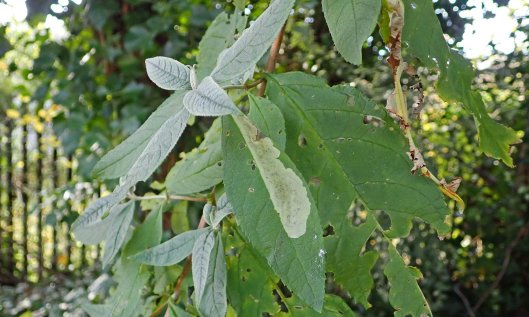
It’s #LeafmineMonday again on social media so here’s another leaf mine to look for when you’re out walking. And this is an easy plant to recognise because I’m sure everyone knows what the Butterfly bush (Buddleja davidii) looks like, right?

201214 Amauromyza verbasci (1)

These mines on Buddleja leaves, which start as a narrow corridor and quickly develop into a large blotch, are caused by the larvae of a tiny fly, Amauromyza verbasci. The fly also lays its eggs on several other plants, including Mullein and Common figwort.

201214 Amauromyza verbasci (3)

Mines can be seen from June to November, so it’s almost too late to see these now. The Buddleja plants in my area are already generating new growth but, as you can see from the photo above, the mines may still be seen on the older leaves before they drop.

201214 Amauromyza verbasci (2)

According to the UK Fly mines website, Amauromyza verbasci is widespread in Britain, though I have to say that I have only seen these mines once, despite a lot of looking at Buddleja bushes. And this sighting was a particularly lucky one for me, as this turned out to be the 1000th species (of flora and fauna) I had recorded on my local biodiversity records centre database.

Like Loading...

342/366 Leaf mines: Cerodontha iridis

07 Monday Dec 2020

Posted by sconzani in insects, leaves, plants, winter

≈ 1 Comment

Tags

Cerodontha iridis, Iris foetidissima, Iris leaf miner, leaf mines, leaf-mining fly larvae, leafminer, Stinking iris

When I first recorded this leaf mine (found on 24 November at Cosmeston Lakes Country Park, where there is rather a lot of it in one particular area), it was named ‘Record of the Week’ by SEWBReC, the local biodiversity records centre, and hailed as only the third Welsh record (though the national recorder for this species later corrected this, as it seems several records from north Wales had not been added to the Welsh database at that stage). Since then, I’ve found these mines in five more locations, proving that once again this is an under-recorded leaf-mining species.

201207 Cerodontha iridis (1)

These leaf mines were made on Stinking iris (Iris foetidissima) by the fly Cerodontha iridis, and they can also be found in Britain on other Iris species, though I haven’t seen any of those. The mines occur in early autumn, though they can still be seen on Iris leaves later than that – I’m seeing them now, in early winter. Often the adult fly lays several eggs on one leaf and, after the larvae hatch and start munching, they create blotch mines, which may be quite large when several mines coalesce.

201207 Cerodontha iridis (2)
OLYMPUS DIGITAL CAMERA

You can read more detailed information about this species and see some excellent images, including close-ups of the larvae and their puparia, on the Bladmineerders website here.

201207 Cerodontha iridis (4)

Like Loading...

338/366 Leaf mines: Acidia cognata

03 Thursday Dec 2020

Posted by sconzani in insects, leaves, plants, wildflowers

≈ Leave a comment

Tags

Acidia cognata, British flies, leaf mines, leaf-mining fly larvae, leaf-mining larvae, leafminer, Petasites fragrans, Winter heliotrope

Though the UK Fly mines website says the leaf mines of the little orange fly Acidia cognata are made in October-November, I’m sure the mines will still be visible this month, and possibly further into the winter, so this is one to look out for now when you’re out walking.

201203 acidia cognata (1)

One of the plants this fly mines – this is the one I’ve found these mines on – is Winter heliotrope (Petasites fragrans), which is particularly noticeable now, due to the pretty pink flowers that appear from November to February. Other favoured larval plants are Butterbur (Petasites hybridus), a plant very similar to Winter heliotrope, and Colt’s-foot (Tussilago farfara), the leaves of which don’t appear till after the flowers, so approximately from April onwards.

201203 acidia cognata (6)
201203 acidia cognata (7)

After hatching, the Acidia cognata larvae create a corridor on the upper surface of the leaf. As the larvae grow, the mine widens and eventually becomes more of a blotch, especially if there are several larvae on a single leaf and their mines meet. I’ve found these mines in two local patches of Winter heliotrope but not found any sign of them in other locations, so distribution does seem a little random. If you spot any, please do record your sightings as, like many leaf-miners where the adult flies are not often seen, this species is probably under-recorded.

201203 acidia cognata (2)
201203 acidia cognata (3)
201203 acidia cognata (4)
201203 acidia cognata (5)
Like Loading...

331/366 Leafmines: Phyllonorycter leucographella

26 Thursday Nov 2020

Posted by sconzani in autumn, insects, plants

≈ Leave a comment

Tags

British moths, Firethorn leaf miner, leaf mines, leaf mines on Pyracantha, leaf-mining larvae, leaf-mining moth, leafminer, moth larvae, moth larvae in leaf mines, Phyllonorycter leucographella

I stumbled across these leaf mines by accident but I simply can’t resist including them … because the tiny striped larvae are so darn cute!

201126 phyllonorycter leucographella (1)

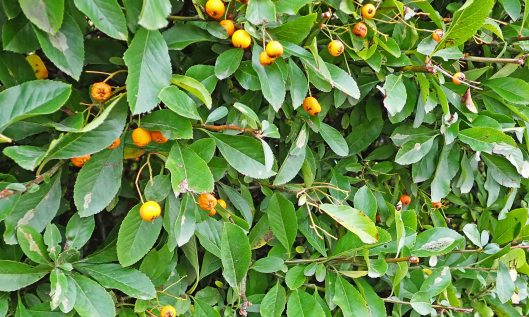
These are the larvae of the moth Phyllonorycter leucographella, the adult of which is also rather striking – you can see photos of it on the UK Moths website here. As the website reports, this moth is a recent arrival to Britain, first spotted in Essex just 40 years ago, but for such a small creature – its wingspan is only 7-9mm – it’s managed to fly and settle far and wide, from Yorkshire in the north of England to Pembrokeshire in the west of Wales, and all points in between. This may partly be due to the fact that its larvae feed on many garden plants: I found an abundance of leaf mines on an orange-berried variety of Firethorn (Pyracantha coccinea), which explains why the moth’s common name is Firethorn leaf miner.

201126 phyllonorycter leucographella (2)
201126 phyllonorycter leucographella (3)
201126 phyllonorycter leucographella (4)
201126 phyllonorycter leucographella (5)

As you can see from my pictures, the larval ‘mine’ is like a blister, centred over the midrib on the upper side of the leaf. The larva, which, with black blobs on a white body, is very distinctive, can often be seen through the membrane of the mine, especially when it’s feeding at the edge of the blister. You can read more about this leaf miner, its life cycle and preferred larval plants on the UK Fly Mines website here.

201126 pyracantha

Like Loading...

322/366 Leaf mines: Phytomyza agromyzina

17 Tuesday Nov 2020

Posted by sconzani in autumn, insects, leaves, plants

≈ Leave a comment

Tags

Cornus sanguinea, Dogwood, fly leaf mines, leaf mines, leaf mines on Dogwood, leaf-mining fly larvae, leaf-mining larvae, leafminers, Phytomyza agromyzidae

So far, in my recent posts on leaf mines, I’ve only covered a few of the many micro moths whose larvae make mines in leaves. But many fly species also inhabit leaves in their larval stage, and today’s post is about one of those, Phytomyza agromyzina.

201117 Phytomyza agromyzina (1)

You will probably never see the tiny adult fly (and, in fact, I haven’t even been able to find an illustration of one online, though this Wiki page shows an example of one member of the Agromyzidae fly family, which will give you a general idea.) but, anytime between July and November, you should be able to find its larvae’s leaf mines, as it’s probably widespread in Britain (though under-recorded, so if you do find some, please record your sighting).

201117 Phytomyza agromyzina (2)
201117 Phytomyza agromyzina (3)

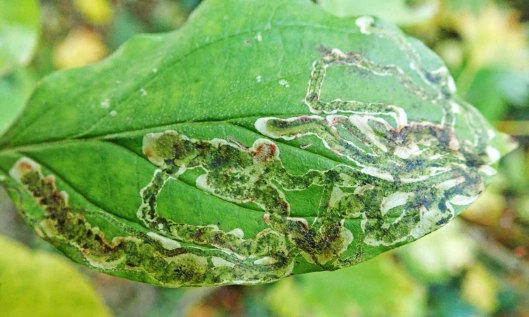
The mines I’ve found have all been on the leaves of Dogwood (Cornus sanguinea), though it is known to mine other species of Cornus. They’re gallery mines (i.e. forming corridors), long and meandering through the upper side of the leaf surface, and almost completely filled with frass (i.e. poo).

201117 Phytomyza agromyzina (4)

The UK Fly Mines website provides more detailed information on this, and the many other types of leaf mines you can find in Britain.

Like Loading...

316/366 Green islands

11 Wednesday Nov 2020

Posted by sconzani in autumn, insects, trees

≈ 3 Comments

Tags

beech, gall causing midge, galls on Beech, green islands, green islands on Beech leaves, Hartigiola annulipes, leaf mines, leaf mines on Beech, Stigmella tityrella

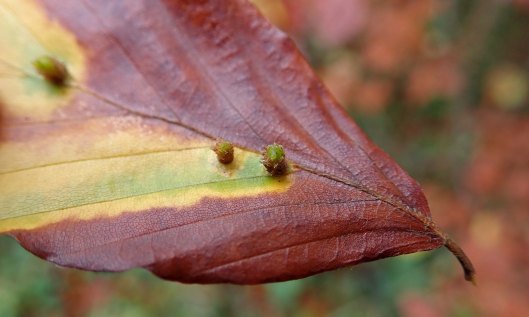
It’s late autumn, nearly winter, and, as you would expect, the leaves on this Beech tree have all now changed from vivid summer green to autumn brown … or have they? If you look more closely at this image, you’ll notice that some of the leaves have what entomologists, moth-ers and others in the know call ‘green islands’.

201111 green islands on beech

Butterfly Conservation’s Associate Director of Recording and Monitoring Richard Fox explained the reason for this most succinctly in a recent post on Twitter: ‘Thanks to Wolbachia bacteria in its body, the caterpillar uses cytokinin to maintain a green island of plant tissue in which it can feed in autumn.’

201111 green island stigmella tityrella (2)
201111 green island stigmella tityrella (1)

Fox was referring to leaf-mining moth caterpillars, like the Stigmella tityrella moth larvae that produced the mines in the leaves shown above, but other insects also manipulate the physiology of leaves so they can continue feeding. Another example from the same Beech tree can be seen below – here the larvae of the gall-inducing midge Hartigiola annulipes have also caused green islands to form in the leaves.

201111 Hartigiola annulipes green islands (1)

If you want to read more on the science behind this process, I found a paper entitled ‘Plant green-island phenotype induced by leaf-miners is mediated by bacterial symbionts‘, on the Royal Society website.
Like Loading...

314/366 Leaf mines: Parornix anglicella

09 Monday Nov 2020

Posted by sconzani in autumn, insects, leaves, trees

≈ Leave a comment

Tags

British moths, Hawthorn, leaf mines, leaf mines on Hawthorn, moth larvae in leaf mines, moth leafmines, Parornix anglicella

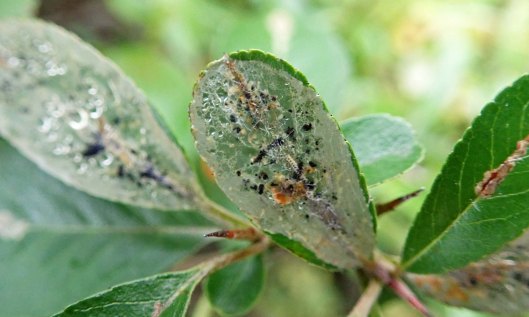
Here’s another leaf mine to look for in your local hedgerows, a very distinctive mine on Hawthorn (Crataegus sp.) made by the larvae of the micro moth Parornix anglicella, also known as the Hawthorn slender.

201109 parornix anglicella cones (1)

Although the newly hatched moth larva initially creates a corridor mine and then a blotch, it later makes itself a cone-shaped tent, using silk to adhere the bent-over edge to the main part of the leaf, and these cones are very easy to spot. Turn over the leaf to view the underside and you’ll find incredibly beautiful, almost sculptural structures, some resembling miniature latticework pyramids.

201109 parornix anglicella cones (2)
201109 parornix anglicella cones (3)
201109 parornix anglicella cones (4)
201109 parornix anglicella cones (5)

You can read more scientific detail about the leaf mine on the UK Fly Mines website here, and see what the adult moth looks like on the UK Moths website here.

201109 parornix anglicella cones (6)

Like Loading...

Horse chestnut leafminer

18 Wednesday Jul 2018

Posted by sconzani in insects, leaves, nature, trees

≈ 6 Comments

Tags

Cameraria ohridella, Horse chestnut leaf-mining moth, Horse chestnut tree, leaf mines, leaf-mining larvae, leafminer, moth larvae, moths

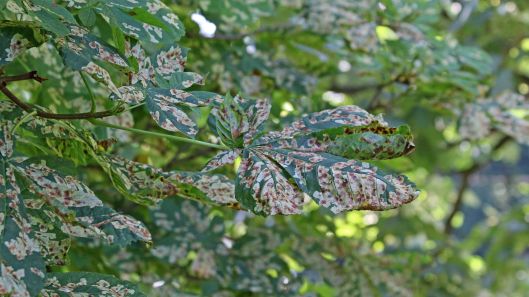
You may well have noticed that many (most?) of the Horse chestnut trees around you are starting to look a bit manky. Their leaves have become covered in white and brown blotches.

180718 Horse chestnut leafminer (4)

Those blotches are actually leaf mines, home to the larvae of Cameraria ohridella, the Horse chestnut leaf-mining moth (the brown blobs in the mines). According to the UK moths website

This species was discovered near Macedonia in 1985, and since then has spread rapidly to other countries in Europe. It was first discovered in Britain at Wimbledon in south-west London in 2002, but possibly had arrived the previous year, as it was quite plentiful. It is thought that the species may be expanding partially due to accidental transportation by man, either by road or rail. It has now been found quite extensively in the south-east of England.


180718 Horse chestnut leafminer (2)
180718 Horse chestnut leafminer (3)

Obviously, since that website entry was written, the moths have now spread from south-east England to south Wales and, indeed, to parts much further north. You’re mostly likely to see the blotches between June and September and, though you might not like the look of them, they’re not thought to inflict any permanent damage on the tree because, of course, the leaves are shed in the autumn anyway.

180718 Horse chestnut leafminer (1)

Like Loading...
← Older posts
Newer posts →

About me

sconzani

sconzani

I'm a writer and photographer; researcher and blogger; birder and nature lover; countryside rambler and city strider; volunteer and biodiversity recorder.

View Full Profile →

Follow earthstar on WordPress.com

Enter your email address to follow this blog and receive notifications of new posts by email.

Recent blog posts

  • O is for Odonata December 20, 2025
  • N is for nest December 19, 2025
  • M is for mite December 18, 2025
  • L is for lepidopteran lifers December 17, 2025
  • K is for Keeled skimmers December 16, 2025

From the archives

COPYRIGHT

Unless otherwise acknowledged, the text and photographs on this blog are my own and are subject to international copyright. Nothing may be downloaded or copied without my permission.

Fellow Earth Stars!

  • Unknown's avatar
  • Unknown's avatar
  • Unknown's avatar
  • Unknown's avatar
  • Unknown's avatar
  • Unknown's avatar
  • Unknown's avatar
  • Unknown's avatar
  • Unknown's avatar
  • Unknown's avatar
  • Unknown's avatar
  • Unknown's avatar
  • Unknown's avatar
  • Unknown's avatar
  • Unknown's avatar
  • Unknown's avatar
  • Unknown's avatar
  • Unknown's avatar
  • Unknown's avatar
  • Unknown's avatar
  • Unknown's avatar
  • Unknown's avatar
  • Unknown's avatar
  • Unknown's avatar
  • Unknown's avatar
  • Unknown's avatar
  • Unknown's avatar
  • Unknown's avatar
  • Unknown's avatar
  • Unknown's avatar
  • Unknown's avatar
  • Unknown's avatar
  • Unknown's avatar
  • Unknown's avatar
  • Unknown's avatar
  • Unknown's avatar
  • Unknown's avatar
  • Unknown's avatar
  • Unknown's avatar
  • Unknown's avatar
  • Unknown's avatar
  • Unknown's avatar
  • Unknown's avatar
  • Unknown's avatar
  • Unknown's avatar
  • Unknown's avatar
  • Unknown's avatar
  • Unknown's avatar
  • Unknown's avatar
  • Unknown's avatar

Blog at WordPress.com.

Privacy & Cookies: This site uses cookies. By continuing to use this website, you agree to their use.
To find out more, including how to control cookies, see here: Cookie Policy
  • Subscribe Subscribed
    • earthstar
    • Join 667 other subscribers
    • Already have a WordPress.com account? Log in now.
    • earthstar
    • Subscribe Subscribed
    • Sign up
    • Log in
    • Report this content
    • View site in Reader
    • Manage subscriptions
    • Collapse this bar
 

Loading Comments...
 

You must be logged in to post a comment.

    %d