• ABOUT
  • BIRDING 2018
  • Birding 2019
  • BLOG POSTS
  • Butterflies 2018
  • Resources

earthstar

~ a celebration of nature

earthstar

Tag Archives: leaf-mining fly larvae

Leafmines: on Teasel, 2

27 Tuesday Jul 2021

Posted by sconzani in insects, plants

≈ Leave a comment

Tags

British leaf mines, Chromatomyia ramosa, leaf mines, leaf mines on Teasel, leaf-mining fly larvae, leafminers

Another day, another leafmine on Teasel. This is not what I’d planned to blog about today but, by sheer coincidence, I discovered this new-to-me leafmine during yesterday’s walk so thought I’d share. And, in fact, once I had the national expert check my identification, he also confirmed that this is the first record of these mines in south Wales.

210727 Chromatomyia ramosa (1)

The larvae of the tiny fly Chromatomyia ramosa are responsible for these mines, feeding both on Teasel and on the various Scabious plant species. As you can see in my photos, the larvae feed along the midrib of the leaf and also in short galleries leading off from the midrib. Though under-recorded, this fly is thought to be widespread in Britain, so I’ll certainly be on the look out for more of its leafmines.

210727 Chromatomyia ramosa (2)
210727 Chromatomyia ramosa (3)
Like Loading...

Leafmines: on Teasel

26 Monday Jul 2021

Posted by sconzani in plants

≈ 2 Comments

Tags

Agromyza dipsaci, British leaf mines, fly mines on Teasel, leaf mines, leaf-mining fly larvae, leafminers, Teasel

I wasn’t aware of any leafmines on Teasel until I saw a post on Twitter on 23 June by @leafminerman Rob Edmunds. Since then, I’ve been checking the newly sprouted leaves of Teasel whenever I see them. And, finally, on Friday I spotted some mines on a small group of Teasel plants at Cosmeston Lakes Country Park.

210726 Agromyza dipsaci (1)
210726 Agromyza dipsaci (2)

These are the mines of the fly Agromyza dipsaci, another tiny creature I’ll probably never see but I know it’s around from seeing its larval home. The mines appear in early summer once the Teasel leaves start growing, the blotch usually starting at the edge of the leaf and broadening as the larva consumes more and grows. Its large grains of frass can often be seen inside the mine, as shown in the photo on the right above.

210726 Agromyza dipsaci (3)

The British leafminers website reports that this is an uncommon miner in the UK so I thought I’d check the records. Sure enough, there are only four Welsh records showing in Aderyn, the country’s biodiversity database – five when my record is included, and only seventeen records (including the four Welsh ones) on the NBN Atlas, the British database. It may be, though, that like many invertebrate species, this little fly is under-recorded. So, if you spot these mines on Teasel near you, please make sure to record your sightings.

210726 Agromyza dipsaci (4)

Like Loading...

Leaf mines: Chromatomyia scolopendri

01 Monday Mar 2021

Posted by sconzani in insects, plants

≈ Leave a comment

Tags

Agromyzidae, Chromatomyia scolopendri, Hart's tongue, leaf mine on Hart's tongue, leaf miners, leaf mines, leaf-mining fly larvae

Another week, another leaf mine – in fact, lots of mines in the glossy, lush leaves of Hart’s-tongue ferns (Asplenium scolopendrium).

210301 Chromatomyia scolopendri (1)

I have actually blogged about these before (Leaf mine in Hart’s-tongue, January 2018) but those finds were made in Somerset and I’m now finding lots of these mines in my local area in south Wales. The mines are made by the larvae of the fly Chromatomyia scolopendri, one of the Agromyzidae family of flies, and their long, winding gallery mines are unmistakeable.

210301 Chromatomyia scolopendri (2)
210301 Chromatomyia scolopendri (3)
210301 Chromatomyia scolopendri (4)
210301 Chromatomyia scolopendri (5)

You can read more about these flies on the newly launched Agromyzidae Recording Scheme website, and, if you’re interested in finding out which leaf mines to look out for and when, the scheme has a page that lists which species are most commonly recorded each month. Can you find Chromatomyia scolopendri mines in your area?

Like Loading...

Leaf mines: Phytomyza ilicis

23 Tuesday Feb 2021

Posted by sconzani in insects, plants

≈ Leave a comment

Tags

British leaf mines, Holly, Holly leaf-miner, Ilex aquifolium, leaf mines, leaf-mining fly larvae, Phytomyza ilicis

The tale of the Holly leaf miner (Phytomyza ilicis) is a tangled one. Way back in December 2016, I blogged about the leaf-mining life of this tiny fly’s larvae. Then, early in 2020, doubt was cast on the true identity of this leaf miner, when two scientists published a paper, stating that, through genital examination of one particular Phytomyza ilicis specimen, they had determined there were in fact two very similar species to be found in Britain. Of course, this called into question the true identification of all prior records, and no subsequent records could be confirmed without genital examination of specimens.

210223 phytomyza ilicis (1)
210223 phytomyza ilicis (2)

At that stage, I stopped recording leaf mines on Holly. But now I can start again because the work of those earlier scientists has recently been disproved. The organiser of the Agromyzidae Recording Scheme (the family to which Phytomyza ilicis belongs) re-examined the questionable specimen and found the genitals had actually been damaged, which had led to them being wrongly identified.

210223 phytomyza ilicis (4)
210223 phytomyza ilicis (3)

So, until that ‘other’ Holly leaf miner (Phytomyza jucunda) makes its way from Europe to Britain and so long as the mines look similar to the various ones I’ve included here, it is safe to record the Holly leaf mines we see as Phytomyza ilicis.

210223 phytomyza ilicis (5)
210223 phytomyza ilicis (6)

You can access the splendid new website of the Agromyzidae Recording Scheme here, and read more about the story of the Holly leaf miner in a recent newsletter here.

Like Loading...

Leaf mine: Chromatomyia primulae

18 Thursday Feb 2021

Posted by sconzani in insects, plants, wildflowers

≈ Leave a comment

Tags

Chromatomyia primulae, leaf mine on Primrose, leaf mines, leaf-mining fly, leaf-mining fly larvae, leaf-mining larvae, leafminers, primrose

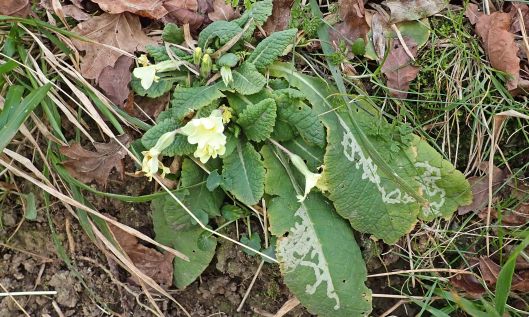
I was feeling a little miffed that my walk plans have been stymied by a slippery sided stream that I didn’t fancy trying to jump and was retracing my steps when I spotted this flowering Primrose (Primula vulgaris) – and it made my day, partly because I love these buttery yellow flowers, but also because of the mines on its leaves, a new species for me.

210218 Chromatomyia primulae (1)

These are the mines of a tiny fly, Chromatomyia primulae, whose larvae also mine the leaves of Cowslip (Primula veris). I couldn’t see any larvae in the mines, which concurs with the information on the British Leafminers website that says the larvae are active in January, and then again from June to November. If I’d known, I could’ve looked for any pupae, which apparently lodge themselves in the mine next to a leaf vein. I might have to go back for a closer look.

210218 Chromatomyia primulae (2)
210218 Chromatomyia primulae (3)

Very few of these mines have been recorded in south Wales – only 1 record in each of the 1km-squares around me – though that is probably because they are under-recorded. And that may be the same in other parts of Britain, so do please record any you see. You can read more about these leaf miners on the British Leafminers site referenced above and on the UK Fly mines website here.

Like Loading...

Leaf mines: Phytomyza chaerophylli

02 Tuesday Feb 2021

Posted by sconzani in insects, plants

≈ Leave a comment

Tags

Cow parsley, leaf mines, leaf mining fly, leaf-mining fly larvae, leafminer, Phytomyza chaerophylli

It may be winter but there are still leaf mines to check for, if you live in a location where the Cow parsley (Anthriscus sylvestris) is already springing up – here in coastal south Wales, I’ve even spotted a few flowers, though the official flowering period is April to June.

210202 phytomyza chaerophylli (1)
210202 phytomyza chaerophylli (2)

The leaf miner is a fly, Phytomyza chaerophylli, whose larvae munch their way through the leaves of several umbellifer species and can usually be seen from early spring right through to the end of summer, sometimes even earlier and later if the temperatures are mild enough. You can read more about these leaf mines and see more images on the UK Fly Mines website.

210202 phytomyza chaerophylli (3)
210202 phytomyza chaerophylli (4)
Like Loading...

356/366 Leaf mines: Euleia heraclei

21 Monday Dec 2020

Posted by sconzani in insects, plants

≈ Leave a comment

Tags

Alexanders, Alexanders plants, British leaf mines, Celery fly, Celery leaf fly, Euleia heraclei, leaf mines, leaf-mining fly larvae, leafminers

Finally, a leaf mine where I’ve actually seen the adult – in this case, a fly rather than a moth – and not the specific adult that laid the eggs that hatched into the larvae that made these particular leaf mines, but rather adult flies seen on other occasions. And very pretty little flies they are too!

201221 Euleia heraclei (1)

These are Euleia heraclei, also known as Celery flies or Celery leaf flies because one of the plants their larvae feed on is Celery. Other plants include Parsley, Hogweed, Angelica, Lovage, Wild parsnip and, the plant I found these leaf mines on, Alexanders (Smyrnium olusatrum). In the photos below, the fly on the left is the male, the one on the right the female.

201221 Euleia heraclei male
201221 Euleia heraclei female

According to the Nature Spot website, the adult flies are usually seen between April and November, and the British Leafminers website says that the larval mines can be seen throughout summer and into early autumn, though one of my photos below was taken as recently as 27 November and the larva is clearly visible so perhaps they have a longer season when the weather conditions are mild.

201221 Euleia heraclei (4)
201221 Euleia heraclei (5)
Like Loading...

349/366 Leaf mines: Amauromyza verbasci

14 Monday Dec 2020

Posted by sconzani in insects, leaves, plants, winter

≈ 2 Comments

Tags

Amauromyza verbasci, Buddleja davidii, leaf mines, leaf-mining fly larvae, leafminer

It’s #LeafmineMonday again on social media so here’s another leaf mine to look for when you’re out walking. And this is an easy plant to recognise because I’m sure everyone knows what the Butterfly bush (Buddleja davidii) looks like, right?

201214 Amauromyza verbasci (1)

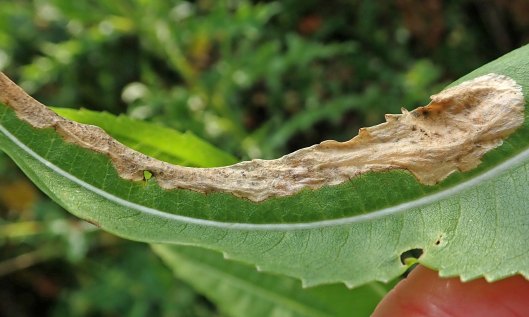
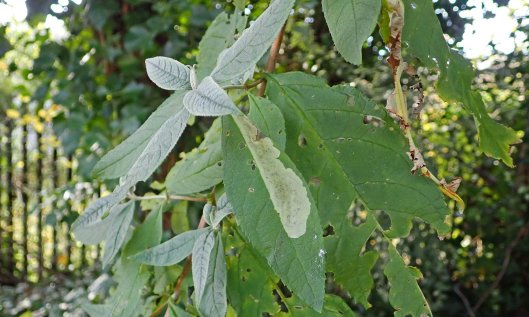
These mines on Buddleja leaves, which start as a narrow corridor and quickly develop into a large blotch, are caused by the larvae of a tiny fly, Amauromyza verbasci. The fly also lays its eggs on several other plants, including Mullein and Common figwort.

201214 Amauromyza verbasci (3)

Mines can be seen from June to November, so it’s almost too late to see these now. The Buddleja plants in my area are already generating new growth but, as you can see from the photo above, the mines may still be seen on the older leaves before they drop.

201214 Amauromyza verbasci (2)

According to the UK Fly mines website, Amauromyza verbasci is widespread in Britain, though I have to say that I have only seen these mines once, despite a lot of looking at Buddleja bushes. And this sighting was a particularly lucky one for me, as this turned out to be the 1000th species (of flora and fauna) I had recorded on my local biodiversity records centre database.

Like Loading...

342/366 Leaf mines: Cerodontha iridis

07 Monday Dec 2020

Posted by sconzani in insects, leaves, plants, winter

≈ 1 Comment

Tags

Cerodontha iridis, Iris foetidissima, Iris leaf miner, leaf mines, leaf-mining fly larvae, leafminer, Stinking iris

When I first recorded this leaf mine (found on 24 November at Cosmeston Lakes Country Park, where there is rather a lot of it in one particular area), it was named ‘Record of the Week’ by SEWBReC, the local biodiversity records centre, and hailed as only the third Welsh record (though the national recorder for this species later corrected this, as it seems several records from north Wales had not been added to the Welsh database at that stage). Since then, I’ve found these mines in five more locations, proving that once again this is an under-recorded leaf-mining species.

201207 Cerodontha iridis (1)

These leaf mines were made on Stinking iris (Iris foetidissima) by the fly Cerodontha iridis, and they can also be found in Britain on other Iris species, though I haven’t seen any of those. The mines occur in early autumn, though they can still be seen on Iris leaves later than that – I’m seeing them now, in early winter. Often the adult fly lays several eggs on one leaf and, after the larvae hatch and start munching, they create blotch mines, which may be quite large when several mines coalesce.

201207 Cerodontha iridis (2)
OLYMPUS DIGITAL CAMERA

You can read more detailed information about this species and see some excellent images, including close-ups of the larvae and their puparia, on the Bladmineerders website here.

201207 Cerodontha iridis (4)

Like Loading...

338/366 Leaf mines: Acidia cognata

03 Thursday Dec 2020

Posted by sconzani in insects, leaves, plants, wildflowers

≈ Leave a comment

Tags

Acidia cognata, British flies, leaf mines, leaf-mining fly larvae, leaf-mining larvae, leafminer, Petasites fragrans, Winter heliotrope

Though the UK Fly mines website says the leaf mines of the little orange fly Acidia cognata are made in October-November, I’m sure the mines will still be visible this month, and possibly further into the winter, so this is one to look out for now when you’re out walking.

201203 acidia cognata (1)

One of the plants this fly mines – this is the one I’ve found these mines on – is Winter heliotrope (Petasites fragrans), which is particularly noticeable now, due to the pretty pink flowers that appear from November to February. Other favoured larval plants are Butterbur (Petasites hybridus), a plant very similar to Winter heliotrope, and Colt’s-foot (Tussilago farfara), the leaves of which don’t appear till after the flowers, so approximately from April onwards.

201203 acidia cognata (6)
201203 acidia cognata (7)

After hatching, the Acidia cognata larvae create a corridor on the upper surface of the leaf. As the larvae grow, the mine widens and eventually becomes more of a blotch, especially if there are several larvae on a single leaf and their mines meet. I’ve found these mines in two local patches of Winter heliotrope but not found any sign of them in other locations, so distribution does seem a little random. If you spot any, please do record your sightings as, like many leaf-miners where the adult flies are not often seen, this species is probably under-recorded.

201203 acidia cognata (2)
201203 acidia cognata (3)
201203 acidia cognata (4)
201203 acidia cognata (5)
Like Loading...
← Older posts
Newer posts →

About me

sconzani

sconzani

I'm a writer and photographer; researcher and blogger; birder and nature lover; countryside rambler and city strider; volunteer and biodiversity recorder.

View Full Profile →

Follow earthstar on WordPress.com

Enter your email address to follow this blog and receive notifications of new posts by email.

Recent blog posts

  • Weevil: Mecinus pyraster January 10, 2026
  • Red in beak and claw January 9, 2026
  • Who’s watching who? January 8, 2026
  • Springtail: Orchesella cincta January 7, 2026
  • A good year for Redwings January 6, 2026

From the archives

COPYRIGHT

Unless otherwise acknowledged, the text and photographs on this blog are my own and are subject to international copyright. Nothing may be downloaded or copied without my permission.

Fellow Earth Stars!

  • Unknown's avatar
  • Unknown's avatar
  • Unknown's avatar
  • Unknown's avatar
  • Unknown's avatar
  • Unknown's avatar
  • Unknown's avatar
  • Unknown's avatar
  • Unknown's avatar
  • Unknown's avatar
  • Unknown's avatar
  • Unknown's avatar
  • Unknown's avatar
  • Unknown's avatar
  • Unknown's avatar
  • Unknown's avatar
  • Unknown's avatar
  • Unknown's avatar
  • Unknown's avatar
  • Unknown's avatar
  • Unknown's avatar
  • Unknown's avatar
  • Unknown's avatar
  • Unknown's avatar
  • Unknown's avatar
  • Unknown's avatar
  • Unknown's avatar
  • Unknown's avatar
  • Unknown's avatar
  • Unknown's avatar
  • Unknown's avatar
  • Unknown's avatar
  • Unknown's avatar
  • Unknown's avatar
  • Unknown's avatar
  • Unknown's avatar
  • Unknown's avatar
  • Unknown's avatar
  • Unknown's avatar
  • Unknown's avatar
  • Unknown's avatar
  • Unknown's avatar
  • Unknown's avatar
  • Unknown's avatar
  • Unknown's avatar
  • Unknown's avatar
  • Unknown's avatar
  • Unknown's avatar
  • Unknown's avatar
  • Unknown's avatar

Blog at WordPress.com.

Privacy & Cookies: This site uses cookies. By continuing to use this website, you agree to their use.
To find out more, including how to control cookies, see here: Cookie Policy
  • Subscribe Subscribed
    • earthstar
    • Join 669 other subscribers
    • Already have a WordPress.com account? Log in now.
    • earthstar
    • Subscribe Subscribed
    • Sign up
    • Log in
    • Report this content
    • View site in Reader
    • Manage subscriptions
    • Collapse this bar
 

Loading Comments...
 

You must be logged in to post a comment.

    %d