• ABOUT
  • BIRDING 2018
  • Birding 2019
  • BLOG POSTS
  • Butterflies 2018
  • Resources

earthstar

~ a celebration of nature

earthstar

Tag Archives: leafminer

53/366 A new leafmine

22 Saturday Feb 2020

Posted by sconzani in insects, nature

≈ 2 Comments

Tags

British moths, Ectoedemia heringella, Evergreen oak, leafminer, leafmines on Evergreen oak, moth leafmines

I was a woman on a mission today, and these are what I was looking for. They are the leafmines of the larvae of the moth Ectoedemia heringella, found on Evergreen Oak.
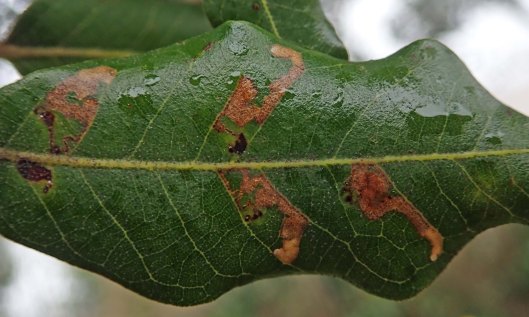
200222 ectoedemia heringella leafmines (1)

You’ve probably never heard of this moth and neither had I, until yesterday, when I read a tweet by George Tordoff, Senior Moth Ecologist with Butterfly Conservation here in Wales, that he had found its leafmines on an oak at Barry Island. His find was only the third record for the county of Glamorgan – the first two were found by County Moth Recorder Dave Slade, in Cardiff’s Bute Park. It made sense that the mines might also be found in locations between Cardiff and Barry, so today I went looking and found them on every Evergreen oak in Penarth’s Windsor Gardens. And my fellow Penarthian, Gareth, also went looking today and found several mines on the trees at nearby St Mary’s Well Bay. Success!

200222 ectoedemia heringella leafmines (2)
200222 ectoedemia heringella leafmines (3)

According to the UK Moths website, Ectoedemia heringella only arrived in Britain (in Greater London) from Europe in 1996 and has slowly been spreading out from there. The adult moths don’t appear until mid summer, and I may never see one, but at least now our records can help track their spread across the country.

200222 ectoedemia heringella leafmines (4)

Like Loading...

Horse chestnut leafminer

18 Wednesday Jul 2018

Posted by sconzani in insects, leaves, nature, trees

≈ 6 Comments

Tags

Cameraria ohridella, Horse chestnut leaf-mining moth, Horse chestnut tree, leaf mines, leaf-mining larvae, leafminer, moth larvae, moths

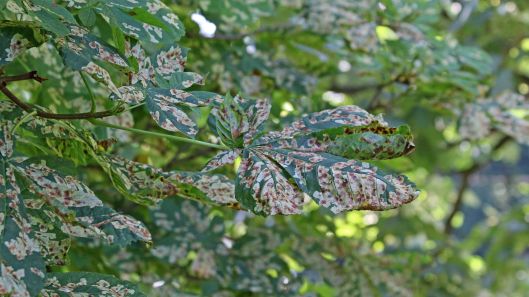
You may well have noticed that many (most?) of the Horse chestnut trees around you are starting to look a bit manky. Their leaves have become covered in white and brown blotches.

180718 Horse chestnut leafminer (4)

Those blotches are actually leaf mines, home to the larvae of Cameraria ohridella, the Horse chestnut leaf-mining moth (the brown blobs in the mines). According to the UK moths website

This species was discovered near Macedonia in 1985, and since then has spread rapidly to other countries in Europe. It was first discovered in Britain at Wimbledon in south-west London in 2002, but possibly had arrived the previous year, as it was quite plentiful. It is thought that the species may be expanding partially due to accidental transportation by man, either by road or rail. It has now been found quite extensively in the south-east of England.


180718 Horse chestnut leafminer (2)
180718 Horse chestnut leafminer (3)

Obviously, since that website entry was written, the moths have now spread from south-east England to south Wales and, indeed, to parts much further north. You’re mostly likely to see the blotches between June and September and, though you might not like the look of them, they’re not thought to inflict any permanent damage on the tree because, of course, the leaves are shed in the autumn anyway.

180718 Horse chestnut leafminer (1)

Like Loading...

Birth notice

17 Saturday Mar 2018

Posted by sconzani in insects, nature, plants, wildflowers

≈ 6 Comments

Tags

Ficaria verna, flies, fly, leaf mines, leaf mining fly, leafminer, Lesser Celandine, Phytomyza ranunculi

I was handing out the cigars last Monday!
Now, you might well think me more than a little mad to be excited about the birth of a fly but this was the first time I had tried rearing one … and it was actually successful, which bodes well for the fact that I’m intending to take part in a fly-rearing investigation this summer (more on that closer to the time).

180317 Phytomyza ranunculi (2)
180317 Phytomyza ranunculi (3)

The fly is Phytomyza ranunculi, a creature whose larvae often make their home in the leaves of Lesser celandine (Ficaria verna). I blogged about this leafminer, its larvae and the pupa here, and it is that pupa which finally hatched earlier this week. I had been told it would take about 3 weeks to hatch but it was, in fact, longer than that – it was 6 February when I found the pupa and 12 March when it hatched, so 34 days in total.

180317 Phytomyza ranunculi (1)

Now, here I must admit to a rookie error. As it was well over the 3 weeks, I had almost given up on its hatching so, on Monday night, when I had a sudden notion to open the container, I didn’t look inside first. The fly popped straight out, perched on the edge for a very brief time – and I managed to get just one photo, and then it flew off. I’ve searched for it in my flat, and it did a quick fly by when I was washing the dishes yesterday, but I haven’t been able to find it, neither to take more photos nor to let it outside.

Like Loading...

Leafminer: Phytomyza ranunculi

11 Sunday Feb 2018

Posted by sconzani in insects, nature

≈ 2 Comments

Tags

Buttercup, fly, fly larva, fly puparium, leaf mine on buttercup, leaf mine on Lesser celandine, leaf mines, leafminer, Lesser Celandine, Phytomyza ranunculi

You might think there are no insects around in winter but you’d be wrong, as I’ve been discovering in the past week or so. In my checks for blooming wildflowers, I’ve seen the odd Lesser celandine and Buttercup flower and, looking more closely at the plants, I’ve noticed leaf mines on some. And where there are leaf mines, there are insects laying eggs and larvae developing from those eggs to create the mines.

180210 Phytomyza ranunculi (6)
180210 Phytomyza ranunculi (5)

These particular mines are created by Phytomyza ranunculi, an incredibly tiny fly which I haven’t yet seen. But I have seen – and can show you here – a larva and a puparium. I brought home a couple of Lesser celandine leaves, intending to take better photos of them, but I didn’t reckon on them shrivelling up overnight. On the positive side, when I picked up one leaf, a tiny larva was sitting underneath, presumably having popped out of the leaf as it dried up.

180210 Phytomyza ranunculi larva (1)
180210 Phytomyza ranunculi larva (2)

A couple of days later I brought home another couple of leaves, for the same purpose, but this time left them in a sealed container. The next day, when I opened it, I saw this tiny speck in the bottom of the container and realised a larva from one of the leaves must have pupated. I’m trying to hatch it so I – and you – get to see the fly. Fingers crossed!

180210 Phytomyza ranunculi puparium (7)
180210 Phytomyza ranunculi puparium (8)
Like Loading...

Leafminer on bramble

29 Monday Jan 2018

Posted by sconzani in insects, nature, plants

≈ 6 Comments

Tags

bramble, British micro moth, British moths, Golden pigmy moth, leaf mines, leafminer, moth larvae in leaf mines, Rubus fruticosus agg, Stigmella aurella

Following on from my Leafmines 101 post and the one about leafminers on Hart’s tongue fern, here’s another leaf mine I think I can identify (note the ‘I think’!).

180129 Stigmella aurella on bramble (1)

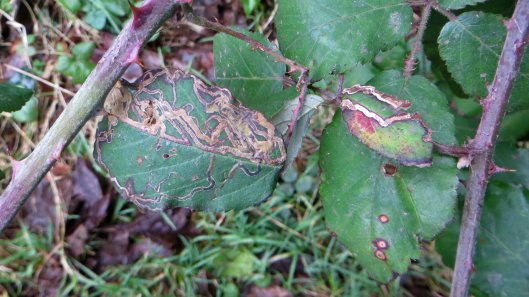
The reason I’m hesitant about positively IDing this one is because there are two species of micro moth whose larvae produce very similar mines on bramble (Rubus fruticosus agg.) leaves. One is the Glossy bramble pigmy moth (Stigmella splendidissimella) but the more likely in this case is the Golden pigmy moth (Stigmella aurella).

180129 Stigmella aurella on bramble (2)
180129 Stigmella aurella on bramble (3)

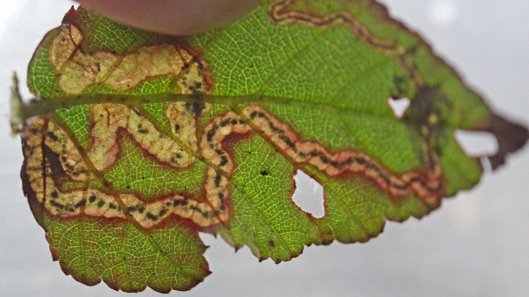
Though it’s very common and widespread in Britain, I’ve never seen this tiny moth (images on the UK moths website here) but the mines its larvae create on bramble leaves are everywhere I look. As you can see, the mine starts out small but, as the larva within chews and chews, so it widens its mine to accommodate its expanding girth.

You can see if the inhabitant is still at home by holding the leaf up to the light. Most of these seemed to be empty, as you can see from the images below (the central black lines are the frass). I’ve never actually opened a mine to have a look at the larva when it has been inside but, if I did, I would see an orangey-yellow grub with a brownish tinge to its head (there are images on the Bladmineerders website here).

180129 Stigmella aurella on bramble (4)180129 Stigmella aurella on bramble (5)

Like Loading...

Leafmines 101

13 Saturday Jan 2018

Posted by sconzani in insects, leaves, nature, plants, trees

≈ 5 Comments

Tags

British insects, homes of insect larvae, insect larvae in leaves, leaf mine, leafmine, leafminer, mines on leaves

Leafmines and their miners are a subject I started to look at last summer but I quickly discovered that, in order to identify the miner, you had to know the plant they were mining, so I needed to improve my botanical knowledge before I could go much further. That effort has begun, and is ongoing, so I will start to look again at the miners in the coming months.

180113 leafmines (1)
180113 leafmines (2)

Firstly though, in case you don’t know, leafmines are made by the larvae of various insects. The mines are their homes and their larders – as well as providing them with some degree of protection from predators, the larvae eat the tissue of the leaves they live within, thus creating their mines. The larvae can be the immature stages of various species of flies, sawflies or moths, and, apparently, some beetles also mine leaves.

180113 leafmines (3)
180113 leafmines (4)

If you look at a mine, you will often see a tiny hole at one end, which means the creature that made it has left the premises, to pupate or to being life as an adult. Sometimes, you can still see the larva within, and you can often also see the pooh (known as frass) it has left behind as it eats and tunnels.

180113 leafmines (5)
180113 leafmines (6)

The shapes of the mines can vary considerably, from long meandering or straight lines to roundish blotches, and these shapes, plus the placement of the mine within the leaf (some occupy just the upper or lower surface, some go right through) and the identity of the plant, are the main ways to determine which creature has made the mine.

**p.s. Since posting this, I’ve been told what I thought was a leaf mine on ivy (the photo on the right in the middle) is actually caused by a fungus, possibly Phoma hedericola, the most common leaf spot of ivy. I can see these leafmines are going to be even more tricky than I anticipated!

Like Loading...
Newer posts →

About me

sconzani

sconzani

I'm a writer and photographer; researcher and blogger; birder and nature lover; countryside rambler and city strider; volunteer and biodiversity recorder.

View Full Profile →

Follow earthstar on WordPress.com

Enter your email address to follow this blog and receive notifications of new posts by email.

Recent blog posts

  • Weevil: Mecinus pyraster January 10, 2026
  • Red in beak and claw January 9, 2026
  • Who’s watching who? January 8, 2026
  • Springtail: Orchesella cincta January 7, 2026
  • A good year for Redwings January 6, 2026

From the archives

COPYRIGHT

Unless otherwise acknowledged, the text and photographs on this blog are my own and are subject to international copyright. Nothing may be downloaded or copied without my permission.

Fellow Earth Stars!

  • Unknown's avatar
  • Unknown's avatar
  • Unknown's avatar
  • Unknown's avatar
  • Unknown's avatar
  • Unknown's avatar
  • Unknown's avatar
  • Unknown's avatar
  • Unknown's avatar
  • Unknown's avatar
  • Unknown's avatar
  • Unknown's avatar
  • Unknown's avatar
  • Unknown's avatar
  • Unknown's avatar
  • Unknown's avatar
  • Unknown's avatar
  • Unknown's avatar
  • Unknown's avatar
  • Unknown's avatar
  • Unknown's avatar
  • Unknown's avatar
  • Unknown's avatar
  • Unknown's avatar
  • Unknown's avatar
  • Unknown's avatar
  • Unknown's avatar
  • Unknown's avatar
  • Unknown's avatar
  • Unknown's avatar
  • Unknown's avatar
  • Unknown's avatar
  • Unknown's avatar
  • Unknown's avatar
  • Unknown's avatar
  • Unknown's avatar
  • Unknown's avatar
  • Unknown's avatar
  • Unknown's avatar
  • Unknown's avatar
  • Unknown's avatar
  • Unknown's avatar
  • Unknown's avatar
  • Unknown's avatar
  • Unknown's avatar
  • Unknown's avatar
  • Unknown's avatar
  • Unknown's avatar
  • Unknown's avatar
  • Unknown's avatar

Blog at WordPress.com.

Privacy & Cookies: This site uses cookies. By continuing to use this website, you agree to their use.
To find out more, including how to control cookies, see here: Cookie Policy
  • Subscribe Subscribed
    • earthstar
    • Join 669 other subscribers
    • Already have a WordPress.com account? Log in now.
    • earthstar
    • Subscribe Subscribed
    • Sign up
    • Log in
    • Report this content
    • View site in Reader
    • Manage subscriptions
    • Collapse this bar
 

Loading Comments...
 

You must be logged in to post a comment.

    %d