• ABOUT
  • BIRDING 2018
  • Birding 2019
  • BLOG POSTS
  • Butterflies 2018
  • Resources

earthstar

~ a celebration of nature

earthstar

Tag Archives: moths

148/365 The one that got away

28 Tuesday May 2019

Posted by sconzani in 365DaysWildin2019, insects, nature

≈ 3 Comments

Tags

#365DaysWild, Bird’s-foot trefoil, British moths, Burnet companion, Cosmeston, Cosmeston Lakes Country Park, moth, moths

I mentioned in yesterday’s post about the amazing Narrow-bordered Bee Hawk-moth that I had actually been trying to re-find a Burnet Companion moth when I spotted the Hawk-moth. Well, today I got the one that got away yesterday – not the actual moth, as today I was at Cosmeston not Lavernock, and not just one but three Burnet Companions appeared for my camera today.

190528 burnet companion (1)

I felt a bit sad for the first one I saw (below left). Either it hadn’t developed properly in its pupa or something had happened to it since hatching, as its wings appeared damaged and it didn’t seem able to fly.

190528 burnet companion (2)
190528 burnet companion (3)

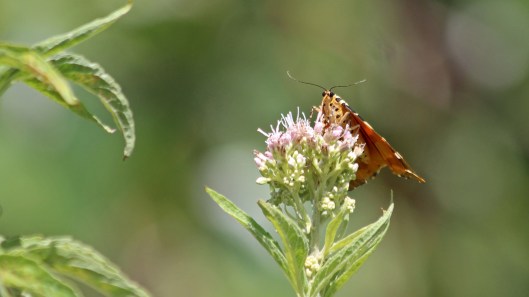
But the other two were flitting merrily from flower to flower, drinking in as much Bird’s-foot trefoil nectar as their tiny tongues could manage. And not only do they have lovely markings on the top side of their wings but they’re a wonderful buttery yellow underneath as well (above right).

190528 burnet companion (4)

Like Loading...

147/365 Narrow-bordered Bee Hawk-moth

27 Monday May 2019

Posted by sconzani in 365DaysWildin2019, insects, nature

≈ 11 Comments

Tags

#365DaysWild, British moths, Hemaris tityus, Lavernock Nature Reserve, moth, moths, Narrow-bordered Bee Hawk-moth, rare moth

I had a heart-stopping few moments at Lavernock Nature Reserve this afternoon. I’d just taken a rubbish photo of my first Burnet Companion moth of the year but it had flitted off and I was trying to re-find it when I spotted this beauty … and I couldn’t believe what I was seeing. It’s a Narrow-bordered Bee Hawk-moth (Hemaris tityus) and it’s something of a rarity here in south Wales.

190527 narrow-bordered bee hawk-moth (1)

According to Aderyn, Wales’s Biodiversity and Information Reporting Database, this species has not been recorded anywhere near my area for more than 50 years, yet they seem to be having a good year in 2019: George, from our local Butterfly Conservation branch, tells me this special moth has been seen in three new sites in south Wales so far this year. Long may this trend continue!

190527 narrow-bordered bee hawk-moth (2)

Like Loading...

Two in two days

04 Tuesday Sep 2018

Posted by sconzani in insects, nature

≈ 4 Comments

Tags

Aplocera plagiata, British moth, moth, moths, Treble-bar

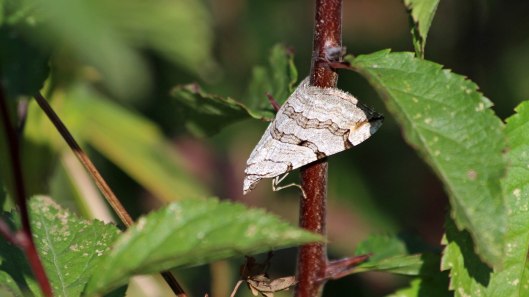
I’d only ever seen this beautifully patterned moth once before so it was a treat last week to see two of them on two consecutive days. Despite having a guide book, I always find moths difficult to identify but this one, the Treble-bar (Aplocera plagiata), lives up to its name rather nicely. Having said that, there is a chance these could be Lesser Treble-bars but they are much less common so I’m assuming they’re not (and I wasn’t able to check the ends of their abdomens to be sure!).

180904 treble bar (1)

These are probably second generation moths, the first having emerged, mated, laid, munched, pupated during May and June, and the second now going through that process during August and September.

180904 treble bar (2)

Like Loading...

Common purple & gold

20 Monday Aug 2018

Posted by sconzani in insects, nature

≈ Leave a comment

Tags

British moths, Common purple & gold, Cosmeston, Cosmeston Lakes Country Park, moth, moths, Pyrausta purpuralis, UK moths

Every step I take across the west paddock at Cosmeston seems to send at least two tiny beige-looking insects flicking off in different directions in front of me. At first, I think they might be grasshoppers or crickets, springing quickly out of the way of my trampling feet but no – these creatures are not making straight leaps, they are fluttering and flying. They’re not easy to follow – as soon as they touch the ground they seem to disappear so I have to focus intently to follow each flight and then approach very slowly to discover what they are.

180820 Pyrausta purpuralis (1)

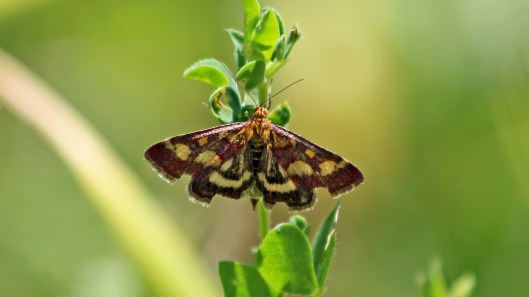
It turns out they’re not beige at all – they’re a quite striking combination of maroon and yellow, hence their common name, Common purple & gold. This is Pyrausta purpuralis, not to be confused with Pyrausta aurata, a very similar moth of the same family (see more here).

180820 Pyrausta purpuralis (4)
180820 Pyrausta purpuralis (5)

180820 Pyrausta purpuralis (2)

With a wingspan of just 20mm, this moth really is tiny but it’s relatively common throughout Britain, particularly on chalky downs and dry grasslands. The moths I’m seeing now in such abundance are the second brood of the year and fly, both during the day and at night, from July to August. I saw their parents during May and June, though they didn’t seem as plentiful. Perhaps this is a moth species that has enjoyed our hot dry weather this summer.

180820 Pyrausta purpuralis (3)

Like Loading...

Three in one day

04 Saturday Aug 2018

Posted by sconzani in insects, nature

≈ Leave a comment

Tags

British moths, Jersey tiger, Jersey tiger moth, Lavernock Nature Reserve, moths, tiger moth

Many of you probably knew that last Sunday 29 July was International Tiger Day but I’ll bet you didn’t know that Tuesday the 31st was Jersey Tiger Day!

180804 Jersey tiger (1)

Well, of course you didn’t because I just made that up. And why?

180804 Jersey tiger (2)

Because that was the day I saw my first Jersey Tiger moths for the year.

180804 Jersey tiger (3)

And I didn’t just see one – I saw three of these most gorgeous of moths.

180804 Jersey tiger (4)

Want to know why I was so delighted to see them? Read on …

Like Loading...

Horse chestnut leafminer

18 Wednesday Jul 2018

Posted by sconzani in insects, leaves, nature, trees

≈ 6 Comments

Tags

Cameraria ohridella, Horse chestnut leaf-mining moth, Horse chestnut tree, leaf mines, leaf-mining larvae, leafminer, moth larvae, moths

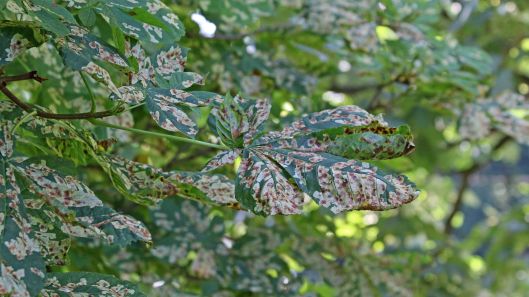
You may well have noticed that many (most?) of the Horse chestnut trees around you are starting to look a bit manky. Their leaves have become covered in white and brown blotches.

180718 Horse chestnut leafminer (4)

Those blotches are actually leaf mines, home to the larvae of Cameraria ohridella, the Horse chestnut leaf-mining moth (the brown blobs in the mines). According to the UK moths website

This species was discovered near Macedonia in 1985, and since then has spread rapidly to other countries in Europe. It was first discovered in Britain at Wimbledon in south-west London in 2002, but possibly had arrived the previous year, as it was quite plentiful. It is thought that the species may be expanding partially due to accidental transportation by man, either by road or rail. It has now been found quite extensively in the south-east of England.


180718 Horse chestnut leafminer (2)
180718 Horse chestnut leafminer (3)

Obviously, since that website entry was written, the moths have now spread from south-east England to south Wales and, indeed, to parts much further north. You’re mostly likely to see the blotches between June and September and, though you might not like the look of them, they’re not thought to inflict any permanent damage on the tree because, of course, the leaves are shed in the autumn anyway.

180718 Horse chestnut leafminer (1)

Like Loading...

Some recent moths

16 Monday Jul 2018

Posted by sconzani in insects, nature

≈ 2 Comments

Tags

Blood-vein, British moths, Burnet companion, Common purple & gold, Glyphipterix thrasonella, moths, Orange-spot piercer, Riband wave, Riband wave banded form, Scarlet tiger

Though they seem to have disappeared now, the Burnet companions (Euclidia glyphica) were out in force at Cosmeston for about six weeks, from the last day of May until early July.

180716 1 Burnet companion

The Common purple & gold (Pyrausta purpuralis) is a tiny but very colourful moth – a rich maroon-purple base with pretty gold markings.

180716 2 Pyrausta purpuralis

With a thin red line running horizontally from one wing tip to the other, it’s easy to see how the Blood-vein (Timandra comae) got its name.

180716 3 Blood-vein

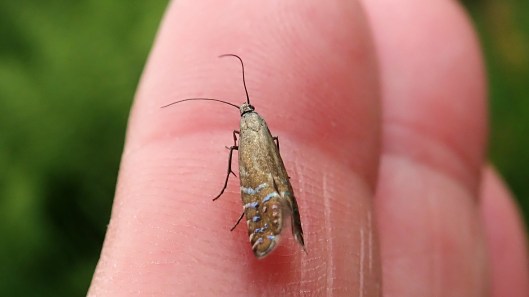
Glyphipterix thrasonella (no common name) is another very small moth, as you can tell from its size relative to my fingers, and is another with attractive markings, this time bright light blue on a gold base.

OLYMPUS DIGITAL CAMERA

In Bute Park recently I spotted two different species of moth. The first was this tiny micro on Hogweed, an Orange-spot piercer (Pammene aurana).

180716 5 Orange-spot piercer

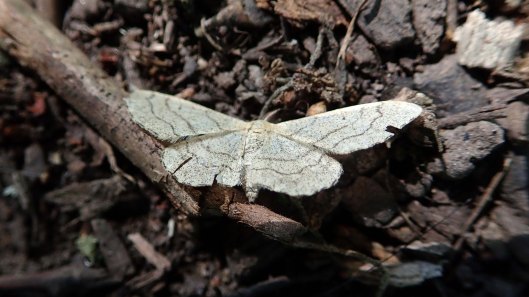
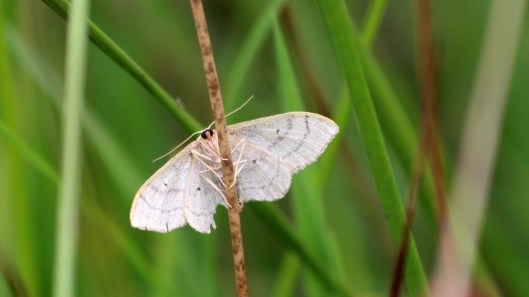
I didn’t have to try hard to see the second moth as it fluttered down from a tree on to the earth in front of me. This is a Riband wave (Idaea aversata).

OLYMPUS DIGITAL CAMERA

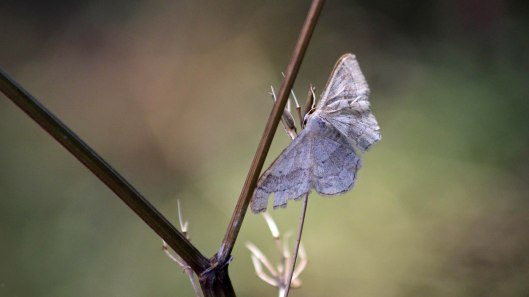
And, while we’re on the subject of Riband waves, here’s another but this is the banded form – note how the area between the two lines on its wings has been ‘coloured in’.

180716 7 Riband wave banded form

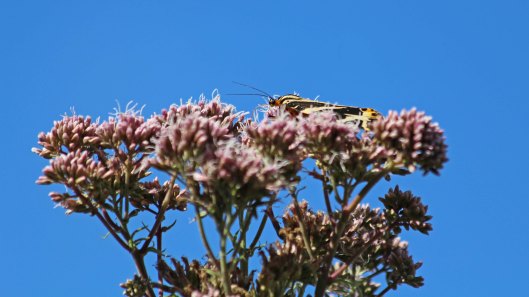
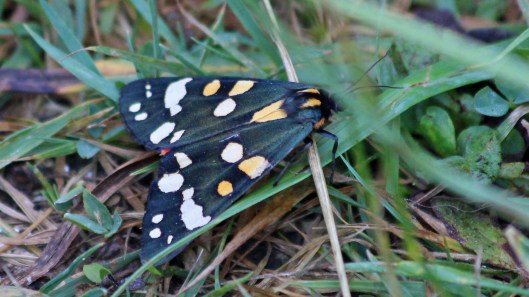
Last but certainly not least is this stunning Scarlet tiger (Callimorpha dominula), which was sitting on the grassy path in front of me during a recent meander around Lavernock Nature Reserve.

180716 8 Scarlet tiger

Like Loading...

Aberbargoed Grasslands revisited

06 Friday Jul 2018

Posted by sconzani in insects, nature

≈ 2 Comments

Tags

Aberbargoed Grasslands, British butterflies, British moths, Burnet companion, butterflies, Common purple & gold, Large skipper, moths, Riband wave, Ringlet, Silver Y, Small heath, Small skipper

On Wednesday I made my second visit to Aberbargoed Grasslands National Nature Reserve with my friend Sharon. Last time we dipped on seeing the Marsh fritillaries because it was too overcast; this time, we dipped again because the recent spell of hot dry weather has meant their season has finished for the year. Still, we have now walked most of the paths around the reserve so we’ll know exactly where to look next year. And, though we missed out the fritillaries, there were still plenty of other butterflies and moths to charm and delight us.

180705 1 small heath

Small heath (Coenonympha pamphilus)

180705 2 Ringlet

Ringlet (Aphantopus hyperantus)

180705 3 Small skipper

Small skipper (Lycaena phlaeas)

180705 4 Large skipper

Large skipper (Lycaena dispar)

180705 5 Burnet companion

Burnet companion (Euclidia glyphica)

180705 6 Pyrausta purpuralis

Common purple & gold (Pyraustra purpuralis)

180705 7 Riband wave

Riband wave (Idaea aversata)

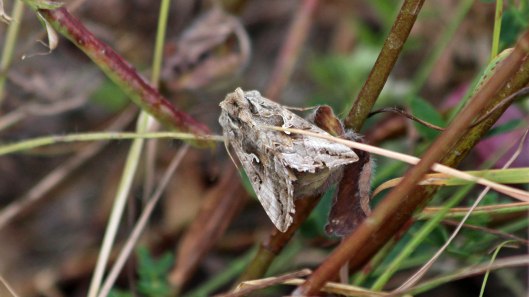
180705 8 Silver Y

Silver Y (Autographa gamma)


Like Loading...

A Common footman

04 Wednesday Jul 2018

Posted by sconzani in insects, nature

≈ 2 Comments

Tags

British moths, Common footman, Eilema lurideola, moth, moths

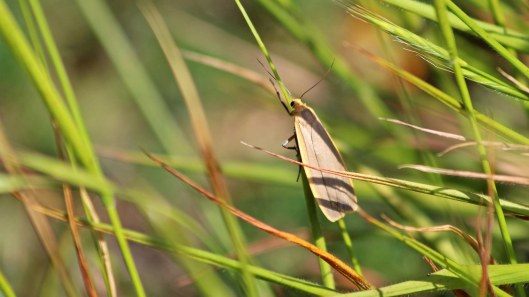
Moths have some wonderful names. I mean, you’ve got to wonder why one little group is named after a domestic servant. As well as this one, the Common footman, there are also Buff, Orange, Scarce, Dingy, Northern, Pigmy, and Hoary footmen, all members of the Eilema group of moths.

180703 common footman (1)

I spotted this little chap, Eilema lurideola, floundering around in the grass at Cosmeston recently. It might well be an elegant flier but it was having a great deal of trouble climbing up stalks of grass.

180703 common footman (2)
180703 common footman (3)
180703 common footman (4)
180703 common footman (5)
Like Loading...

Leptastic!

25 Monday Jun 2018

Posted by sconzani in insects, nature

≈ Leave a comment

Tags

#30DaysWild, 30 Days Wild, British butterflies, British moths, butterflies, Common blue, Large skipper, Meadow Brown, moths, Pyrausta purpuralis, Ringlet, Six-spot burnet, Small skipper, Small white, Speckled wood

Day 25 of #30DaysWild was hot – the hottest day of the year so far in Wales! I’m not a huge fan of the heat or the burning sun – one of the reasons I moved to Britain was to escape them, but the climate is a’changing. The only good thing about sunshine is that it brings out the Lepidoptera, the butterflies and moths, though even they looked a bit frantic, as if the heat was making them crazy. Still, on my Penarth – Lavernock – Cosmeston – Penarth circuit, I did manage to see my first Small skipper for the year and a host of other fantastic Leps as well.

180625 6-spot burnet

Six-spot burnet moth

180625 common blue

Common blue

180625 large skipper

Large skipper

180625 meadow brown

Meadow brown

180625 Pyrausta purpuralis

Pyrausta purpuralis moth

180625 ringlet

Ringlet

180625 small skipper

Small skipper

180625 small white

Small white

180625 speckled wood

Speckled wood

Like Loading...
← Older posts
Newer posts →

About me

sconzani

sconzani

I'm a writer and photographer; researcher and blogger; birder and nature lover; countryside rambler and city strider; volunteer and biodiversity recorder.

View Full Profile →

Follow earthstar on WordPress.com

Enter your email address to follow this blog and receive notifications of new posts by email.

Recent blog posts

  • Blackthorn in bloom January 11, 2026
  • Weevil: Mecinus pyraster January 10, 2026
  • Red in beak and claw January 9, 2026
  • Who’s watching who? January 8, 2026
  • Springtail: Orchesella cincta January 7, 2026

From the archives

COPYRIGHT

Unless otherwise acknowledged, the text and photographs on this blog are my own and are subject to international copyright. Nothing may be downloaded or copied without my permission.

Fellow Earth Stars!

  • Unknown's avatar
  • Unknown's avatar
  • Unknown's avatar
  • Unknown's avatar
  • Unknown's avatar
  • Unknown's avatar
  • Unknown's avatar
  • Unknown's avatar
  • Unknown's avatar
  • Unknown's avatar
  • Unknown's avatar
  • Unknown's avatar
  • Unknown's avatar
  • Unknown's avatar
  • Unknown's avatar
  • Unknown's avatar
  • Unknown's avatar
  • Unknown's avatar
  • Unknown's avatar
  • Unknown's avatar
  • Unknown's avatar
  • Unknown's avatar
  • Unknown's avatar
  • Unknown's avatar
  • Unknown's avatar
  • Unknown's avatar
  • Unknown's avatar
  • Unknown's avatar
  • Unknown's avatar
  • Unknown's avatar
  • Unknown's avatar
  • Unknown's avatar
  • Unknown's avatar
  • Unknown's avatar
  • Unknown's avatar
  • Unknown's avatar
  • Unknown's avatar
  • Unknown's avatar
  • Unknown's avatar
  • Unknown's avatar
  • Unknown's avatar
  • Unknown's avatar
  • Unknown's avatar
  • Unknown's avatar
  • Unknown's avatar
  • Unknown's avatar
  • Unknown's avatar
  • Unknown's avatar
  • Unknown's avatar
  • Unknown's avatar

Blog at WordPress.com.

Privacy & Cookies: This site uses cookies. By continuing to use this website, you agree to their use.
To find out more, including how to control cookies, see here: Cookie Policy
  • Subscribe Subscribed
    • earthstar
    • Join 669 other subscribers
    • Already have a WordPress.com account? Log in now.
    • earthstar
    • Subscribe Subscribed
    • Sign up
    • Log in
    • Report this content
    • View site in Reader
    • Manage subscriptions
    • Collapse this bar
 

Loading Comments...
 

You must be logged in to post a comment.

    %d