• ABOUT
  • BIRDING 2018
  • Birding 2019
  • BLOG POSTS
  • Butterflies 2018
  • Resources

earthstar

~ a celebration of nature

earthstar

Tag Archives: RSPB Lodmoor

Sandwich terns

19 Friday Sep 2025

Posted by sconzani in autumn, birds

≈ Leave a comment

Tags

birding, birdwatching, British birds, British terns, Ferrybridge birding, RSPB Lodmoor, Sandwich tern, tern species

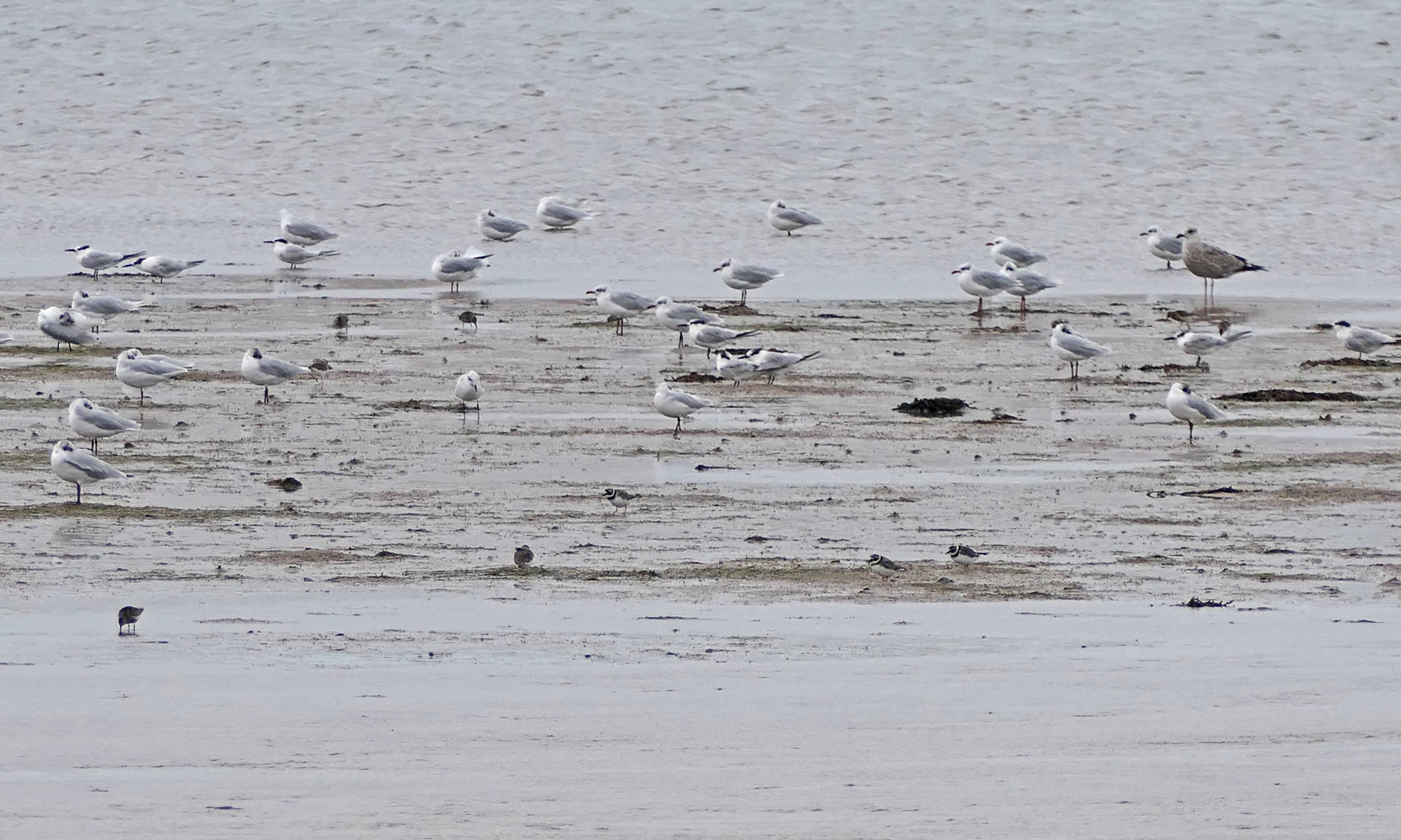
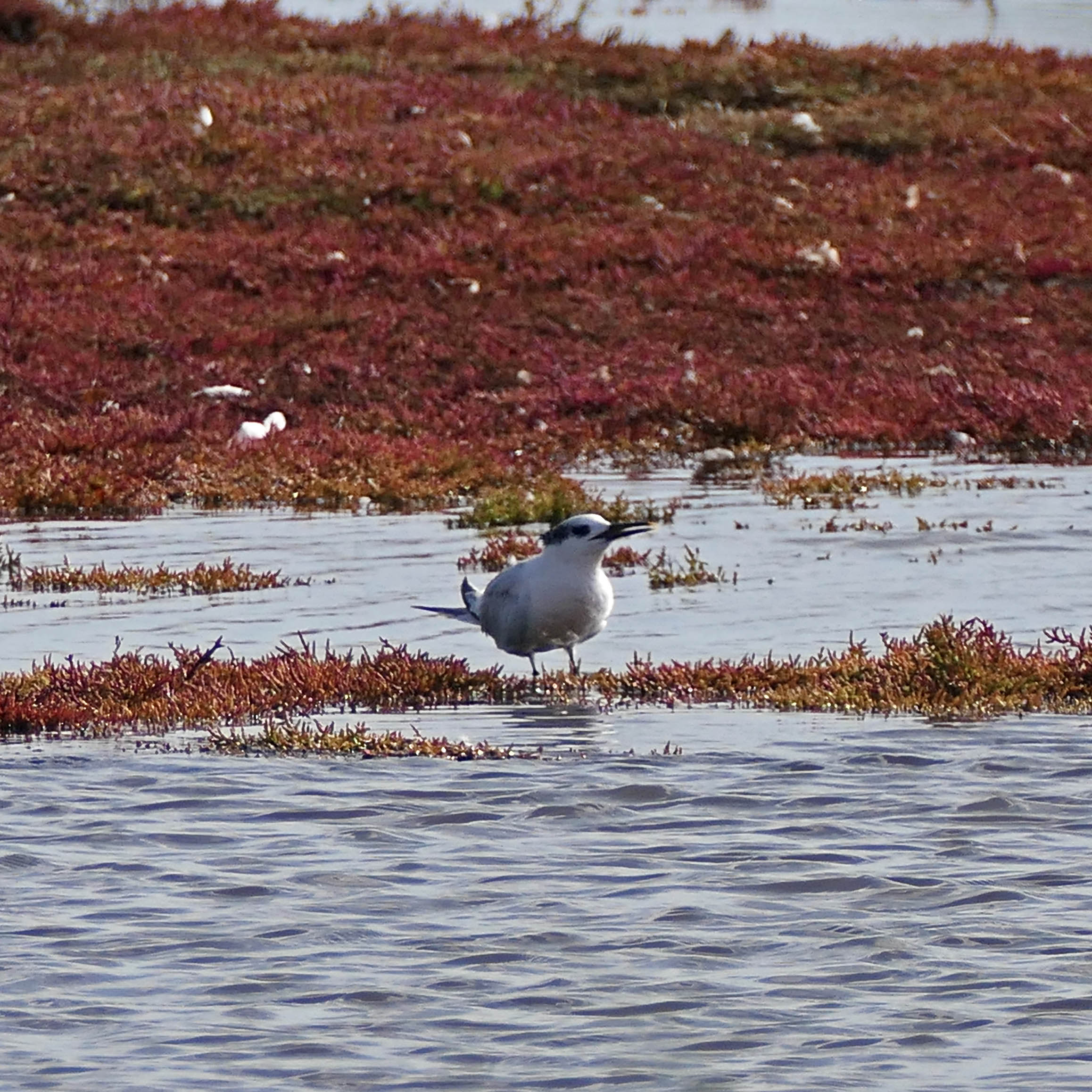
These beauties are the last of the birds I’ll share from my recent trip to Weymouth: Sandwich terns (Sterna sandvicensis). Though some tern species can be tricky to tell apart (Common and Arctic, in particular), with their yellow-tipped black beaks, black legs and black-capped heads, Sandwich terns are a bit more straight forward to identify.

~  Sandwich terns seen here with mostly Mediterranean gulls, Dunlin & Ringed plover

As you can perhaps see in my photos, the black cap on its head is not a permanent feature; it is fully black at the beginning of the breeding season but then quickly begins to develop white speckles above the eyes and, by the end of the summer, the whole of the forehead is white, making the ‘hair do’ resemble more of a monk’s tonsure. I guess the stress of raising young will do that, even to terns!

I didn’t know much about these birds but my guide book tells me that Sandwich terns breed in northern Europe (including in colonies around the coast of Britain), Russia and North America, then move south, which is when they can be seen in southern Britain, on passage to their wintering locations, mostly on the west coast of Africa.

If you’re wondering, as I was, about the origin of its name, in Fauna Britannica, Stefan Buczacki tells that ‘Its association with the town of Sandwich on the Kent coast dates back to 1785, when the naturalist John Latham was sent specimens collected from there by some local boys’.

Like Loading...

Reddening Glasswort

14 Sunday Sep 2025

Posted by sconzani in autumn, plants, wildflowers

≈ Leave a comment

Tags

autumn colour, Glasswort, reddening plant, RSPB Lodmoor, Salicornia species, saltmarsh plants, seaside plants

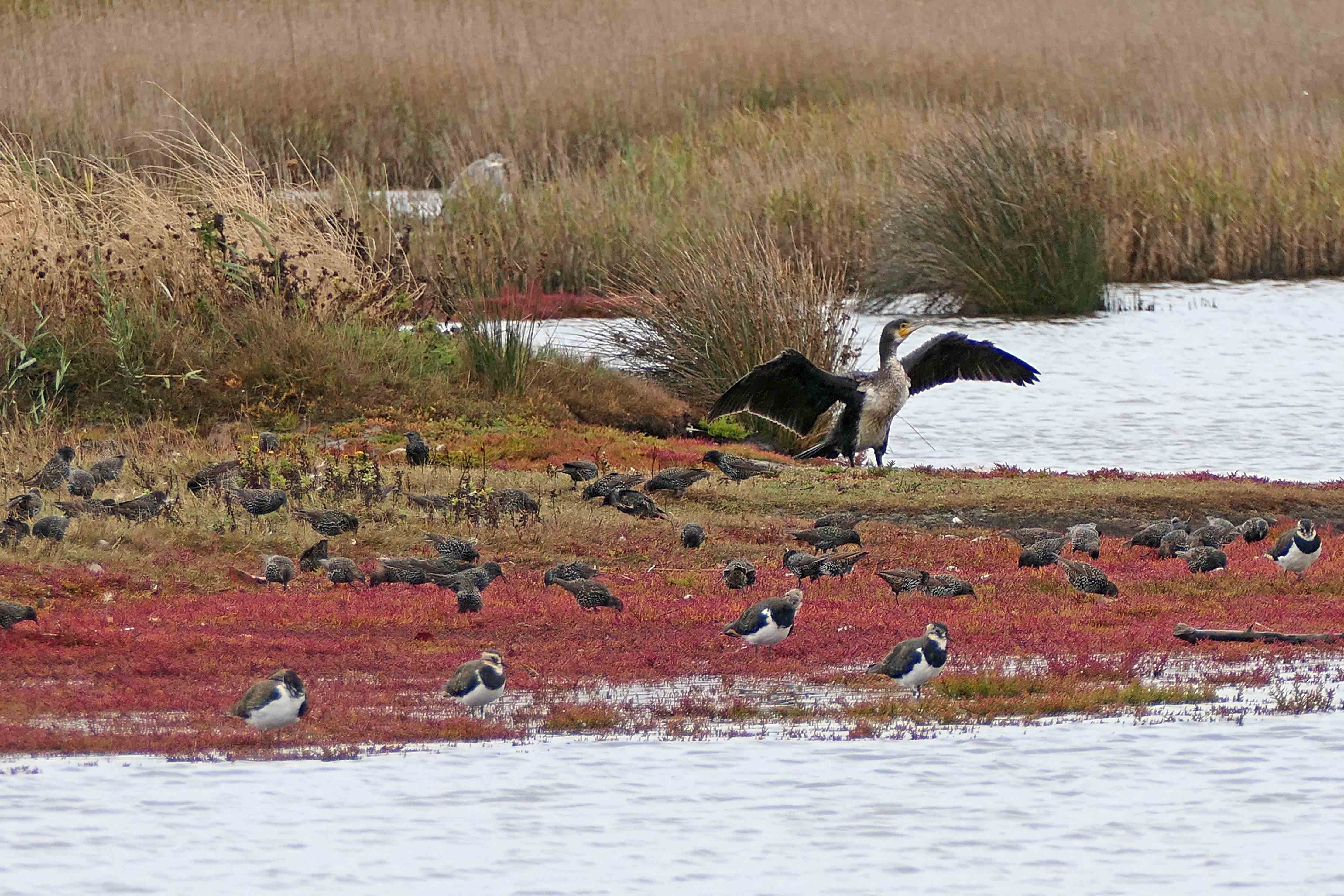
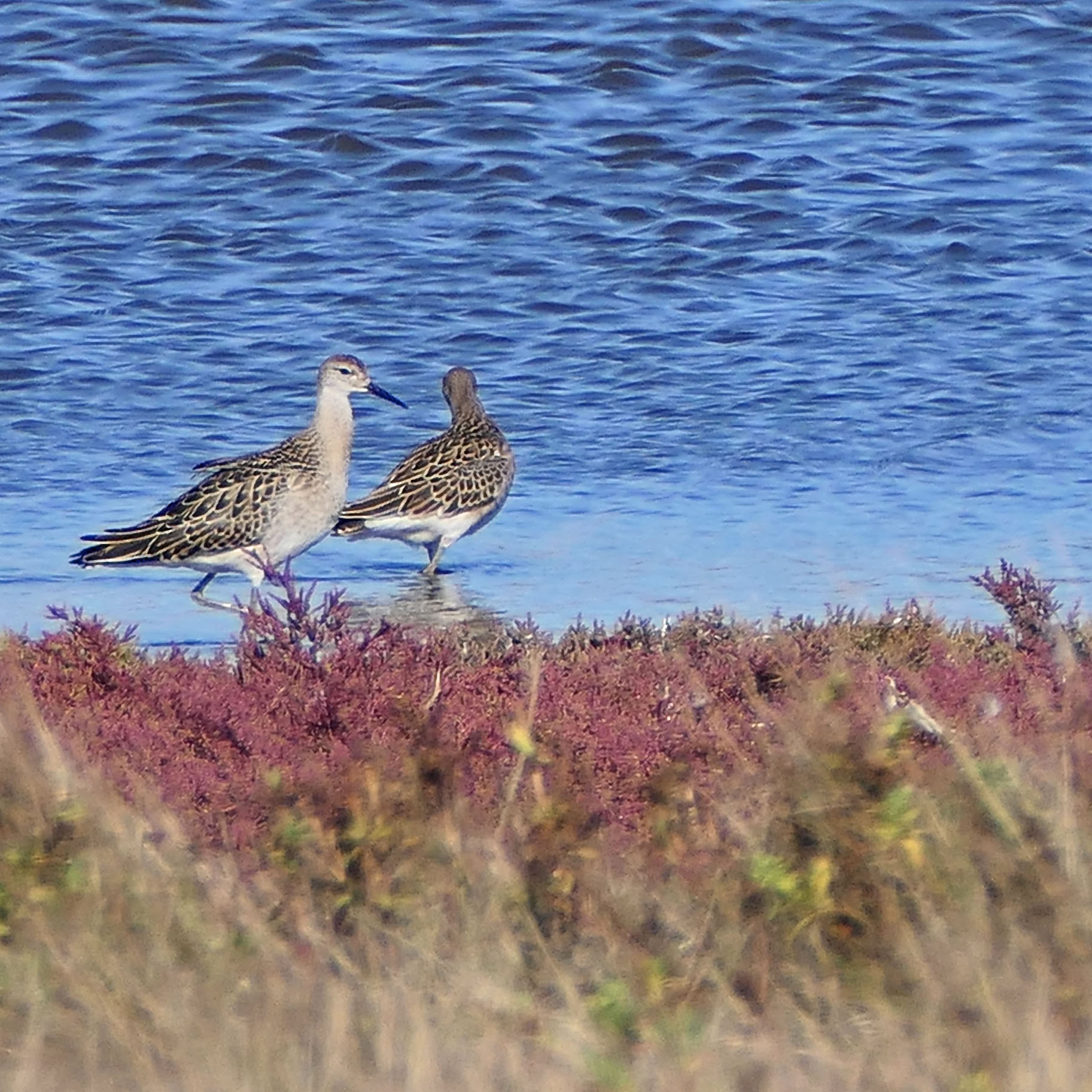
You may have noticed, in a couple of yesterday’s Ruff photos – as in the photo below (which includes Lapwings, Starlings, a Cormorant drying its wings, with a Grey heron lurking in the background) – the birds are moving around amongst a reddish-coloured plant.

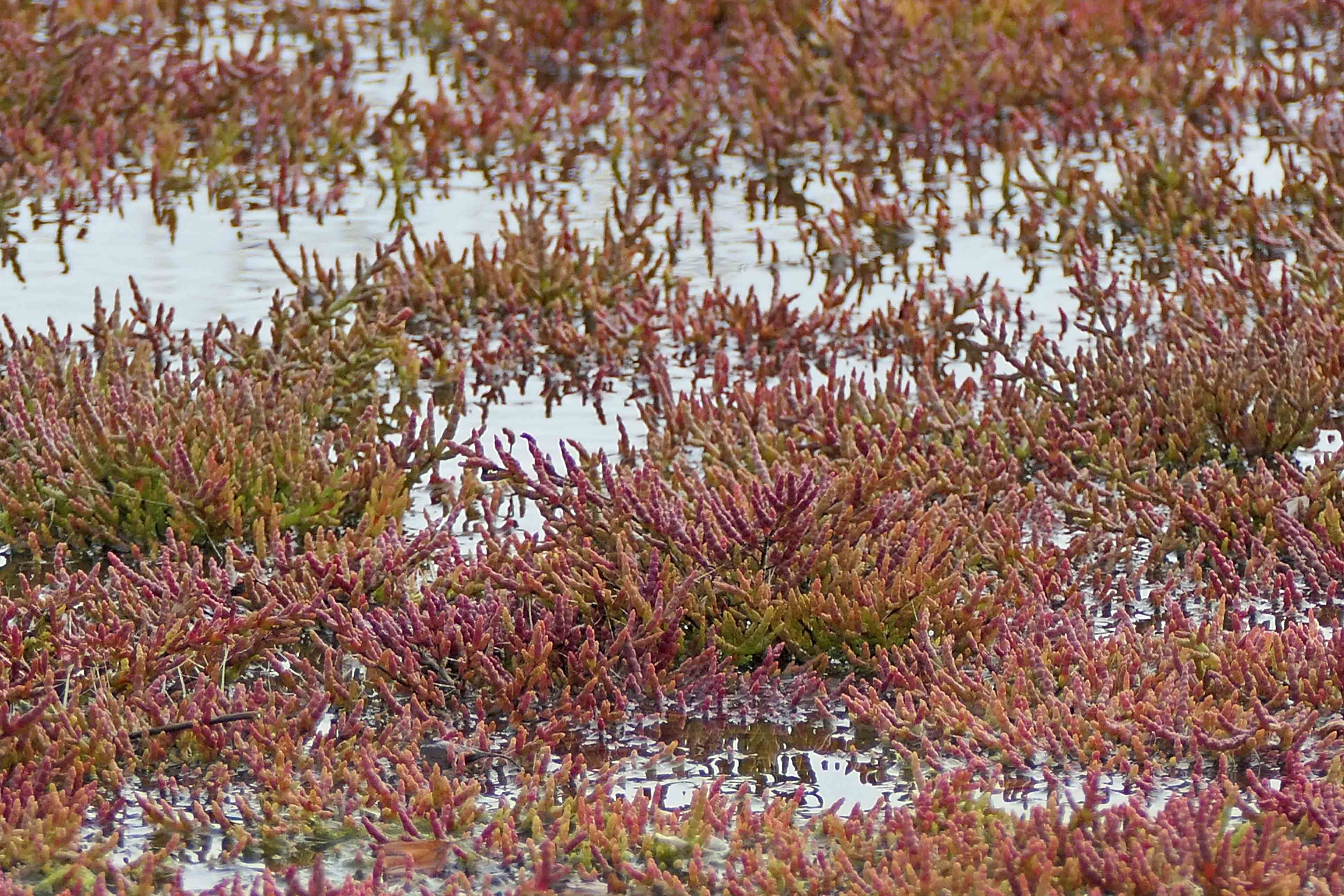
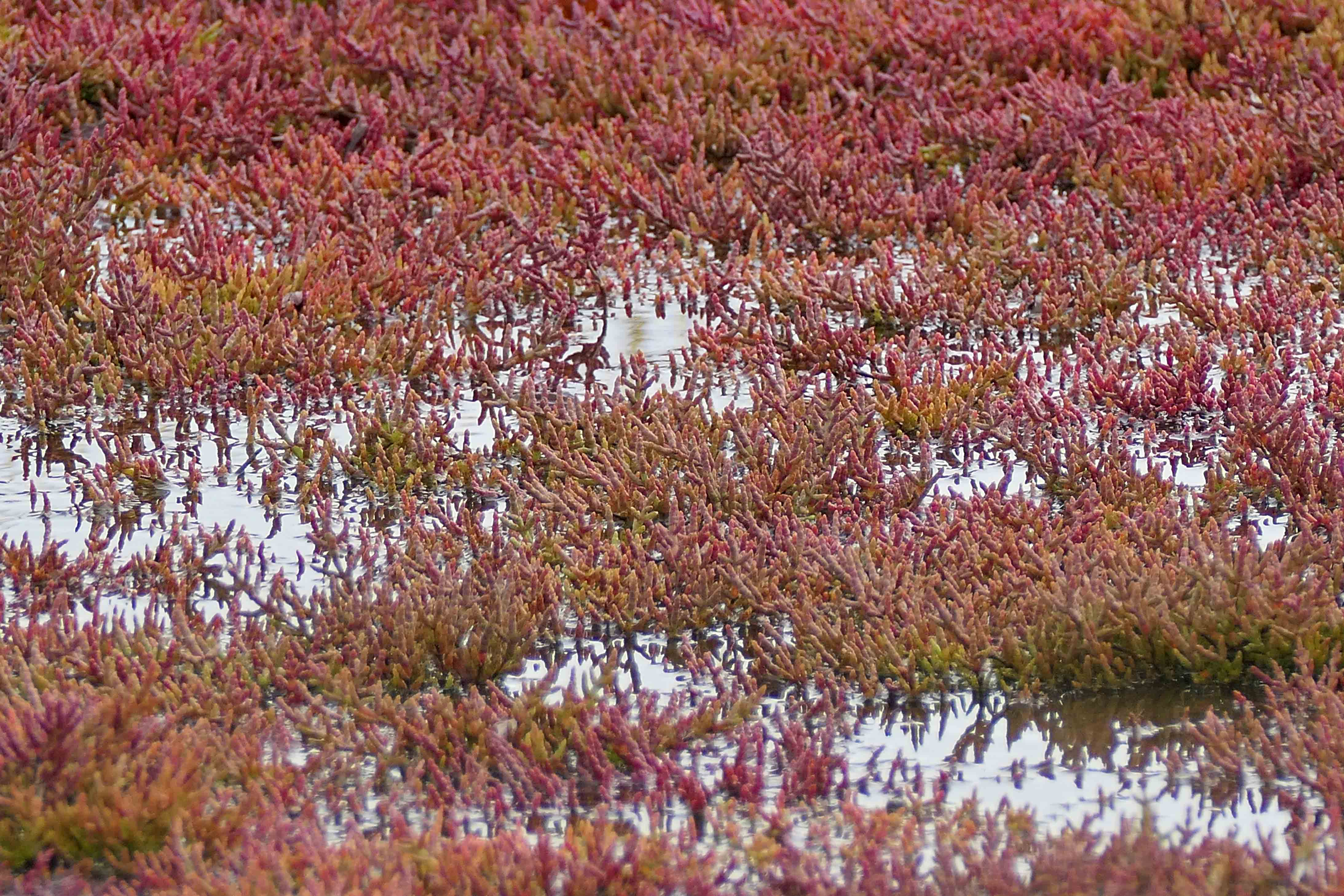
This is Glasswort, one of the Salicornia species, though I don’t which of several species this might be. For one thing, due to the watery environment in which Glassworts thrive, I couldn’t get close to any of the plants, but also these plants can be tricky to distinguish one from the other. If you see Glasswort and want to give it a try, the Wildflower Society website has a downloadable pdf ‘A Guide to the Identification of the Glassworts of the British Isles’.

The Glassworts are plants of seasides and saltmarshes, and are common all around the British coastline. Until this latest visit to RSPB Lodmoor, I hadn’t particularly noticed these plants but this time, as the season is changing from summer to autumn, the Glassworts begin to change colour, and, I think, look stunning. I’m sure the photographers amongst you will also appreciate what a wonderful backdrop this colour provides for images of the local birds.

Like Loading...

Ruffing it

13 Saturday Sep 2025

Posted by sconzani in autumn, birds

≈ Leave a comment

Tags

autumn migration, birding, birdwatching, British birds, female Ruff, Philomachus pugnax, Reeve, RSPB Lodmoor, Ruff

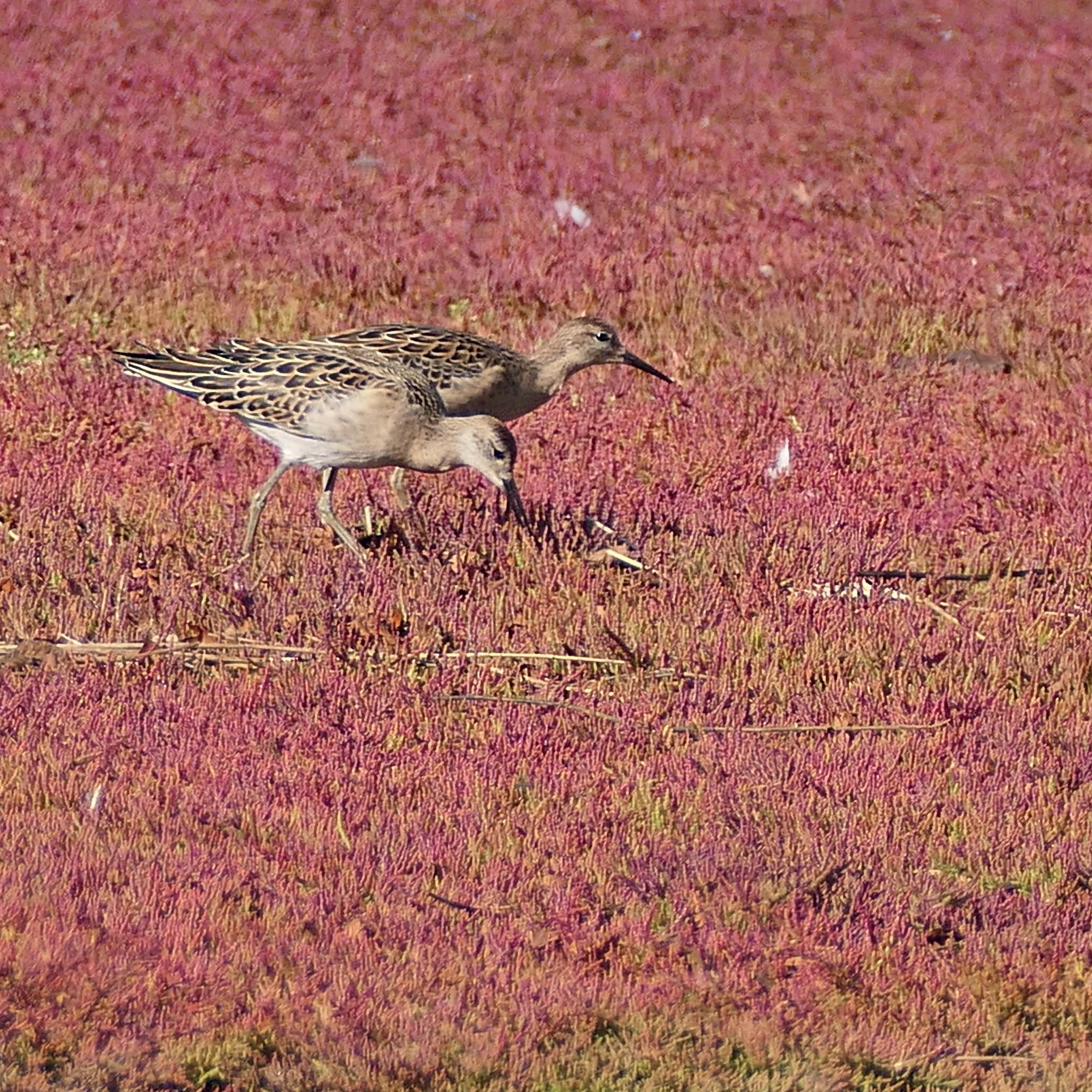
I’ve just returned from another few days on England’s south coast, in Weymouth and on the Isle of Portland, this time, due to its being migration season and the often inclement weather, mostly birding. And, despite the blasting westerly winds and the frequent heavy rain, it was wonderful!

After arriving mid afternoon on Monday, I took myself on a walk – to stretch my old body after five hours’ train travel and to get some fresh air in my lungs – to RSPB Lodmoor. It’s such a convenient distance from Weymouth town centre and always has something to delight my birding senses. And Monday’s visit did not disappoint, providing my first sighting this year of Ruff (Philomachus pugnax).

The story of the Ruff in Britain is a sad one. My guide book recounts that Ruff became extinct as a breeding bird in Britain around 1850, though it managed to re-establish itself in East Anglia for a time in the 1960s. Now, few if any young are raised in Britain, with the bird’s main breeding grounds ranging from Scandinavia as far east as Siberia, and south as far as the Netherlands. Though some Ruff are present throughout the year in Britain, and several hundred over-winter here, most are seen during autumn migration when the birds pass through on their way to Africa, some flying as far as South Africa.

The Ruff is red-listed in Britain and is globally threatened, as its population has declined dramatically and its breeding and non-breeding ranges have also declined. The two birds I saw are female (though the species name is Ruff, the male bird is known as Ruff due to its extraordinary breeding plumage, while the female is known as Reeve). I felt very privileged to enjoy reasonably close sightings of these large waders and spent quite a lot of time watching them feeding up for their long journey south.

Like Loading...

Lodmoor’s distant birds

07 Thursday Aug 2025

Posted by sconzani in birds

≈ Leave a comment

Tags

Bearded tit, birding, birdwatching, Black-tailed godwits, British birds, Common tern, Dunlin, Green sandpiper, Lapwing, Little tern, Marsh harrier, RSPB Lodmoor, Wood sandpiper

I wrote in Tuesday’s blog (Egrets, little and large) that I would share in a subsequent post more of the birds I saw during last week’s three visits to RSPB Lodmoor, and here they are. Most were quite distant but I thought it was worth documenting the wide variety of birds that can be seen at this wonderful reserve.

You may struggle to spot the two birds in this photo – they are sitting facing each other on the ‘beach’ area but their colours blend in rather well to the background. In spite of that, this was probably the standout sighting for me, as these are Bearded tits, and, given their sandy colouring, these were probably fledglings, the first ones I’ve seen.

Black-tailed godwit numbers increased from three on my first visit to Lodmoor to eight on my final visit, and numbers will likely continue to increase as these birds return from their breeding grounds in Iceland and continental Europe. You may just be able to spot some smaller birds amongst the shorter reeds in the foreground. These are Dunlin.

I blogged about seeing Breeding Common terns after my June visit to Lodmoor. This time the Common terns had almost all fledged, though one chick remained on one of the breeding platforms and several sat on the sand waiting for their parents to return and feed them. Above you can see two Common terns at the left of the frame but the two terns in the centre of the image are Little terns. These breed, in a specially protected area, on nearby Chesil Beach and, though I saw some there very distantly during my last visit, it was wonderful to see these two at a much closer distance. The birds in the background are a mix of Mediterranean and Black-headed gulls.

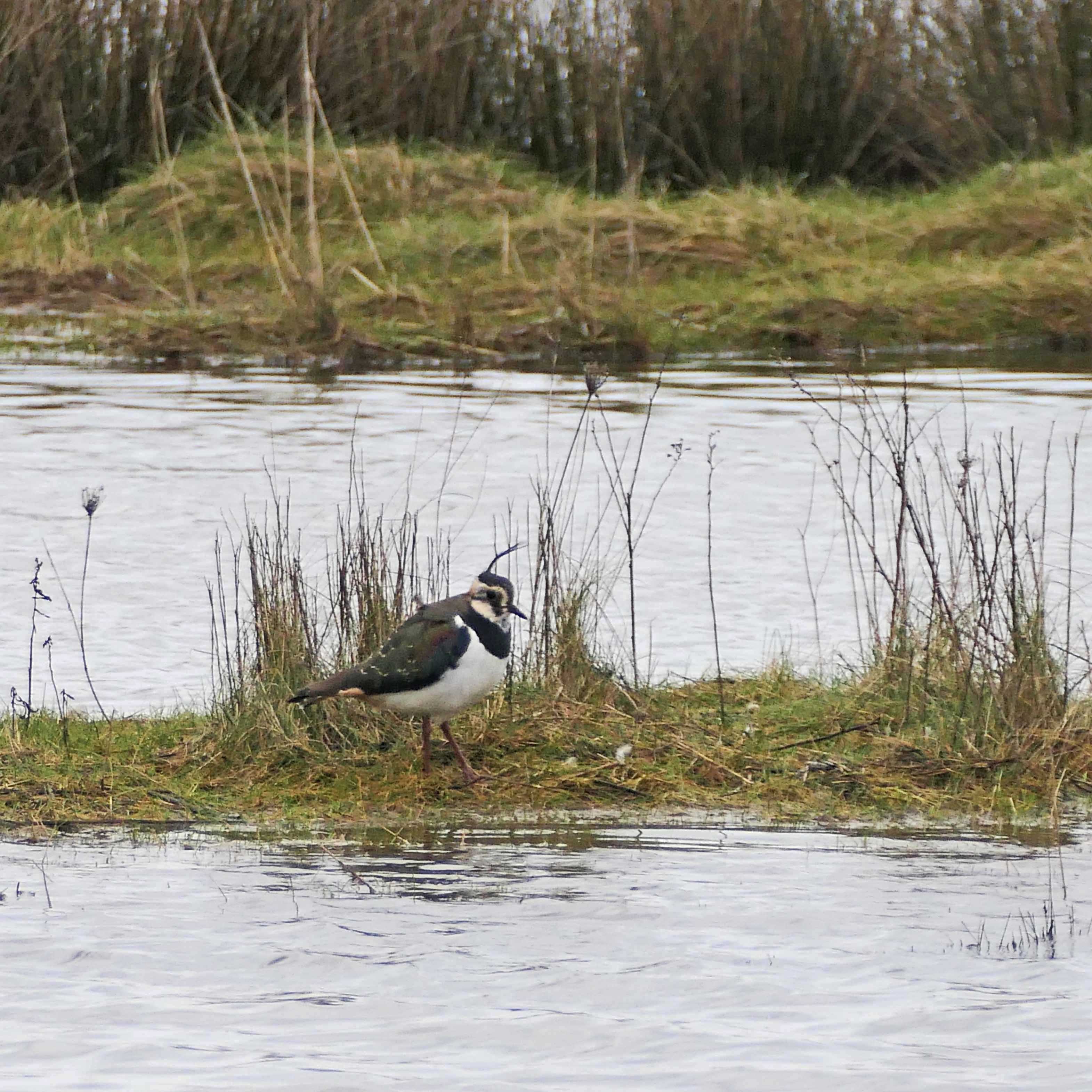
How gorgeous is this Lapwing? I think it’s a juvenile bird as it seemed curious rather than scared by my proximity on the path just across from where it was foraging for food, and I had read that Lapwings have bred on the reserve this year.

I was scanning the reeds for anything interesting when this stunning Marsh harrier flew up almost right in front of me. Bushes obscured it from view for a few minutes so I couldn’t get any better photos and, though it did a circuit around the far side of the reserve, it soon disappeared from sight once again.

Last but by no means least are two sandpipers. On the left is a Wood sandpiper, a bird I’d only ever seen once before and, though my picture only shows one, two birds frequented this pool all of last week. This species is only seen in Britain during Spring and Autumn as they move between their breeding grounds in northern Europe and their over-wintering locations in Africa, so I was particularly lucky to have synchronised my visit with their stopover. The bird on the right is a Green sandpiper, another bird I don’t see very often. Though they are known to frequent a river quite near where I live, it’s not a location I can easily access, plus they are very flighty birds, heading for the skies at the slightest suggestion of humans close by.

Like Loading...

Egrets, little and large

05 Tuesday Aug 2025

Posted by sconzani in birds

≈ 2 Comments

Tags

birding, birdwatching, British birds, Cattle egret, Great white egret, Grey heron, Little egret, RSPB Lodmoor

This is a view of RSPB Lodmoor from the footpath that runs along the western edge of the reserve. With areas of open water and hidden pools, lush reedbeds and swathes of saltmarsh, it’s a wetland paradise for birds and, as well as having a resident population of water fowl, the fact that the reserve is right on the coast means that it’s also a mecca for migrating birds, and sightings of rarities are relatively frequent.

I’ll share more of Lodmoor’s birds in another post but today want to focus on the egrets. They are members of the Heron family and share Lodmoor with their Grey heron (Ardea cinerea) cousins, though not always harmoniously – I saw a couple of spats between the herons and egrets during my visits. There is a resident population of Little egrets (Egretta garzetta), which only arrived in numbers in the UK in 1989 and first bred somewhere in Dorset in 1996, per the RSPB website, but are now quite common in southern Britain. The photo below shows a Grey heron, a Great white egret and two Little egrets.

I saw my first Great white egret (Ardea alba) of the year during my visit to Lodmoor in June but it was moving around the edge of a distant, inaccessible pool, so I didn’t get a good look at it. This time, there were several Great whites around the reserve and, as you might guess from the photo below, I had my closest ever views of this handsome bird as it stalked around a pool, hoping to spear a fish or two.

While it was wonderful to enjoy such good sightings of the Great white egrets, the egret highlight of this trip came during my second visit to Lodmoor, and only happened because I got chatting to some other birders. One of them was convinced she had seen a Cattle egret (Bubulcus ibis) but it had subsequently disappeared behind the tall reeds. Luckily for me, within minutes the bird popped up again. Below, you can see two Great white egrets and the much smaller Cattle egret, with two Grey herons off to the right.

Like the Little egret, the Cattle egret is a recent migrant to Britain that has made itself at home. It was first recorded breeding here in 2008, and its population is expanding ever northwards from its initial strongholds in southern Britain. This particular Cattle egret remained distant and soon vanished again into the reed beds but it was a delight to have seen so many members of the heron family together.

Like Loading...

Sunshine in a butterfly

04 Monday Aug 2025

Posted by sconzani in insects

≈ Leave a comment

Tags

British butterflies, butterfly, Clouded yellow, Colias croceus, Dorset butterflies, migrating butterflies, RSPB Lodmoor

I’ve been away for another mini break, staying once again in Weymouth, on Dorset’s south coast, for four nights, spending my three and a half days surrounded by birds and butterflies (also crowds of summertime beach visitors, though, fortunately for me, most of them weren’t in Weymouth for the same kind of wildlife as I was). With cool winds and lengthy spells of drizzle, the weather wasn’t as good as during my visit in early June, but I saw lots of lovely creatures that I will share with you over the coming week.

First up today is the first of four new-for-2025 butterfly species I saw, this gorgeous Clouded yellow (Colias croceus), a butterfly I don’t see in south Wales every year as they’re migrants from Europe and their appearance on our shores depends a lot on weather and wind direction and how their population is faring. This sighting was particularly welcome, as I had spent Tuesday morning wandering around the RSPB’s Radipole reserve in almost constant drizzle, then headed for an afternoon wander around RSPB Lodmoor. This little drop of sunshine fluttered up right in front of me when I got to Lodmoor, a sign of the lovely afternoon to follow.

Like Loading...

Breeding Common terns

17 Tuesday Jun 2025

Posted by sconzani in birds

≈ Leave a comment

Tags

birding, birdwatching, breeding Common terns, British birds, Common tern, Common tern chicks, Lodmoor Nature Reserve, RSPB Lodmoor

My afternoon walk to Lodmoor Nature Reserve proved the perfect antidote to my five-hour journey on four different trains to get to Weymouth. And what an absolute delight it was when I arrived at Lodmoor to first hear – very raucous, and then see the Common terns and their Black-headed gull companions breeding in close proximity on two artificial islands near the edge of the lakes. (These islands are ring-fenced and fitted out with some enclosed nesting ‘boxes’ to try to offer the birds better protection during the breeding season.)

Though Common terns can be seen at certain times of year when moving on passage up and down the Bristol Channel, I’ve rarely managed to catch sight of them in my local stomping ground, so seeing them at reasonably close quarters, and with their tiny chicks just beginning to explore the world around them, was another special treat of this holiday.

Terns are magnificent aeronauts. Their skill at manoeuvring their streamlined shape through the thermal airwaves, their ability to twist and turn and plunge and lift – these fliers are a joy to watch, particularly when diving for the tiny fish swimming just below the water’s surface. And, with several tiny chicks to feed, these terns were almost constantly in the air. Many seemed to fly straight out to sea where, presumably, their prey was more bountiful but I also noticed, when walking around Weymouth’s other local nature reserve, Radipole Lakes, that the Common terns were successfully exploiting the fishing opportunities there as well.

Like Loading...

276/365 Ruffing it

03 Thursday Oct 2019

Posted by sconzani in birds, nature

≈ Leave a comment

Tags

birding, birdwatching, British birds, RSPB Lodmoor, Ruff, satellite male Ruff, white-headed ruff

When we spotted this white-headed Ruff at RSPB Lodmoor, I couldn’t help but wonder if it was the same bird we’d seen at this same location on our 2018 trip to Portland. Of course, as the bird wasn’t ringed, there was no way to tell for sure but it certainly was a handsome bird, a ‘satellite’ male as I explained in last year’s post here.

191003 ruff (1)
191003 ruff (2)

191003 ruff (3)
191003 ruff (4)

Like Loading...

275/365 Black-tailed godwits

02 Wednesday Oct 2019

Posted by sconzani in autumn, birds, nature

≈ Leave a comment

Tags

birding, birdwatching, Black-tailed godwit, British birds, RSPB Lodmoor

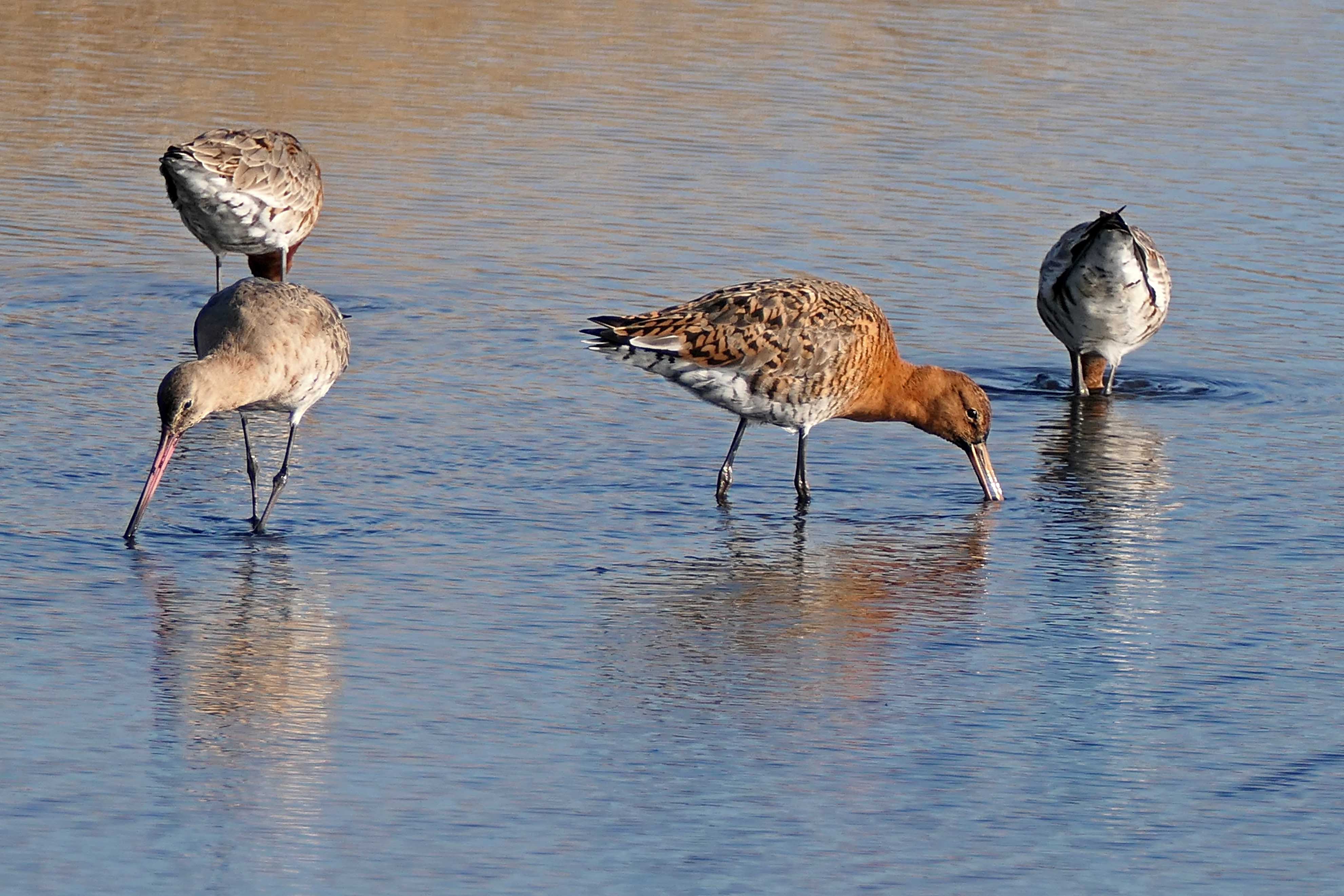
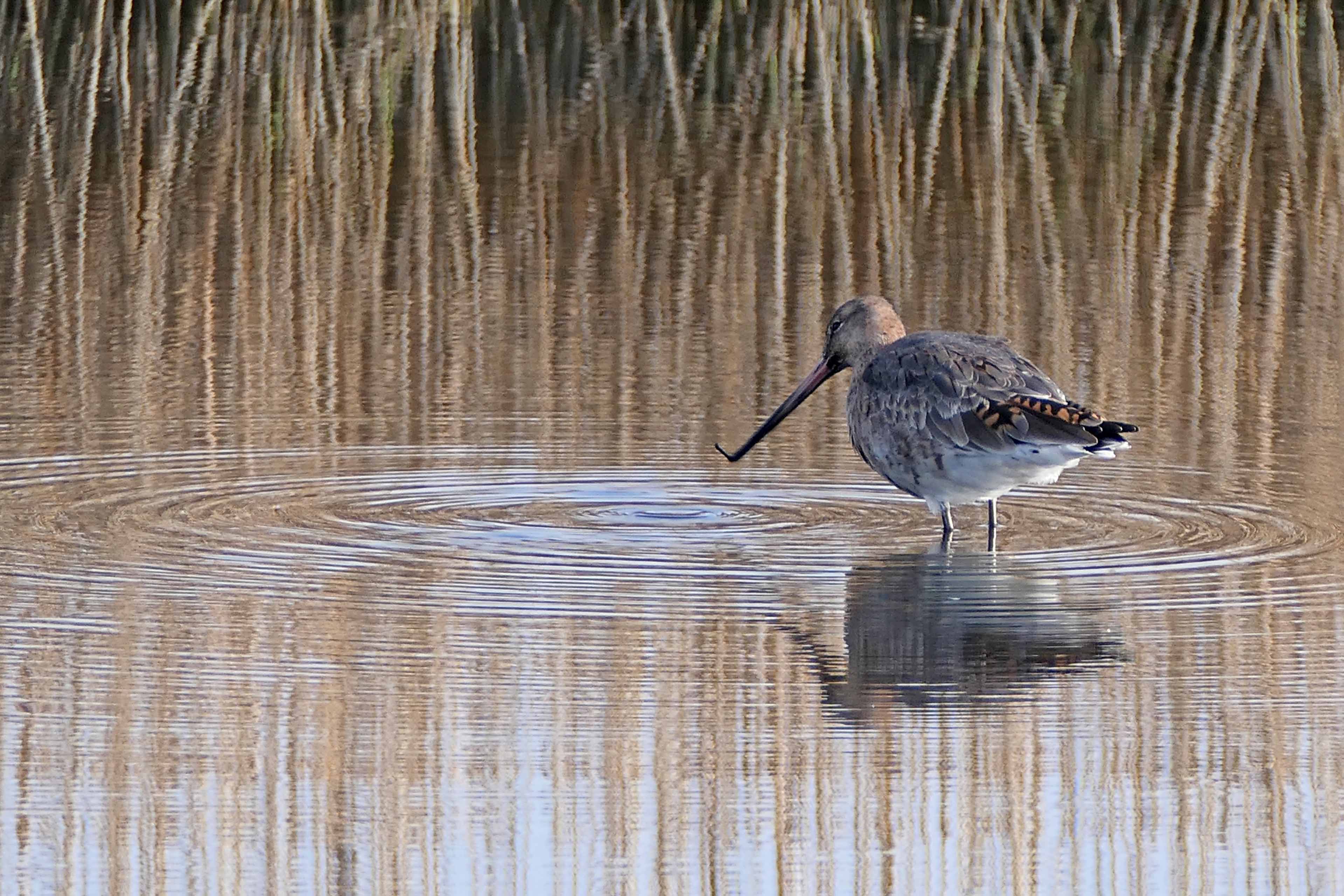
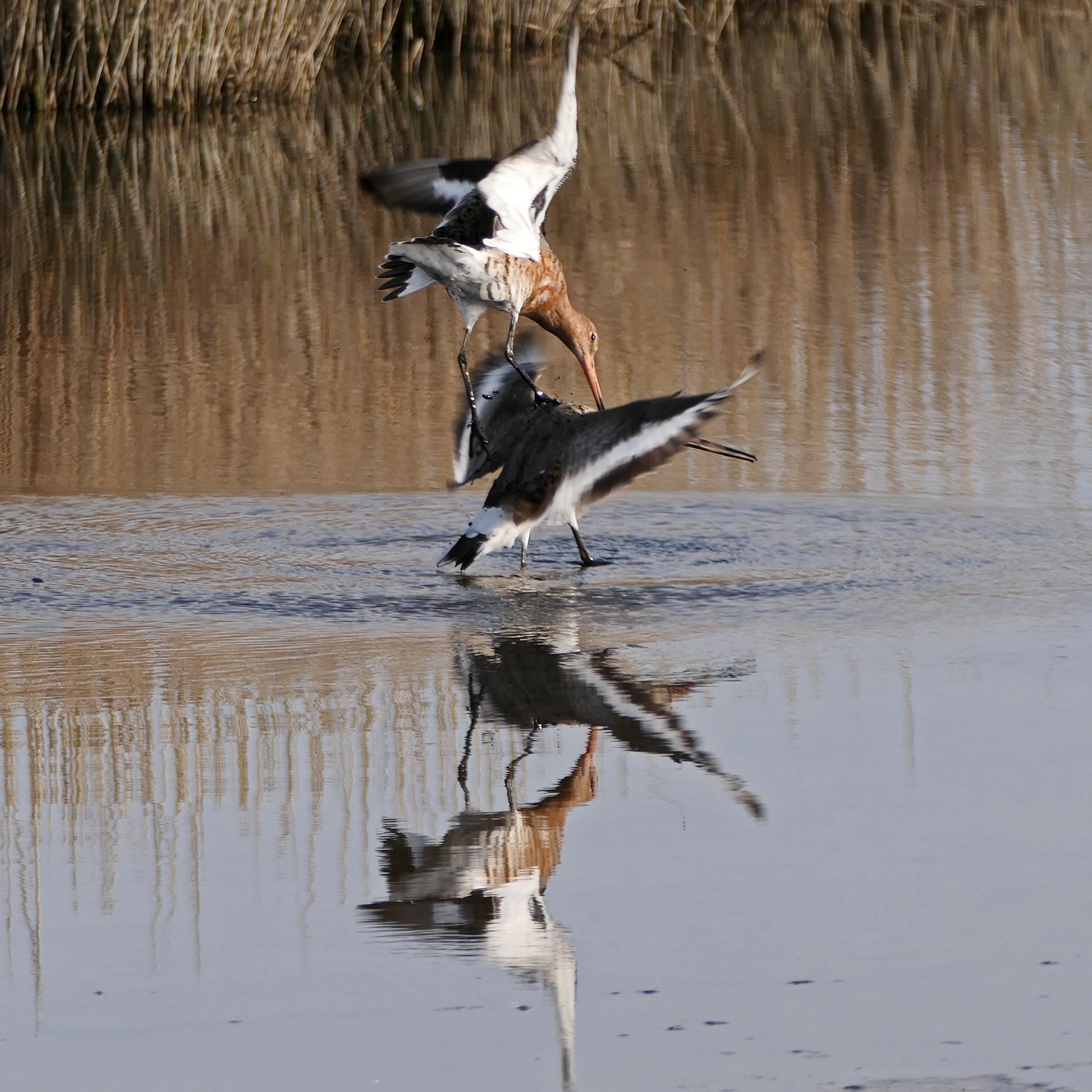
For me, the Black-tailed godwits were a highlight of our walk around RSPB Lodmoor. They’re not uncommon birds but I don’t see them on my local patch and don’t often get close views of them.

191002 black-tailed godwit (1)

There were several at Lodmoor but the little beauty shown below was feeding quite close to the western path. That feeding was a constant repetition of probing the mud to locate some choice morsel, raising its beak from the water and throwing back its head to gulp down said morsel, then plunging its head down into the water again. If its frequent gulps were any indication, the bird was finding plenty of food.

191002 black-tailed godwit (2)191002 black-tailed godwit (3)

Black-tailed godwits are handsome waders that can be seen almost year round in Britain. Though local populations migrate to overwinter in Africa, birds from Iceland come to Britain to enjoy our relatively milder winter climate.

191002 black-tailed godwit (4)

Like Loading...

274/365 Egrets and herons

01 Tuesday Oct 2019

Posted by sconzani in birds, nature

≈ 4 Comments

Tags

birding, birdwatching, British birds, Great white egret, Grey heron, Little egret, RSPB Lodmoor, RSPB Radipole

On the way to Portland last Friday our birding group stopped off at the RSPB’s Lodmoor Nature Reserve on the outskirts of Weymouth. It’s a wonderful environment for birds, with small lakes and large reedbeds, open saltmarshes and hedge-enclosed pathways, and it always turns up a good variety of birds.

191001 egrets

Now, I’ve only been in Britain four years so I don’t remember the ‘old days’ when twitchers would race across the country to see a Little egret or a Great white egret, but even I can see how much these birds have increased in number in a very short time.

191001 little egret (1)
191001 little egret (2)

At Lodmoor, there were several Little egrets (above) – I didn’t count the ones I did see, and I’m sure there were several lurking amongst the reeds that I couldn’t see and, amazingly, there were six (!) Great white egrets (below), for a time all congregated in one spot. Now, that was a sight to see.

191001 great white egret (1)
191001 great white egret (2)

I was also impressed by the large numbers of Grey herons, especially those at nearby RSPB Radipole, all lined up along the edge of the reeds, sheltering from the strong westerly winds.

191001 herons and little egret

Like Loading...
← Older posts

About me

sconzani

sconzani

I'm a writer and photographer; researcher and blogger; birder and nature lover; countryside rambler and city strider; volunteer and biodiversity recorder.

View Full Profile →

Follow earthstar on WordPress.com

Enter your email address to follow this blog and receive notifications of new posts by email.

Recent blog posts

  • M is for mite December 18, 2025
  • L is for lepidopteran lifers December 17, 2025
  • K is for Keeled skimmers December 16, 2025
  • J is for Jersey tiger December 15, 2025
  • I is for Ichneumon December 14, 2025

From the archives

COPYRIGHT

Unless otherwise acknowledged, the text and photographs on this blog are my own and are subject to international copyright. Nothing may be downloaded or copied without my permission.

Fellow Earth Stars!

  • Unknown's avatar
  • Unknown's avatar
  • Unknown's avatar
  • Unknown's avatar
  • Unknown's avatar
  • Unknown's avatar
  • Unknown's avatar
  • Unknown's avatar
  • Unknown's avatar
  • Unknown's avatar
  • Unknown's avatar
  • Unknown's avatar
  • Unknown's avatar
  • Unknown's avatar
  • Unknown's avatar
  • Unknown's avatar
  • Unknown's avatar
  • Unknown's avatar
  • Unknown's avatar
  • Unknown's avatar
  • Unknown's avatar
  • Unknown's avatar
  • Unknown's avatar
  • Unknown's avatar
  • Unknown's avatar
  • Unknown's avatar
  • Unknown's avatar
  • Unknown's avatar
  • Unknown's avatar
  • Unknown's avatar
  • Unknown's avatar
  • Unknown's avatar
  • Unknown's avatar
  • Unknown's avatar
  • Unknown's avatar
  • Unknown's avatar
  • Unknown's avatar
  • Unknown's avatar
  • Unknown's avatar
  • Unknown's avatar
  • Unknown's avatar
  • Unknown's avatar
  • Unknown's avatar
  • Unknown's avatar
  • Unknown's avatar
  • Unknown's avatar
  • Unknown's avatar
  • Unknown's avatar
  • Unknown's avatar
  • Unknown's avatar

Blog at WordPress.com.

Privacy & Cookies: This site uses cookies. By continuing to use this website, you agree to their use.
To find out more, including how to control cookies, see here: Cookie Policy
  • Subscribe Subscribed
    • earthstar
    • Join 667 other subscribers
    • Already have a WordPress.com account? Log in now.
    • earthstar
    • Subscribe Subscribed
    • Sign up
    • Log in
    • Report this content
    • View site in Reader
    • Manage subscriptions
    • Collapse this bar
 

Loading Comments...
 

You must be logged in to post a comment.

    %d