Limiting my palette to yellow, for the challenge and the sunshine cheeriness of the colour, I went searching for wildflowers in bloom in my local area this week. These are the dozen I managed to find …
A selection of the wildflowers in bloom during these last weeks of summer – last week, my video featured flowers of more mellow, subtle hues; this week, you’ll need your sunglasses as these are the brights!
I had to laugh when I read in Flora Britannica that, because this plant’s large leaves feel like they are covered in soft grey wool: ‘In a more modern – and practical – vein, mullein has been nicknamed “the Andrex plant”, and its leaves used accordingly.’ I cannot attest to the veracity of this statement!
This is Great mullein (Verbascum thapsus), which also has some wonderful, less recent vernacular names: Aaron’s Rod, Hagtapers, Adam’s flannel, and Our Lady’s candle. These names are no doubt inspired partly by those leaves and also by the enormous yellow-flowered spike, which can grow to four or five feet tall. Mullein is a biennial plant: in its first year there is just a rosette of leaves, and it’s not till its second year that the flower spike grows.
We’ve rain today, the gentle soft rain that I’ve come to associate with life in Wales, but I’m not complaining. It’s much needed, by the land, its plants and its beasties, after a couple of weeks of strong sunshine and baking heat. To counteract the dull grey I see out my window, I’m about to compile today’s post, a little video full of summer sunshine, with some of the yellow-flowered wildflowers currently in bloom. I know I’ve done this before, and quite recently, but I do so enjoy the bright cheeriness of yellow.
It seems I’m not the only one who likes buttercups, judging by the quantity and variety of mini-beasties I’ve spotted in them in recent days: bees and hoverflies, earwigs and micro-moths, and even a slug.
A month ago, I shared some of the yellow-flowered wildflowers I’d found for the weekly #WildflowerHour challenge. In the weeks since, more yellow flowers have begun to bloom and, as today’s weather (I’m writing this on Saturday, as we sit under a heavy rain warning) is grey and windy and very wet, I fancy some bright sunshiny yellow. So, here we go …
The flowers are the butterflies’ favourite Bird’s-foot trefoil and the vibrant bushes of Broom. Although I shared some of these last time, I couldn’t resist a Shrew’s-eye view of more Cowslips. The buttercups are beginning to take over from the Lesser celandine as Nature’s yellow carpet in the meadows – these are Creeping and Meadow buttercups. Prickly sow-thistles line the edges of the lane behind my house, and Spotted medick is now brightening up the pavement verges. I’d glimpsed Yellow archangel last time but now these lovely spikes are popping up everywhere in my local woodland, a beautiful compliment to the Bluebells.
This week’s Wildflower Hour challenge was to find yellow-flowered wildflowers currently in bloom. Here are my finds – a blast of spring sunshine to enjoy this Sunday evening:
Groundsel, Opposite-leaved golden saxifrage (perhaps a bit of a stretch to say this is yellow, but it does have ‘golden’ in its name), Yellow archangel
Prickly sow-thistle, Cowslips, Ragwort
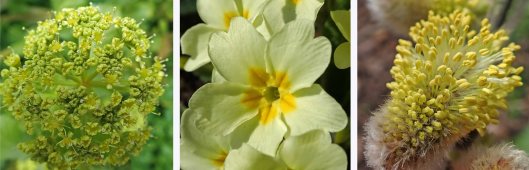
Pushing the envelope on these ones but … Alexanders (greenish-yellow), Primrose (buttery yellow), Pussy willow (not strictly a wildflower, but I’m having it)
I’ve been feeling the need for bright cheery sunshine yellow this week, to combat the dull weather, the short days, and the almost constant doom and gloom in the news, and the wildflowers have provided it. These are Black medick, a Dandelion species, Meadow buttercup, Nipplewort (actually photographed in sunshine!), Ragwort, and Yellow-wort.
It occurs to me when looking at recent flower photos I’ve taken that the wildflowers currently in bloom have a very imperial look to them: masses of purple, the colour favoured by the emperors of Rome, and swathes of yellow, the colour that dominated the imperial wardrobe in China.
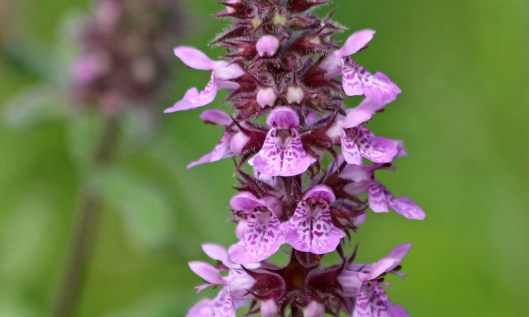
Marsh woundwort (Stachys palustris), found growing in the wildflower meadows in Cardiff’s Hailey Park this week; once regarded as the most effective of the wound-healing woundwort family.
Dyer’s greenweed (Genista tinctoria), plentiful at Lavernock Nature Reserve; also found in archaeological remains left by Vikings in York, proving its use as a yellow dye since at least the 9th century.
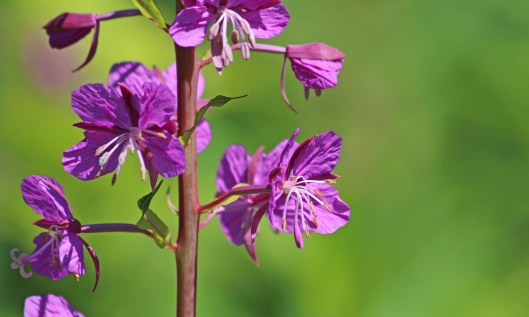
Rosebay willowherb (Chamerion angustifolium), firing up the conservation areas at Cathays Cemetery; nicknamed ‘bombweed’ during World War II when it grew in the London ruins created by German bombing raids.
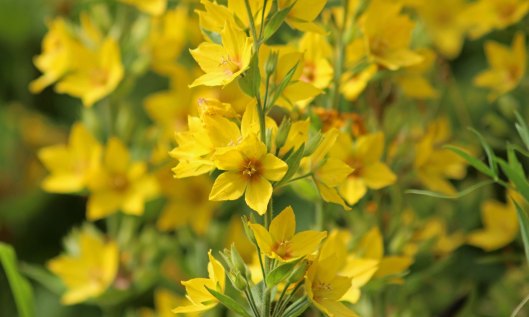
Yellow loosestrife (Lysimachia vulgaris), ablaze beside the River Taff in Cardiff; named in honour of Macedonian King Lysimachus who supposedly fed it to his cattle to calm them, hence lose + strife!
The interesting snippets about these plants were mostly extracted from my Flora Britannica.
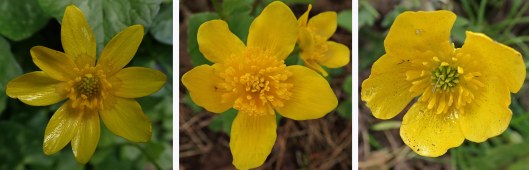
Now before you feel the need to correct the spelling of ‘merry-gold’ in my title, let me just say that it was deliberate because I find Marsh marigolds such cheery, merry flowers, and it always makes me smile to see them. I spotted some yesterday in Cardiff’s Heath Park, and they’re also in full flower at the moment in Penarth’s Alexandra Park, where I went for a meander earlier today.










 earthstar
You must be logged in to post a comment.