• ABOUT
  • BIRDING 2018
  • Birding 2019
  • BLOG POSTS
  • Butterflies 2018
  • Resources

earthstar

~ a celebration of nature

earthstar

Monthly Archives: September 2018

Friday’s walk 2: Rocky the pipit

30 Sunday Sep 2018

Posted by sconzani in autumn, birds, nature, walks

≈ 4 Comments

Tags

birding, birdwatching, British birds, Rock pipit, Rock pipit behaviour, Rock pipit territorial behaviour, Rock pipits fighting, Sully, Sully beach

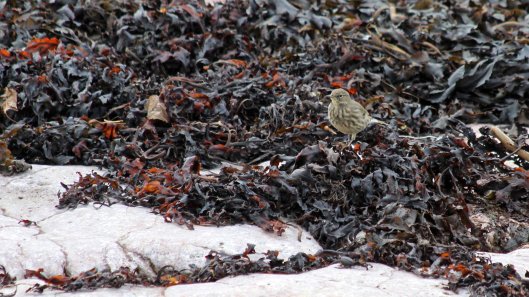
Before leaving Friday’s walk along Sully beach, I have another bird encounter to share.
180930 Rocky the pipit (1)

There were a lot of Rock pipits foraging amongst the rocks and piles of seaweed, more than I have seen before on Sully beach.

180930 Rocky the pipit (2)

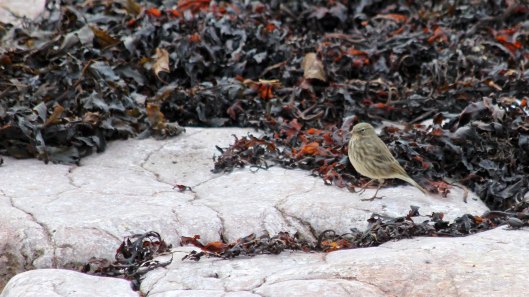
One bird was reasonably close to where I was sitting so I had the camera up, trying to get some photos of it, when I noticed what seemed like rather odd behaviour.
180930 Rocky the pipit (3)180930 Rocky the pipit (4)

The bird hopped down from the seaweed on to a flat stone and started to stamp its feet and shuffle back and forth, looking for all the world like it was practising its line-dancing moves.
180930 Rocky the pipit (6)

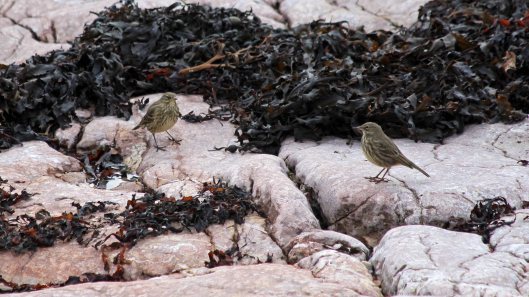
Because I had the camera up to my face and was zoomed in on this one bird – let’s call him Rocky – I didn’t realise that there was actually another Rock pipit standing very close by.
180930 Rocky the pipit (7)

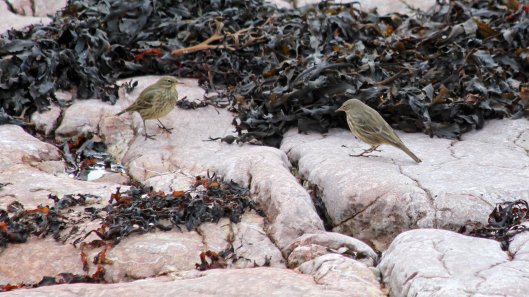
Rocky was focused intently on this other bird. He puffed up his chest and strutted about and did some more line-dancing moves, but the other bird didn’t seem very impressed. If this had been springtime, I would have said Rocky was trying to impress a female but it’s autumn.

180930 Rocky the pipit (8)

Next thing, Rocky’s done with the dancing and flew straight at the other bird.

180930 Rocky the pipit (9)

They bumped chests, flapped wings and generally fluttered about for a couple of minutes, presumably each bird trying to assert its dominance through this display.
180930 Rocky the pipit (10)

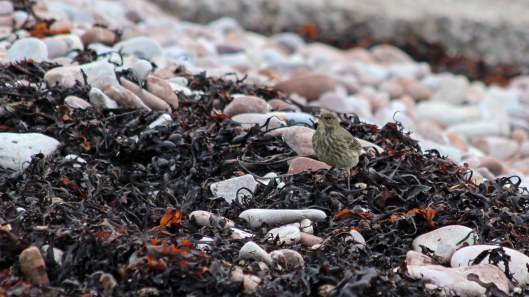
The other bird relinquished the rock, and the seaweed, to Rocky, who looked rather pleased with his success. I’ve since read that Rock pipits can be very territorial so I assume Rocky was defending his patch on the beach from the intruder. It was certainly fascinating to watch.

Like Loading...

Friday’s walk 1: along Sully beach

29 Saturday Sep 2018

Posted by sconzani in birds, nature, walks

≈ 2 Comments

Tags

birding, birdwatching, British birds, Dunlin, Ringed plover, Sully, Turnstone, Wheatear

I try to time my walks at Sully with a mid-morning high tide – that way I don’t have to get up too early for the bus and I miss the early morning dog walkers. Yesterday was one such day and, though there was a cool wind blowing, it was a lovely day for a long walk. At first, I just sat and scanned the beach and the shoreline and the sea.

180929 Sully birdlife (1)

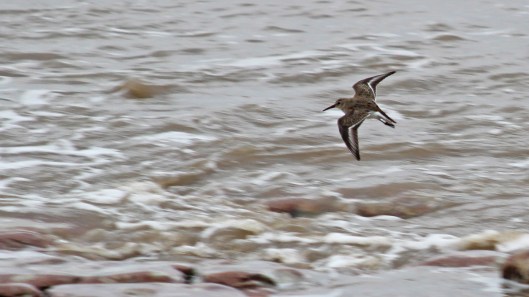
Several Turnstones were browsing the big deposit of seaweed the tide had rolled in and then this Dunlin flew in to join them.

180929 Sully birdlife (2)

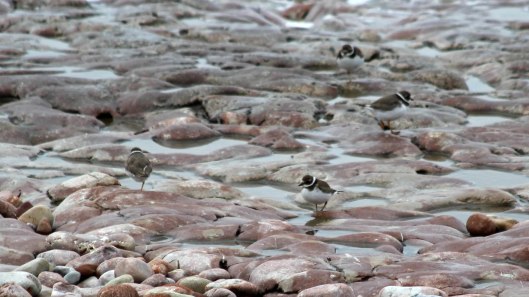
With my bins I followed it in and saw it plop down to join a small number of Ringed plovers by the water’s edge. To me, their dark eye masks make Ringed plovers look like bandits, though very tiny and very cute bandits to be sure.

180929 Sully birdlife (3)

One of the banditos only had one leg but it seemed to be managing to hop along okay. That made me think of Hop-along Cassidy but I was mixing up my masked men – the Lone Ranger was the one who wore the mask and, of course, he was no bandit.

180929 Sully birdlife (4)

At that point a dog and its owner came tootling along the beach, which put all the birds up … and I realised there were, in fact, two Dunlins (the two lower birds in the centre of this photo).

180929 Sully birdlife (5)

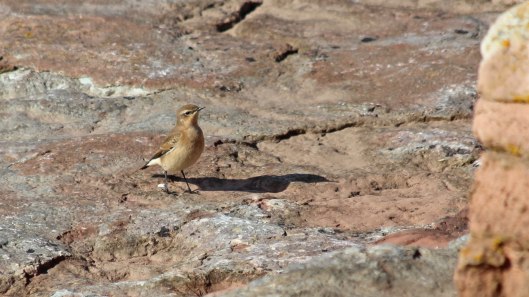
I took this opportunity to walk further along the beach and found myself a spot on the stone wall edging a slipway, a location where my birding friend Ceri said he’d seen a large number of waders the previous day. I hadn’t been sitting there long when a Wheatear flew right over my head and on to a boulder about 10 metres in front of me. I’m not sure who got the biggest surprise!

180929 Sully birdlife (6)

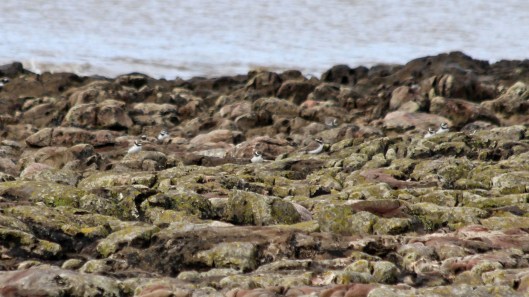
A large group of waders flew across from Sully Island and landed on rocks near the water. They were a bit far away to see clearly but most seemed to be Ringed plovers, a group of perhaps 30.

180929 Sully birdlife (7)

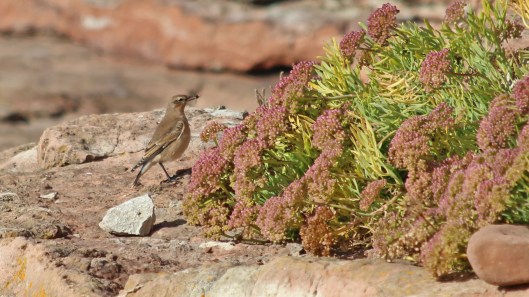
People walking along the coastal path above me scared my little Wheatear friend away but then I realised there were actually two birds flitting along the rocks and scrub.

180929 Sully birdlife (8)

They’re such lovely little birds and this one managed to catch itself a snack, which reminded me that it was almost lunchtime, time for me to be moving along on my walk. More tomorrow …

180929 Sully birdlife (9)

Like Loading...

Blooming autumn

28 Friday Sep 2018

Posted by sconzani in autumn, flowers, nature, wildflowers

≈ Leave a comment

Tags

British flora, British wildflowers, Cosmeston, Cosmeston Lakes Country Park, wildflowers

Last week we had our first two named autumn storms, this week we’ve had glorious clear days but rather chilly overnight temperatures, so I think it’s fair to say autumn has well and truly arrived. Amazingly, though, wildflowers are still blooming in large numbers. Here are the species I’ve found during my walks around Cosmeston Lakes Country Park this week.

180928 Cosmeston flowers (1)
180928 Cosmeston flowers (2)
180928 Cosmeston flowers (3)
180928 Cosmeston flowers (4)
180928 Cosmeston flowers (5)
180928 Cosmeston flowers (6)
180928 Cosmeston flowers (7)
180928 Cosmeston flowers (8)
180928 Cosmeston flowers (9)
180928 Cosmeston flowers (10)
180928 Cosmeston flowers (11)
180928 Cosmeston flowers (12)
180928 Cosmeston flowers (13)
180928 Cosmeston flowers (14)
180928 Cosmeston flowers (15)
180928 Cosmeston flowers (16)
180928 Cosmeston flowers (17)
180928 Cosmeston flowers (18)
180928 Cosmeston flowers (19)
180928 Cosmeston flowers (20)
180928 Cosmeston flowers (21)
180928 Cosmeston flowers (22)
180928 Cosmeston flowers (23)
180928 Cosmeston flowers (24)
180928 Cosmeston flowers (27)
180928 Cosmeston flowers (26)
180928 Cosmeston flowers (25)


Like Loading...

Definitely a Dunlin

27 Thursday Sep 2018

Posted by sconzani in birds, nature

≈ Leave a comment

Tags

birding, birdwatching, British birds, bundie, Calidris alpina, Dunlin, Kenfig National Nature Reserve, peewee, pickerel, sandmouse, sea lark, Sker Rocks

Here’s another beautiful wader from my recent bird club walk at Kenfig National Nature Reserve.

180927 dunlin (1)

The Dunlin (Calidris alpina) is probably the British wader most people have seen – even if they didn’t realise what it was. With 9,600 breeding pairs and 350,000 Dunlin over-wintering in Britain, it’s certainly the most common.

180927 dunlin (2)
180927 dunlin (3)

And because it’s so common, it’s been given a huge number of common names by the folks that live in different parts of these isles. Some of my favourites are: sand mouse (Westmorland), peewee (Northamptonshire), pickerel (Scotland), bundie (Orkney), and sea lark, from several different locations.

180927 dunlin (4)

Like Loading...

Wild word: Dew

26 Wednesday Sep 2018

Posted by sconzani in autumn, nature, weather

≈ 2 Comments

Tags

#WildWords, dew, dew on dandelion seedhead, dew on grass, wild words

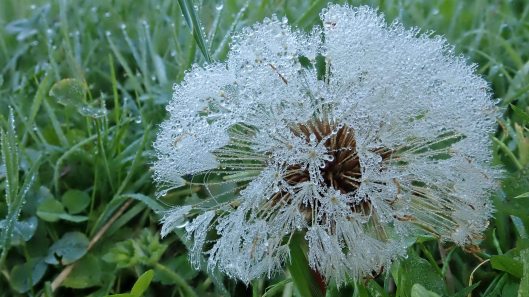
Dew: Noun; tiny drops of water that form on cool surfaces at night, when atmospheric vapour condenses (Oxford Dictionary).

OLYMPUS DIGITAL CAMERA

Like Loading...

It’s a brittlestem

25 Tuesday Sep 2018

Posted by sconzani in fungi, nature

≈ 2 Comments

Tags

British fungi, brittlestem fungi, Conical brittlestem, fungus, Parasola conopilus, Psathyrella conopilus

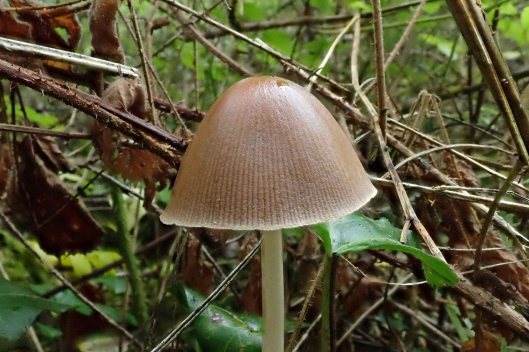
After misidentifying my fungi last week, I’m going to take a huge chance and say that I’m fairly confident these are Conical brittlestems (Parasola conopilus, formerly known as Psathyrella conopilus). I completely understand if you don’t believe me!

180925 Conical brittlestem (2)

180925 Conical brittlestem (3)
180925 Conical brittlestem (1)
Like Loading...

Mini-beasties at Llandegfedd

24 Monday Sep 2018

Posted by sconzani in insects, ladybird, nature

≈ 4 Comments

Tags

bonking beetles, British insects, Llandegfedd Reservoir, minibeasts, Orange ladybird

While my fellow birders were standing in a particularly windy spot to scope the distant shoreline at Llandegfedd Reservoir last Wednesday, I moved along the trail a little to seek shelter behind some trees. And, as I always do, I had a little look at the leaves to see what small creatures were about.

180924 Llandegfedd minibeasties (1)

180924 Llandegfedd minibeasties (2)
180924 Llandegfedd minibeasties (3)

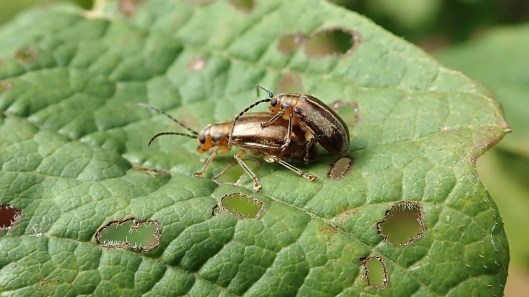
First up were these two bonking beetles who decided to come over and say hello despite being rather busy at increasing their species. After a couple of photos, I returned them to a new leaf and wished them well.

180924 Llandegfedd minibeasties (6)

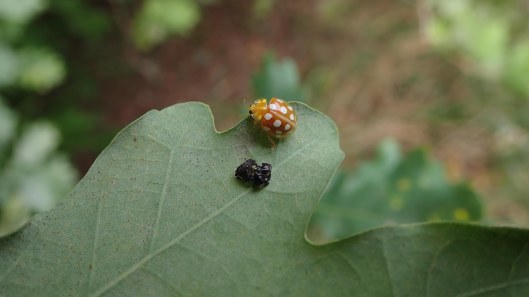
Then it was a warm welcome to the world to this newly emerged Orange ladybird – that little pile of dark matter is what remains of its pupa.

180924 Llandegfedd minibeasties (4)
180924 Llandegfedd minibeasties (5)

And I’m not sure what this mini-beastie is but I love its pale green body, the hint of turquoise in its wings and those incredible feathery feelers out front.

Like Loading...

Glorious Golden plovers

23 Sunday Sep 2018

Posted by sconzani in autumn, birds, nature

≈ 5 Comments

Tags

birding, birds as lost souls, birdwatching, British birds, cry of the Golden plover, evocative bird cries, Golden plover, Pluvialis apricaria, Sker Rocks

As well as the Sanderlings I blogged about yesterday, the other stand-out birds from last Saturday’s birding walk were these Golden plovers (Pluvialis apricaria) though, in stark contrast to the Sanderlings, they did not move, at all, not one inch, in the 15 minutes or so I was watching them. And, as you can see in my second photo, they were keeping a close eye on me so I couldn’t move around much either in case that scared them off.

180923 golden plover (2)

As a result my photos are all very similar and, just to be clear, I have had to lighten these images a lot so you can see the plumage details (it was mostly a very dull day). Still, I hope you can tell how magnificent the plumage of these birds is. These yellow and black markings are their summer colours, which change in winter to a more stark combination of white and beige.

180923 golden plover (1)

These birds are British residents, breeding in the high moorland areas of Scotland, northern England and Wales, and then, in the autumn, moving to lowland areas, to fields and sometimes coastal sites, where they can often be seen feeding and flying in large flocks during the winter months.

180923 golden plover (3)

I didn’t hear so much as a peep out of the Golden plovers I saw at Sker but I really want to hear their call now that I’ve read this in my copy of Stefan Buczacki’s Fauna Britannica:

The Cheshire name ‘sheep’s guide’ arises from the belief that it gives warning to sheep of impending danger by its plaintive call. In Aberdeenshire, its cry is said to be giving friendly advice to the ploughman: ‘Plough weel, shave weel, harrow weel.’ In other areas, such as North Wales, it is the Golden Plover rather than the Lapwing, Curlew or other waders that has been linked with the legend of the Seven Whistlers (seven birds, flying together by night, whose cries forebode disaster). In common with other birds with plaintive calls, Golden Plovers have also sometimes been regarded as lost souls.

Like Loading...

Scurrying Sanderlings

22 Saturday Sep 2018

Posted by sconzani in autumn, birds, nature

≈ 8 Comments

Tags

autumn migration, bird migration, birding, birdwatching, British birds, Calidris alba, migrating birds, Sanderling, Sker Rocks

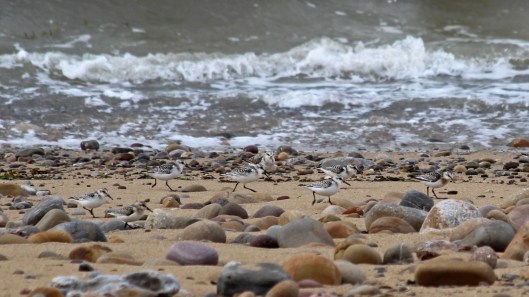
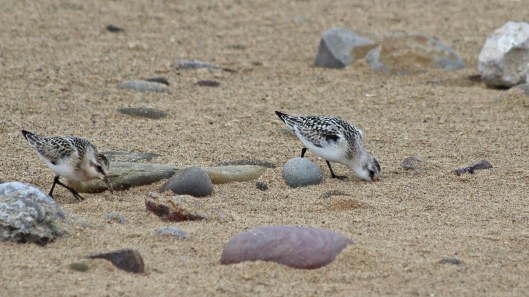
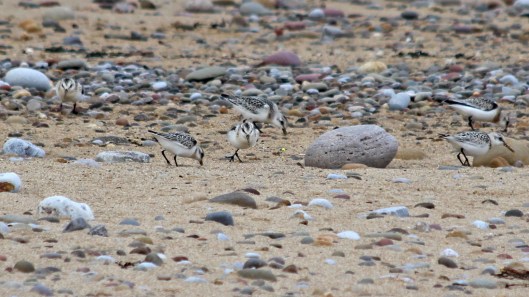
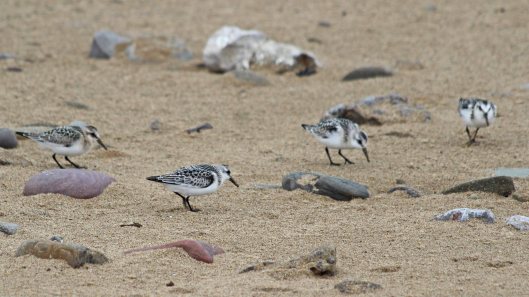
Watching these busy little birds scurrying back and forth along the beach at Sker last Saturday was the highlight of my day.

180922 sanderlings (1)

I had walked away a little from the group of birders I was with as I wanted to try to get better photographs of the waders moving along the water’s edge, and I’m so glad I did, as the birds weren’t as bothered about one person standing very still and silent as they would’ve been about 25 chattering people moving about, and so came up reasonably close to me.

180922 sanderlings (2)

Small flocks of Sanderlings (Calidris alba), and other small waders, were flying back and forth from the rocks to the sandy beach to feed, poking their heads right up to their eyes in the soft sand to probe for their preferred food of small crustaceans and molluscs.

180922 sanderlings (3)180922 sanderlings (3a)

According to the Merriam Webster dictionary, the name Sanderling is a combination of the fairly obvious ‘sand’ and ‘erling’, which probably comes from the Old English yrthling, meaning ploughman (from yrth earth and erian to plough). That certainly makes sense when you see these little birds in action.

180922 sanderlings (4)

Sanderlings are passage migrants that move through Britain in spring and autumn on their way to and from their breeding grounds in the High Arctic and their over-wintering sites in southern Europe and Africa.

180922 sanderlings (5)

The birds’ plumage changes for the breeding season, becoming much darker, with shades of reddish-brown on the head, neck and back, and you can still see hints of that on some of the birds in my photos. Also, many of my birds seem to be juveniles, with quite chequered markings on their backs and very clean white under-parts.

180922 sanderlings (6)

One fascinating factoid I discovered when reading up about these birds is that they have only three toes on each foot, with no hind toe to provide balance, and this is the reason for their scurrying motion. If you want to see Sanderlings in action, I uploaded a very short video to youtube.

180922 sanderlings (7)

Like Loading...

Rosy russulas

21 Friday Sep 2018

Posted by sconzani in autumn, fungi, nature

≈ 2 Comments

Tags

#FungiFriday, British fungi, fungus, Red russula, Russula

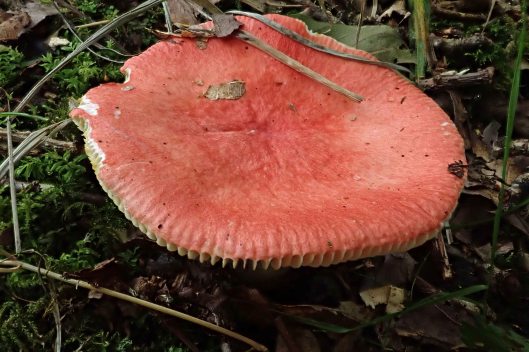
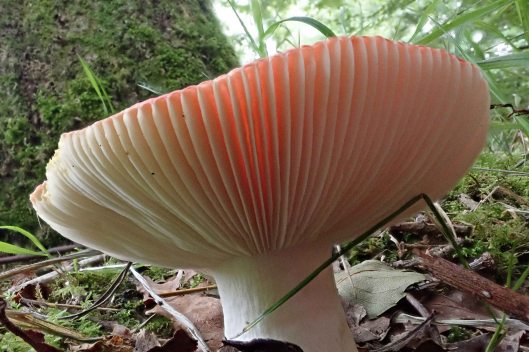
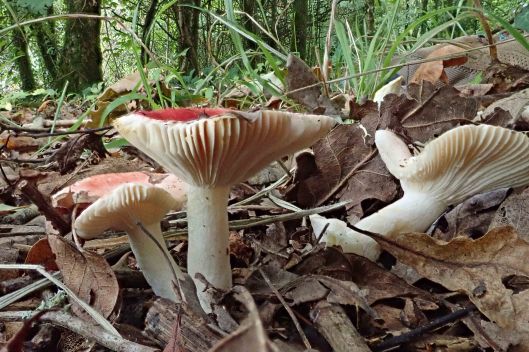
It’s Fungi Friday and today I have for your pleasure and delight one of the Russula species of fungi. According to the First Nature website of fungi expert Pat O’Reilly, around 160 species of Russula can be found in Britain, and I know from venturing out on past forays with the Glamorgan Fungus Group that the reddish-coloured ones can be especially difficult to identify so I’m not even going to try to put a name to these particular fungi. I just think they’re rather lovely and I hope they brighten your day as much as they did mine.

180921 Russula fungi (5)180921 Russula fungi (6)

180921 Russula fungi (3)
180921 Russula fungi (4)

180921 Russula fungi (1)180921 Russula fungi (2)

Like Loading...
← Older posts

About me

sconzani

sconzani

I'm a writer and photographer; researcher and blogger; birder and nature lover; countryside rambler and city strider; volunteer and biodiversity recorder.

View Full Profile →

Follow earthstar on WordPress.com

Enter your email address to follow this blog and receive notifications of new posts by email.

Recent blog posts

  • Chiffchaffs chiffchaffing April 4, 2026
  • Bearded tit!!! April 3, 2026
  • A Portland Bill Kestrel April 2, 2026
  • A proliferation of Peacocks April 1, 2026
  • Little owl March 31, 2026

From the archives

COPYRIGHT

Unless otherwise acknowledged, the text and photographs on this blog are my own and are subject to international copyright. Nothing may be downloaded or copied without my permission.

Fellow Earth Stars!

  • Unknown's avatar
  • Unknown's avatar
  • Unknown's avatar
  • Unknown's avatar
  • Unknown's avatar
  • Unknown's avatar
  • Unknown's avatar
  • Unknown's avatar
  • Unknown's avatar
  • Unknown's avatar
  • Unknown's avatar
  • Unknown's avatar
  • Unknown's avatar
  • Unknown's avatar
  • Unknown's avatar
  • Unknown's avatar
  • Unknown's avatar
  • Unknown's avatar
  • Unknown's avatar
  • Unknown's avatar
  • Unknown's avatar
  • Unknown's avatar
  • Unknown's avatar
  • Unknown's avatar
  • Unknown's avatar
  • Unknown's avatar
  • Unknown's avatar
  • Unknown's avatar
  • Unknown's avatar
  • Unknown's avatar
  • Unknown's avatar
  • Unknown's avatar
  • Unknown's avatar
  • Unknown's avatar
  • Unknown's avatar
  • Unknown's avatar
  • Unknown's avatar
  • Unknown's avatar
  • Unknown's avatar
  • Unknown's avatar
  • Unknown's avatar
  • Unknown's avatar
  • Unknown's avatar
  • Unknown's avatar
  • Unknown's avatar
  • Unknown's avatar
  • Unknown's avatar
  • Unknown's avatar
  • Unknown's avatar
  • Unknown's avatar

Blog at WordPress.com.

Privacy & Cookies: This site uses cookies. By continuing to use this website, you agree to their use.
To find out more, including how to control cookies, see here: Cookie Policy
  • Subscribe Subscribed
    • earthstar
    • Join 642 other subscribers
    • Already have a WordPress.com account? Log in now.
    • earthstar
    • Subscribe Subscribed
    • Sign up
    • Log in
    • Report this content
    • View site in Reader
    • Manage subscriptions
    • Collapse this bar
 

Loading Comments...
 

You must be logged in to post a comment.

    %d