I was checking out the lichens and mosses on this tree trunk when part of the grey bark moved. This tiny spider, which I think is a Zebra spider (Salticus scenicus), was so well camouflaged that I hadn’t even noticed it.


24 Wednesday Feb 2021
I was checking out the lichens and mosses on this tree trunk when part of the grey bark moved. This tiny spider, which I think is a Zebra spider (Salticus scenicus), was so well camouflaged that I hadn’t even noticed it.
23 Tuesday Feb 2021
Tags
British leaf mines, Holly, Holly leaf-miner, Ilex aquifolium, leaf mines, leaf-mining fly larvae, Phytomyza ilicis
The tale of the Holly leaf miner (Phytomyza ilicis) is a tangled one. Way back in December 2016, I blogged about the leaf-mining life of this tiny fly’s larvae. Then, early in 2020, doubt was cast on the true identity of this leaf miner, when two scientists published a paper, stating that, through genital examination of one particular Phytomyza ilicis specimen, they had determined there were in fact two very similar species to be found in Britain. Of course, this called into question the true identification of all prior records, and no subsequent records could be confirmed without genital examination of specimens.


At that stage, I stopped recording leaf mines on Holly. But now I can start again because the work of those earlier scientists has recently been disproved. The organiser of the Agromyzidae Recording Scheme (the family to which Phytomyza ilicis belongs) re-examined the questionable specimen and found the genitals had actually been damaged, which had led to them being wrongly identified.


So, until that ‘other’ Holly leaf miner (Phytomyza jucunda) makes its way from Europe to Britain and so long as the mines look similar to the various ones I’ve included here, it is safe to record the Holly leaf mines we see as Phytomyza ilicis.


You can access the splendid new website of the Agromyzidae Recording Scheme here, and read more about the story of the Holly leaf miner in a recent newsletter here.
22 Monday Feb 2021
Posted in birds
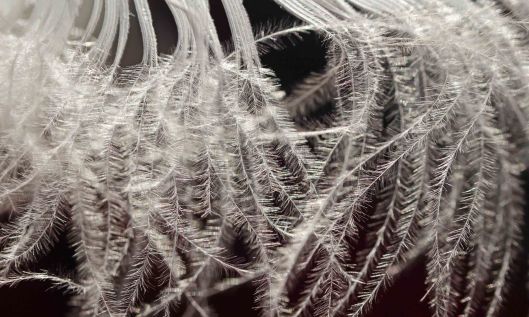
Where the Mute swans do their grooming and preening, there is always a profusion of white feathers, large and small, stiff and downy. I grabbed this one because I liked the way it showed the constituent parts of the feather.

Rather than repeat what others have so ably published, I thought I’d just post the pretty pictures here and, if you want to learn more, you can check out this particularly good post (with excellent illustrated drawings to aid their explanations) on The Cornell Lab website.
21 Sunday Feb 2021
Posted in flowers, spring, wildflowers
Tags
British wildflowers, naturalised wildflowers, non-native British wildflowers, Snowdrops, spring flowers
I thought the Snowdrop was a native British wildflower but it seems not.

This is from the publication Wonderland (by Brett Westwood and Stephen Moss):
Though they were once considered native, botanists now believe they were brought here from continental Europe to adorn Elizabethan gardens.
The first definite record in the wild dates from the 1770s, when they were discovered in Gloucestershire and Worcestershire. If these showy flowers were truly native before then, it is hard to imagine them being overlooked.


I’m now seeing plenty of Snowdrops when I’m out and about on my exercise walks, though I’m not sure whether they’re naturalised non-natives or have been planted along the roadsides by green-fingered locals. There are several different varieties of Snowdrop, and I’ve also seen quite a lot of double-flowered varieties amongst the more common types. The doubles (pictured on the right above) are probably Galanthus nivalis Flore Pleno, according to the identification crib sheet on the BSBI website, which, if you’re interested, also gives clear details of how to ID the single-flowered varieties.

20 Saturday Feb 2021
Posted in birds
Now that the cold-weather ‘Beast from the East’, a freezing Arctic blast, has passed and been replaced with much milder temperatures, the birds have decided it’s spring.

This week I’ve heard Song thrushes and Blackbirds belting out their tunes from the treetops, Dunnocks singing from the bushes, male Greenfinches wheezing a welcome to prospective mates, and Skylarks songflighting above the local farm fields, which is all wonderful, but it also means the thrushes that have been over-wintering in Britain will be heading back to their breeding grounds.

These Fieldfares are probably the last I’ll see, until the winter thrushes return again later in the year. They may already have started their long flight back east, to the Scandinavian peninsula, Finland or northwest Russia, according to the BTO website.
19 Friday Feb 2021
Posted in fungi
I can never go past Turkey tail fungi (Trametes versicolor) without checking out their wonderful rings of colour.

These are neither as vibrant nor as varied as some I’ve seen but there is a hint of blue in one of those outer bands that doesn’t really show up well in my photos, as the light was very dull this day. I figured they were still worth sharing for Fungi Friday.

18 Thursday Feb 2021
Posted in insects, plants, wildflowers
Tags
Chromatomyia primulae, leaf mine on Primrose, leaf mines, leaf-mining fly, leaf-mining fly larvae, leaf-mining larvae, leafminers, primrose
I was feeling a little miffed that my walk plans have been stymied by a slippery sided stream that I didn’t fancy trying to jump and was retracing my steps when I spotted this flowering Primrose (Primula vulgaris) – and it made my day, partly because I love these buttery yellow flowers, but also because of the mines on its leaves, a new species for me.
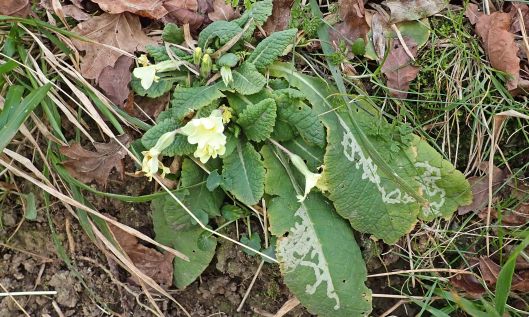
These are the mines of a tiny fly, Chromatomyia primulae, whose larvae also mine the leaves of Cowslip (Primula veris). I couldn’t see any larvae in the mines, which concurs with the information on the British Leafminers website that says the larvae are active in January, and then again from June to November. If I’d known, I could’ve looked for any pupae, which apparently lodge themselves in the mine next to a leaf vein. I might have to go back for a closer look.


Very few of these mines have been recorded in south Wales – only 1 record in each of the 1km-squares around me – though that is probably because they are under-recorded. And that may be the same in other parts of Britain, so do please record any you see. You can read more about these leaf miners on the British Leafminers site referenced above and on the UK Fly mines website here.
17 Wednesday Feb 2021
Posted in birds
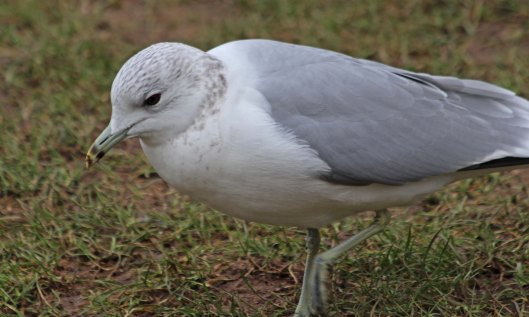
I was standing at a regular feeding spot on the edge of one of the lakes at Cosmeston Lakes Country Park, checking the gulls that were floating on the choppy waters, watching them watching me. Amongst the many Black-headed gulls, there was one Common gull, a species which, despite its name, is not so common in my local area.

There was a bitter easterly blasting across the lake and I knew the birds were hungry, hoping for a handout. So, I obliged, sprinkled the contents of the seed container I had brought with me on to the grassy bank.

The reaction was instant, a screeching of throats, wings flapping, an excited flurry of hungry gulls heading for the bank, knowing they had to be quick, to beat their fellows, to gain even one seed.

As I’d hoped, the Common gull came with them, and its slightly larger size meant it had an advantage, used its bulk to muscle in and claim more than its share of seed. And, of course, that meant I was also able to get some reasonably close photos of it. A win for the gulls, and a win for me.
16 Tuesday Feb 2021
My first sighting of Blackthorn blossom for 2021 has happened a bit later than last year – is that because the flowers are later or my lack of attention? I can’t tell but whichever, it’s another sign that spring is on its way!

15 Monday Feb 2021
Posted in birds
Pheasant feathers – these long tail feathers, in particular – have long been prized as adornments to fashionable hats, and such feathers are still available in large quantities today, due to the huge numbers of pheasants that are bred and released throughout Britain for the sport of the shooting fraternity. Though there are no pheasant-breeding farms in my local area, these birds can frequently be heard, if not always seen, as soon as I step outside our urban streets.


 earthstar
You must be logged in to post a comment.