• ABOUT
  • BIRDING 2018
  • Birding 2019
  • BLOG POSTS
  • Butterflies 2018
  • Resources

earthstar

~ a celebration of nature

earthstar

Monthly Archives: May 2023

The chasers

31 Wednesday May 2023

Posted by sconzani in insects

≈ 2 Comments

Tags

British dragonflies, Broad-bodied Chaser, chaser dragonflies, dragonfly, Four-spotted Chaser, Libellula depressa, Libellula dragonflies, Libellula quadrimaculata

There are three common or locally common species of chaser dragonflies, the Libellula, in Britain – so far, I’ve only seen two of them, the two shown here, the Four-spotted chaser (Libellula quadrimaculata) and the Broad-bodied chaser (Libellula depressa). I’ve just been checking the Welsh biodiversity database and found that the third species, the Scarce chaser (Libellula fulva), can be found at a couple of local sites, so I need to make finding that species a priority. Meantime, these other two chasers are active now around ponds and small lakes so do try and spot yourself a dragon or two if you’re out walking in your local countryside.

230531 4-spotted chaser

Four-spotted chaser

230531 Broad-bodied chaser

Broad-bodied chaser (male)

Like Loading...

The illegals

30 Tuesday May 2023

Posted by sconzani in insects

≈ Leave a comment

Tags

British butterflies, butterfly, fritillary butterflies, Marsh fritillary

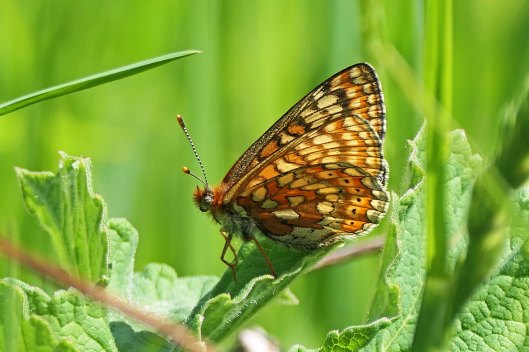
It’s happening again. Some idiot is fiddling with our local butterflies, illegally. This month, Marsh fritillaries have been spotted at Lavernock Nature Reserve, at Cosmeston Lakes Country Park, and along one of the reens (streams) at Rumney, on the eastern outskirts of Cardiff.

230530 marsh fritillary (3) fem

The sightings at Cosmeston and Rumney were of solitary butterflies and, though Cosmeston is not much more than a mile from Lavernock, Rumney is nowhere near any known site and Marsh fritillaries are not strong fliers so neither of these butterflies is likely to have arrived accidently. Also, though Cosmeston does have some areas of Devil’s-bit scabious, the butterfly’s larval food plant, Rumney has none. Hence my description of the person doing this as an idiot – the butterflies at Cosmeston and Rumney have no chance at all of establishing a colony.

230530 marsh fritillary (1)

The situation at Lavernock is a little different, as at least three Marsh fritillaries were found there last year (see An illegal introduction, May 2022). There is a slim possibility those butterflies bred and this year’s fritillaries are the result, but the experts I’ve been in contact with believe it is much more likely these 2023 butterflies are more illegal introductions.

230530 marsh fritillary (4) male

The British population of Marsh fritillaries has been in steady decline for many years so these gorgeous butterflies definitely need help but these random releases in unsuitable locations are not the answer. In south Wales, a large-scale, properly managed and licensed conservation project is already underway. If you’re interested in finding out more, check out the project page and the more recent news page on the Initiative for Nature Conservation Cymru (INCC) website.

230530 marsh fritillary (2)

Like Loading...

Figwort weevils and larva

29 Monday May 2023

Posted by sconzani in insects

≈ Leave a comment

Tags

British weevils, Cionus scrophulariae, Figwort weevil, Figwort weevil larva, weevil

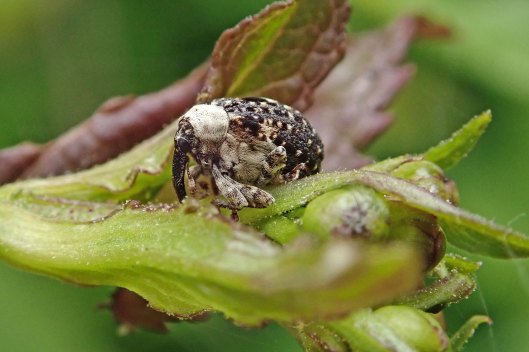
I love weevils! I’ve probably said that before; I’ll undoubtedly say it again. So, I was grinning like a Cheshire cat when I spotted these gorgeous mini-beasties.

230529 figwort weevil (1)

Perched on the tiny bundles of fruit of the plant they’re named for, these are Figwort weevils (Cionus scrophulariae). Their furry looking coats of beige and brown and light grey are pure decoration (imagine having a coat like that to wear!), and probably also good camouflage. And their impressive snouts are used for sucking the juices from their plant hosts (they can also be found on Mullein), though I don’t think these two weevils were feeding – I think they were egg-laying, as I noticed tiny blobs of yellow emerging from their rear ends, and I don’t think it was pooh.

230529 figwort weevil (2)

Amazingly, I managed to find a Figwort weevil larva, something I’ve never seen before. I’ve lightened this photo to show the detail a little more clearly but, as the UK Beetles website explains, they are actually dark brown, ‘almost black, and covered in a shiny and sticky secretion which makes them distasteful to predators and is thought to give some protection from parasites’. I actually find it quite difficult to comprehend that this slimy slug lookalike morphs into the complicated character that is the adult Figwort weevil.

230529 figwort weevil (3)

Like Loading...

R.I.P. the Bees

28 Sunday May 2023

Posted by sconzani in flowers, wildflowers

≈ Leave a comment

Tags

Bee orchid, British orchids, native orchids, orchid

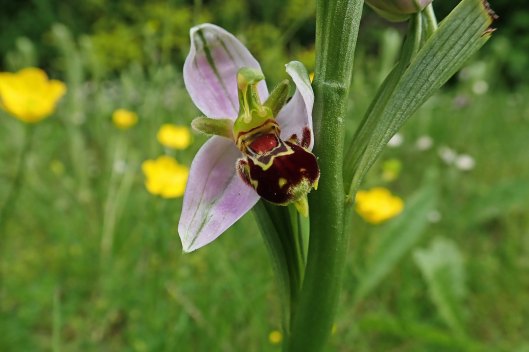
Overjoyed one day; saddened, depressed, and angry the next! That seems to be a recurring pattern for me, and probably for many of you who are passionate about our natural world. This week, the reason for my joy and pain was a beautiful colony of Bee orchids growing on a road verge in Cardiff.

230528 bee orchids (3)

I’d been watching the area for months, not sure what the grey-green rosettes of leaves would produce. They’d already had their tops cut once but were persisting and, on Wednesday’s walk, I was overjoyed to see that in little more than a week of warm, dry weather they’d sprouted flower stems and many were already open – they were Bee orchids, at least 30, probably more. I was so excited to see them – posted a rubbish phone photo on Twitter, better images later. Other people loved them too.

230528 bee orchids (1)

The very next morning they were obliterated by a contractor working for the land owner (in this case, the verge is privately owned, not council property). That same contractor has previously left areas of planted Daffodils, even after they’d finished flowering, so he recognised those planted bulbs but failed to recognise the Bee orchids. Such ignorance is part of the reason our planet is in trouble, I think – people don’t see the beauty of the natural world, nor do they have the knowledge to make informed decisions. In an ideal world, he would’ve recognised the Bees, phoned his manager, arranged a stay of execution until the orchids had had time to flower and seed.

230528 bee orchids (2)

A modicum of hope: the person who sent me the sad news about the Bees is endeavouring to find out who owns the land so we can try to prevent this happening in future.

Like Loading...

Interesting snippets about Swallows

27 Saturday May 2023

Posted by sconzani in birds

≈ Leave a comment

Tags

birding, birdwatching, British birds, Swallow

My Fauna Britannica tells me that:
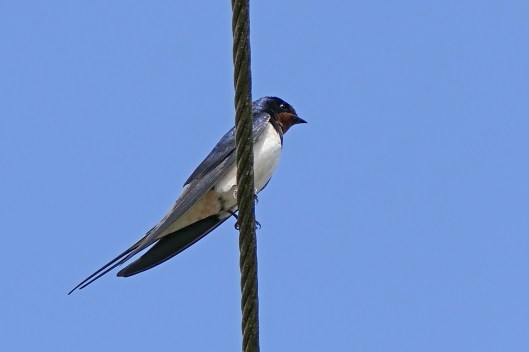
— Swallow ‘is an ancient name, traceable back to Middle English and possibly originating in an earlier term for a “cleft stick”, a reference to the forked tail.’
— ‘In the south of Scotland … many a gardener will not sow peas until the Swallow has arrived’
— if Swallows ‘fly high, fine weather is assured’, so says ‘many a country sage’
— ‘to destroy a Swallow’s nest or kill the bird has been widely thought to bring ill luck’ – and, these days, is also illegal.
I hope you have Swallows soaring in your skies above!

230526 swallow

Like Loading...

Dryad’s saddles

26 Friday May 2023

Posted by sconzani in fungi

≈ Leave a comment

Tags

bracket fungi, British fungi, Dryad's saddle, fungus, Polyporus squamosus

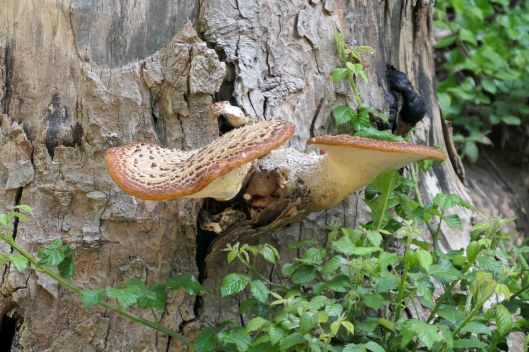
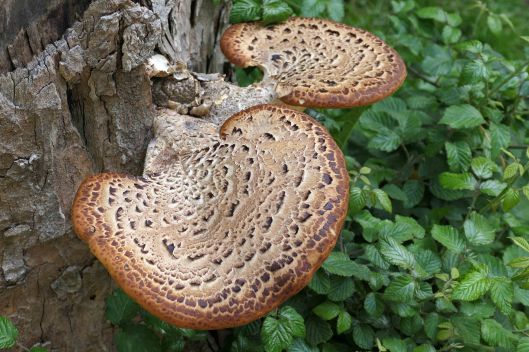
What a cracking pair these were, both at least 30 cms across, fresh, boldly marked, rigid, an imposing sight!

230527 dryads saddle (1)

These are Dryad’s saddles (Polyporus squamosus), named for their saddle-like shape that one might, with a liberal sprinkling of imagination, visualise being used by the tree nymphs for their travels through their forest domain.

230527 dryads saddle (2)

Like Loading...

You know it’s almost summer when …

25 Thursday May 2023

Posted by sconzani in insects, seasons

≈ Leave a comment

Tags

British beetles, Buttercup, Cuckooflower, signs of summer, Swollen-thighed beetle

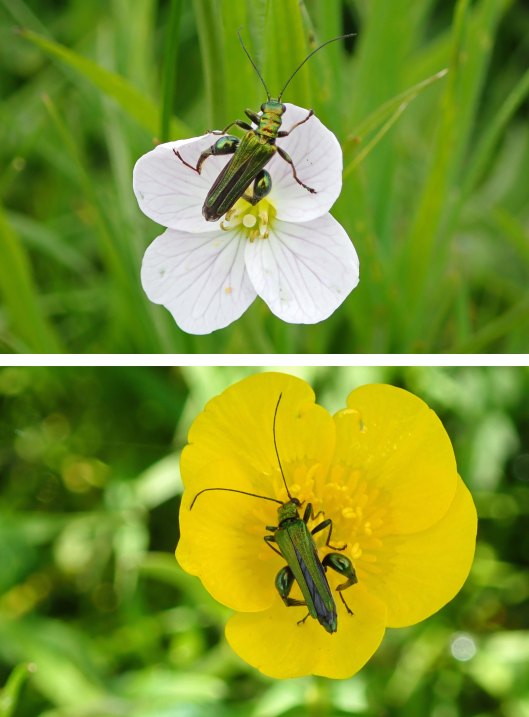
I’m sure you all have things that say ‘it’s almost summer’ to you – when you spot your first Swallow perched on an overhead wire or you hear your first screaming Swifts; when a particular flower blooms; when the morning light wakes you up earlier than your alarm; when you spot your first dragonfly of the year; when it’s warm enough to wear short sleeves. Well, one of the things that says summer to me is the appearance of these metallic-green mini-beasties, the Swollen-thighed beetles, in this case the males with the tell-tale swollen thighs, shown here on a cuckooflower and on a buttercup.

230525 swollen-thighed beetle

Like Loading...

Wild word: antenna

24 Wednesday May 2023

Posted by sconzani in insects

≈ Leave a comment

Tags

antenna, antennae, moth antennae, plumose moth antennae, Yellow belle

Antenna: noun, biology; An antenna (plural antennae) is a sensory organ, almost always one of two, that can be found on the head of an insect. Antennae are sensitive to touch, smell and, in some species, sound. Antennae are made up of several segments and different groups of insects have different forms of antennae (from the Amateur Entomologists’ Society website, which has excellent descriptions of the various types of antennae). The examples shown below are of plumose antennae, on the head of a Yellow belle moth. Having feather-like antennae like these increases the surface area available for the receptors a male moth uses to detect the pheromones of a female.

230524 antennae yellow belle

Like Loading...

Mr and Ms Orange-tip

23 Tuesday May 2023

Posted by sconzani in insects

≈ Leave a comment

Tags

British butterflies, butterfly, female Orange-tip, male Orange-tip, Orange-tip

It was early April when I saw my first male Orange-tip this year but, as usual with those early hatching males, it zipped past at the speed of flight, and it’s taken several weeks to get close enough to one that had paused, briefly, to refuel to get some half-way decent photos. And most males continue to zoom quickly past, searching – always searching for an available female to mate with.

230523 orange-tip (2)

The females are much more laid back – no need to spend their time and energy searching when the males will almost certainly find them. Instead, they feed and rest, and pose very nicely for any passing photographer who wants to appreciate their beauty.

230523 orange-tip (1)

Like Loading...

Leafmines: Eriocrania unimaculella

22 Monday May 2023

Posted by sconzani in insects, trees

≈ Leave a comment

Tags

British leafminers, British moths, Eriocrania unimaculella, leaf-mining moths, leafmine, leafmine on Birch, moth leafmines

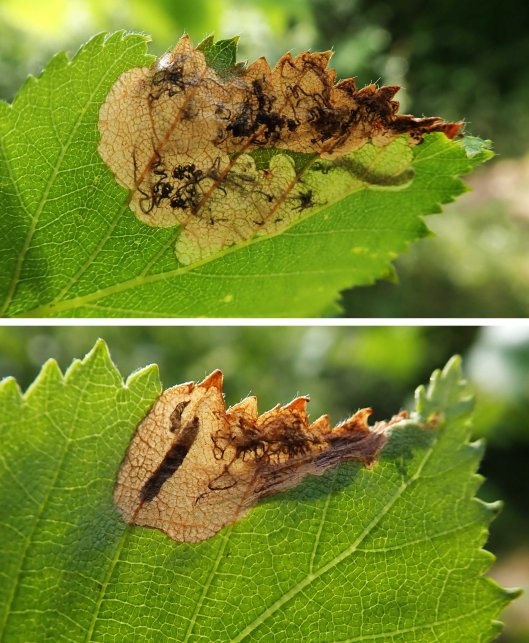
The moth formerly known as Heringocrania unimaculella, now known as Eriocrania unimaculella – either way a tongue twister! – spends its larval stage developing within the leaves of Birch trees. And it poohs … a lot … pooh that Rob Edmunds, expert from the British Leafminers website, describes as ‘long strands of spaghetti’. There are several Eriocrania species that can be difficult to identify but Rob produced an excellent well-illustrated guide explaining how to separate them in his March 2018 newsletter (click to access). The adult moth is a tiny golden critter, which you can see on the UK Moths website.

230522 eriocrania unimaculella on birch

Like Loading...
← Older posts

About me

sconzani

sconzani

I'm a writer and photographer; researcher and blogger; birder and nature lover; countryside rambler and city strider; volunteer and biodiversity recorder.

View Full Profile →

Follow earthstar on WordPress.com

Enter your email address to follow this blog and receive notifications of new posts by email.

Recent blog posts

  • A bumper day, part 2 May 8, 2026
  • A bumper day, part 1 May 7, 2026
  • NFY: Dingy skipper May 6, 2026
  • NFY: Small copper May 5, 2026
  • First dragon of 2026 May 4, 2026

From the archives

COPYRIGHT

Unless otherwise acknowledged, the text and photographs on this blog are my own and are subject to international copyright. Nothing may be downloaded or copied without my permission.

Fellow Earth Stars!

  • Unknown's avatar
  • Unknown's avatar
  • Unknown's avatar
  • Unknown's avatar
  • Unknown's avatar
  • Unknown's avatar
  • Unknown's avatar
  • Unknown's avatar
  • Unknown's avatar
  • Unknown's avatar
  • Unknown's avatar
  • Unknown's avatar
  • Unknown's avatar
  • Unknown's avatar
  • Unknown's avatar
  • Unknown's avatar
  • Unknown's avatar
  • Unknown's avatar
  • Unknown's avatar
  • Unknown's avatar
  • Unknown's avatar
  • Unknown's avatar
  • Unknown's avatar
  • Unknown's avatar
  • Unknown's avatar
  • Unknown's avatar
  • Unknown's avatar
  • Unknown's avatar
  • Unknown's avatar
  • Unknown's avatar
  • Unknown's avatar
  • Unknown's avatar
  • Unknown's avatar
  • Unknown's avatar
  • Unknown's avatar
  • Unknown's avatar
  • Unknown's avatar
  • Unknown's avatar
  • Unknown's avatar
  • Unknown's avatar
  • Unknown's avatar
  • Unknown's avatar
  • Unknown's avatar
  • Unknown's avatar
  • Unknown's avatar
  • Unknown's avatar
  • Unknown's avatar
  • Unknown's avatar
  • Unknown's avatar
  • Unknown's avatar

Blog at WordPress.com.

Privacy & Cookies: This site uses cookies. By continuing to use this website, you agree to their use.
To find out more, including how to control cookies, see here: Cookie Policy
  • Subscribe Subscribed
    • earthstar
    • Join 644 other subscribers
    • Already have a WordPress.com account? Log in now.
    • earthstar
    • Subscribe Subscribed
    • Sign up
    • Log in
    • Report this content
    • View site in Reader
    • Manage subscriptions
    • Collapse this bar

Loading Comments...

You must be logged in to post a comment.

    %d