• ABOUT
  • BIRDING 2018
  • Birding 2019
  • BLOG POSTS
  • Butterflies 2018
  • Resources

earthstar

~ a celebration of nature

earthstar

Author Archives: sconzani

C is for Chough

08 Monday Dec 2025

Posted by sconzani in birds

≈ Leave a comment

Tags

birding, birdwatching, British birds, British corvids, Chough, corvids

It was back in November 2019, at Rhossili, that I first saw Britain’s rarest corvid, the Chough, and I only managed to grab a few blurry record shots before the birds flew to a more distant location. So, you can perhaps imagine my delight when, this October, I had a totally unexpected and relatively close encounter of the Chough kind much closer to home (Choughed, 10 October). A definite highlight of my birding year!

Like Loading...

B is for bugs and beetles

07 Sunday Dec 2025

Posted by sconzani in insects

≈ 2 Comments

Tags

British beetles, British bugs, Juniper shieldbug, Kleidocerys resedae, new beetle finds, new bug finds

One of my wildlife aims this year has been to try to find as many new species, of all kinds, as possible, and I’ve been extremely lucky to have found many new-to-me bugs and beetles. These include Lesser thorn-tipped longhorn beetle, 4 January; My first Pine ladybird, 10 March; My first Eyed ladybird, 22 April; Fine streaked bugkins, 26 April; Cyllecoris histrionius, adult and nymph, 12 May; Cantharis decipiens, 13 May; Cacopsylla ambigua, 29 May; Rhopalus subrufus, 6 June; Rhabdomiris striatellus, 10 June; Bug: Deraeocoris flavilinea, 28 June; Beetle: Grammoptera ruficornis, 30 July; Beetle: Four-banded longhorn, 2 August; and Bug: Megacoelum infusum, 12 September.

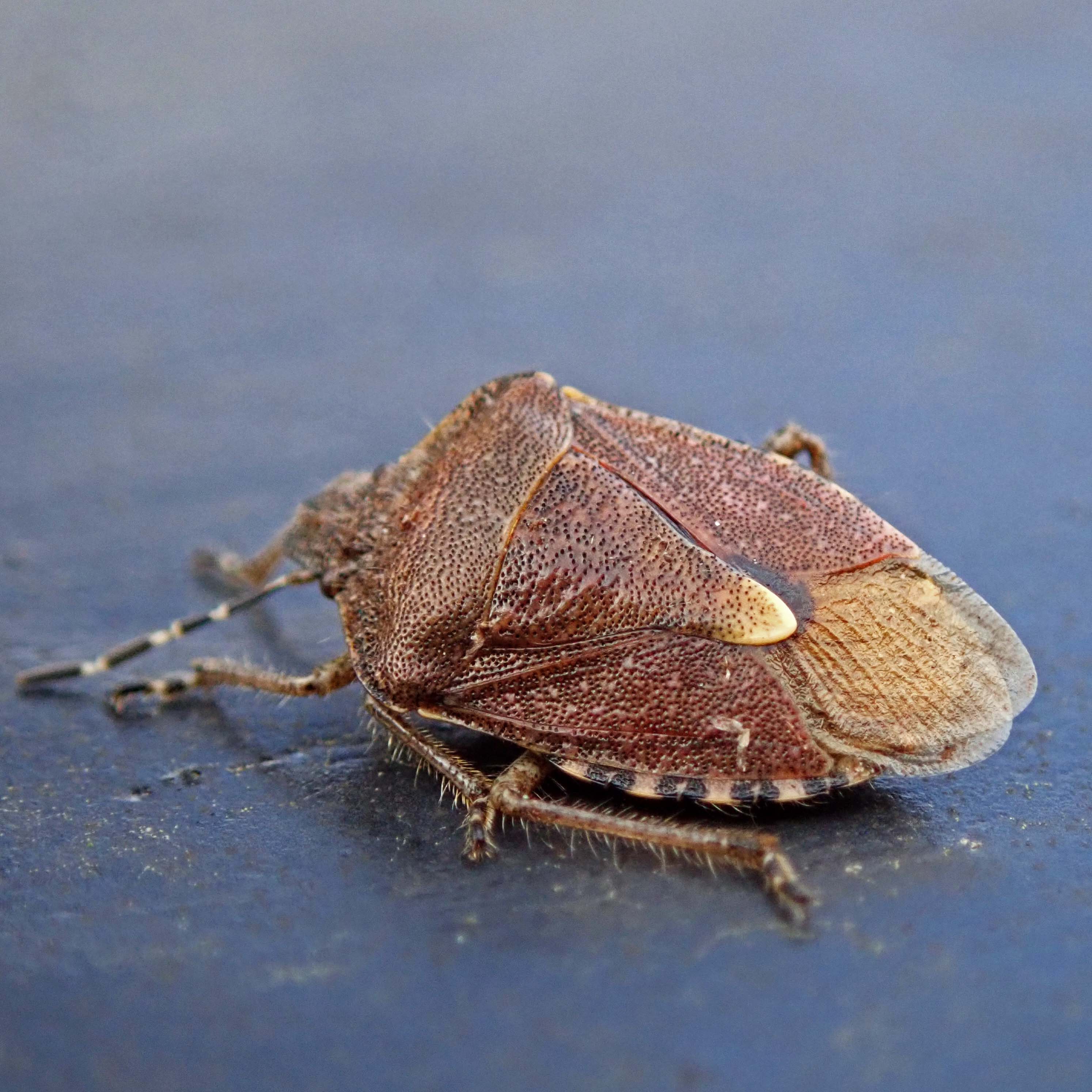
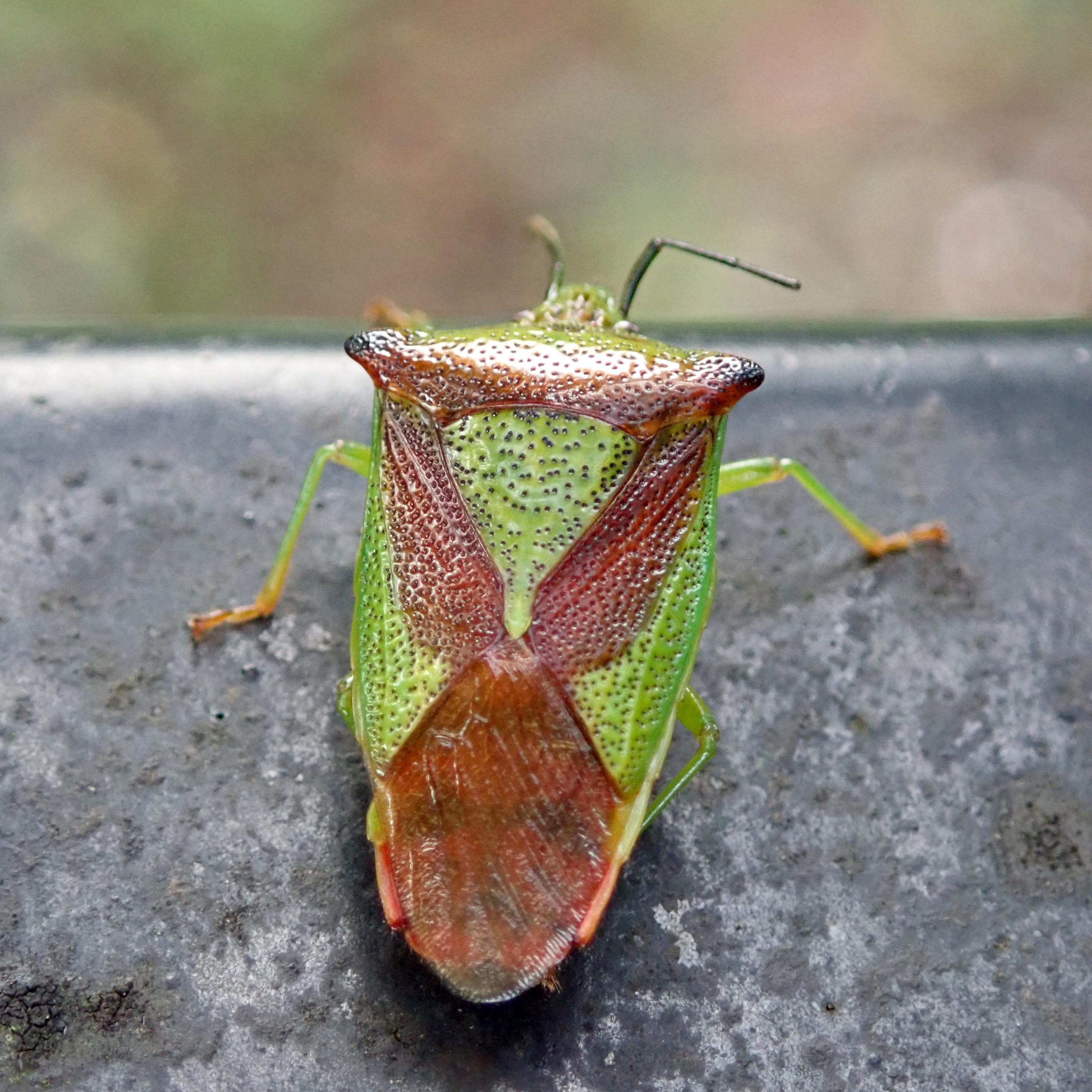
I was particularly chuffed to find my first Juniper shieldbugs (Juniper shieldbug, 3 June) and, now that I know to look for them on some other tree species, I’ve managed to find them on four separate occasions, three of those in the same location as my initial find, on a Cypress growing in a local park, and the other on a different Cypress species growing in one of Cardiff’s oldest cemeteries, alongside Llandaff Cathedral.

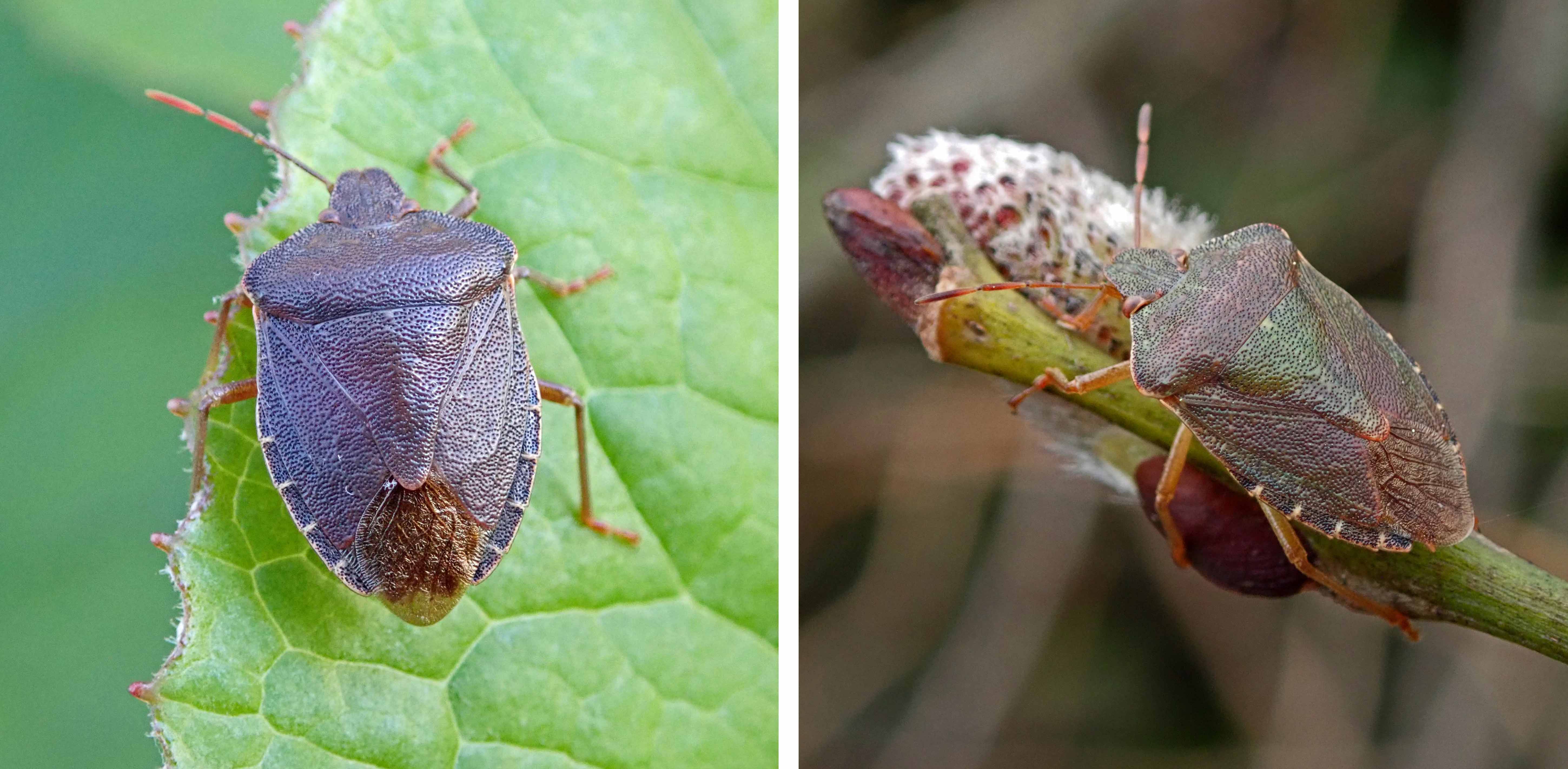
Another new bug that I think is particularly attractive is Bug: Kleidocerys resedae. I wrote about that on 27 June, and this is another species that I’ve managed to re-find, on 15 November, when I spotted three different adult bugs within a few metres of each other.

Like Loading...

A is for Arocatus roeselli

06 Saturday Dec 2025

Posted by sconzani in insects

≈ Leave a comment

Tags

Arocatus longiceps, Arocatus longiceps / roeselii, Arocatus roeselii, British bugs, bugs on Alder trees

Another year of wonderful flora and fauna sightings is drawing to a close and, as I’ve done for a few years now, I’m going to do an alphabetical countdown of some of my more memorable moments in Nature. I’m very proud to have added three more first-for-Wales sightings to my list in 2025, and this beautiful bug was one of them (as reported in Bug: Arocatus roeselii, 12 July).

Like Loading...

Tripe, but you wouldn’t want to eat it

05 Friday Dec 2025

Posted by sconzani in fungi

≈ 2 Comments

Tags

Auricularia mesenterica, British fungi, fungus, Tripe, Tripe fungus

In fact, you probably wouldn’t want to eat the other form of tripe, the stomach lining of cows, pigs and sheep, either, unless you were desperate, and definitely not if, like me, you’re a vegetarian.

I’ve only ever seen Tripe fungus (Auricularia mesenterica) in a couple of different places before today, so it was good to add a new site to my list.

There’s one particular location I know, where the fungus can be seen year round on the stump of a long dead Elm tree, in summer looking just like a grouping of dried, shrivelled brackets but, in winter, when they’ve rehydrated, plump and hairy like these ones I found today.

The various species of Elm are where Tripe grows most commonly and, though today’s new location was a large fallen tree trunk that could have been any species of tree, I had previously found Wrinkled peach growing on it, another Elm-specific fungus.

Like Loading...

A pair of Goldeneyes

04 Thursday Dec 2025

Posted by sconzani in birds

≈ 2 Comments

Tags

birding, birdwatching, British birds, Bucephala clangula, Cardiff Bay birding, diving ducks, female Goldeneye, Goldeneye, male Goldeneye

Local birders have this week been treated to the appearance of a pair of Goldeneyes (Bucephala clangula) in Cardiff Bay, though they have occasionally been elusive, disappearing from their favoured area in the bay behind the Ice Rink for long periods, then reappearing as if by magic. When present, they also dive very frequently, so it’s easy to blink and miss them.

The male is a particularly handsome duck. He looks black in his upper parts and white below, though his head is actually a very dark green, and he has white cheek patches. As is usually the case with ducks, the female is more plain, her body patterned in shades of grey, though the brown colouration of her head is a warm rich hue. Both sexes have the golden-coloured eye they are named for.

Like Loading...

Wordless on Wednesday

03 Wednesday Dec 2025

Posted by sconzani in trees

≈ 2 Comments

Tags

#WordlessOnWednesday, #WordlessWednesday

Like Loading...

Ever watchful

02 Tuesday Dec 2025

Posted by sconzani in birds

≈ 3 Comments

Tags

bird of prey, birding, birdwatching, British birds, Kestrel

Despite my being partially concealed by low trees and tall shrubs, moving as quietly as possible over the uneven ground, and pretending not to have noticed this stunning Kestrel (I always think it’s better not to meet their eyes when trying to be stealthy), I still didn’t manage to get close enough for a very good photograph. It was almost as if the bird was teasing me, leading me to think I could get closer, before it flew up and away to hover several times over the neighbouring field while searching for unfortunate small mammals.

Like Loading...

Aphid: Eriosoma lanigerum

01 Monday Dec 2025

Posted by sconzani in insects, plants, trees

≈ 2 Comments

Tags

American blight, aphid, aphids on Apple trees, aphids on Firethorn, aphids on Pyracantha, British aphids, Eriosoma lanigerum, galls on Firethorn, galls on Pyracantha, Woolly apple aphid

When I set out on my walk last Saturday, I wasn’t intentionally targeting aphids but up they popped. At this first location I wasn’t completely certain that what I saw was caused by aphids but, as soon as I poked one of the fuzzy white lumps on this Firethorn (Pyracantha species) and my finger came away stained red, I knew I’d just inadvertently squashed an aphid (this has happened to me before when I grabbed a willow branch without noticing the aphids perched on it).

After a little research when I got home, it quickly became apparent that these were Eriosoma lanigerum, also known as Woolly apple aphids and American blight. The sap-sucking feeding of Eriosoma lanigerum causes deformation and swellings on the branches, trunks and roots of their host plants, as you can see from the lumpy growths on the branches of this Firethorn bush.

The white ‘wooliness’ is a wax substance the aphids produce in specialised glands and excrete as filaments from various parts of their bodies. The Influential Points website, which is an excellent resource for information about aphids, summarises the various reasons scientists have reached for this wax secretion:

Smith suggests that the primary role of the secreted wax is to prevent the aphids becoming contaminated by their own honeydew … and that of other members of the colony…. Other secondary roles of wax may include individual microclimate isolation, protection from fungi, parasites and predators plus waterproofing and frost protection.

Though their primary plant hosts are Pyracantha and Cotoneaster species, as the Woolly apple aphid name suggests, their secondary host is Apple and, on the various species of Apple trees, they are considered a major pest, often having a severe economic impact on Apple crops. If you’re interested in reading more about this, the Influential Points website has a long list of various scientific research papers from around the globe on the subject of these aphids, their reproduction habits, their seasonal movements, their genetics and population dynamics, as well as ways to control their infestations.

Like Loading...

Autumn trees: Whitebeam

30 Sunday Nov 2025

Posted by sconzani in autumn, leaves, trees

≈ 2 Comments

Tags

autumn colour, autumn leaves, British trees, Sorbus aria, Whitebeam, Whitebeam bark, whitebeam berries, Whitebeam leaves

Whitebeam (Sorbus aria) is a tree I’ve overlooked until now, though I did take a few photos earlier in the year, of its smooth grey bark and its berries, before they ripened. (According to the Woodland Trust website, the berries ‘are known as chess apples in north-west England and are edible when nearly rotten’, which doesn’t make them sound very appetizing to me.)

Whitebeam’s leaves are quite distinctive: elliptical in shape with serrated edges, the upper sides a shiny dark green, the under sides light grey and hairy. In the autumn, they aren’t particularly spectacular, simply changing to yellow, orange, and brown as they lose their chlorophyll.

The Woodland Trust site has some interesting facts about this handsome tree:

Whitebeam timber is fine-grained, hard and white. Traditional uses included wood turning and fine joinery, including chairs, beams, cogs and wheels in machinery.

And

Whitebeam is native to southern England, though widely planted in the north of the UK. It is common in parks and gardens, but is quite rare in the wild.

And

The leaves are eaten by caterpillars of a number of moths, including Parornix scoticella, Phyllonorycter corylifoliella and Phyllonorycter sorbi.

All three of those moths have leaf-mining larvae, none of which I’ve yet seen, so I must keep an eye out next year.

Like Loading...

Recent Robins

29 Saturday Nov 2025

Posted by sconzani in birds

≈ Leave a comment

Tags

birding, birdwatching, British birds, Erithacus rubecula, robin, Robin Redbreast

Just because I adore these cheeky little characters …

Like Loading...
← Older posts
Newer posts →

About me

sconzani

sconzani

I'm a writer and photographer; researcher and blogger; birder and nature lover; countryside rambler and city strider; volunteer and biodiversity recorder.

View Full Profile →

Follow earthstar on WordPress.com

Enter your email address to follow this blog and receive notifications of new posts by email.

Recent blog posts

  • M is for mite December 18, 2025
  • L is for lepidopteran lifers December 17, 2025
  • K is for Keeled skimmers December 16, 2025
  • J is for Jersey tiger December 15, 2025
  • I is for Ichneumon December 14, 2025

From the archives

COPYRIGHT

Unless otherwise acknowledged, the text and photographs on this blog are my own and are subject to international copyright. Nothing may be downloaded or copied without my permission.

Fellow Earth Stars!

  • Unknown's avatar
  • Unknown's avatar
  • Unknown's avatar
  • Unknown's avatar
  • Unknown's avatar
  • Unknown's avatar
  • Unknown's avatar
  • Unknown's avatar
  • Unknown's avatar
  • Unknown's avatar
  • Unknown's avatar
  • Unknown's avatar
  • Unknown's avatar
  • Unknown's avatar
  • Unknown's avatar
  • Unknown's avatar
  • Unknown's avatar
  • Unknown's avatar
  • Unknown's avatar
  • Unknown's avatar
  • Unknown's avatar
  • Unknown's avatar
  • Unknown's avatar
  • Unknown's avatar
  • Unknown's avatar
  • Unknown's avatar
  • Unknown's avatar
  • Unknown's avatar
  • Unknown's avatar
  • Unknown's avatar
  • Unknown's avatar
  • Unknown's avatar
  • Unknown's avatar
  • Unknown's avatar
  • Unknown's avatar
  • Unknown's avatar
  • Unknown's avatar
  • Unknown's avatar
  • Unknown's avatar
  • Unknown's avatar
  • Unknown's avatar
  • Unknown's avatar
  • Unknown's avatar
  • Unknown's avatar
  • Unknown's avatar
  • Unknown's avatar
  • Unknown's avatar
  • Unknown's avatar
  • Unknown's avatar
  • Unknown's avatar

Blog at WordPress.com.

Privacy & Cookies: This site uses cookies. By continuing to use this website, you agree to their use.
To find out more, including how to control cookies, see here: Cookie Policy
  • Subscribe Subscribed
    • earthstar
    • Join 667 other subscribers
    • Already have a WordPress.com account? Log in now.
    • earthstar
    • Subscribe Subscribed
    • Sign up
    • Log in
    • Report this content
    • View site in Reader
    • Manage subscriptions
    • Collapse this bar
 

Loading Comments...
 

You must be logged in to post a comment.

    %d