• ABOUT
  • BIRDING 2018
  • Birding 2019
  • BLOG POSTS
  • Butterflies 2018
  • Resources

earthstar

~ a celebration of nature

earthstar

Author Archives: sconzani

Common periwinkles

17 Thursday Apr 2025

Posted by sconzani in coastal fauna, molluscs

≈ Leave a comment

Tags

British molluscs, Common periwinkle, Littorina littorea, periwinkles, shellfish

One benefit of this moving malarkey, which is limiting my time to get out for long walks, is that my shorter walks have taken me down to the local beach a few times and reminded me how much I enjoy fossicking along the tide line and how little I know about the flora and fauna of the seashore.
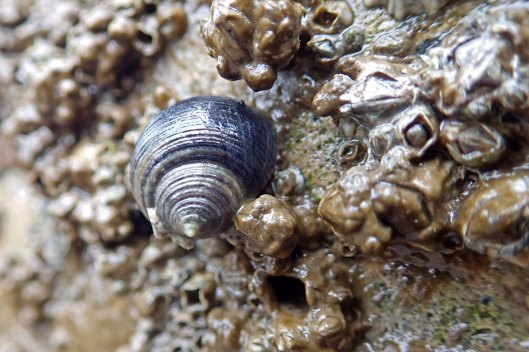
This week’s finds included these shellfish which, I think, are Common periwinkles (Littorina littorea). They are found all around the rocky coasts of Britain, though, locally, these periwinkles are growing on the concrete and steel supports of the pier.

The Marine Life Information Network website says these are

the largest British periwinkle, with the shell reaching a maximum height of 52 mm. The shell is sharply conical with a pointed apex and surface sculpturing. The spiral ridges which are marked in young animals tend to become obscured in older individuals, giving the shell a smooth appearance.

Like Loading...

Whack a snack!

16 Wednesday Apr 2025

Posted by sconzani in birds, insects

≈ Leave a comment

Tags

birding, birdwatching, blackbird, Blackbird eating moth, British birds, British moths, Herald moth, Scoliopteryx libatrix, The Herald

Wouldn’t you know it? This was my first ever Herald moth (Scoliopteryx libatrix) and it ended up being snatched, whacked, and snacked on by a Blackbird. I guess a bird’s gotta eat. (If you want to see what an intact Herald looks like, there are some cracking photos on the UK Moths website.)

Like Loading...

Small zooming Orange-tips

15 Tuesday Apr 2025

Posted by sconzani in insects, spring

≈ Leave a comment

Tags

British butterflies, butterfly, male Orange-tip, Orange-tip

As I write this, a weather warning has just come into force, potentially bringing thunder, lightning and heavy rain from midday today until midday tomorrow. These warnings don’t always produce the forecast downpours but I feel for all the newly emerged small creatures, especially the delicate butterflies like this little Orange-tip. Of all the small Orange-tip males I’ve recently seen zooming along the hedgerows and banks of wildflowers, desperately seeking females, this one finally paused long enough to refuel, which allowed me to quickly snap a few photos. I hope he, and all his butterfly cousins, manage to find sufficient shelter to survive any deluges.

Like Loading...

On the move

15 Tuesday Apr 2025

Posted by sconzani in birds, spring

≈ 2 Comments

Tags

birding, birdwatching, British birds, Common sandpiper, spring migration

I feel a little like this migrating Common sandpiper looks, ruffled, not at my best, discombobulated. If all goes to plan, I will be moving flats next week, and I’m up to my neck in cleaning, tidying, organising, packing, recycling, binning, repurposing, donating…. I’m sure you all know what it’s like. I just wanted to let you know that I’m trying to keep to my daily posting schedule (and those posts will appear below) but I may miss the odd day. Thanks to you all for following along with me here, and thanks, too, for your understanding.

Like Loading...

Leafmines: Elachista cinereopunctella

14 Monday Apr 2025

Posted by sconzani in insects

≈ Leave a comment

Tags

British leafmines, Elachista cinereopunctella, Glaucous sedge-miner, leafmines, leafmines on Glaucous sedge, leafmining moth larvae, leafmining moths

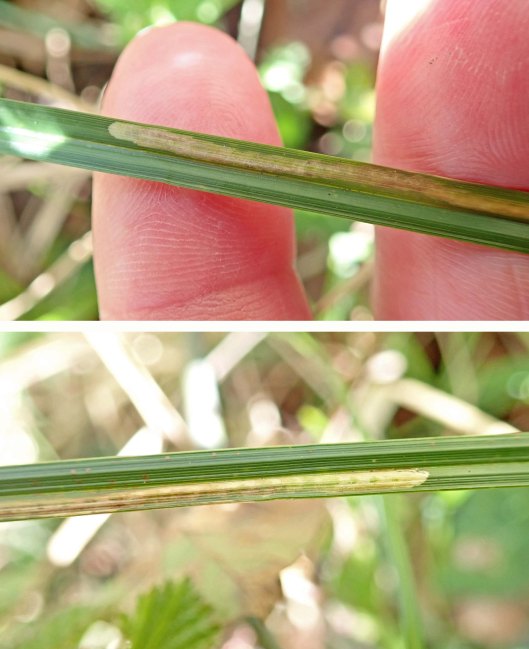
These two leafmines, in the leaves of Glaucous sedge (Carex flacca), may look quite boring and nondescript but scroll down to see what lies within.

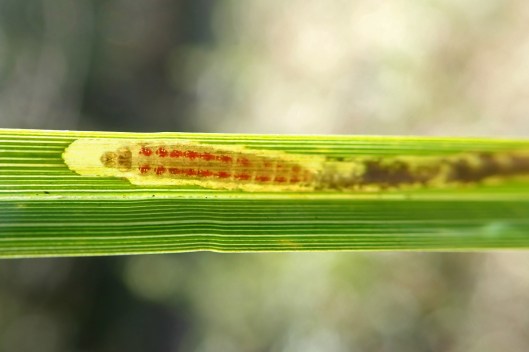
This is the stunning little larva of Elachista cinereopunctella, a moth that can be found throughout Britain but only in areas where its larval plants can be found (mainly Glaucous sedge, but some other sedges are also used). And the moth’s not actually that common in Wales, with just 13 records showing in the national biodiversity database. This may be because the adult moth is also rather nondescript (see a photo on the UK Moths website here) and few people look for and record the leaf-mining larval stage. I was lucky to be directed to the presence of these mines by my friendly local moth expert, George, though it still took some poking about the sedges in a local area of woodland to find them.

Like Loading...

Luscious leek for lunch

13 Sunday Apr 2025

Posted by sconzani in flowers, insects, spring, wildflowers

≈ 2 Comments

Tags

Allium triquetrum, Dark-edged bee-fly, Hairy-footed flower bee, insects on Three-cornered leek, solitary bee, Three-cornered garlic, Three-cornered leek

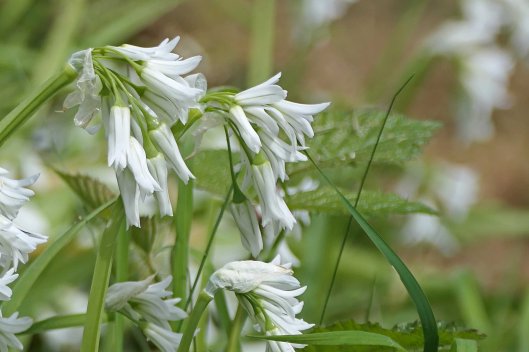
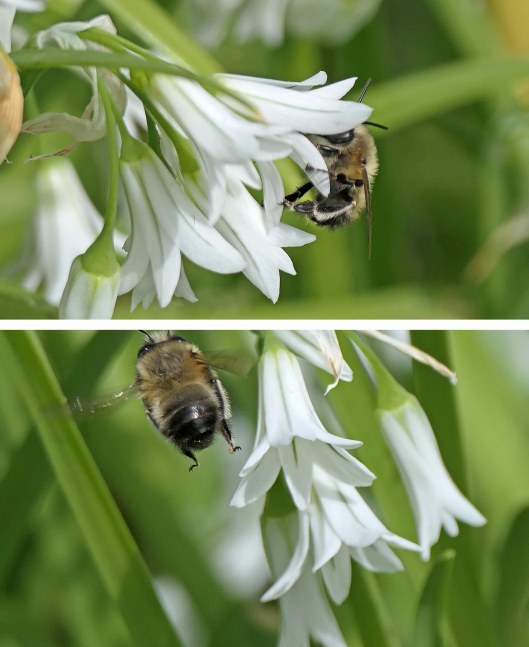
Today’s short local meander was rather smelly, firstly with swathes of Wild garlic (which will feature in an upcoming post) and also this lush area of Three-cornered leek (or Three-cornered garlic, Allium triquetrum), which was attracting lots of insects.

First up, a tiny solitary bee.

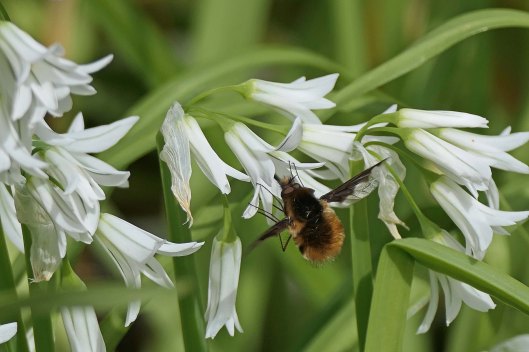
Then, several Dark-edged bee-flies came hovering in to view, long spiky legs dangling below and long tongues poking in to the flowers to feed.

And then this brute showed up, the first Hairy-footed flower bee I’ve managed to photograph this year, just.

Like Loading...

Greenland Wheatear

12 Saturday Apr 2025

Posted by sconzani in birds, spring

≈ Leave a comment

Tags

birding, birdwatching, British birds, Cardiff Bay birding, Greenland Wheatear, Oenanthe oenanthe leucorhoa, spring migration, Wheatear

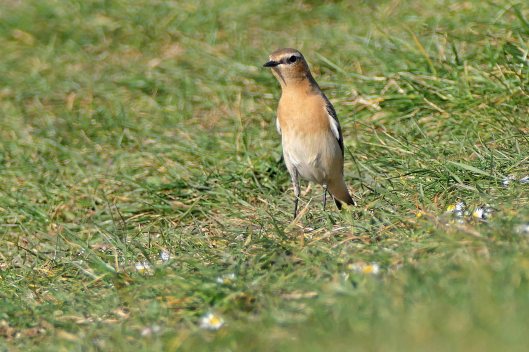
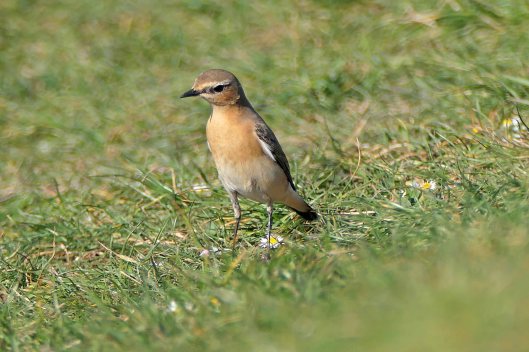
I struggle to distinguish between the ‘usual’ Wheatears we see passing through my area and the Greenland Wheatear, one of four subspecies that has the scientific name Oenanthe oenanthe leucorhoa and is usually seen only in the spring as it heads from its overwintering locations in African countries like Kenya to its breeding grounds in Greenland, Iceland and north-eastern Canada. So, when one of our more expert local birders announced the arrival of this Greenland Wheatear on Cardiff Bay Barrage, I went down for a look.

It was certainly a very handsome bird, and I’ve since tried to familiarise myself with some its key features. Given the requirement for its long-haul flight, it’s probably no surprise that Greenland Wheatears are longer winged than the subspecies that fly from Europe to Britain to breed. The Greenland’s relatively large size, longer legs and upright stance are also diagnostic.

They are often described as rotund and pot-bellied, which this bird didn’t really seem to be, but then it had just flown all the way from central Africa so probably needed to feed up to replenish its fat supplies. Fortunately, it wasn’t too bothered by the numerous people and dogs walking in the area, and did seem to be finding plenty of insects to snack on. I’m not sure I could yet confidently identify a Greenland Wheatear without expert help, but this was certainly a stunning bird to see and watch and photograph.

Like Loading...

What an effort!

11 Friday Apr 2025

Posted by sconzani in insects, spring

≈ Leave a comment

Tags

British butterflies, butterfly, butterfly eggs, butterfly eggs on nettle, Peacock, Peacock butterfly, Peacock butterfly eggs, Peacock butterfly laying eggs, Stinging nettle

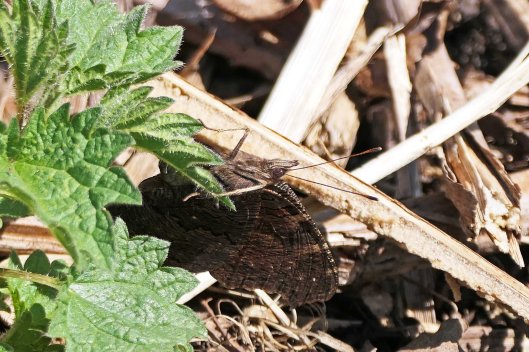
As I write this, my fingers are still stinging. And none of my photos are sharp, partly because ‘Ouch!’ but also because I didn’t want to disturb the clutch so was trying to move the leaf as little as possible. But, when I watched their beautiful mother laying the first of these yesterday, I knew I had to go back today to see how many she’d produced.

And here she is, the gorgeous female Peacock butterfly, clinging on to a Stinging nettle leaf. You might just be able to see how her abdomen is curved up towards the underside of the leaf where she is depositing her eggs. My guide book tells me that a female Peacock ‘lays her eggs in batches of up to 400 eggs, a process that can take over two hours’. What an effort! I will, of course, be looking out for when the tiny caterpillars emerge, in approximately two weeks’ time.

Like Loading...

Mystery: on a pine tree

10 Thursday Apr 2025

Posted by sconzani in insects, trees

≈ Leave a comment

Tags

mystery egg sac, mystery insect, mystery object on pine tree, mystery pupa, mystery pupal case, pine

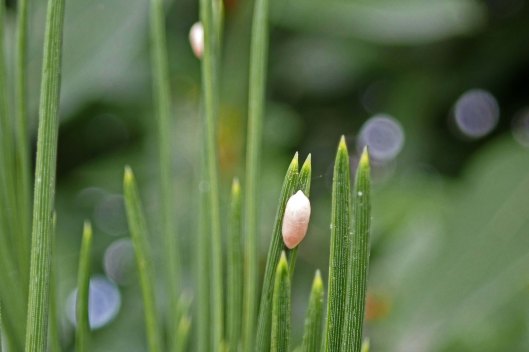
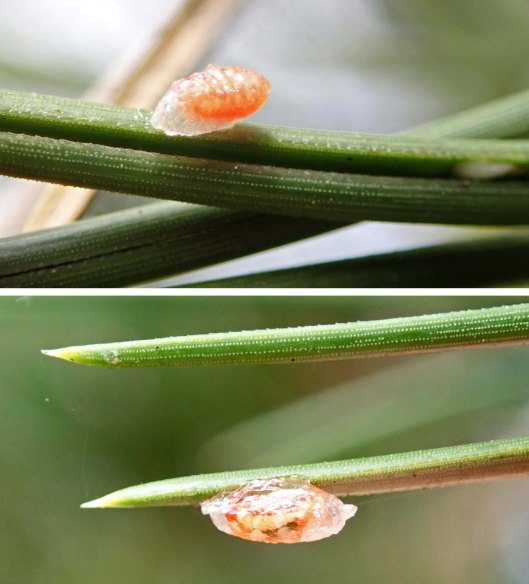
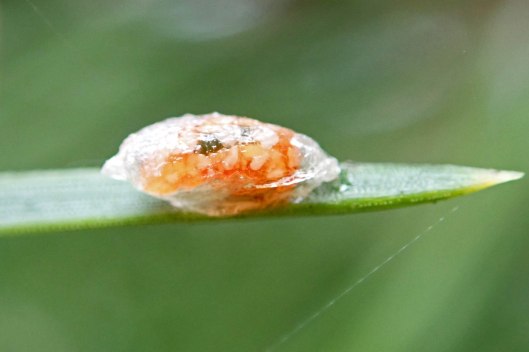
As the spring and summer progress, this first ‘mystery’ post may well develop in to a mystery series, depending on how many intriguing things I manage to find and how many I don’t manage to identify. These first mystery items were found recently when I was looking more closely than usual at Pine trees to see if I could spot any more Pine ladybirds. I did find one more of those lovely creatures but I also found these ‘things’, dotted sparsely around, attached to the Pine needles.

No amount of googling has produced any similar images or information and, when I asked for help on social media, I was inundated with helpful people saying they were Pine scale, which, after checking the lifecycle of those scales, I’m fairly sure they’re not. They look to me like some kind of egg sac or pupal case, with a tiny creature growing and developing inside.

In an attempt to solve the mystery, I plucked a couple of Pine needles, with the things attached, off one tree, and I’ve brought them home, stuck them in a jar on my kitchen window sill. Whether or not something will emerge remains to be seen and, rest assured, I will definitely write another blog post if that does happen. In the meantime, if any of you has any bright ideas, please do share them in the comments.

Like Loading...

Holly blue and Small white

09 Wednesday Apr 2025

Posted by sconzani in insects

≈ Leave a comment

Tags

blue butterflies, British butterflies, butterfly, Holly blue, Small white, white butterflies

Two for the price of one today!
It’s always a joy to see the blue butterflies emerge; it’s like a tiny piece of the sky has fallen to earth and is flitting amongst the flowers and shrubs and along the trees and hedges. The first to appear locally are the Holly blues. My first, on 2 April, was in an unlikely place; as I walked past, it flitted out from the street-side hedge of a house a few streets away from where I live. There was no Holly or Ivy in sight but perhaps those larval plants were growing in a nearby back garden that I couldn’t see in to.

Next to appear, just a couple of days later, was a Small white that was already looking a bit tatty. It seems its short life was proving to be a challenge, escaping from bird attacks or, perhaps, getting snagged in vegetation. My second Small white was pristine, feeding along a field edge so abundant with Blackthorn blossom that the area had attracted six species of butterfly: as well as the Small white, there were Speckled wood, Comma, another Holly blue, Brimstone, and my first Orange-tip of 2025 (which will feature in a future blog, as soon as one stays still long enough for a photo).

Like Loading...
← Older posts
Newer posts →

About me

sconzani

sconzani

I'm a writer and photographer; researcher and blogger; birder and nature lover; countryside rambler and city strider; volunteer and biodiversity recorder.

View Full Profile →

Follow earthstar on WordPress.com

Enter your email address to follow this blog and receive notifications of new posts by email.

Recent blog posts

  • Turtle bug March 23, 2026
  • Springtime invasives March 22, 2026
  • Singing Dunnocks March 21, 2026
  • New cat: Large yellow underwing March 20, 2026
  • Curious Coal tit March 19, 2026

From the archives

COPYRIGHT

Unless otherwise acknowledged, the text and photographs on this blog are my own and are subject to international copyright. Nothing may be downloaded or copied without my permission.

Fellow Earth Stars!

  • Unknown's avatar
  • Unknown's avatar
  • Unknown's avatar
  • Unknown's avatar
  • Unknown's avatar
  • Unknown's avatar
  • Unknown's avatar
  • Unknown's avatar
  • Unknown's avatar
  • Unknown's avatar
  • Unknown's avatar
  • Unknown's avatar
  • Unknown's avatar
  • Unknown's avatar
  • Unknown's avatar
  • Unknown's avatar
  • Unknown's avatar
  • Unknown's avatar
  • Unknown's avatar
  • Unknown's avatar
  • Unknown's avatar
  • Unknown's avatar
  • Unknown's avatar
  • Unknown's avatar
  • Unknown's avatar
  • Unknown's avatar
  • Unknown's avatar
  • Unknown's avatar
  • Unknown's avatar
  • Unknown's avatar
  • Unknown's avatar
  • Unknown's avatar
  • Unknown's avatar
  • Unknown's avatar
  • Unknown's avatar
  • Unknown's avatar
  • Unknown's avatar
  • Unknown's avatar
  • Unknown's avatar
  • Unknown's avatar
  • Unknown's avatar
  • Unknown's avatar
  • Unknown's avatar
  • Unknown's avatar
  • Unknown's avatar
  • Unknown's avatar
  • Unknown's avatar
  • Unknown's avatar
  • Unknown's avatar
  • Unknown's avatar

Blog at WordPress.com.

Privacy & Cookies: This site uses cookies. By continuing to use this website, you agree to their use.
To find out more, including how to control cookies, see here: Cookie Policy
  • Subscribe Subscribed
    • earthstar
    • Join 668 other subscribers
    • Already have a WordPress.com account? Log in now.
    • earthstar
    • Subscribe Subscribed
    • Sign up
    • Log in
    • Report this content
    • View site in Reader
    • Manage subscriptions
    • Collapse this bar
 

Loading Comments...
 

You must be logged in to post a comment.

    %d