• ABOUT
  • BIRDING 2018
  • Birding 2019
  • BLOG POSTS
  • Butterflies 2018
  • Resources

earthstar

~ a celebration of nature

earthstar

Author Archives: sconzani

Mad with joy

30 Sunday Mar 2025

Posted by sconzani in flowers, spring

≈ 3 Comments

Tags

British wildflowers, Spring colour, spring wildflowers, wildflowers

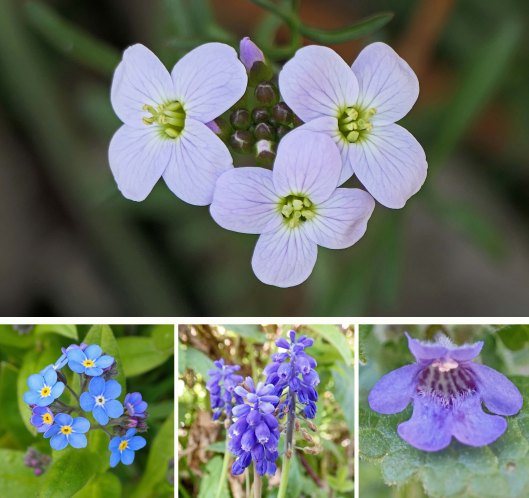
People from a planet without flowers would think we must be
mad with joy the whole time to have such things about us.
~ Iris Murdoch, from the novel A Fairly Honourable Defeat, Vintage, 1970

Mad as a hatter, me, as the Spring wildflowers begin to bloom. I hope you’re enjoying them too!


Like Loading...

Leafhopper: Mocydia crocea

29 Saturday Mar 2025

Posted by sconzani in insects

≈ Leave a comment

Tags

British cicadellidae, British leafhoppers, Cicadellidae, leafhopper, Mocydia crocea

Though I’d seen a few tiny green leafhoppers flitting around Bramble bushes on warm sunny days, this gorgeous little creature is the first leafhopper I’ve managed to get photographs of this year, and, even better, it’s a species I’ve not seen before. This is Mocydia crocea, a stunningly marked hopper which, according to the British Bugs website, can be found ‘amongst grass in many habitats, from woodlands to hay meadows.’ It’s supposed to be widespread but there were just 22 records in the Welsh database before I added this one.

The British Bugs website also warns that this species can be tricky to identify as it is easily confused with two other species but there’s a handy photo showing the features to look for and I’m fairly confident I’ve identified this correctly.

Like Loading...

False puffball

28 Friday Mar 2025

Posted by sconzani in fungi, nature

≈ Leave a comment

Tags

Enteridium lycoperdon, False puffball, Reticularia lycoperdon, slime, slime mould, slime mould on dead tree

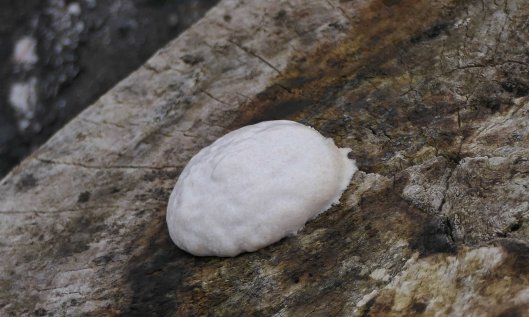
It’s been a while since slime featured here but, as it’s Fungi Friday (yes, I know slime isn’t exactly a fungus) and I happened to spot some slime yesterday, slime it is for today’s post, folks.

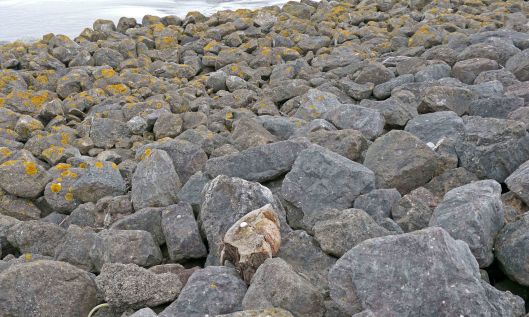
This particularly slime doesn’t really look like your typical example, which is presumably why its common name is False puffball; its scientific name is Reticularia lycoperdon (also known as Enteridium lycoperdon). And I spotted it in rather an odd place, growing on a stump that must have been thrown up on to the outer Barrage rocks in Cardiff Bay during a particularly high tide. You can read more about these intriguing organisms and see examples of the various stages of their life cycle on the excellent NatureSpot website.

Like Loading...

10-spot ladybird

27 Thursday Mar 2025

Posted by sconzani in insects, ladybird

≈ Leave a comment

Tags

10-spot ladybird, Adalia decempunctata, British ladybirds, ten-spot ladybird

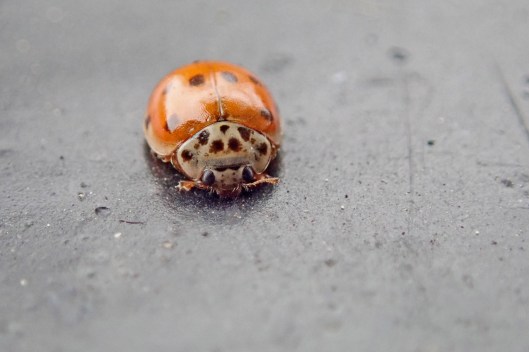
This sweet little creature was a lovely surprise on the park railings earlier. It was tiny, looked only half the size of the many Harlequins that were lumbering along nearby.

I wasn’t sure which of the ladybird species it was until I got home and checked. Though its colours and markings can vary greatly, this is a 10-spot ladybird (Adalia decempunctata), a species I’ve only seen once before and that was back in 2016.

They prefer woody places, whether they be actual woodland or parks or simply gardens with plenty of trees, and they can be found from now until October, so I’ll be keeping my eyes peeled for more.

Like Loading...

Starlings and bee-flies

26 Wednesday Mar 2025

Posted by sconzani in birds, insects

≈ Leave a comment

Tags

birding, birdwatching, Bombylius major, British birds, Dark-edged bee-fly, starling

Starlings and bee-flies may seem like an odd combination but these were the highlights of yesterday’s walk. First, I listened spellbound to the extraordinary range of sounds this gorgeous Starling and its friends were producing – and I’ve heard that the human ear isn’t capable of hearing the full range of its acoustic repertoire, which is even more astounding. And don’t even get me started on those fabulous feathers.

Meander … amble … stroll … and I ended up having a mooch around my favourite scruffy and neglected Cardiff park, which always manages to turn up something special (as long as you ignore the rubbish and the occasional druggie lurking in the vegetation). Yesterday, up popped my first two Dark-edged bee-flies (Bombylius major) of 2025, those little bundles of flying fluff that hide a dark and gruesome lifecycle of parasitism on their solitary bee cousins. They are cute to look at though.

Like Loading...

Spider: Steatoda nobilis

25 Tuesday Mar 2025

Posted by sconzani in spiders

≈ Leave a comment

Tags

British spiders, False widow spider, Noble false widow, Steatoda nobilis

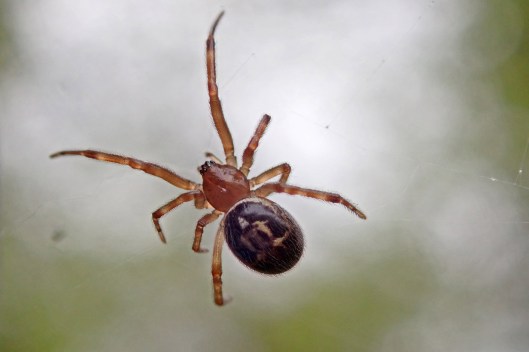
I was delighted yesterday to get an email verifying my two most recent spider finds. Both were fairly commonplace spiders but it’s nice to have confirmation that I’m making positive progress in being able to identify my finds, and to feel that I am paying back in the form of new records the book grant I received from my local biodiversity records centre to buy my spider guide book.

So, meet Steatoda nobilis, otherwise known as the False widow spider (or, sometimes, the Noble false widow). According to the Spider and Harvestman Recording Scheme website, it’s not a British native, and is presumed to have been an accidental introduction – maybe it hitched a ride with someone returning from holiday in Europe or in a lorry full of imported goods. From the first report of its presence near Torquay back in 1879, it has become naturalised across much of southern Britain, and appears to be spreading further north. I found mine on the local park railings but Steatoda nobilis is most common around buildings, including houses and garages and sheds and even public toilets. And, yes, it has been known to bite humans but don’t believe the negative publicity you might have seen in the media – like most creatures, this spider is more likely to avoid contact with humans if at all possible.

Like Loading...

Greenfinches snacking on pine seeds

24 Monday Mar 2025

Posted by sconzani in birds

≈ Leave a comment

Tags

birding, birdwatching, British birds, Cardiff Bay birding, Greenfinch, Greenfinches eating pine seeds, Greenfinches feeding in Pines

Once again, this morning’s search for the first Wheatear of the season on the boulders and grassy areas of Cardiff Bay’s Barrage proved fruitless, as did a walk around the small fenced-off brownfield paddocks of Porth Teigr where, in previous winters, the Black redstarts would assemble (but not this past winter) and an occasional Wheatear might appear.

Luckily for me, my disappointment at the lack of Wheatears was more than compensated for by the little flock of Greenfinches I found, and heard, feeding in the stand of pine trees in front of the BBC studios.

Each bird, both male and female, moved from one pine cone to the next, using their strong sharp beaks to extract the scales from the female cones, then nibble away at the scale until only the seed remained.

BBC staff may have been busy creating their next award-winning nature series within the neighbouring building but, actually, the reality show happening right outside was much more riveting.

Like Loading...

Hairy violets

23 Sunday Mar 2025

Posted by sconzani in flowers, spring, wildflowers

≈ Leave a comment

Tags

British wildflowers, Hairy violet, Spring colour, spring wildflowers, Viola hirta, violet species, violets

As I wrote in last Sunday’s post, it’s violet time, and I’ve since realised that I’ve not previously blogged about one violet species I see very often, the Hairy violet (Viola hirta).
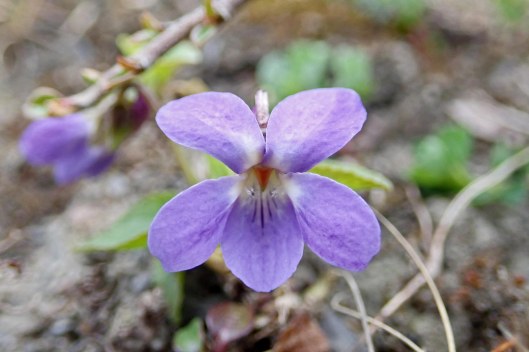
This species and the Sweet violet (Viola odorata) are the only two to have rounded sepals, which narrows down the possibilities for identification purposes. Also, the sepal appendages are different: in Sweet violet, these are angled away from the flower’s stem, while the sepal appendages of the Hairy violet are pressed towards the stem.
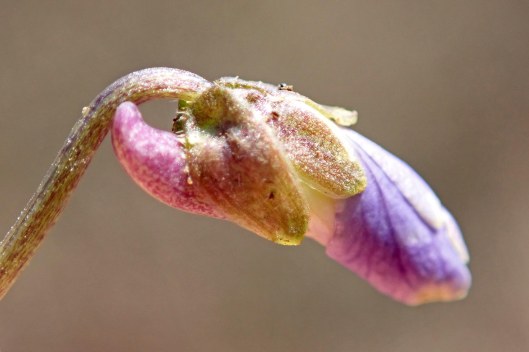
Another distinguishing feature is the petal colour: the petals of the Hairy violet are paler, with a lilac hue, whereas those of the Sweet violet are a deep purple (unless they’re the white-coloured sub-species, of course).
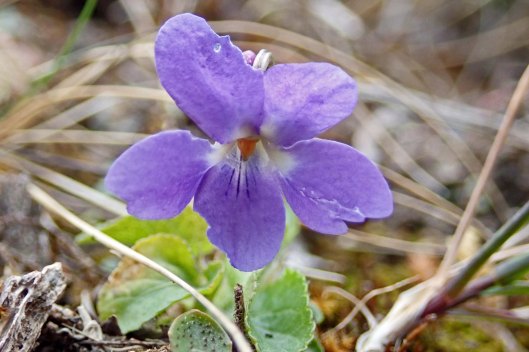
The two violet species also grow in different environments. Sweet violets prefer the edges of woodland rides, and churchyards, and roadside verges, while Hairy violets are mostly found on dry calcareous grasslands, like those found in two of the fields at my local country park, Cosmeston Lakes, which is where I took these photos earlier today.


Like Loading...

Belting out its song

22 Saturday Mar 2025

Posted by sconzani in birds, spring

≈ Leave a comment

Tags

birding, birdwatching, British birds, singing Wren, wren

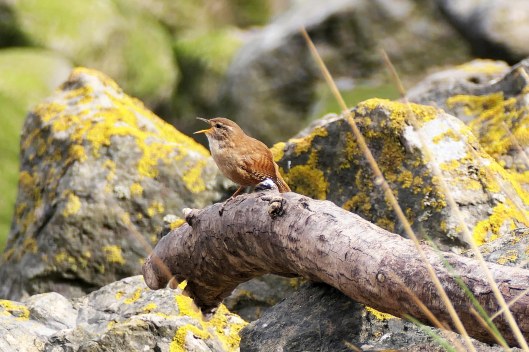
Can you hear it?

I can’t remember where I read it but I’m fairly sure the Wren has one of the loudest voices of any birds in Britain, though even its song is eclipsed by the boom of the Bittern, which can be heard around 2 miles away. At this time of year, male Wrens in particular sing regularly and loudly, to advertise themselves and their territories in order to attract any available females. The Wren in my photo has a very nice seaside territory amongst the large boulders of Cardiff Bay’s outer Barrage breakwater – if I were a female Wren, I’d certainly be interested. If you’re not familiar with the song of the Wren, you can hear it on the RSPB website.

Like Loading...

Staring at willows

21 Friday Mar 2025

Posted by sconzani in insects, spring, trees

≈ Leave a comment

Tags

Bombus hypnorum, Bombus terrestris, Brimstone, British butterflies, Buff-tailed bumblebee, butterflies feeding on willow flowers, insects feeding on willow flowers, insects on willow, Small tortoiseshell, Tree bumblebee, willow

This is your occasional reminder, if you are interested in spotting flying insects, that it is a very good idea at this time of year, when the various willows (Salix species) are coming in to flower, to spend a little staring at these trees. That is partly how I came to find so many butterflies yesterday. Several of the Brimstones I saw, in particular the two females that were feeding up prior to egg-laying, and the beautiful Small tortoiseshell were all found initially on willow flowers.

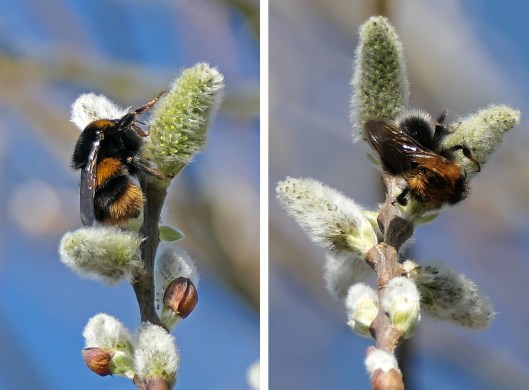
The fluffy yellow flowers were also providing much needed sustenance for a variety of flies, for honey bees and hoverflies. Due to their larger size, I was also able to see at least two species of bumblebee, Buff-tailed (Bombus terrestris) (left below) and Tree bumblebee (Bombus hypnorum) (below right).

Like Loading...
← Older posts
Newer posts →

About me

sconzani

sconzani

I'm a writer and photographer; researcher and blogger; birder and nature lover; countryside rambler and city strider; volunteer and biodiversity recorder.

View Full Profile →

Follow earthstar on WordPress.com

Enter your email address to follow this blog and receive notifications of new posts by email.

Recent blog posts

  • Singing from every tree top March 24, 2026
  • Turtle bug March 23, 2026
  • Springtime invasives March 22, 2026
  • Singing Dunnocks March 21, 2026
  • New cat: Large yellow underwing March 20, 2026

From the archives

COPYRIGHT

Unless otherwise acknowledged, the text and photographs on this blog are my own and are subject to international copyright. Nothing may be downloaded or copied without my permission.

Fellow Earth Stars!

  • Unknown's avatar
  • Unknown's avatar
  • Unknown's avatar
  • Unknown's avatar
  • Unknown's avatar
  • Unknown's avatar
  • Unknown's avatar
  • Unknown's avatar
  • Unknown's avatar
  • Unknown's avatar
  • Unknown's avatar
  • Unknown's avatar
  • Unknown's avatar
  • Unknown's avatar
  • Unknown's avatar
  • Unknown's avatar
  • Unknown's avatar
  • Unknown's avatar
  • Unknown's avatar
  • Unknown's avatar
  • Unknown's avatar
  • Unknown's avatar
  • Unknown's avatar
  • Unknown's avatar
  • Unknown's avatar
  • Unknown's avatar
  • Unknown's avatar
  • Unknown's avatar
  • Unknown's avatar
  • Unknown's avatar
  • Unknown's avatar
  • Unknown's avatar
  • Unknown's avatar
  • Unknown's avatar
  • Unknown's avatar
  • Unknown's avatar
  • Unknown's avatar
  • Unknown's avatar
  • Unknown's avatar
  • Unknown's avatar
  • Unknown's avatar
  • Unknown's avatar
  • Unknown's avatar
  • Unknown's avatar
  • Unknown's avatar
  • Unknown's avatar
  • Unknown's avatar
  • Unknown's avatar
  • Unknown's avatar
  • Unknown's avatar

Blog at WordPress.com.

Privacy & Cookies: This site uses cookies. By continuing to use this website, you agree to their use.
To find out more, including how to control cookies, see here: Cookie Policy
  • Subscribe Subscribed
    • earthstar
    • Join 668 other subscribers
    • Already have a WordPress.com account? Log in now.
    • earthstar
    • Subscribe Subscribed
    • Sign up
    • Log in
    • Report this content
    • View site in Reader
    • Manage subscriptions
    • Collapse this bar
 

Loading Comments...
 

You must be logged in to post a comment.

    %d