• ABOUT
  • BIRDING 2018
  • Birding 2019
  • BLOG POSTS
  • Butterflies 2018
  • Resources

earthstar

~ a celebration of nature

earthstar

Author Archives: sconzani

Black-tailed godwits

28 Friday Feb 2025

Posted by sconzani in birds

≈ Leave a comment

Tags

birding, birdwatching, Black-tailed godwit, British birds, godwits, Limosa limosa

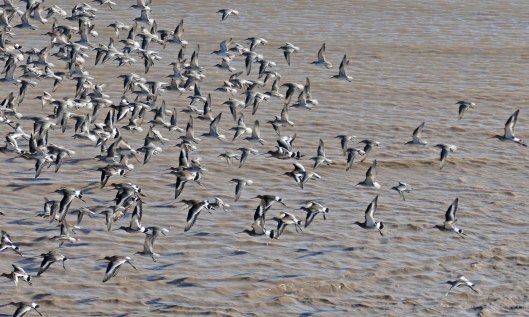
The most numerous bird species in Monday’s murmuration (see Wednesday’s blog for photos) was undoubtedly the Black-tailed godwit (Limosa limosa). With their long legs, necks and beaks and well-proportioned bodies, these are elegant birds.

We have two species of godwit in Britain, Black-tailed and Bar-tailed (Limosa lapponica), and, at first glance, they can be difficult to tell apart but, as you can see in some of my photos, the Black-tailed have broad white wing-bars and their white tails finish with a black band, hence their name.

Some of these local birds are starting to change in to their breeding plumage of brick-red heads, necks and breasts, which is why the birds’ colours pictured here are so different. Only a very small number of Black-tailed godwits breed in the UK; most, if not all, of the birds pictured will soon be heading north-west to their breeding grounds in Iceland.

And that breeding location is one of the reasons Black-tailed godwits are now on the British red list, as the lowland Icelandic grasslands these birds favour are increasingly being converted to arable production and forestry. Climate change and environmental pressures are also affecting the locations in Britain where the birds over-winter, so they are facing pressure all year round. I feel privileged to have seen so many of these stunning creatures at such close quarters and to see their incredibly well synchronised aerial display earlier this week.
Like Loading...

Beautiful bumbles

27 Thursday Feb 2025

Posted by sconzani in insects, spring

≈ Leave a comment

Tags

British bumblebees, Buff-tailed bumblebee, bumblebee emergence, bumblebee queens

This week we’ve had a couple of blue-sky days and much-wanted sunshine, with more in the forecast. And, though the overnight temperatures and winds are still quite cold, the daytime temperatures have risen just enough to cause some insects to awaken and emerge.

During today’s wander around Cardiff’s Grangemoor Park, I spotted these two beautiful Buff-tailed bumblebee queens, one drawn to willow flowers that are just beginning to open and another with her tongue stuck deep into the bright yellow flowers of a gorse bush. Finally, it feels like Spring is in the air.

Like Loading...

Murmuration

26 Wednesday Feb 2025

Posted by sconzani in nature

≈ 2 Comments

Tags

birding, birdwatching, Black-tailed godwit, British birds, Dunlin, Knot, large flock of flying birds, murmuration

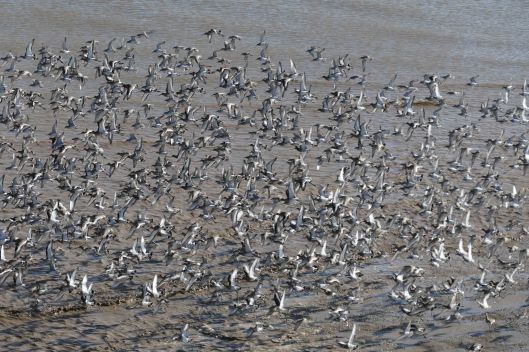
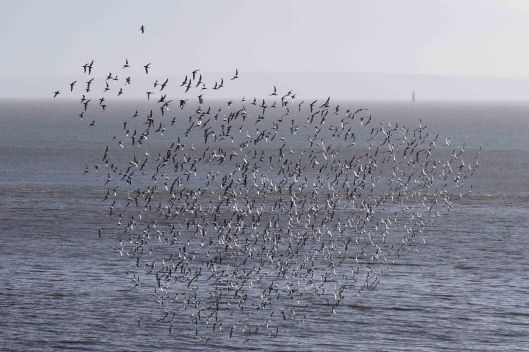
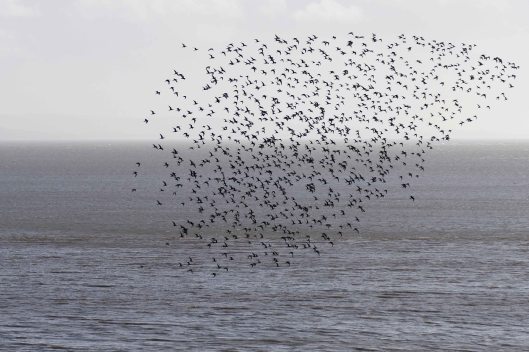
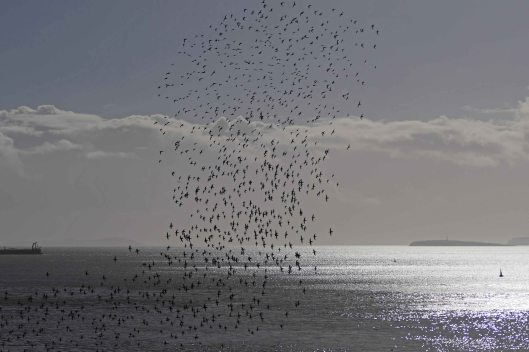
When you hear or read the word murmuration, you probably think of Starlings and the incredible sight of thousands of those birds flying though the evening sky in perfect unison. But it isn’t only Starlings that execute such amazing aerial displays; many other species of bird perform similar feats of synchronised flying and, on Monday, I was privileged to see just such a spectacle.

As soon as I arrived at the Cardiff Bay Barrage, I saw a large flock of birds flying around the area outside the Barrage, on the edge of the Bristol Channel. Luckily for me, the birds settled on one of the mudflats and began feeding. In my almost ten years of living in the area, I had never seen so many waders doing this; they usually feed on mudflats north of Cardiff.

The flock must have been several hundred strong and consisted of three species of wader, Black-tailed godwit, Knot and Dunlin. For 45 minutes, I watched and listened to and photographed these stunning birds, sharing my delight and wonder with a man who was out walking his dog and who’d never seen anything like this sight in his many years of living locally.

Then, for some unknown reason, the Barrage operations staff opened more of the sluice gates that allow water in Cardiff Bay to flow out in to the Bristol Channel, creating a small wave that swiftly encroached on the area of mud where the flock was feeding, and eventually covering it completely. As the wave reached them, the birds took to the air, creating an ever expanding cloud of flying birds. As one, they flew around the outer Barrage area, looking for another place to land but there was nowhere. For perhaps ten minutes, they swirled high into the air, then back down towards the water, wheeling left and right in perfect harmony, before abandoning their search for more mudflats and heading northwards along the coast. It was a sublime aerial symphony that I will never forget.

Like Loading...

Hoovering Shelduck

25 Tuesday Feb 2025

Posted by sconzani in birds, winter

≈ Leave a comment

Tags

birding, birdwatching, British birds, feeding Shelducks, Shelduck, Shelducks feeding

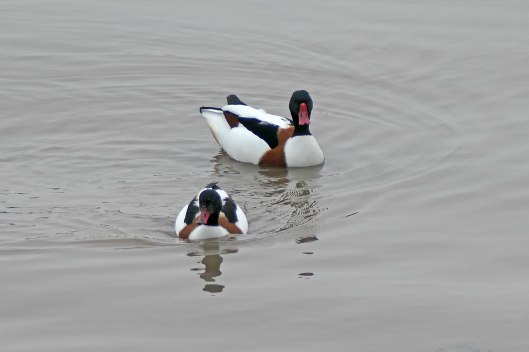
According to a research report* published on the British Trust for Ornithology’s website, the Shelduck (Tadorna tadorna) was ‘one of the most common waterbird species at Cardiff Bay prior to barrage-closure’. When the report was written, in 2003, Shelduck were still using the Bay as a roosting site between tides, albeit in small numbers. Twenty-two years later, the Bay has become so overwhelmed by human water traffic (jetboats, speedboats, water taxis, yachts, kayakers, paddleboarders) that it is rare to see Shelduck within the Bay itself.

Fortunately, there are still reasonably untouched areas of mudflat along the coast between Cardiff and Newport, and Bridgwater Bay, a National Nature Reserve renowned for its population of Shelducks, is a relatively short flight across the Bristol Channel from Cardiff Bay. So, the birds can often be seen, at a distance, feeding on the tidal mudflats outside the Barrage at low tide. And, occasionally, as happened one day last week, a pair will arrive early and wait for the lowering tide along the beach below Penarth Heads or, in this case, in the Barrage basin. This is the only time I get to see these beautiful birds up close so I sat on a rock and watched and, as the mud was exposed, took this short video of them hoovering and filtering the mud for tiny invertebrates.

* S. J. Holloway, N. A. Clark & N. H. K. Burton, ‘The Numbers and Status of Waterbirds using Cardiff Bay from 1999/2000 to 2002/2003‘, BTO Research Report No.319, The National Centre for Ornithology, Norfolk, July 2003.

Like Loading...

First Water vole of the year

24 Monday Feb 2025

Posted by sconzani in animals, mammal

≈ 2 Comments

Tags

British mammals, mammal, vole, Water vole

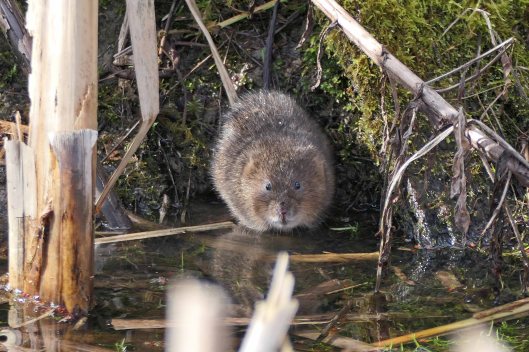
Saturday was probably the warmest day of 2025 so far, and it was noticeable how this rise in temperature affected the wildlife. Flies were basking in the sun on Ivy leaves, a bumblebee went buzzing past as I bent to photograph a wildflower (likely a Buff-tailed queen), and this Water vole popped out briefly to survey its domain and check the pond for edibles. It didn’t linger long as it’s the half-term school holiday here this week and the country park was awash with noisy children, but it was still a treat to watch this cute furry bundle, if only for a short time.

Like Loading...

Winter 9 plus

23 Sunday Feb 2025

Posted by sconzani in flowers, wildflowers, winter

≈ Leave a comment

Tags

British wildflowers, wildflowers in bloom, winter wildflowers

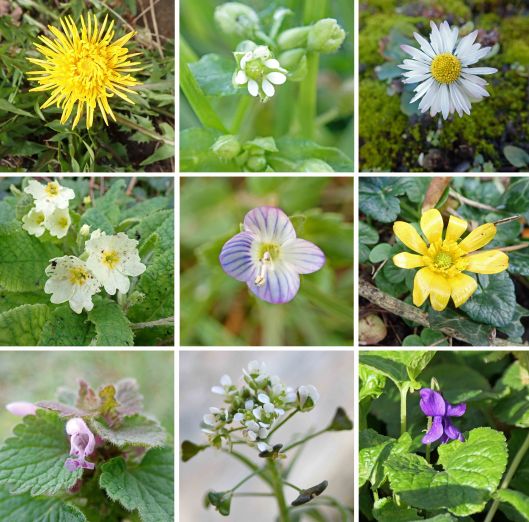
As poet Robbie Burns wrote ‘The best laid schemes … gang aft agley’, and such was my experience this week. I’d planned to go for a long walk today to search out as many wildflowers in bloom as I could but the weather has intervened, with forecast strong wind and heavy rain warnings. So, here are nine flowers I grabbed in a short walk yesterday, though I didn’t photograph all I saw. I know, for example, that Petty spurge, Groundsel, one of the bittercresses, Snow drops and Three-cornered leek, as well as Ivy-leaved toadflax, were among those I missed. Still, it was nice to see my first Sweet violets of the year and a little Red dead-nettle, and there’s always next Sunday …

Like Loading...

A Dipper dipping

22 Saturday Feb 2025

Posted by sconzani in birds

≈ Leave a comment

Tags

birding, birdwatching, British birds, Dipper

I heard this Dipper singing before I saw it. With my binoculars, I scanned the stones and small boulders along the opposite edge of the River Taff, near Radyr in south Wales, until I spotted the bird, then stood mesmerised as it sang its sweet melody, presumably hoping to attract a female Dipper.

Serenade over, the bird proceeded to do as its name implies, dipping beneath the fast-flowing waters of the river. This is how Dippers feed, moving along underwater in the search for small invertebrates, though, in this case, I’m not sure whether the Dipper was feeding or washing itself or simply enjoying a good splash. It was a delight to watch so I tried to capture some of the action for you all to enjoy.

Like Loading...

Spider: Platnickina tincta

21 Friday Feb 2025

Posted by sconzani in spiders

≈ Leave a comment

Tags

arachnids, British arachnids, British spiders, Platnickina tincta

My local records centre SEWBReC, the South East Wales Biodiversity Records Centre, likes to support local recorders like me and has recently, very generously, given me a book grant, with which I’ve purchased guide books to help me identify spiders, craneflies and, yet to come when it’s published in October, a book about flies.

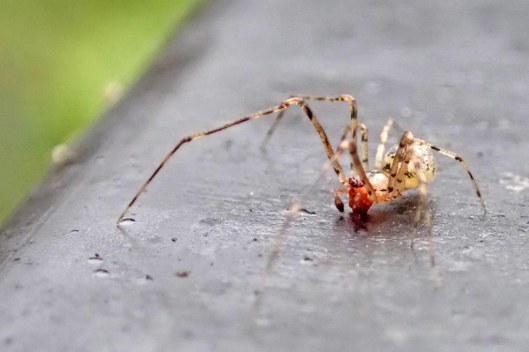
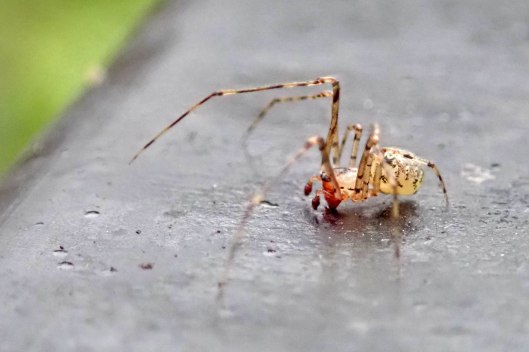
Now, I feel duty bound to look more closely at these creatures (of course, that’s why I chose these books), and this week I found a spider I’d never seen before. At first, I thought this tiny spider, just 2.5-3.5mm in length, was a Spitting spider but the size, location and daytime sighting didn’t fit – Spitting spiders are slightly larger, night time roamers and favour indoor locations, particularly museums for some reason. So, I posted some photos on social media, and got an almost instant answer from SEWBReC’s partner organisation Cofnod, the local environmental records centre for north Wales.

My spider is almost certainly an adult male Platnickina tincta, a species that’s usually found low down in shrubs and tree branches. It’s a bit of an opportunist it seems, feeding on other small spiders and stealing their prey from their webs. It’s uncommon in Wales; the Spider and Harvestman Recording Scheme website shows the distribution in Britain, where this species is abundant in the southeast but increasingly scarce as we track north and west.

Like Loading...

Male Bullfinches

20 Thursday Feb 2025

Posted by sconzani in birds, winter

≈ 2 Comments

Tags

birding, birdwatching, British birds, bullfinch, Forest Farm Nature Reserve, male Bullfinch

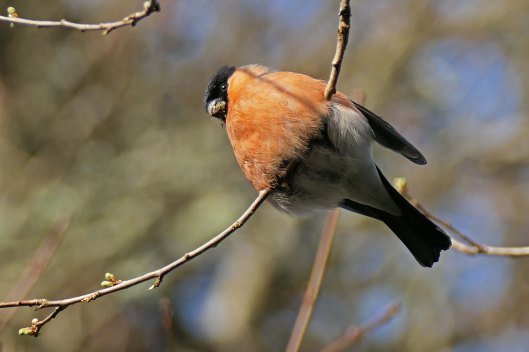
For me the male Bullfinch, with his glorious apricot breast feathers, is the most exotic-looking of Britain’s birds. He looks like he belongs in a tropical rain forest, not in the sub-zero temperatures of a British winter. These two particularly handsome chaps were busily nibbling the new buds from the trees at Forest Farm Nature Reserve earlier this week, which is why these birds are never much liked by orchardists.

There were female Bullfinches about as well, though, for some reason, they tended to be skulking in the furthest reaches of the branches, out of this photographer’s lens range. Perhaps it’s just that male birds in general like to advertise their presence more as we approach spring and the breeding season.

Like Loading...

Elm bark beetle

19 Wednesday Feb 2025

Posted by sconzani in insects, trees

≈ Leave a comment

Tags

dead Wych elm, Dutch Elm disease, elm bark beetle, elm bark beetle tunnels, Large elm bark beetle, Scolytus scolytus, Wych elm

After last Friday’s post about the Velvet shanks I’d found on a dead Wych elm, it occurred to me that I couldn’t recall seeing any traces of the elm bark beetles (likely the Large elm bark beetle Scolytus scolytus, according to an article on the Forest Research website) that carry the fungus that killed the tree. So, I went back for another look, and it turns out I hadn’t looked closely enough: there were signs of beetle activity all over the exposed areas of trunk where bark had fallen away and this showed up much more clearly on the darker underside of the bark itself.

During the summer, the female elm bark beetle drills a hole through the tree’s bark, then creates a long straight burrow (called the mother tunnel) under the bark. As she excavates, she lays eggs and, when the larvae hatch they create their own tunnels outwards from the mother tunnel. If the effects of their presence weren’t so deadly, the tunnels could almost be viewed as tiny works of art.

Like Loading...
← Older posts
Newer posts →

About me

sconzani

sconzani

I'm a writer and photographer; researcher and blogger; birder and nature lover; countryside rambler and city strider; volunteer and biodiversity recorder.

View Full Profile →

Follow earthstar on WordPress.com

Enter your email address to follow this blog and receive notifications of new posts by email.

Recent blog posts

  • Singing from every tree top March 24, 2026
  • Turtle bug March 23, 2026
  • Springtime invasives March 22, 2026
  • Singing Dunnocks March 21, 2026
  • New cat: Large yellow underwing March 20, 2026

From the archives

COPYRIGHT

Unless otherwise acknowledged, the text and photographs on this blog are my own and are subject to international copyright. Nothing may be downloaded or copied without my permission.

Fellow Earth Stars!

  • Unknown's avatar
  • Unknown's avatar
  • Unknown's avatar
  • Unknown's avatar
  • Unknown's avatar
  • Unknown's avatar
  • Unknown's avatar
  • Unknown's avatar
  • Unknown's avatar
  • Unknown's avatar
  • Unknown's avatar
  • Unknown's avatar
  • Unknown's avatar
  • Unknown's avatar
  • Unknown's avatar
  • Unknown's avatar
  • Unknown's avatar
  • Unknown's avatar
  • Unknown's avatar
  • Unknown's avatar
  • Unknown's avatar
  • Unknown's avatar
  • Unknown's avatar
  • Unknown's avatar
  • Unknown's avatar
  • Unknown's avatar
  • Unknown's avatar
  • Unknown's avatar
  • Unknown's avatar
  • Unknown's avatar
  • Unknown's avatar
  • Unknown's avatar
  • Unknown's avatar
  • Unknown's avatar
  • Unknown's avatar
  • Unknown's avatar
  • Unknown's avatar
  • Unknown's avatar
  • Unknown's avatar
  • Unknown's avatar
  • Unknown's avatar
  • Unknown's avatar
  • Unknown's avatar
  • Unknown's avatar
  • Unknown's avatar
  • Unknown's avatar
  • Unknown's avatar
  • Unknown's avatar
  • Unknown's avatar
  • Unknown's avatar

Blog at WordPress.com.

Privacy & Cookies: This site uses cookies. By continuing to use this website, you agree to their use.
To find out more, including how to control cookies, see here: Cookie Policy
  • Subscribe Subscribed
    • earthstar
    • Join 642 other subscribers
    • Already have a WordPress.com account? Log in now.
    • earthstar
    • Subscribe Subscribed
    • Sign up
    • Log in
    • Report this content
    • View site in Reader
    • Manage subscriptions
    • Collapse this bar
 

Loading Comments...
 

You must be logged in to post a comment.

    %d