• ABOUT
  • BIRDING 2018
  • Birding 2019
  • BLOG POSTS
  • Butterflies 2018
  • Resources

earthstar

~ a celebration of nature

earthstar

Category Archives: autumn

317/366 Colour it bramble

12 Thursday Nov 2020

Posted by sconzani in autumn, leaves, plants

≈ Leave a comment

Tags

autumn colour, bramble, Bramble autumn colour, bramble leaves

Bramble: rambling over fences and through hedgerows, its flowers and fruit provide nourishment to insects, mammals and birds for much of the year; its leaves are home to leaf-mining moths and a multitude of other invertebrates; and, in the autumn, bramble colours our world with a burst of golden yellows, brilliant crimsons, burnt oranges and scarlet reds. What a plant!

201112 bramble colour (1)
201112 bramble colour (2)
201112 bramble colour (3)
201112 bramble colour (4)
201112 bramble colour (5)
201112 bramble colour (6)
201112 bramble colour (7)
201112 bramble colour (8)
201112 bramble colour (9)
Like Loading...

316/366 Green islands

11 Wednesday Nov 2020

Posted by sconzani in autumn, insects, trees

≈ 3 Comments

Tags

beech, gall causing midge, galls on Beech, green islands, green islands on Beech leaves, Hartigiola annulipes, leaf mines, leaf mines on Beech, Stigmella tityrella

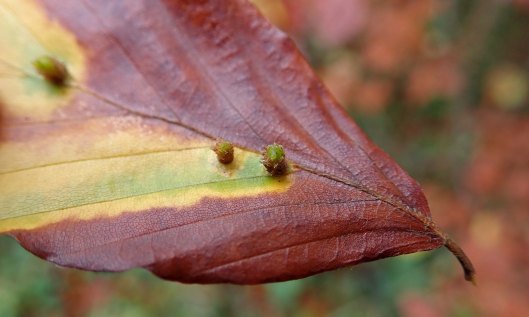
It’s late autumn, nearly winter, and, as you would expect, the leaves on this Beech tree have all now changed from vivid summer green to autumn brown … or have they? If you look more closely at this image, you’ll notice that some of the leaves have what entomologists, moth-ers and others in the know call ‘green islands’.

201111 green islands on beech

Butterfly Conservation’s Associate Director of Recording and Monitoring Richard Fox explained the reason for this most succinctly in a recent post on Twitter: ‘Thanks to Wolbachia bacteria in its body, the caterpillar uses cytokinin to maintain a green island of plant tissue in which it can feed in autumn.’

201111 green island stigmella tityrella (2)
201111 green island stigmella tityrella (1)

Fox was referring to leaf-mining moth caterpillars, like the Stigmella tityrella moth larvae that produced the mines in the leaves shown above, but other insects also manipulate the physiology of leaves so they can continue feeding. Another example from the same Beech tree can be seen below – here the larvae of the gall-inducing midge Hartigiola annulipes have also caused green islands to form in the leaves.

201111 Hartigiola annulipes green islands (1)

If you want to read more on the science behind this process, I found a paper entitled ‘Plant green-island phenotype induced by leaf-miners is mediated by bacterial symbionts‘, on the Royal Society website.

Like Loading...

315/366 Birds in a field

10 Tuesday Nov 2020

Posted by sconzani in autumn, birds

≈ Leave a comment

Tags

birding, birdwatching, blackbird, British birds, Chiffchaff, dunnock, Reed bunting

On Sunday, I blogged about the wildflowers I’ve recently found still blooming in local farm fields. When I’ve been wandering those field edges, I have, of course, also been keeping one eye on the skies, to see what birds might be enjoying this currently unmanaged farmland. Here’s a selection …

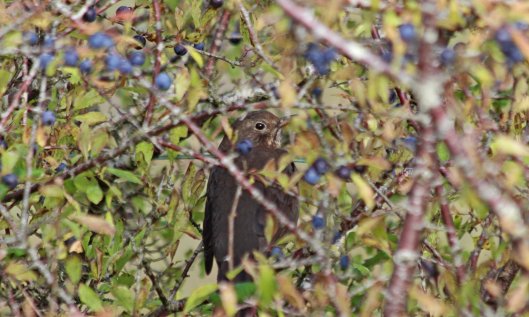
201110 blackbird

There were several species of winter thrushes feeding in berry trees – Song thrushes, Redwings and a small flock of Fieldfares, and a large number of Blackbirds, the only ones I managed to photograph.

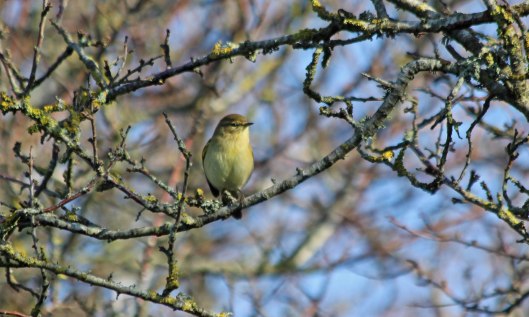
201110 chiffchaff

Two Chiffchaffs were chasing each other through tree branches. They’re late migrating but some Chiffchaffs do remain in Britain so maybe these two will stay local this winter.

201110 dunnock

A juvenile Dunnock was calling constantly, presumably for its parents, but they may well have decided it was time to cut the parental ties.

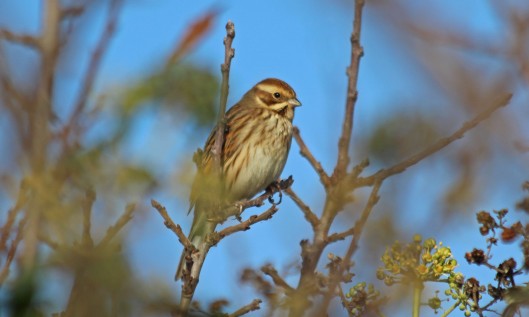
201110 reed bunting

Reed buntings aren’t always found in reeds. A family of three were flitting from hedge to field, foraging for seeds and insects.

Like Loading...

314/366 Leaf mines: Parornix anglicella

09 Monday Nov 2020

Posted by sconzani in autumn, insects, leaves, trees

≈ Leave a comment

Tags

British moths, Hawthorn, leaf mines, leaf mines on Hawthorn, moth larvae in leaf mines, moth leafmines, Parornix anglicella

Here’s another leaf mine to look for in your local hedgerows, a very distinctive mine on Hawthorn (Crataegus sp.) made by the larvae of the micro moth Parornix anglicella, also known as the Hawthorn slender.

201109 parornix anglicella cones (1)

Although the newly hatched moth larva initially creates a corridor mine and then a blotch, it later makes itself a cone-shaped tent, using silk to adhere the bent-over edge to the main part of the leaf, and these cones are very easy to spot. Turn over the leaf to view the underside and you’ll find incredibly beautiful, almost sculptural structures, some resembling miniature latticework pyramids.

201109 parornix anglicella cones (2)
201109 parornix anglicella cones (3)
201109 parornix anglicella cones (4)
201109 parornix anglicella cones (5)

You can read more scientific detail about the leaf mine on the UK Fly Mines website here, and see what the adult moth looks like on the UK Moths website here.

201109 parornix anglicella cones (6)

Like Loading...

313/366 Flowers in a field

08 Sunday Nov 2020

Posted by sconzani in autumn, wildflowers

≈ 3 Comments

Tags

autumn colour, autumn wildflowers, British wildflowers, farm field wildflowers, wildflowers in bloom

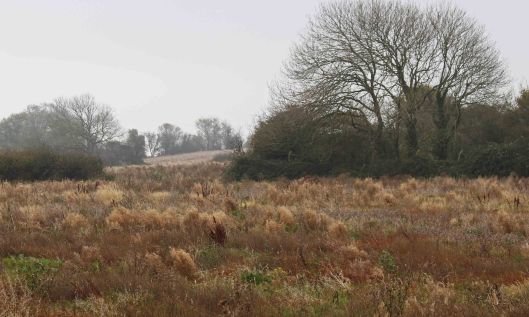
Running alongside the local coastal path are a series of farm fields, belonging, I understand, to the Welsh government.
201108 a field

These fields are usually leased for farming but, because there are currently plans to build 500 houses here (and don’t even get me started on how ludicrous that is!), it seems no local farmer was willing to lease the fields this year so they have not been cultivated. This has been an incredible bonus for wildlife (this is a well-used flyway so migrating birds have taken advantage of the re-wilded environment) and for the wildflowers that would usually be sprayed to death prior to crop planting.

This slideshow requires JavaScript.

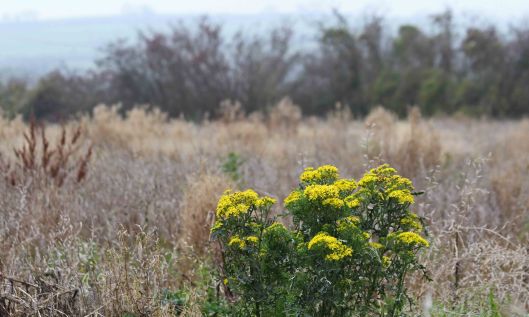
This week I’ve checked which flowers are still in bloom in these fields and their surrounding hedgerows, and found the following: Hedge bindweed, Bramble species, Bristly oxtongue, Creeping thistle, Dandelion species, Field speedwell, Rape, Scarlet pimpernel (the day was too dull for the flower to open), Smooth sow-thistle, Spear thistle, Sun spurge, and Ragwort.

201108 x ragwort

Like Loading...

311/366 The bonnets are back

06 Friday Nov 2020

Posted by sconzani in autumn, fungi

≈ 2 Comments

Tags

Bonnet fungi, Bonnet mushroom, British fungi, Grooved bonnet, Mycena polygramma

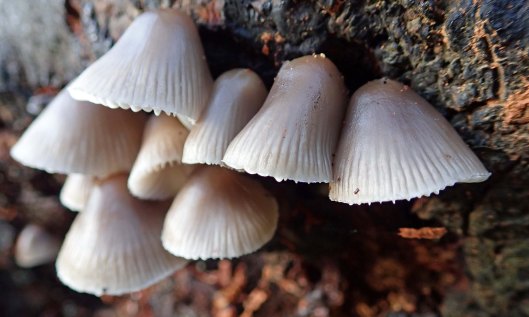
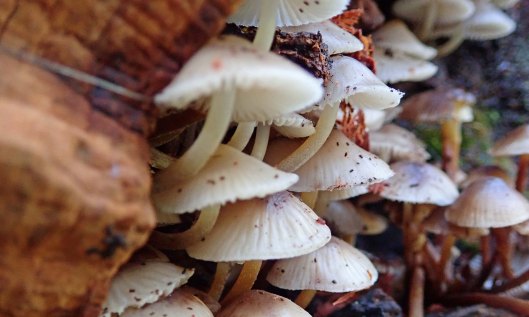
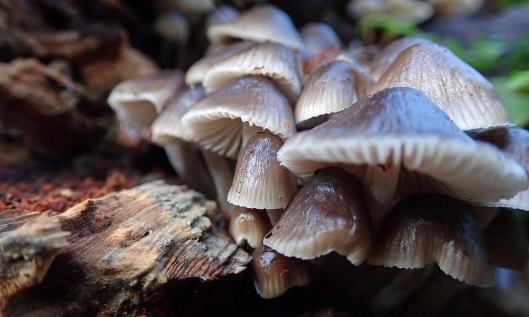
It’s almost a year since I published the post Groovy bonnets (on 27 November 2019), about a troop of Grooved bonnet fungi (Mycena polygramma) that was growing on a tree in the green space around a local church.

201106 grooved bonnets (1)

Since then, sadly, the tree they were growing on has mostly gone, blown down in one of our winter storms early this year – now, only the stump remains.

201106 grooved bonnets (2)

But the fungi were still there, living silently unseen beneath the surface, until now, when they are fruiting again.

201106 grooved bonnets (3)

And these gorgeous fungi are supporting other life – spot the millipede amongst the gills in my second photo.

201106 grooved bonnets (4)

Like Loading...

310/366 Geography in a leaf

05 Thursday Nov 2020

Posted by sconzani in autumn, leaves, trees

≈ Leave a comment

Tags

autumn colour, autumn leaves, Oak leaf

This Oak leaf looks to me like a lesson in geography, maybe a topographical map or perhaps a close view of the earth from a satellite, where the veins are rivers, the green the agricultural fields nurtured by their water, the brown the dry uplands.

Like Loading...

309/366 Seedheads, 4

04 Wednesday Nov 2020

Posted by sconzani in autumn, plants, weather, wildflowers

≈ Leave a comment

Tags

British wildflowers, seedheads, seeds, water on seedheads, wet weather

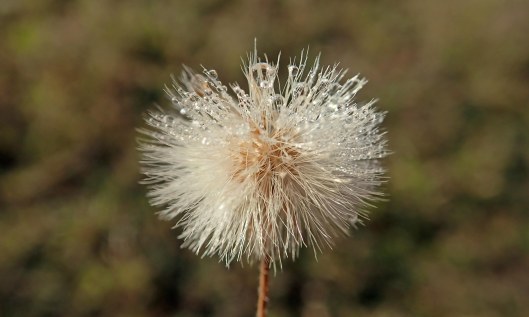
If you thought I’d exaggerated about how wet last month was, it’s official – Derek, the Welsh BBC weatherman, yesterday tweeted that ‘October was wetter than average in Wales with 208mm of rain’. Temperatures and sunshine were also below normal, and, having just returned from a long local walk, I can tell you it’s very squelchy out there. Still, the wet has its compensations as today’s seedheads testify.

201104 seedhead (1)201104 seedhead (2)201104 seedhead (3)201104 seedhead (4)

Like Loading...

307/366 Leaf mines: Tischeria ekebladella

02 Monday Nov 2020

Posted by sconzani in autumn, insects

≈ Leave a comment

Tags

blotch mines on Oak, British moths, leaf mines on Oak, moth larvae, moth larvae in leaf mines, moth leafmines, Tischeria ekebladella

I mentioned in a recent post (Gone galling, again, 28 October) that October was a good month to find galls and mines on leaves and, in fact, that also extends into November, or until the deciduous trees have shed their leaves and those fallen leaves have turned to mush, and the leaves of wild plants have also become unrecognisable in the mud under our feet.

201102 Tischeria ekebladella (1)

So, let’s start this mini series on leaf mines with a look at the blotch mines made on Oak (and sometimes Sweet chestnut) by the larvae of the micro moth Tischeria ekebladella. The blotch starts off looking quite white but often browns, from the centre, with age, giving it a look that one astute observer described as a fried egg. The larva creates a cocoon within the blotch and remains there until its ready to pupate in the springtime. The adult moth emerges from pupation and is on the wing in May and June.

201102 Tischeria ekebladella (2)
201102 Tischeria ekebladella (3)

By holding leaves up to the light, I managed to photograph larvae within a couple of mines, though, one of our local moth experts, George, who’s a senior moth ecologist with Butterfly Conservation, told me that the larva in the photo on the right below looks to have been parasitised and a different creature’s larva seems to have emerged from the Tischeria larva. Such is the way of Nature.

201102 Tischeria ekebladella (4)
201102 Tischeria ekebladella (5)
Like Loading...

306/366 Anti-gloom

01 Sunday Nov 2020

Posted by sconzani in autumn, flowers, wildflowers

≈ 4 Comments

Tags

British wildflowers, yellow wildflowers

I’ve been feeling the need for bright cheery sunshine yellow this week, to combat the dull weather, the short days, and the almost constant doom and gloom in the news, and the wildflowers have provided it. These are Black medick, a Dandelion species, Meadow buttercup, Nipplewort (actually photographed in sunshine!), Ragwort, and Yellow-wort.

201101 black meddick
201101 dandelion
201101 meadow buttercup
201101 nipplewort
201101 ragwort
201101 yellow-wort
Like Loading...
← Older posts
Newer posts →

About me

sconzani

sconzani

I'm a writer and photographer; researcher and blogger; birder and nature lover; countryside rambler and city strider; volunteer and biodiversity recorder.

View Full Profile →

Follow earthstar on WordPress.com

Enter your email address to follow this blog and receive notifications of new posts by email.

Recent blog posts

  • Cuttlebones March 16, 2026
  • No woodland here March 15, 2026
  • Family comes first March 14, 2026
  • Local Little egrets March 13, 2026
  • Cormorants, young and old March 12, 2026

From the archives

COPYRIGHT

Unless otherwise acknowledged, the text and photographs on this blog are my own and are subject to international copyright. Nothing may be downloaded or copied without my permission.

Fellow Earth Stars!

  • Unknown's avatar
  • Unknown's avatar
  • Unknown's avatar
  • Unknown's avatar
  • Unknown's avatar
  • Unknown's avatar
  • Unknown's avatar
  • Unknown's avatar
  • Unknown's avatar
  • Unknown's avatar
  • Unknown's avatar
  • Unknown's avatar
  • Unknown's avatar
  • Unknown's avatar
  • Unknown's avatar
  • Unknown's avatar
  • Unknown's avatar
  • Unknown's avatar
  • Unknown's avatar
  • Unknown's avatar
  • Unknown's avatar
  • Unknown's avatar
  • Unknown's avatar
  • Unknown's avatar
  • Unknown's avatar
  • Unknown's avatar
  • Unknown's avatar
  • Unknown's avatar
  • Unknown's avatar
  • Unknown's avatar
  • Unknown's avatar
  • Unknown's avatar
  • Unknown's avatar
  • Unknown's avatar
  • Unknown's avatar
  • Unknown's avatar
  • Unknown's avatar
  • Unknown's avatar
  • Unknown's avatar
  • Unknown's avatar
  • Unknown's avatar
  • Unknown's avatar
  • Unknown's avatar
  • Unknown's avatar
  • Unknown's avatar
  • Unknown's avatar
  • Unknown's avatar
  • Unknown's avatar
  • Unknown's avatar
  • Unknown's avatar

Blog at WordPress.com.

Privacy & Cookies: This site uses cookies. By continuing to use this website, you agree to their use.
To find out more, including how to control cookies, see here: Cookie Policy
  • Subscribe Subscribed
    • earthstar
    • Join 668 other subscribers
    • Already have a WordPress.com account? Log in now.
    • earthstar
    • Subscribe Subscribed
    • Sign up
    • Log in
    • Report this content
    • View site in Reader
    • Manage subscriptions
    • Collapse this bar
 

Loading Comments...
 

You must be logged in to post a comment.

    %d