• ABOUT
  • BIRDING 2018
  • Birding 2019
  • BLOG POSTS
  • Butterflies 2018
  • Resources

earthstar

~ a celebration of nature

earthstar

Category Archives: fungi

The photo-bombing beetle

03 Sunday Jul 2016

Posted by sconzani in fungi, insects, nature

≈ 10 Comments

Tags

beetle, fungus, inkcap, insect photobomber, mossy log, Red-headed Cardinal beetle, Rhydypennau Wood

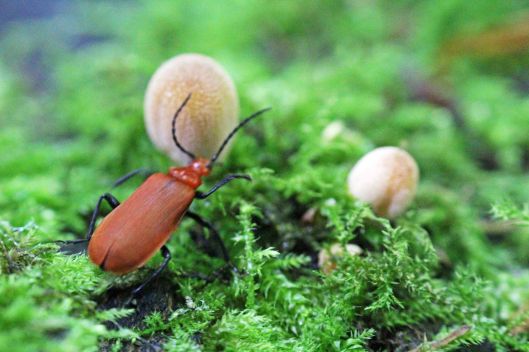
During yesterday’s walk to the stunning wildflower meadows neighbouring Cardiff’s Llanishen Reservoir, I detoured through Rhydypennau Wood to see what fungi might be about. There wasn’t a lot but I spotted some inkcaps sprouting amongst the moss on a fallen log so thought I’d get some photos.

160703 photobombing beetle (1)

The camera was out, I was kneeling in the leaf litter, leaning on the log, and had just taken my first shot when …
160703 photobombing beetle (2)

‘Oi, lady photographer leaning all over MY mossy log, I’m coming through!’, squeaked the Red-headed cardinal beetle.

160703 photobombing beetle (3)

It tootled along the log, through my shot, over MY inkcaps, and on its merry way.

160703 photobombing beetle (4)

And it left me laughing in its wake. Best photo bomb ever!
Like Loading...

What colour is my parachute?

28 Tuesday Jun 2016

Posted by sconzani in fungi, nature

≈ 11 Comments

Tags

Collared parachute, fungus, Marasmius rotula

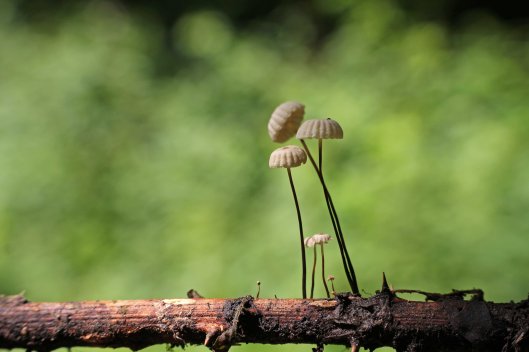
No, this post is not ‘A Practical Manual for Job-Hunters & Career-Changers’ (the book by Dick Bolles). Nor is it about the colour of ‘A cloth canopy which fills with air and allows a person or heavy object attached to it to descend slowly when dropped from an aircraft’ (Oxford Dictionary). This is about Marasmius rotula, the Collared parachute fungus, which seems to be springing up all around at the moment (well, three woodland areas near me, anyway), and the answer to the question is cream.

160628 Collared parachute fungus (1)

This little parachute is tiny: the caps range from 0.5 to 1.5cm across and these fungi grow no more than 7cm high. The epithet rotula refers to its wheel-like shape and, if you have a peep under the cap, you’ll soon seen why – the widely spaced gills are joined to a little collar that encircles the stem and the whole looks very like the spokes on a wheel. Turn it right way up and it looks for all the world like a parachute – but only one suitable for fairies! These grow mostly on the dead wood of deciduous trees and appear from June to September so if you’re out for a woodland walk, keep an eye out for them under the trees.

160628 Collared parachute fungus (2)
160628 Collared parachute fungus (3)
Like Loading...

Dryad’s Saddle

16 Thursday Jun 2016

Posted by sconzani in fungi, nature

≈ 10 Comments

Tags

dryad, Dryad's saddle, fungus, mushroom, Polyporus squamosus

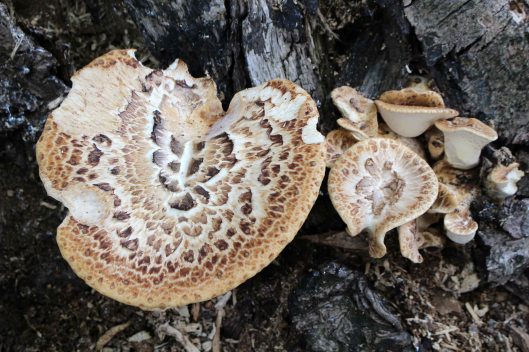
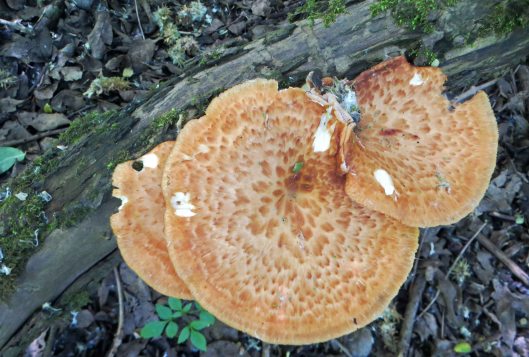
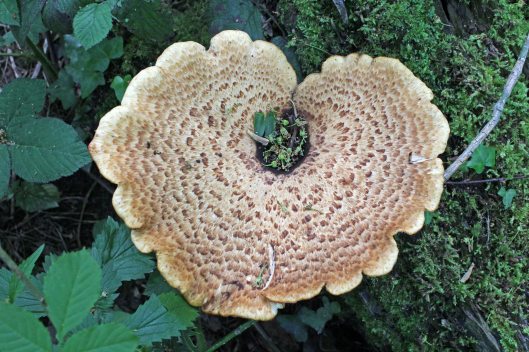
I used to think fungi only appeared in the autumn but I was wrong. I’ve found these three examples of Dryad’s Saddle (Polyporus squamosus) in the past two weeks at three different locations. It’s an edible fungus so I won’t disclose the locations, as the modern trend of foraging all edible fungi can also put some fungi in danger of being over-collected. I prefer just to take photos and leave the fungi to the critters that undoubtedly enjoy it.

160616 dryads saddle (1)

Another common name for this fungus is Pheasant’s back mushroom – as the name implies, the pretty brown colour patterns on the fungus are similar to those seen on the back of a pheasant. The scientific name also refers partly to this patterning (squamosus means scaly), and polyporus means ‘having many pores’ – this is not a gilled mushroom like those you buy at the supermarket; instead, it has a myriad of tiny tubes from which the spores are dispersed.

160616 dryads saddle (3)

The name Dryad’s saddle must have come from someone with a good imagination. In Greek mythology, dryads were tree spirits or nymphs, and the shape of some these fungi does indeed resemble a saddle so, perhaps, when we’re not looking, the dryads emerge from their trees for a gallop around the woodland!

160616 dryads saddle (2)

Like Loading...

Welsh biodiversity: Heath Park

12 Sunday Jun 2016

Posted by sconzani in fungi, insects, nature, wildflowers

≈ 5 Comments

Tags

biodiversity, biological diversity, Heath Park, Wales Biodiversity Week

This is the last, but by no means least, day of Wales Biodiversity Week, and today we’re checking out the biodiversity of another of my locals, Heath Park.

160612 heath park (1)

Once upon a time (in the 1830s), the Lewis family built a great mansion (Heath House) on this land (since demolished – where the Miniature Railway and neighbouring carpark are now) and the present park was part of their estate (you can read more here). Today, the 37-hectare site is owned by Cardiff Council, and contains sports fields, courts and playgrounds, a large carpark (also useful for visitors to neighbouring Heath Hospital), large fields for picnics and dog-walking, a mature woodland and two ponds.

160612 heath park (2)

Part of the woodland is very damp so, as you can see from my photos, it’s ideal for fungi, even in the summer months. And there is also a rather smelly stream, the Nant-y-Wedal, which had a surprising abundance of wildlife amongst the vegetation adorning its banks. Heath Park was an unexpected biodiversity hot spot, so we have a bumper number of photographs which seems a fitting way to close Wales Biodiversity Week for 2016.

160612 heath park (3)
160612 heath park (4)
160612 heath park (5)
160612 heath park (6)
160612 heath park (7)
160612 heath park (8)
160612 heath park (9)
160612 heath park (10)
160612 heath park (11)
160612 heath park (12)
160612 heath park (13)
160612 heath park (14)
160612 heath park (15)
160612 heath park (16)
160612 heath park (17)
Like Loading...

The real peel

30 Monday May 2016

Posted by sconzani in fungi, nature

≈ 5 Comments

Tags

Aleuria aurantia, Bute Park, fungus, Orange peel fungus, SEWBReC

I owe the nifty title for this blog to my friend and colleague in fungi and biological recording, Amy, who works at SEWBReC, the South East Wales Biological Records Centre, and who can not only spin a good line but is extremely handy with a microscope. She checked the tiny aspects of my peel to confirm it really was Orange Peel fungus, despite this being entirely the wrong time of year.

160530 Orange peel fungus (1)

Orange peel fungus (Aleuria aurantia) usually appears in the autumn, fruiting between August and November, though anyone who observes the natural world on a regular basis will know that many things have been well out of sequence this year. The fungus starts out as a cup shape but often splits and contorts as it grows, making it appear even more like the discarded skin of an orange. Its bright orange colour makes it easy to spot in its preferred location, the disturbed soil alongside woodland paths, which is exactly where I found these specimens, in Cardiff’s Bute Park.

160530 Orange peel fungus (2)

Like Loading...

Long live Biological Diversity!

21 Saturday May 2016

Posted by sconzani in flowers, fungi, insects, nature, plants, wildflowers

≈ 5 Comments

Tags

biological diversity, biological recording, biological recording centre, International Bay for Biological Diversity

Tomorrow it will be 24 years since the Convention on Biological Diversity was adopted by the United Nations. To commemorate that momentous day back in 1992, 22 May is now celebrated as the International Day for Biological Diversity. Around the world, events of various kinds – from seminars, exhibitions and leaflets to more hands-on programmes of tree-planting – are organised to promote awareness of the importance of biodiversity, to spread the word that a high variety of plant and animal life is crucial in all habitats.

160521 biodiversity (10)

For my personal celebration, I visited a local nature reserve to see what species of plants, animals, insects, molluscs, etc I could find. And what a treasure trove there was waiting to be discovered! I’ve included some photos here to show you how diverse the area is but I haven’t yet identified everything I saw. I am slowly working my way through my 400 photos. And, as it’s extremely important to record what can be found around us, as a responsible Citizen Scientist, I will also be entering my records into the database of the local biological records centre.

So, here’s a challenge for you. Head out tomorrow, 22 May, and see what you can find in your local park, nature reserve, or even your own garden … and don’t forget to record what you see.

160521 biodiversity (1)
160521 biodiversity (2)
160521 biodiversity (9)
160521 biodiversity (3)
160521 biodiversity (4)
160521 biodiversity (5)
160521 biodiversity (11)
160521 biodiversity (6)
160521 biodiversity (12)
160521 biodiversity (7)
160521 biodiversity (13)
160521 biodiversity (8)
160521 biodiversity (14)
Like Loading...

Fluttering their eyelashes

17 Tuesday May 2016

Posted by sconzani in fungi, nature

≈ 1 Comment

Tags

Cheilymenia, Eyelash fungi, Scutellinia

It’s easy to see how the Scutellinia fungi got their common name of Eyelash fungi – the long dark hairs that grow around their rims would be any girl’s dream – and some of their other vernacular names are delightful: Eyelash cup, Eyelash pixie cup and, my favourite, Molly eye-winker.

160517 Eyelash Scutellinia sp (1)

The fungi in my photos may be Scutellinia scutellata, the Common Eyelash fungi, but, as there are around 50 species of cup-shaped eyelash-fluttering fungi (Scutellinia and Cheilymenia) and they’re all rather tiny (usually no more than 3 to 5 mm across), you need a microscope to tell them apart.

160517 Eyelash Scutellinia sp (2)
160517 Eyelash Scutellinia sp (3)

Though very common in Britain, Europe and North America, and also found in much of South America, Australasia and Asia, the Eyelash fungi are easily overlooked because of their small size, and because they’re often obscured by their mossy surroundings. They have a preference for moist places where there’s plenty of rotten timber to eat, so next time you walk through a soggy woodland, kept a look out for these little dots of orangey-red. They’re around from late spring to late autumn.

160517 Eyelash Scutellinia sp (4)

Like Loading...

When we went down to the woods today …

15 Friday Apr 2016

Posted by sconzani in fungi, nature, nature photography

≈ 9 Comments

Tags

Armillaria mellea, Auricularia mesenterica, Coed Ty Rhiw, Coprinellus micaceus, Daedaleopsis confragosa, fungi foray, Hypoxylon multiforme, Lycogala sp., Metatrichia floriformis, Piptoporus betulinus, Polyporus brumalis, Reticularia lycoperdon, Scutellinia scutellata, Terana caerulea, Trametes versicolour, Xylaria hypoxylon

Well, there weren’t any teddy bears in the Coed Ty Rhiw woods today but we did get lots of lovely surprises. Five friends and fellow members of the Glamorgan Fungi Club and I went on a foray, mostly looking for spring fungi but, as we had a ton of other wildlife expertise in our group, we were also drawn to birds and bugs, bees and butterflies.

Here’s a selection of our fungi finds: Piptoporus betulinus Birch polypore; Auricularia mesenterica Tripe Fungus; Daedaleopsis confragosa Blushing bracket; an unidentified crust fungus; Hypoxylon multiforme Birch woodwart; Terana caerulea Cobalt crust; Reticularia lycoperdon False puffball; Metatrichia floriformis – a slime mould; Lycogala sp. – another slime mould; Trametes versicolour Turkey tail and Xylaria hypoxylon Candlesnuff; Polyporus brumalis Winter Polypore; Trametes versicolour Turkey tail (lovely patterns on this one); Scutellinia scutellata Eyelash fungus; Armillaria mellea rhizomorphs Honey fungus bootlaces; and Coprinellus micaceus Glistening inkcap.

160415 Coed Ty Rhiw foray (1)
160415 Coed Ty Rhiw foray (2)
160415 Coed Ty Rhiw foray (3)
160415 Coed Ty Rhiw foray (4)
160415 Coed Ty Rhiw foray (5)
160415 Coed Ty Rhiw foray (9)
160415 Coed Ty Rhiw foray (10)
160415 Coed Ty Rhiw foray (13)
160415 Coed Ty Rhiw foray (14)
160415 Coed Ty Rhiw foray (15)
160415 Coed Ty Rhiw foray (17)
160415 Coed Ty Rhiw foray (18)
160415 Coed Ty Rhiw foray (19)
160415 Coed Ty Rhiw foray (20)
160415 Coed Ty Rhiw foray (21)
Like Loading...

Merthyr Mawr National Nature Reserve

03 Sunday Apr 2016

Posted by sconzani in fungi, nature

≈ 6 Comments

Tags

Merthyr Mawr National Nature Reserve, national nature reserve, sand dunes, SSSI

What a marvellous place this is! Yesterday, I joined several of my friends from the Glamorgan Fungi Club for a foray up, down and around the rolling sand dunes of the Merthyr Mawr National Nature Reserve. You might think the words fungi and sand dunes are incompatible but you’d be wrong. Though we didn’t find the somewhat elusive fungi we were seeking, we did find several other interesting species, as well as an assortment of the more common critters: ladybirds and butterflies, hoverflies and bees, a glow worm larva and a lizard.

Auricularia auricula-judae Jelly ear
Daedaleopsis confragosa Blushing bracket (1)
Rickenella fibula Orange mosscap (1)
Taphrina alni Alder tongue
Tulostoma brumale Winter stalkball
Xylaria hypoxylon Candlesnuff

The dunes provide the perfect habitat for some rare insect species (the Dune tiger beetle, a rare weevil, the Solitary wasp, the Cuckoo bee and the Mining bee), and are also home to many rare and endangered plants, including two species of Marsh-orchid.

160403 merthyr mawr (2)

These dunes are the second highest in Europe, and, as well as providing a home to wildlife, they have also seen their fair share of human activity over the millennia: everything from Mesolithic stone axes and Neolithic pottery to Bronze Age burial chambers and Roman coins have been found here. It is a place to explore again and again, with each season offering the visitor something special and superb.

160403 Merthyr Mawr to Porthcawl

At the end of the trail through the dunes, the sea!

Like Loading...

Fungi finger prints

06 Sunday Mar 2016

Posted by sconzani in fungi, nature, nature photography, trees

≈ Leave a comment

Tags

fungus, Rhytisma acerinum, sulphur dioxide air pollution, sycamore, Tar spot

Well, they look a bit like finger prints to me – or, perhaps, the wax seals people used to stamp on their communications and documents. But no! These are, in fact, the signs of Tar spot, a disease that most often affects sycamore trees but can also occur in other species of acer, and is caused by the fungus Rhytisma acerinum.

Rhytisma acerinum Sycamore Tarspot (1)

The spots start out yellow in the springtime, then eventually morph into the slightly raised bumpy black spots you can see in my photos. Although they look a little ugly, the spots don’t affect the health of the trees – they merely cause the leaves to drop a little earlier than normal in the autumn.

Rhytisma acerinum Sycamore Tarspot (2)
Rhytisma acerinum Sycamore Tarspot (3)

Though you might not like the look of them, there is one big benefit to seeing these spots on your sycamore tree: as the fungus is particularly sensitive to sulphur dioxide air pollution, its presence indicates your air is relatively clean and healthy.

Rhytisma acerinum Sycamore Tarspot (4)

Like Loading...
← Older posts
Newer posts →

About me

sconzani

sconzani

I'm a writer and photographer; researcher and blogger; birder and nature lover; countryside rambler and city strider; volunteer and biodiversity recorder.

View Full Profile →

Follow earthstar on WordPress.com

Enter your email address to follow this blog and receive notifications of new posts by email.

Recent blog posts

  • Cuttlebones March 16, 2026
  • No woodland here March 15, 2026
  • Family comes first March 14, 2026
  • Local Little egrets March 13, 2026
  • Cormorants, young and old March 12, 2026

From the archives

COPYRIGHT

Unless otherwise acknowledged, the text and photographs on this blog are my own and are subject to international copyright. Nothing may be downloaded or copied without my permission.

Fellow Earth Stars!

  • Unknown's avatar
  • Unknown's avatar
  • Unknown's avatar
  • Unknown's avatar
  • Unknown's avatar
  • Unknown's avatar
  • Unknown's avatar
  • Unknown's avatar
  • Unknown's avatar
  • Unknown's avatar
  • Unknown's avatar
  • Unknown's avatar
  • Unknown's avatar
  • Unknown's avatar
  • Unknown's avatar
  • Unknown's avatar
  • Unknown's avatar
  • Unknown's avatar
  • Unknown's avatar
  • Unknown's avatar
  • Unknown's avatar
  • Unknown's avatar
  • Unknown's avatar
  • Unknown's avatar
  • Unknown's avatar
  • Unknown's avatar
  • Unknown's avatar
  • Unknown's avatar
  • Unknown's avatar
  • Unknown's avatar
  • Unknown's avatar
  • Unknown's avatar
  • Unknown's avatar
  • Unknown's avatar
  • Unknown's avatar
  • Unknown's avatar
  • Unknown's avatar
  • Unknown's avatar
  • Unknown's avatar
  • Unknown's avatar
  • Unknown's avatar
  • Unknown's avatar
  • Unknown's avatar
  • Unknown's avatar
  • Unknown's avatar
  • Unknown's avatar
  • Unknown's avatar
  • Unknown's avatar
  • Unknown's avatar
  • Unknown's avatar

Blog at WordPress.com.

Privacy & Cookies: This site uses cookies. By continuing to use this website, you agree to their use.
To find out more, including how to control cookies, see here: Cookie Policy
  • Subscribe Subscribed
    • earthstar
    • Join 668 other subscribers
    • Already have a WordPress.com account? Log in now.
    • earthstar
    • Subscribe Subscribed
    • Sign up
    • Log in
    • Report this content
    • View site in Reader
    • Manage subscriptions
    • Collapse this bar
 

Loading Comments...
 

You must be logged in to post a comment.

    %d