• ABOUT
  • BIRDING 2018
  • Birding 2019
  • BLOG POSTS
  • Butterflies 2018
  • Resources

earthstar

~ a celebration of nature

earthstar

Category Archives: insects

61/365 From food to frass

02 Saturday Mar 2019

Posted by sconzani in 365DaysWildin2019, insects, nature, plants, wildflowers

≈ 2 Comments

Tags

#365DaysWild, Alexanders, Angle shades caterpillar, Angle shades larvae, Angle shades moth, British moths, British wildflowers, Phlogophora meticulosa

First I noticed the frass (that’s pooh, to most of us). Then I thought ‘Something fairly big must be in these Alexanders’ flower heads somewhere’. And, sure enough, with a little gentle pulling aside of leaves and flowers, I found the frass creator, very well camouflaged by its light green colouring. And then I thought, ‘There might be more’. And, sure enough, I found three caterpillars on three different plants, and frass on several more plants. These are the larvae of the Angle Shades moth (Phlogophora meticulosa). I thought it seemed rather early for them but my local Butterfly Conservation expert George tells me you can find them pretty much any time of year. 

OLYMPUS DIGITAL CAMERA
Like Loading...

57/365 Buzzing

26 Tuesday Feb 2019

Posted by sconzani in 365DaysWildin2019, insects, nature, spring

≈ 10 Comments

Tags

bees, British insects, climate breakdown, climate change, hoverflies, insects emerging early, spring in winter

For the second day in a row, places in north Wales have posted record high winter temperatures and, though a chilly breeze has kept things a bit cooler here in the south, it’s still much warmer than it should be. And these unseasonable highs have been responsible for the early awakening of much insect life. On today’s wander I spotted several hoverflies and bumblebees, a Brimstone butterfly flew past my house earlier, and the cherry tree outside my window has been buzzing with bees all day. It’s wonderful to see all these critters out and about again but it’s also a worry as winter’s probably not finished with us yet.

190226 hoverfly (1)
190226 hoverfly (2)
190226 bee (2)
190226 bee (1)
Like Loading...

44/365 Bee-lieve it or not

13 Wednesday Feb 2019

Posted by sconzani in 365DaysWildin2019, insects, nature, spring, wildflowers

≈ 2 Comments

Tags

#365DaysWild, Alexanders, first bee of the year, Smyrnium olusatrum, Spring is in the air

OLYMPUS DIGITAL CAMERA

Today has been incredibly mild and Spring-like, and the warmer temperatures encouraged the birds to sit singing on tree tops, flowers to open (the flowers in this photo are Alexanders Smyrnium olusatrum – the first I’ve seen open this year), and lapping up the pollen from those flowers was my first bee of 2019.

Like Loading...

28/365 Red admiral

28 Monday Jan 2019

Posted by sconzani in 365DaysWildin2019, insects, nature, winter

≈ 5 Comments

Tags

#365DaysWild, British butterflies, butterfly in January, Red Admiral, winter butterfly

190128 red admiral

The sun may have been shining but it was frosty and very chilly when I spotted this Red admiral on the Penarth to Lavernock coastal path this morning. This is actually my second Red admiral for the year – I also saw one at Cathays Cemetery in Cardiff last week, but only managed a photo of a blurry red splotch high in a tree. I couldn’t help but feel sorry for this morning’s little butterfly, partly because of the cold – and it’s forecast to get much colder in the coming week – but also because there were no flowers to be seen anywhere today. If it doesn’t freeze to death, this little Red admiral might well die of hunger.

Like Loading...

Galls on Red valerian

22 Tuesday Jan 2019

Posted by sconzani in insects, nature

≈ 10 Comments

Tags

British bugs, galls on Centranthus ruber, galls on Red valerian, leaf-roll galls, Trioza centranthi

I first noticed these strange rolled-up leaf edges about a week ago, in the lane behind my house, and, since then, I’ve seen them in several places locally.

190122 trioza centranthi (1)

The plant is Red valerian (Centranthus ruber) and the leaf-rolls are galls, almost certainly caused by the larvae of a little bug called Trioza centranthi. The gall is where it makes its home until it matures into an adult bug, and you can see some of the larvae in the lower right photo below.

190122 trioza centranthi (2)
190122 trioza centranthi (3)
190122 trioza centranthi (4)
190122 trioza centranthi (5)

Amazingly, I photographed the little bug (see below) on one of the plants and I think this is the adult. I’ve read that Trioza centranthi is quite uncommon and, certainly, there are only 3 records in Aderyn, the Welsh biodiversity database but I imagine this is to do with under-recording rather than rarity.

190122 trioza centranthi (6)

Like Loading...

6/365 On the fence

06 Sunday Jan 2019

Posted by sconzani in 365DaysWildin2019, insects, lichen, nature

≈ 4 Comments

Tags

#365DaysWild, British lichen, Cosmeston, Cosmeston Lakes Country Park, lichen on fence post, springtail

Much to the amazement – or perhaps the amusement – of Cosmeston’s dogwalkers, I spent rather a lot of time closely studying the tops of fence posts today. The variety of lichen to be found on them is really quite astonishing but I wasn’t only admiring the lichen. There were even more interesting things sitting on those fence posts …

190106 on the fence

Like Loading...

Under the log

29 Saturday Dec 2018

Posted by sconzani in fungi, insects, molluscs, nature, slugs, winter

≈ 2 Comments

Tags

#7DaysofWildChristmas, brain fungi, Catinella olivacea, Cogan Wood, Cosmeston Lakes Country Park, earthworms, Harvestman, orange slime, slugs, snails, turning over logs, woodlice

The weather was back to grey and drizzly again today so I donned my wet weather gear and headed to Cogan Wood to spend part of day 5 of my #7DaysofWildChristmas challenge turning over a few rotten logs and branches. And what did I find lurking there?

Woodlice; snails both long and rotund; earthworms; luscious balls of orange slime; tiny globular balls that looked like the eggs of something or other; pale little lumps of White or Crystal brain fungi; slugs brown and black; a stripey legged Harvestman; miniscule white mushrooms adorned with drops of water; a young centipede or millipede – I can never be quite sure which is which; dark little cup fungi, black with olive rims (Catinella olivacea) – very pleased with that find; and various other things, the photographs of which were either out of focus or too grainy due to the poor light conditions in the woodland. There’s nothing quite like getting wild and muddy – it was fun!

181229 under the log (11)

181229 under the log (1)
181229 under the log (2)
181229 under the log (3)
181229 under the log (4)
181229 under the log (5)
181229 under the log (6)
181229 under the log (7)
181229 under the log (8)
181229 under the log (9)
181229 under the log (10)
Like Loading...

On the bramble

26 Wednesday Dec 2018

Posted by sconzani in fungi, insects, nature, plants, walks, wildflowers

≈ 4 Comments

Tags

bramble, Grooved bonnet, leafhopper, leafmine on bramble, Mycena fungi, Penarth to Lavernock coastal path, south Wales coastal path, Stigmella aurella, Wales Coastal Path

I took myself on a meander along the south Wales coastal path from Penarth to Lavernock and back again today. The weather was still quite gloomy, as it’s been for several days now, but at least there was no rain. I often have this trail to myself but not today – every man, woman, child and their dog had obviously decided this was a good way to walk off their festive feasting. As I had made it today’s mission to look for the little, I got a lot of strange looks, and I heard one or two ‘What was that lady doing?’ comments after people had passed. To their credit a couple of folk were brave enough to ask me directly but their eyes glazed over when I began to extol the beauty of the many leafhoppers I was seeing.

181226 on the bramble (1)

I saw lots of lovely things but thought, for the purposes of this blog, I’d focus on the Bramble (Rubus fruticosus agg.), which grows in abundance along the coastal path and, with this year’s mild weather, is still very green, and even flowering in places.

181226 on the bramble (2)

I haven’t yet had a chance to identify my finds but I think I have photos of three different species of leafhoppers (though it’s possible number 3 is just a yellower version of number 1). I was amazed to see so many of these little critters still flying and hopping around the bushes, though the winter has been very mild here so far and I think some species over-winter as adults.

181226 on the bramble (3)181226 on the bramble (4)181226 on the bramble (5)

I also spotted a couple of other tiny mini-beasties lurking amongst the leaves. I’m not sure what these are.

181226 on the bramble (6)
181226 on the bramble (7)

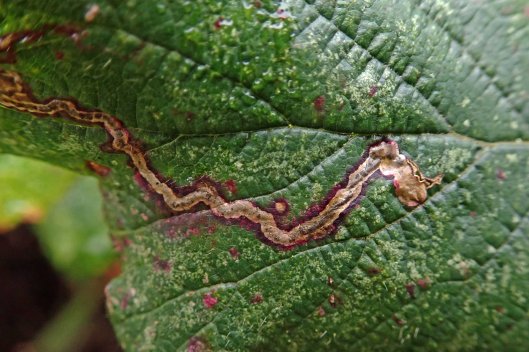
Lots of the leaves had leaf mines, though their makers have now left the leaves. I think most of the mines I saw would have been made by the larvae of Stigmella aurella, a moth.
181226 on the bramble (8)

And my last find was on an old, decaying Bramble branch, where these beautiful little bonnet fungi were growing. Though you can’t see the details in this photo, the caps were striated and the stems grooved so I think these might be Grooved bonnets (Mycena polygramma).


181226 on the bramble (9)

Like Loading...

Two Harvestmen

17 Monday Dec 2018

Posted by sconzani in insects, nature, spiders

≈ 17 Comments

Tags

British insects, British invertebrates, Harvestman, Harvestmen, Opiliones species

I found these two mini-beasties lurking on the outside of my building the other day. They may look like spiders but they’re not really – they’re Harvestmen (Opiliones species). Unlike true spiders, Harvestmen can’t spin webs and their bodies have only one segment, not two. They’re completely harmless – no venom – and, I think, rather prehistoric looking.

181217 harvestmen (1)

And I just discovered this very interesting but slightly creepy snippet of information about them on the UK Safari website:

When attacked, harvestmen are able to shed a leg as a defensive trick. Even after the leg becomes detached from the body it continues to jump and flick about. This distracts the predator while the harvestman makes its escape. They are able to shed up to four legs in this way, but they need to retain at least one of the sensory legs to survive.

181217 harvestmen (2)

Like Loading...

Death on the windowsill

27 Saturday Oct 2018

Posted by sconzani in insects, nature

≈ 2 Comments

Tags

British insects, dead insects, dead insects on the windowsill, dead slater, dead wasp, dead woodlouse, slater, wasp, woodlouse

I don’t know about you but, except on the very coldest of days, I like to have my windows open, at least for a short time each day, to let some fresh air into the house. Trouble is the little critters seem to sense that it’s warmer indoors than out and, if I don’t notice their presence, they don’t manage to escape with their lives. This morning I found two casualties, a Slater and a Wasp.

181025 dead slater181025 dead wasp

Like Loading...
← Older posts
Newer posts →

About me

sconzani

sconzani

I'm a writer and photographer; researcher and blogger; birder and nature lover; countryside rambler and city strider; volunteer and biodiversity recorder.

View Full Profile →

Follow earthstar on WordPress.com

Enter your email address to follow this blog and receive notifications of new posts by email.

Recent blog posts

  • Recent Reed buntings April 17, 2026
  • Tiny but feisty April 16, 2026
  • NFY: Large and Small whites April 15, 2026
  • A loveliness of ladybirds April 14, 2026
  • Hairy-footed flower bees April 13, 2026

From the archives

COPYRIGHT

Unless otherwise acknowledged, the text and photographs on this blog are my own and are subject to international copyright. Nothing may be downloaded or copied without my permission.

Fellow Earth Stars!

  • Unknown's avatar
  • Unknown's avatar
  • Unknown's avatar
  • Unknown's avatar
  • Unknown's avatar
  • Unknown's avatar
  • Unknown's avatar
  • Unknown's avatar
  • Unknown's avatar
  • Unknown's avatar
  • Unknown's avatar
  • Unknown's avatar
  • Unknown's avatar
  • Unknown's avatar
  • Unknown's avatar
  • Unknown's avatar
  • Unknown's avatar
  • Unknown's avatar
  • Unknown's avatar
  • Unknown's avatar
  • Unknown's avatar
  • Unknown's avatar
  • Unknown's avatar
  • Unknown's avatar
  • Unknown's avatar
  • Unknown's avatar
  • Unknown's avatar
  • Unknown's avatar
  • Unknown's avatar
  • Unknown's avatar
  • Unknown's avatar
  • Unknown's avatar
  • Unknown's avatar
  • Unknown's avatar
  • Unknown's avatar
  • Unknown's avatar
  • Unknown's avatar
  • Unknown's avatar
  • Unknown's avatar
  • Unknown's avatar
  • Unknown's avatar
  • Unknown's avatar
  • Unknown's avatar
  • Unknown's avatar
  • Unknown's avatar
  • Unknown's avatar
  • Unknown's avatar
  • Unknown's avatar
  • Unknown's avatar
  • Unknown's avatar

Blog at WordPress.com.

Privacy & Cookies: This site uses cookies. By continuing to use this website, you agree to their use.
To find out more, including how to control cookies, see here: Cookie Policy
  • Subscribe Subscribed
    • earthstar
    • Join 642 other subscribers
    • Already have a WordPress.com account? Log in now.
    • earthstar
    • Subscribe Subscribed
    • Sign up
    • Log in
    • Report this content
    • View site in Reader
    • Manage subscriptions
    • Collapse this bar
 

Loading Comments...
 

You must be logged in to post a comment.

    %d