• ABOUT
  • BIRDING 2018
  • Birding 2019
  • BLOG POSTS
  • Butterflies 2018
  • Resources

earthstar

~ a celebration of nature

earthstar

Category Archives: insects

Rhopalus subrufus

06 Friday Jun 2025

Posted by sconzani in insects

≈ Leave a comment

Tags

British bugs, bugs, mating bugs, Rhopalus subrufus

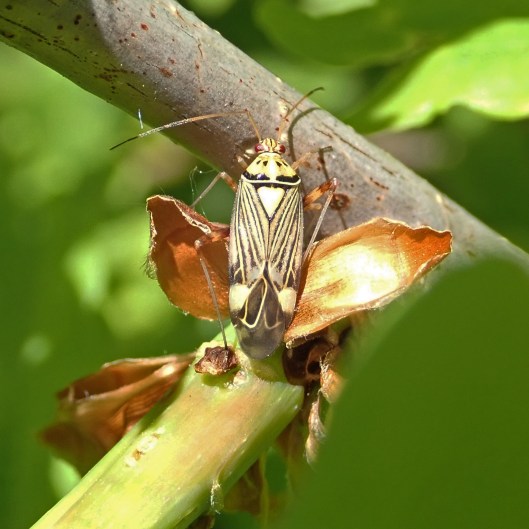
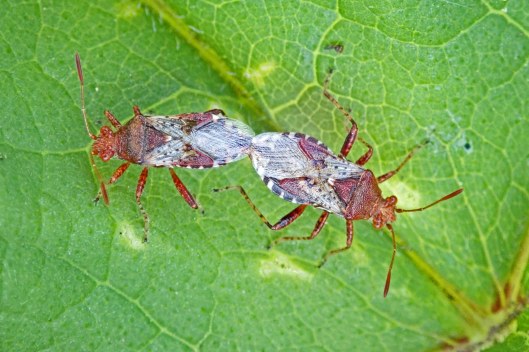
I felt a bit like a voyeur watching these handsome bugs doing their private business but I’d never seen their species before and, with them being preoccupied, it was the perfect opportunity to take a closer look and get some photographs. Rhopalus subrufus is one of four species in the genus Rhopalidae but, fortunately, R. subrufus is relatively easy to identify by the light and dark banding around the edge of its body (that flange is called the connexivum). The location where I found these two is typical of the habitat they favour: on low scrubby vegetation near trees or woodland.

Like Loading...

Cool cats, 2

05 Thursday Jun 2025

Posted by sconzani in insects

≈ Leave a comment

Tags

British moth caterpillars, caterpillars, Common quaker caterpillar, Lackey caterpillar, moth caterpillars, moth larvae, Mottled umber caterpillar, Ruby tiger caterpillar, Vapourer caterpillar

When I’m out walking at this time of year, I always keep a look out for leaf damage as that’s often the way to find invertebrates, whether they be weevils or beetle larvae or moth caterpillars or many other things. Today I thought I’d share some of the cool caterpillars I’ve been finding, most of which are relatively common and easy for everyone to identify. (I’ve linked each name to the relevant page on the UK Moths website so the curious amongst you can see what these cats will look like as moths; it always amazes me how different the adults are from their progeny.)

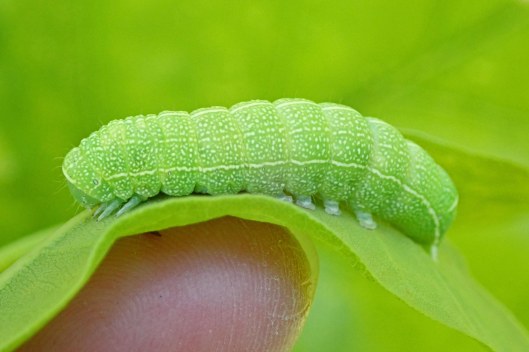
Having said that most of these are relatively common, I’d never actually seen a Common quaker (Orthosia cerasi) caterpillar before but found several recently on one Oak tree. Judging by how plump they were, all had been feeding well, and would be pupating quite soon after I saw them.

As you can perhaps see in my photo, this Lackey (Malacosoma neustria) caterpillar had just moulted (that’s the shed skin on the leaf next to it) and so was looking very vibrant. The Lackey is mostly found in southern parts of Britain and is a good example of how different the adult is – really quite drab.

Do these Mottled umber (Erannis defoliaria) caterpillars think their twig impression will deter hungry birds? Perhaps so. Judging by the fact that I spotted more than 20, of varying sizes and with slight colour variations, on a group of Lombardy poplar trees, their disguise was working.

I have to admit that I wasn’t the first to spot this lovely little Ruby tiger (Phragmatobia fuliginosa) heading purposefully across a local footpath. A young boy, who was out with his parents and their dog, had seen it and was trying, unsuccessfully, to feed it Dandelion leaves.

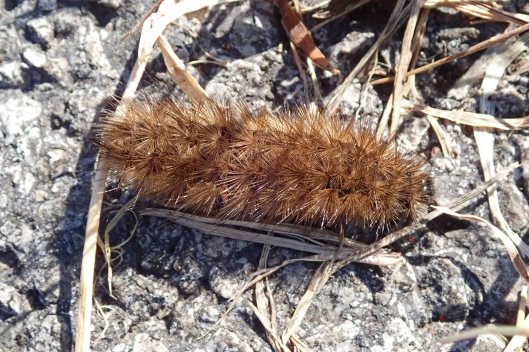
You may recall that, back in January, I blogged about finding a Vapourer cocoon and eggs. Well, though I found this particular caterpillar in a different place entirely, this is what would eventually have emerged from those eggs, the wonderfully flamboyant caterpillar of a Vapourer moth (Orgyia antiqua).

Like Loading...

Juniper shieldbug

03 Tuesday Jun 2025

Posted by sconzani in insects, trees

≈ Leave a comment

Tags

British shieldbugs, Cyphostethus tristriatus, Juniper shieldbug, shieldbug on Juniper, shieldbug on Lawson's cypress

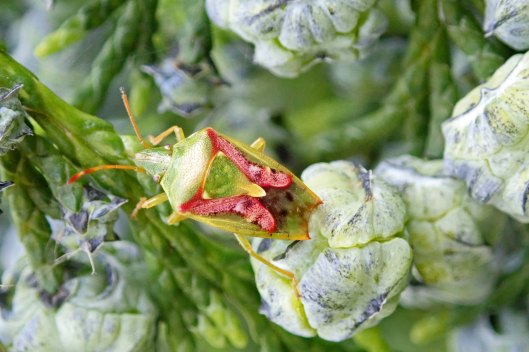
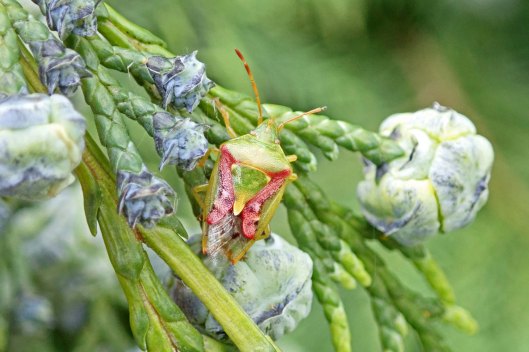
This is a bug I never thought I’d see locally as I don’t know any locations where Juniper trees grow. Fortunately for me, and as stated on the British Bugs website, the Juniper shieldbug (Cyphostethus tristriatus) has started living on Lawson’s cypress (Chamaecyparis lawsoniana) as well as its traditional host tree, the Juniper (Juniperus communis) for which it is named. And Lawson’s cypress is a popular planting in gardens and parks, which is where this tree was growing, alongside a path that runs around a local recreation ground.

British Bugs explains that adult Juniper shieldbugs, with the beautiful reddish-pink markings on their backs, can be seen all year round, though they tend not to be too active during the coldest winter months, like most of us. The nymphs that hatch from mid to late Spring feed on Juniper and Cypress berries and, like all shieldbugs, they go through a series of instars before reaching adulthood. The website has excellent, illustrated downloadable charts of the various stages of most shieldbug species for easy identification if you happen to spot a nymph and, now that I know where this Juniper shieldbug lives, I’ll have to go back and look for more, adults and nymphs.

Like Loading...

Galls: Macrodiplosis pustularis

02 Monday Jun 2025

Posted by sconzani in insects, trees

≈ Leave a comment

Tags

British galls, Cecidomyiidae, folded leaf lobes on Oak leaves, gall midges, galls on Oak leaves, insects on Oak, Macrodiplosis pustularis

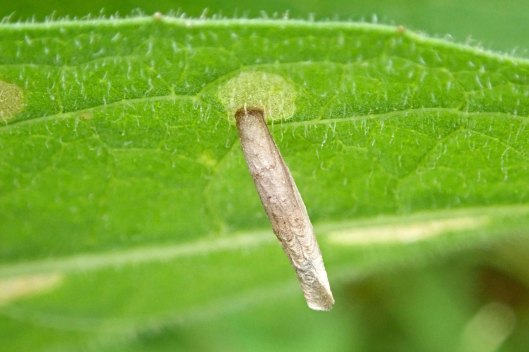
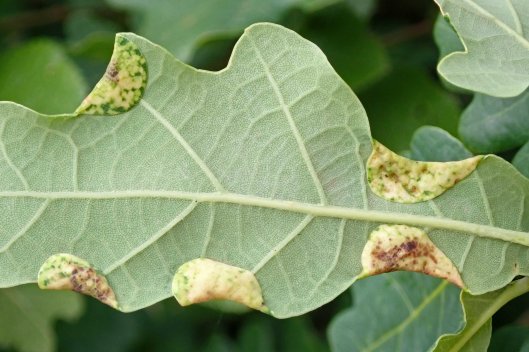
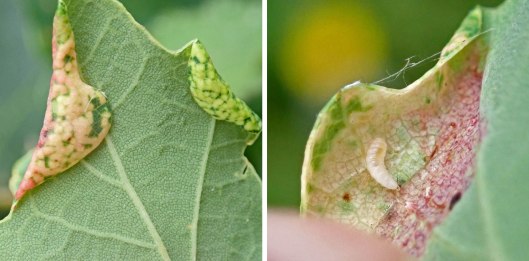
In my ignorance, when I first saw these folded-over leaf lobes on an Oak tree in a local park, I thought they had been created by leaf-mining moth larvae. Fortunately, there are much smarter people around than me and, when I posted some photos on social media, one of them popped up and told me what these really were: galls made by the larvae of the gall midge, Macrodiplosis pustularis.

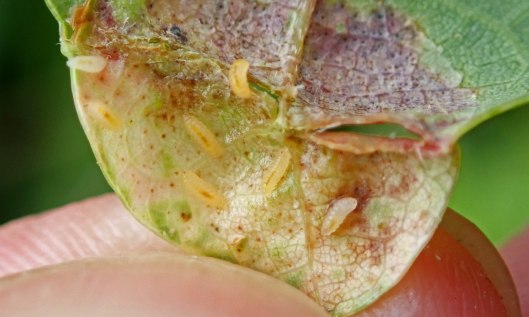
Of course, once I knew that I had to return to the spot and pull up a couple of the folds to see the tiny larvae. The numbers inside can vary, apparently, from one to six or more. They are white when young but change to an orange colour as they develop.

The fold of the leaf is both a means of protection for the vulnerable larvae and also a food larder; they eat the leaf from the inside. Eventually, the larvae will drop from their leaf shelters, pupate and remain in the soil until the following Spring, when the whole process begins again.

Like Loading...

Cacopsylla ambigua

29 Thursday May 2025

Posted by sconzani in insects

≈ 2 Comments

Tags

Cacopsylla ambigua, jumping plant lice, psyllidae, psyllids, psyllids on willow

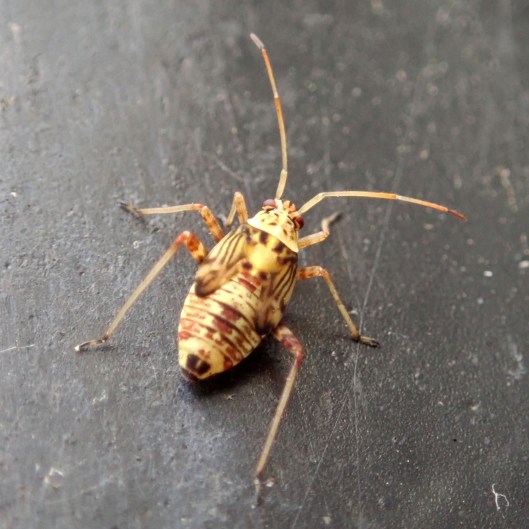
Have you ever heard of jumping plant lice? No? Me neither, until very recently. But when a tiny insect that I initially thought was a barkfly leapt rather dramatically from its leaf into the vegetation a metre or so below rather than have its photograph taken, I thought ‘well, that’s odd’.

The family name for the jumping plant lice is Psyllidae and at least 77 species have been found living in Britain. Fortunately for me, the two Psyllids shown here stayed completely still, allowing me to get close enough for reasonable photos; they’re only 3-4mm long so getting very close is the only way for me to photograph them.

I haven’t yet had their identity confirmed but these have the characteristics of Cacopsylla (formerly Psylla) ambigua that I found listed on the British Bugs website, and they were found on Willow trees, which also fits; they are generally plant-specific, which certainly helps with their identification.

Like Loading...

Two dragons

28 Wednesday May 2025

Posted by sconzani in insects

≈ Leave a comment

Tags

British dragonflies, Broad-bodied Chaser, dragonfly, Four-spotted Chaser, Libellula depressa, Libellula quadrimaculata, Odonata

For me, the larger dragonflies have been few and far between this Spring. I’ve seen the odd one but fleetingly and its flown off before I could get a good view. Or I’ve heard one, that distinctive sound of the small wings rustling together as it takes flight. So, finally to have found two dragons that stayed still long enough for me to admire their colours and get some photographs has been very welcome indeed. Below are a Four-spotted chaser (Libellula quadrimaculata) and a Broad-bodied chaser (Libellula depressa). Fingers crossed for more sightings to come.

Like Loading...

Leafhopper: Oncopsis alni

27 Tuesday May 2025

Posted by sconzani in insects

≈ Leave a comment

Tags

British cicadellidae, British leafhoppers, Cicadellidae, cicadellidae on Alder, leafhoppers on Alder, Oncopsis alni

Oncopsis alni is one of the more chunky leafhoppers and it lives almost exclusively on Alder, hence the alni in its name. As I’ve been strolling along my various local walking routes this Spring, I’ve been checking the Alder trees for signs of leafhoppers, and have seen quite a lot of nymphs of various sizes but, as they’ve been juveniles, I haven’t been certain of their identification.

Now that some of the nymphs are reaching adulthood, it’s possible to be somewhat more certain. Although the Naturespot website warns that this species ‘can only be identified by examination of internal genital structure’, the information on the British Bugs website is a bit more optimistic. For one thing, and with the proviso that bugs don’t always stick to the rules, this is the only member of the Oncopsis genus that is found on Alder. Also, ‘although males can show extensive dark markings on the upper part of the face, the discoidal spots below these are small in both sexes’, and I think I can see this distinguishing feature in my various photos. I should add a disclaimer though: my finds have not yet been verified by the national recorder.

Like Loading...

Fly: Poecilobothrus nobilitatus

26 Monday May 2025

Posted by sconzani in insects

≈ Leave a comment

Tags

British flies, fly, long-legged fly, Poecilobothrus nobilitatus

Its name sounds like an incantation a Harry Potter acolyte might chant to turn an annoying peer into a toad, though Google AI suggests: ‘The genus name Poecilobothrus comes from the Greek words “poikilos” (various, or variegated) and “botryx” (a cluster of grapes), likely referring to the diverse and ornate nature of some dance fly species’ and ‘The species name nobilitatus is derived from the Latin word “nobilitatus,” meaning “made noble” or “ennobled,” which could relate to the elegant or showy appearance of the fly, particularly during courtship.’ I can certainly agree that this little long-legged fly is an ornate and elegantly formed creature.

I don’t usually have much luck identifying fly species but, fortunately for me, this one was a male and so it has distinctive white markings on the end of its wings, which it flashes at potential mates during its courtship display. I spotted this specimen sitting on vegetation next to a local footpath but they are usually to be found in wet locations, often sitting on weed floating on the surface of a pond or slow-moving stream.

Like Loading...

Demoiselles

24 Saturday May 2025

Posted by sconzani in insects

≈ Leave a comment

Tags

Banded Demoiselle, Beautiful Demoiselle, British dragonflies, Calopteryx splendens, Calopteryx Virgo, demoiselles, Odonata

Thursday was a good day for demoiselles. As I strolled along the old Glamorgan canal at Forest Farm Nature Reserve, I was almost constantly entertained by both the Beautiful (Calopteryx virgo) and the Banded demoiselles (Calopteryx splendens), though there were definitely many more of the former than the latter.

 ~ male Beautiful demoiselle

While the females mostly perched quietly on leaves somewhat removed from the males – the only way to escape their attention, the males seldom kept still. They flashed their wings, displaying their metallic blue hues to impress any female that did venture past, and competed with other males for the best territories, those with sun, and shelter, and perches, and suitable places for egg-laying. What was serious breeding business for these stunning creatures was enchanting and magical for me.

~ male Banded demoiselle

Like Loading...

A skipper surprise

23 Friday May 2025

Posted by sconzani in insects

≈ Leave a comment

Tags

British butterflies, butterfly, early emergence, Large skipper, skipper butterflies

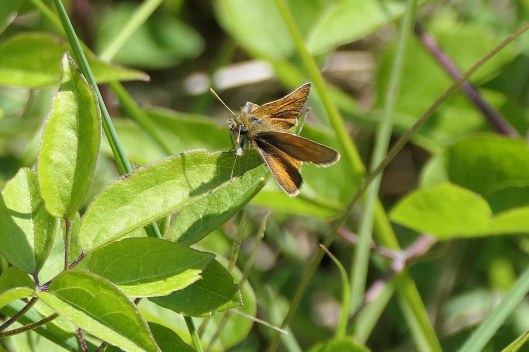
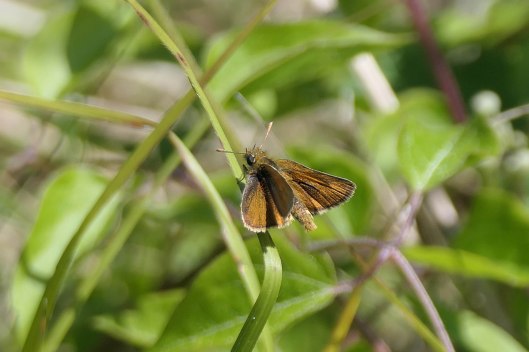
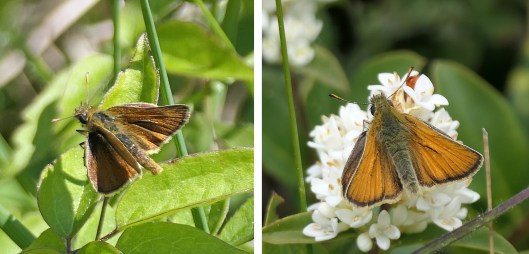
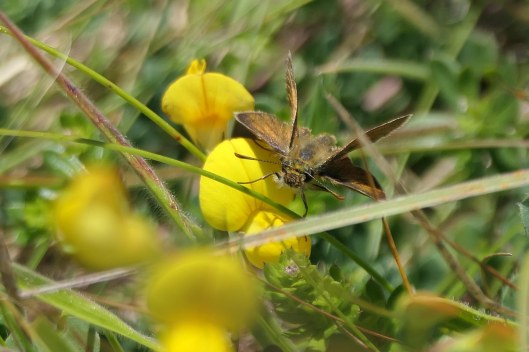
You could’ve knocked me over with the draft from a butterfly’s wing when this gorgeous creature flitted up from the foliage to greet me as I walked the coastal path on Tuesday. Large skippers don’t usually appear locally until early June but our lengthy spell of warm dry weather is having a very obvious effect on insect emergence times this year.

Like Loading...
← Older posts
Newer posts →

About me

sconzani

sconzani

I'm a writer and photographer; researcher and blogger; birder and nature lover; countryside rambler and city strider; volunteer and biodiversity recorder.

View Full Profile →

Follow earthstar on WordPress.com

Enter your email address to follow this blog and receive notifications of new posts by email.

Recent blog posts

  • Three Common sandpipers February 17, 2026
  • Beetle: Athous bicolor February 16, 2026
  • Crocus flower power February 15, 2026
  • Delightful doves February 14, 2026
  • Fan-like fungi February 13, 2026

From the archives

COPYRIGHT

Unless otherwise acknowledged, the text and photographs on this blog are my own and are subject to international copyright. Nothing may be downloaded or copied without my permission.

Fellow Earth Stars!

  • Unknown's avatar
  • Unknown's avatar
  • Unknown's avatar
  • Unknown's avatar
  • Unknown's avatar
  • Unknown's avatar
  • Unknown's avatar
  • Unknown's avatar
  • Unknown's avatar
  • Unknown's avatar
  • Unknown's avatar
  • Unknown's avatar
  • Unknown's avatar
  • Unknown's avatar
  • Unknown's avatar
  • Unknown's avatar
  • Unknown's avatar
  • Unknown's avatar
  • Unknown's avatar
  • Unknown's avatar
  • Unknown's avatar
  • Unknown's avatar
  • Unknown's avatar
  • Unknown's avatar
  • Unknown's avatar
  • Unknown's avatar
  • Unknown's avatar
  • Unknown's avatar
  • Unknown's avatar
  • Unknown's avatar
  • Unknown's avatar
  • Unknown's avatar
  • Unknown's avatar
  • Unknown's avatar
  • Unknown's avatar
  • Unknown's avatar
  • Unknown's avatar
  • Unknown's avatar
  • Unknown's avatar
  • Unknown's avatar
  • Unknown's avatar
  • Unknown's avatar
  • Unknown's avatar
  • Unknown's avatar
  • Unknown's avatar
  • Unknown's avatar
  • Unknown's avatar
  • Unknown's avatar
  • Unknown's avatar
  • Unknown's avatar

Blog at WordPress.com.

Privacy & Cookies: This site uses cookies. By continuing to use this website, you agree to their use.
To find out more, including how to control cookies, see here: Cookie Policy
  • Subscribe Subscribed
    • earthstar
    • Join 670 other subscribers
    • Already have a WordPress.com account? Log in now.
    • earthstar
    • Subscribe Subscribed
    • Sign up
    • Log in
    • Report this content
    • View site in Reader
    • Manage subscriptions
    • Collapse this bar
 

Loading Comments...
 

You must be logged in to post a comment.

    %d