• ABOUT
  • BIRDING 2018
  • Birding 2019
  • BLOG POSTS
  • Butterflies 2018
  • Resources

earthstar

~ a celebration of nature

earthstar

Category Archives: insects

Three moths in one day

20 Monday Jun 2016

Posted by sconzani in insects, nature, nature photography

≈ 6 Comments

Tags

Brimstone moth, Burnet companion, Cathays Cemetery, Cinnabar moth, Euclidia glyphica, moth, Opisthograptis luteolata, Tyria jacobaeae

The day I did my biodiversity hunt at Cathays Cemetery was a bumper day for moths, with three new species spotted.

brimstone (1)
brimstone (2)

The first was this beautiful Brimstone (Opisthograptis luteolata), not to be confused with the butterfly of the same name, though both are a mellow buttery yellow. I was flat out on the grass photographing this when a group of young school children passed by. ‘Teacher, what’s that lady doing?’ ‘I don’t know, David’, came the reply, as the teacher quickly ushered her charges past the mad lady lying down in the cemetery!

cinnabar (1)
cinnabar (2)
cinnabar (3)

The Cinnabar moth (Tyria jacobaeae) is a colourful character. It starts out life as a bright orange and black caterpillar, then transforms into a bright red and black moth – it gets its name from the bright red mineral mercury sulphide, also known as cinnabar. The caterpillars can be cannibalistic when their food source is scarce and, though I never saw them there, these moths were introduced to New Zealand in an attempt to control the invasive ragwort plant on which their caterpillars feed.

160620 burnet companion (3)
160620 burnet companion (4)
160620 burnet companion (5)

Last but certainly not least, as I saw several of these in one small area, was the Burnet companion (Euclidia glyphica). It apparently gets its common name from the fact that it’s often seen in the company of Burnet moths – not on this day! I make no excuses for showing its bottom, as the colour of its underside is a rich orange, almost more attractive than its top. Though they were mostly skittish, one very obligingly remained still long enough to get a head-on shot, which I love.
Like Loading...

Welsh biodiversity: Heath Park

12 Sunday Jun 2016

Posted by sconzani in fungi, insects, nature, wildflowers

≈ 5 Comments

Tags

biodiversity, biological diversity, Heath Park, Wales Biodiversity Week

This is the last, but by no means least, day of Wales Biodiversity Week, and today we’re checking out the biodiversity of another of my locals, Heath Park.

160612 heath park (1)

Once upon a time (in the 1830s), the Lewis family built a great mansion (Heath House) on this land (since demolished – where the Miniature Railway and neighbouring carpark are now) and the present park was part of their estate (you can read more here). Today, the 37-hectare site is owned by Cardiff Council, and contains sports fields, courts and playgrounds, a large carpark (also useful for visitors to neighbouring Heath Hospital), large fields for picnics and dog-walking, a mature woodland and two ponds.

160612 heath park (2)

Part of the woodland is very damp so, as you can see from my photos, it’s ideal for fungi, even in the summer months. And there is also a rather smelly stream, the Nant-y-Wedal, which had a surprising abundance of wildlife amongst the vegetation adorning its banks. Heath Park was an unexpected biodiversity hot spot, so we have a bumper number of photographs which seems a fitting way to close Wales Biodiversity Week for 2016.

160612 heath park (3)
160612 heath park (4)
160612 heath park (5)
160612 heath park (6)
160612 heath park (7)
160612 heath park (8)
160612 heath park (9)
160612 heath park (10)
160612 heath park (11)
160612 heath park (12)
160612 heath park (13)
160612 heath park (14)
160612 heath park (15)
160612 heath park (16)
160612 heath park (17)
Like Loading...

Welsh biodiversity: Roath Wild Gardens

11 Saturday Jun 2016

Posted by sconzani in birds, insects, nature, wildflowers

≈ Leave a comment

Tags

biodiversity, Roath Park, Roath Park Wild Gardens, Wales Biodiversity Week

You’ve heard of the baker’s dozen? Well, today let me introduce you to the Welsh week. In Wales, it seems, a week actually consists of nine days (!) so here is my selection for day eight of Wales Biodiversity Week.

I am lucky to live opposite Roath Park, here in Cardiff, but it’s a large and varied place, with recreation grounds and a botanical garden, as well as a lake, so I’ve chosen just one smallish area for my biodiversity challenge, the Wild Gardens at the northern end of the lake.

160611 roath wild (2)160611 roath wild (1)

Developed slightly later than the rest of the park, in 1896, the Wild Gardens have seen many changes in their lifetime. In the early days there was a summer house in the centre and during 1910-11 three ponds for trout-rearing were constructed. Nowadays the Gardens live up to their ‘wild’ name, with a network of dirt footpaths winding back and forth amongst a canopy of mature trees with shrubby growth beneath. A few weeks ago this place was awash with wild garlic – a most gIorious, if smelly spectacle, and now it’s lush with blackberry bushes and ferns, grasses and wildflowers. I love its wildness and so does the wildlife, as you can see from these photos, all taken on yesterday’s wander.

160611 roath wild (3)
160611 roath wild (4)
160611 roath wild (5)
160611 roath wild (6)
160611 roath wild (7)
160611 roath wild (8)
160611 roath wild (9)
160611 roath wild (10)
160611 roath wild (11)
160611 roath wild (12)
160611 roath wild (13)
160611 roath wild (14)
Like Loading...

Welsh biodiversity: Coryton roundabout

10 Friday Jun 2016

Posted by sconzani in insects, nature, wildflowers

≈ 8 Comments

Tags

biodiversity, Coryton roundabout, native orchids, Wales Biodiversity Week

160610 coryton roundabout (1)

You might think I’ve gone a little bonkers with today’s choice of site for day seven of Wales Biodiversity Week, but you’d be wrong. Officially known as Juncton 32, the Coryton roundabout, where the M4 motorway and the A470 spin around together, is the large roundabout in Wales and one of the largest in Britain. That means it contains large areas of green space within its boundaries and, as the Cardiff Naturalists Society can verify, it is a very rich habitat for all manner of plants and insects.

160610 coryton roundabout (2)

Yesterday was my first visit to this place. If you can ignore the constant traffic noise and the buzz from the large power pylons, it is a lovely patch for a wander, with parcels of mature trees and wedges of flower-filled meadows, which have the added bonus of an abundance of native orchids. Several species can be found here apparently, the Common spotted and Bee orchids, Twayblade and Broad-leaved helloborines, as well as the Pyramidal orchid. I also found quite a few critters enjoying their efflorescent surroundings. It was a most unexpectedly biodiverse location!

160610 coryton roundabout (3)
160610 coryton roundabout (4)
160610 coryton roundabout (5)
160610 coryton roundabout (6)
160610 coryton roundabout (7)
160610 coryton roundabout (8)
160610 coryton roundabout (9)
160610 coryton roundabout (10)
160610 coryton roundabout (11)
160610 coryton roundabout (12)
160610 coryton roundabout (13)
160610 coryton roundabout (14)


Like Loading...

Welsh biodiversity: Forest Farm

09 Thursday Jun 2016

Posted by sconzani in animals, birds, insects, nature

≈ Leave a comment

Tags

biodiversity, birding, birdwatching, damselflies, dragonflies, Forest Farm Nature Reserve, rabbits, Wales Biodiversity Week

I’ve sung the praises of Forest Farm in previous blogs (here and here) and enjoyed many conversations with robins during my walks there but today, on day six of Wales Biodiversity Week, for the wildlife at Forest Farm it was all about procreation.

160609 forest farm (1)

Male damselflies were flashing their colourful wings trying to impress the females; male dragonflies were patrolling their territory to warn off any potential interlopers; damselflies were copulating as they flew along the canal and around the pond, and I saw two female dragonflies depositing their eggs amongst plants and reeds in the pond.

160609 forest farm (2)

The birdlife was a little more advanced – there were chicks and fledglings everywhere: ducklings, baby coots and moorhens, young robins and dunnocks, to name just a few. Perhaps cutest of all, though, were the baby rabbits, happily frolicking and nibbling on the grass near the bird hides. It was like a scene from Watership Down!

1
2
3
4
5
6
7
8
9
10
11
12
Like Loading...

Pretty in pink

02 Thursday Jun 2016

Posted by sconzani in insects, nature

≈ 13 Comments

Tags

Chorthippus parallelus, genetic mutation, Kenfig National Nature Reserve, Meadow grasshopper, pink grasshopper

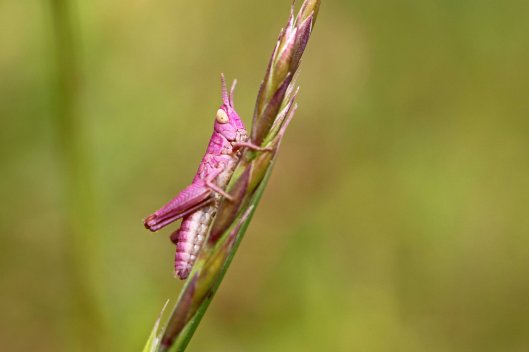
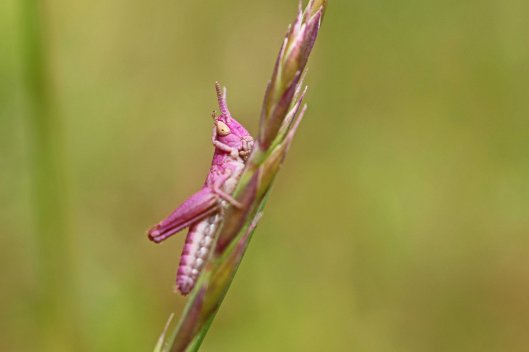
If someone had told me before last Saturday that there was such a thing as a pink grasshopper living in Wales, I would’ve laughed and assumed they were having me on … but, as they say, seeing is believing.

160602 Meadow grasshopper (1)

This is another of the amazing creatures I encountered at Kenfig National Nature Reserve last weekend. It’s a Meadow grasshopper (Chorthippus parallelus), a common species throughout Europe and in parts of Asia. With its lake and ponds, and its frequently damp dune slacks, Kenfig has the perfect habitat for this grasshopper which prefers moist vegetation rather than a dry environment. Although green is the most common colour, the Meadow grasshopper can also be completely or partially brown, a reddish-purple and, yes, pink. It appears that the pink colour is a result of a genetic mutation during the reproductive cycle, similar to that which causes albinism. And it is definitely a she as, apparently, only the females are affected by this recessive gene.

160602 Meadow grasshopper (2)

Like Loading...

The Cardinal wears red

29 Sunday May 2016

Posted by sconzani in insects, nature

≈ 8 Comments

Tags

beetle, Pyrochroa serraticornis, Red-headed Cardinal beetle

160529 Cardinal beetle (1)

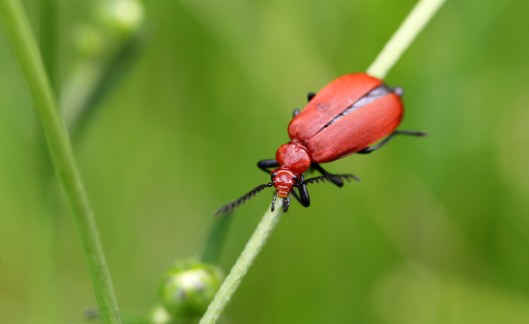
May I respectfully introduce to you His Eminence the Red-headed Cardinal beetle (Pyrochroa serraticornis), gloriously clad in his scarlet attire – no green camouflage for this prominent member of the insect congregation. He’s clever: the bright red colour is a ruse to fool potential predators into thinking he’s toxic. He’s a predator himself: he snacks on flying insects not herbage. Unlike his Christian counterpart, he’s common: he can be found throughout Britain. His diocese is the woodland edge, where he has a particular liking for rotting stumps, though he’s also partial to long periods of sunbathing on large leaves.

160529 Cardinal beetle (2)
160529 Cardinal beetle (3)
160529 Cardinal beetle (4)
Like Loading...

The helicopters of the insect world

24 Tuesday May 2016

Posted by sconzani in insects, nature

≈ Leave a comment

Tags

Brachyopa, Epistrophe eligans, hoverfly, Portevinia maculata, Syrphus

My fascination with hoverflies continues, fuelled partly by their intriguing habit of hovering directly in front of me, as if checking out my human intrusion into their air space. Or maybe it’s just their curiosity. A friend told me to hold out my hand, palm down, for the little critters to use as a landing pad … and, you know, it actually works!

Here are four of my latest helicoptering friends.

160524 Epistrophe eligans Cathays Cem

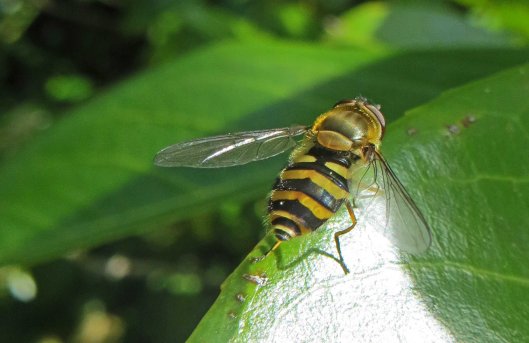
My first newbie is Epistrophe eligans, discovered in Cathays Cemetery on 24 April. Their preferred habitat is sunny hedgerows and woodland edges, with a particular liking for Hawthorn and Blackthorn. Their yellow stripe patterns can vary a lot so I was grateful for the help of the experts on the UK Hoverflies Facebook group for an ID on this (and, in fact, on all my hoverflies).

160524 Syrphus ribesii Cathays Cem

Here’s another from Cathays Cemetery. It’s one of the Syrphus species, possibly ribesii, but it’s almost identical to Syrphus vitripennis and my photo doesn’t show enough detail to differentiate the two. This is one of Britain’s more common hoverflies so I hope to get a better photo eventually.

160524 Portevinia maculate Bute Park

I found this Portevinia maculata in Bute Park last week, flitting around in the Ramsons, its favourite plant. Its black and grey colouring make this an easy one to identify.

160524 Brachyopa sp forest farm

And last but not least, one of the Brachyopa species. At first, I didn’t realise this was a hoverfly, as its grey and brown colours are rather unusual, though they also make it easy to recognise … once you know what it is.

Like Loading...

Green dock beetles

22 Sunday May 2016

Posted by sconzani in insects, nature, spring

≈ 4 Comments

Tags

dock plant, Gastrophysa viridula, Green dock beetle

Green dock beetle seems such a plain name for such a beautiful little creature as this. Even its scientific name, Gastrophysa viridula, makes it sound like a brand of effervescent stomach-acid relief tablet. I think it should be renamed Rainbow dock beetle, as the metallic sheen of its green wing casings makes it appear blue, purple, red, turquoise or even gold, depending on the light.

1 Green Dock Beetle Gastrophysa viridula
2 Green Dock Beetle Gastrophysa viridula

At around 4mm long, Mr GDB is smaller than Mrs GDB, who is usually around 7mm, and he looks even smaller when the female’s body becomes swollen during pregnancy. She expands so much even her wing cases won’t fit properly.

3 Green Dock Beetle Gastrophysa viridula
4 Green Dock Beetle Gastrophysa viridula
5 Green Dock Beetle Gastrophysa viridula
6 Green Dock Beetle Gastrophysa viridula
7 Green Dock Beetle Gastrophysa viridula

he doesn’t give up easily!

As you can surmise from their name, these little beetles live on dock plants and are easily spotted in the months of May and June, if not by that iridescent shimmer, then from all the little holes they make in the dock leaves. Turn over a leaf and you’re likely to find little clusters of yellow-orange eggs or, if you’re lucky, a little group of the next generation, the little dark-greyish larvae. These will eventually pupate underground, then between 7-10 days later the adult beetles will emerge to start the cycle all over again.

Green Dock Beetle Gastrophysa viridula (5)
Green Dock Beetle Gastrophysa viridula (21)
Like Loading...

Long live Biological Diversity!

21 Saturday May 2016

Posted by sconzani in flowers, fungi, insects, nature, plants, wildflowers

≈ 5 Comments

Tags

biological diversity, biological recording, biological recording centre, International Bay for Biological Diversity

Tomorrow it will be 24 years since the Convention on Biological Diversity was adopted by the United Nations. To commemorate that momentous day back in 1992, 22 May is now celebrated as the International Day for Biological Diversity. Around the world, events of various kinds – from seminars, exhibitions and leaflets to more hands-on programmes of tree-planting – are organised to promote awareness of the importance of biodiversity, to spread the word that a high variety of plant and animal life is crucial in all habitats.

160521 biodiversity (10)

For my personal celebration, I visited a local nature reserve to see what species of plants, animals, insects, molluscs, etc I could find. And what a treasure trove there was waiting to be discovered! I’ve included some photos here to show you how diverse the area is but I haven’t yet identified everything I saw. I am slowly working my way through my 400 photos. And, as it’s extremely important to record what can be found around us, as a responsible Citizen Scientist, I will also be entering my records into the database of the local biological records centre.

So, here’s a challenge for you. Head out tomorrow, 22 May, and see what you can find in your local park, nature reserve, or even your own garden … and don’t forget to record what you see.

160521 biodiversity (1)
160521 biodiversity (2)
160521 biodiversity (9)
160521 biodiversity (3)
160521 biodiversity (4)
160521 biodiversity (5)
160521 biodiversity (11)
160521 biodiversity (6)
160521 biodiversity (12)
160521 biodiversity (7)
160521 biodiversity (13)
160521 biodiversity (8)
160521 biodiversity (14)
Like Loading...
← Older posts
Newer posts →

About me

sconzani

sconzani

I'm a writer and photographer; researcher and blogger; birder and nature lover; countryside rambler and city strider; volunteer and biodiversity recorder.

View Full Profile →

Follow earthstar on WordPress.com

Enter your email address to follow this blog and receive notifications of new posts by email.

Recent blog posts

  • The return of the Willow warblers April 23, 2026
  • Bug: Harpocera thoracica April 22, 2026
  • A female Tawny April 21, 2026
  • NFY: Orange-tip April 20, 2026
  • All the yellows April 19, 2026

From the archives

COPYRIGHT

Unless otherwise acknowledged, the text and photographs on this blog are my own and are subject to international copyright. Nothing may be downloaded or copied without my permission.

Fellow Earth Stars!

  • Unknown's avatar
  • Unknown's avatar
  • Unknown's avatar
  • Unknown's avatar
  • Unknown's avatar
  • Unknown's avatar
  • Unknown's avatar
  • Unknown's avatar
  • Unknown's avatar
  • Unknown's avatar
  • Unknown's avatar
  • Unknown's avatar
  • Unknown's avatar
  • Unknown's avatar
  • Unknown's avatar
  • Unknown's avatar
  • Unknown's avatar
  • Unknown's avatar
  • Unknown's avatar
  • Unknown's avatar
  • Unknown's avatar
  • Unknown's avatar
  • Unknown's avatar
  • Unknown's avatar
  • Unknown's avatar
  • Unknown's avatar
  • Unknown's avatar
  • Unknown's avatar
  • Unknown's avatar
  • Unknown's avatar
  • Unknown's avatar
  • Unknown's avatar
  • Unknown's avatar
  • Unknown's avatar
  • Unknown's avatar
  • Unknown's avatar
  • Unknown's avatar
  • Unknown's avatar
  • Unknown's avatar
  • Unknown's avatar
  • Unknown's avatar
  • Unknown's avatar
  • Unknown's avatar
  • Unknown's avatar
  • Unknown's avatar
  • Unknown's avatar
  • Unknown's avatar
  • Unknown's avatar
  • Unknown's avatar
  • Unknown's avatar

Blog at WordPress.com.

Privacy & Cookies: This site uses cookies. By continuing to use this website, you agree to their use.
To find out more, including how to control cookies, see here: Cookie Policy
  • Subscribe Subscribed
    • earthstar
    • Join 642 other subscribers
    • Already have a WordPress.com account? Log in now.
    • earthstar
    • Subscribe Subscribed
    • Sign up
    • Log in
    • Report this content
    • View site in Reader
    • Manage subscriptions
    • Collapse this bar
 

Loading Comments...
 

You must be logged in to post a comment.

    %d