• ABOUT
  • BIRDING 2018
  • Birding 2019
  • BLOG POSTS
  • Butterflies 2018
  • Resources

earthstar

~ a celebration of nature

earthstar

Category Archives: insects

K is for Knopper

16 Saturday Dec 2023

Posted by sconzani in insects, plants, trees

≈ Leave a comment

Tags

British galls, bug galls, galls, galls on Ash, galls on Hazel, galls on oak trees, galls on Poplar, galls on willow, galls on Yew, Knopper gall, midge galls, mite galls, wasp galls

This is really a review of the galls I’ve found this year but the letter G simply had to be about my first ever confirmed Goshawk sighting, so K is for Knopper is my alternative lead in.
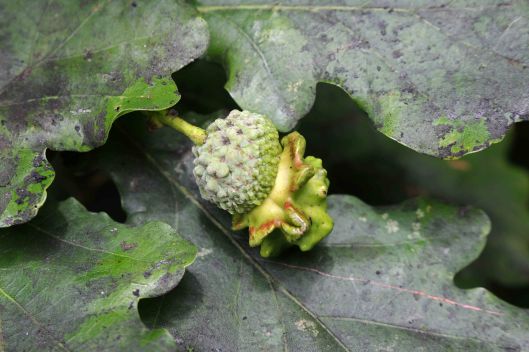
231216 Knopper Andricus quercuscalicis

Knopper galls, like the one shown above, did feature in one post this year, Acorns and galls on 1 October, but there were many other galls, most of which were new finds for me. February saw the year off to a good start with galls on Yew trees caused by a tiny midge (Galls: Taxomyia taxi, 9 February) and galls on Hazel caused by an equally tiny mite (Galls: Phytoptus avellanae, 20 February). In June, it was a small bug that was creating eye-catching galls on the leaves of an Ash tree (Galls: Psyllopsis fraxini, 12 June), and, in July, aphids were the gall causers on a Poplar tree (Galls: Pemphigus spyrothecae, 17 July). In that October blog Acorns and galls I mentioned above, as well as the knoppers, another tiny wasp had caused artichoke galls to form on the same Oak tree. And, a couple of weeks later, I found my final new galls for the year, those caused by midges on Willow trees (Galls: Rabdophaga rosaria, 17 October). All in all, 2023 was quite a galling year!
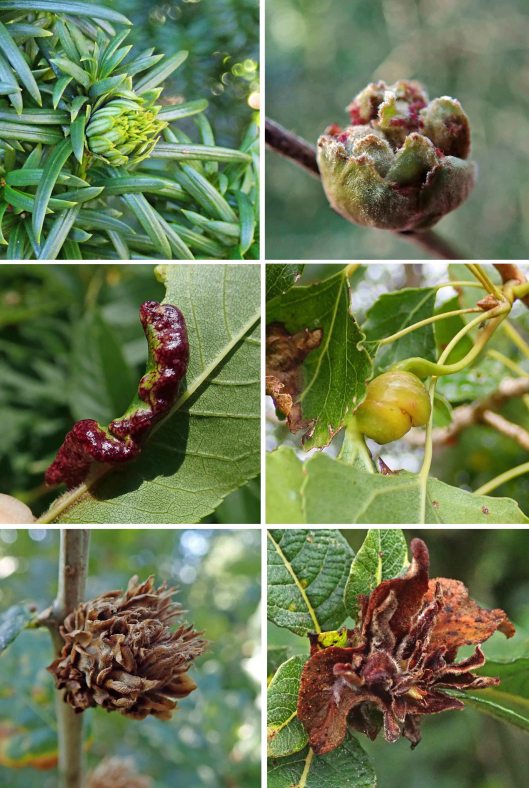
231216 mixed galls

Like Loading...

I is for ichneumon

14 Thursday Dec 2023

Posted by sconzani in insects

≈ Leave a comment

Tags

Amblyjoppa fuscipennis, British ichneumons, British wasps, Ichneumon sarcitorius, Ichneumon wasps, wasp

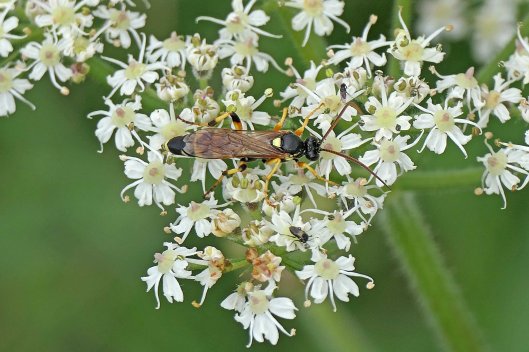
I’m not very good at photographing and/or identifying bee and wasp species (they’re almost never still, and they can be tricky to identify) so I was very happy to nail not one, but two wasp species in August. Both were ichneumon wasps, the first, which featured in An ichneumon, 10 August, is Amblyjoppa fuscipennis.

231214 Amblyjoppa fuscipennis

And this second beauty was also distinctive enough for me successfully to identify. Meet Ichneumon sarcitorius (from Another ichneumon, 11 August).

231214 Ichneumon sarcitorius

Like Loading...

H is for hairstreaks

13 Wednesday Dec 2023

Posted by sconzani in insects

≈ 2 Comments

Tags

British butterflies, butterfly, Green hairstreak, hairstreak, hairstreak butterflies, Purple hairstreak

H is for hairstreaks, purple and green. For me, 2023 was a particularly good year for Purple hairstreaks. On 21 July, in Purple sheen, I blogged about those I had already seen at Lavernock Nature Reserve and at Casehill Woods, but I was lucky to see them in three more locations, at Ystrad Mynach on 25 July, in Dingle Park on 27 July, and finally one at Cosmeston on 1 August. The photos below are from my Ystrad Mynach encounter, where I almost stood on a Purple hairstreak that had been blown on to the pavement in front of me from its large Oak tree across the narrow busy road, probably by the many passing high-sided trucks. After taking a few photographs, I took the tiny creature back across the road and placed it as near to its tree as I could reach.

231213 purple hairstreak

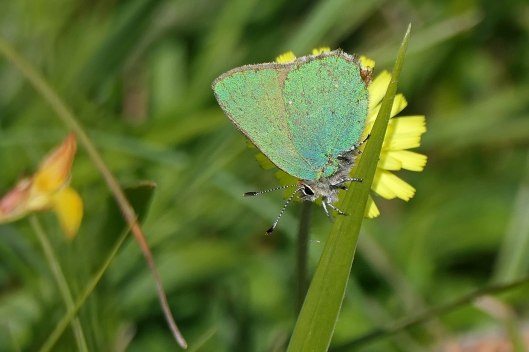
There are no local places to see Green hairstreaks so I was particularly delighted in June to see my first in four years (A streak of green), at Charlton Kings Common just outside Cheltenham.

231213 green hairstreak

I also enjoyed a lovely encounter with a White-letter hairstreak this year but thought I’d highlight in this blog the Purple (for those special in-the-hand moments) and the Green (for the first sighting in so long).

Like Loading...

F is for Firecrest

11 Monday Dec 2023

Posted by sconzani in insects, nature

≈ Leave a comment

Tags

birding, birdwatching, British birds, Firecrest, fly larvae, Lauxaniidae, Lauxaniidae larva

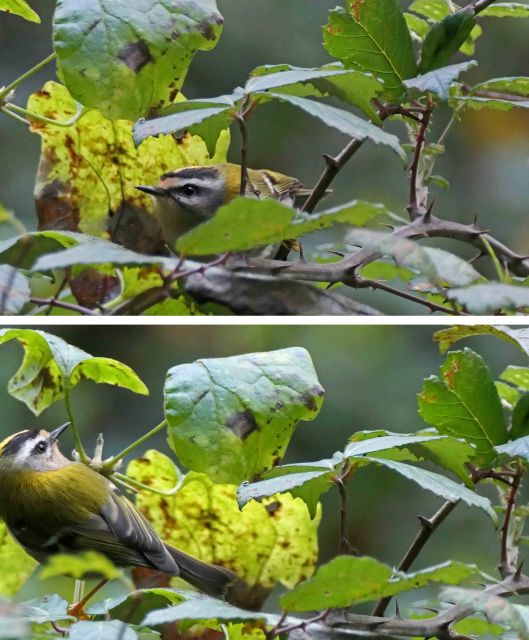
Initially, the letter F was going to be for flies then two fabulous little birds popped up last Tuesday and stole the show (though there were also flies that day). The birds were two Firecrests, probably those first discovered at this location in early November and not seen since, despite me and other birders looking for them. The site has quite dense vegetation so little birds like these can easily disappear.

231208 firecrest

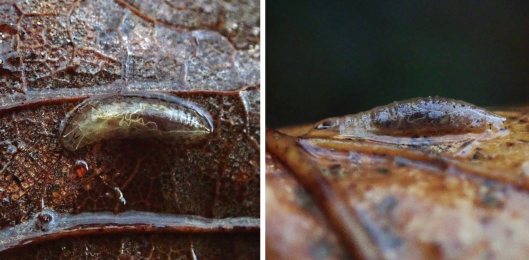
And the flies? Well, I had spent about 20 minutes walking through the area, had stood at various spots searching for movement in the trees and bushes, but not seen any sign of the Firecrests. So, as this is an area with lots of lovely deciduous trees, I decided to ferret through the leaf litter for any nice invertebrates. I’d turned over about 50 soggy, muddyish leaves before I had some success, finding these two Lauxaniidae fly larvae. I’d just finished taking some photos of them when I heard a special little peeping and there were the Firecrests.

231208 Lauxaniidae

Like Loading...

D is for damselfly

09 Saturday Dec 2023

Posted by sconzani in insects

≈ Leave a comment

Tags

British damselflies, damselfly, Odonata, Small red-eyed damselfly

Damselflies have flitted in to these pages three times this year: a Large red damselfly appeared as if by magic in A damsel dropped in on 2 May and a pair of the jewel-like Beautiful demoiselles featured in The beautiful couple on 7 June. The damselfly highlight, though, didn’t appear until late June, when I saw Small red-eyed damselflies for the very first time (Lifer: Small red-eyed damselfly, 29 June), and what gorgeous little creatures they are. My photographs do not do them justice, so I’m very much looking forward to seeking them out and photographing them again in the new year.

231209 small red-eyed damselfly

Like Loading...

C is for Coleophora

08 Friday Dec 2023

Posted by sconzani in insects

≈ Leave a comment

Tags

casebearer, casebearing moth larvae, Coleophora, Coleophora gryphipennella, Coleophora lutipennella, Coleophora serratella, leaf-mining moth larvae, moth larvae

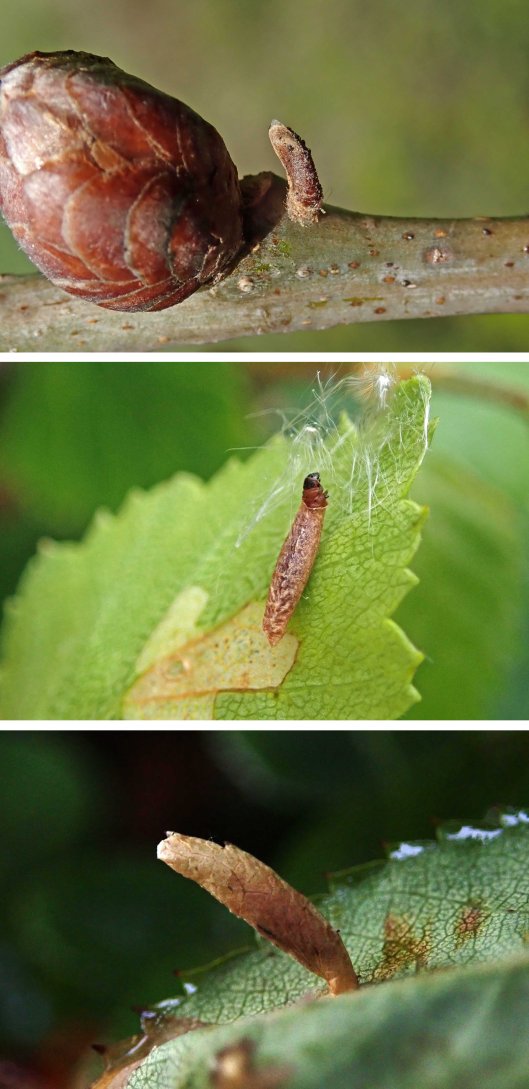
Coleophora: the clue’s in the name, which is a combination of the Greek word koleós meaning sheath and phora meaning carrier. Coleophora is a genus of moths whose larvae construct a case, which they carry around with them and live in, kind of like a snail. These year’s Coleophora finds include Coleophora lutipennella and Coleophora serratella, both in May, and Coleophora gryphipennella just a few weeks ago. You can see from the photos below how diverse their cases are – and these are some of the simpler designs.

231208 Coleophora

Like Loading...

B is for Burgundy

07 Thursday Dec 2023

Posted by sconzani in insects

≈ Leave a comment

Tags

British butterflies, butterfly, Duke of Burgundy

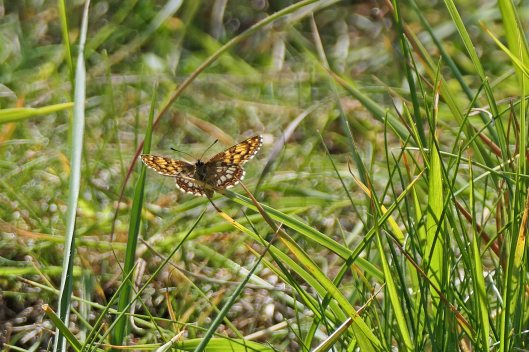
B is for Burgundy, Duke of Burgundy that is, a stunning little butterfly that I had the great pleasure of seeing for the first time, albeit fleetingly, during a short break in Gloucestershire in early June (Lifer: Duke of Burgundy, 10 June). I am already planning a return visit to hopefully see more of these in 2024.

231207 burgundy

Like Loading...

A is for aphid

06 Wednesday Dec 2023

Posted by sconzani in insects

≈ 6 Comments

Tags

aphid, British aphids

As I did two years ago, I’m going to use my last 26 posts to count down alphabetically to the end of the year, sometimes celebrating special finds, often highlighting particular species or families, occasionally indicating the flora and fauna I want to learn more about. That countdown also began with A is for aphids and with my announcement that I intended to look at their various species more closely in 2022. That didn’t really happen; in fact, my fascination with aphids didn’t really kick in until 2023 was half over.

231206 aphids (1)

Initially, aphids were the victims, food for hoverfly larvae (Yummy aphids, 21 June). Next, I found some new galls that were caused by aphids (Galls: Pemphigus spyrothecae, 17 July). Then began my slide down the slippery (and often confusing) slope towards aphids and their parasites, with A parasitised aphid on 19 September; Aphid mummies on 26 September; the 10 October post: A confusion of pie crusts; and more mummies, this time black in colour, Black mummies on 19 October. I finished my 2023 aphid obsession with a chance sighting on 25 October Aphids: Tuberolachnus salignus, and I’m already excited about what I might find next year.

231206 aphids (2)

Like Loading...

Leafmines: Gracillaria syringella

04 Monday Dec 2023

Posted by sconzani in insects, plants

≈ Leave a comment

Tags

British leafmines, Gracillaria syringella, leafmines, leafmines on privet, leafmining moth larvae, Ligustrum vulgare

These finds date from early November but it’s taken a while to get their identity confirmed. These are the larval leafmines of the gorgeous little moth Gracillaria syringella, shown here on Wild privet (Ligustrum vulgare) though they can also be found mining the leaves of Lilac species (Syringa, hence the epithet in their scientific name), Ash (Fraxinus excelsior) and Jasmine (Jasminum sp.).

231204 Gracillaria syringella (1)

Once hatched from their eggs, the larvae initially feed within a gallery mine (difficult to see in my images so I’ve marked them with a red arrow), then broaden their horizons into a large blotch. My finds were late in the year – the mines of Gracillaria syringella can usually be found in June and then again during August-September.

231204 Gracillaria syringella (2)

Like Loading...

Leafhopper: Ribautiana tenerrima

28 Tuesday Nov 2023

Posted by sconzani in insects

≈ Leave a comment

Tags

British leafhoppers, Cicadellidae, leafhopper, leafhopper on Bramble, Ribautiana tenerrima

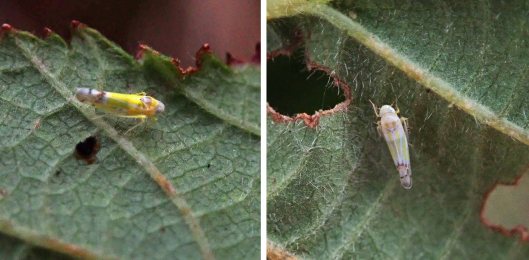
Over the years I’ve seen many small green-looking leafhoppers on Bramble and, knowing that small green-looking leafhoppers can be very difficult to identify, I’ve tended to ignore them. Last week, when Bramble-leaf-turning, I noticed that these little hoppers had some quite subtle markings on their backs (some with more saturated colour than others) that might help to distinguish them from others of their kin and, as they were keeping relatively still, I was able to get some photos (though grainy due to the dim light).

231128 Ribautiana tenerrima (1)

These have now been confirmed as Ribautiana tenerrima sensu lato, one of the most common species in Britain, that can be seen on Brambles and several other plant species between June and December. As there are other very similar Ribautiana species, for recording purposes, where we can’t distinguish one from the other, we use the catch-all name Ribautiana tenerrima sensu lato, with sensu lato meaning ‘in the broad sense’.

231128 Ribautiana tenerrima (2)

Like Loading...
← Older posts
Newer posts →

About me

sconzani

sconzani

I'm a writer and photographer; researcher and blogger; birder and nature lover; countryside rambler and city strider; volunteer and biodiversity recorder.

View Full Profile →

Follow earthstar on WordPress.com

Enter your email address to follow this blog and receive notifications of new posts by email.

Recent blog posts

  • Bearded tit!!! April 3, 2026
  • A Portland Bill Kestrel April 2, 2026
  • A proliferation of Peacocks April 1, 2026
  • Little owl March 31, 2026
  • Distant seabirds March 30, 2026

From the archives

COPYRIGHT

Unless otherwise acknowledged, the text and photographs on this blog are my own and are subject to international copyright. Nothing may be downloaded or copied without my permission.

Fellow Earth Stars!

  • Unknown's avatar
  • Unknown's avatar
  • Unknown's avatar
  • Unknown's avatar
  • Unknown's avatar
  • Unknown's avatar
  • Unknown's avatar
  • Unknown's avatar
  • Unknown's avatar
  • Unknown's avatar
  • Unknown's avatar
  • Unknown's avatar
  • Unknown's avatar
  • Unknown's avatar
  • Unknown's avatar
  • Unknown's avatar
  • Unknown's avatar
  • Unknown's avatar
  • Unknown's avatar
  • Unknown's avatar
  • Unknown's avatar
  • Unknown's avatar
  • Unknown's avatar
  • Unknown's avatar
  • Unknown's avatar
  • Unknown's avatar
  • Unknown's avatar
  • Unknown's avatar
  • Unknown's avatar
  • Unknown's avatar
  • Unknown's avatar
  • Unknown's avatar
  • Unknown's avatar
  • Unknown's avatar
  • Unknown's avatar
  • Unknown's avatar
  • Unknown's avatar
  • Unknown's avatar
  • Unknown's avatar
  • Unknown's avatar
  • Unknown's avatar
  • Unknown's avatar
  • Unknown's avatar
  • Unknown's avatar
  • Unknown's avatar
  • Unknown's avatar
  • Unknown's avatar
  • Unknown's avatar
  • Unknown's avatar
  • Unknown's avatar

Blog at WordPress.com.

Privacy & Cookies: This site uses cookies. By continuing to use this website, you agree to their use.
To find out more, including how to control cookies, see here: Cookie Policy
  • Subscribe Subscribed
    • earthstar
    • Join 642 other subscribers
    • Already have a WordPress.com account? Log in now.
    • earthstar
    • Subscribe Subscribed
    • Sign up
    • Log in
    • Report this content
    • View site in Reader
    • Manage subscriptions
    • Collapse this bar
 

Loading Comments...
 

You must be logged in to post a comment.

    %d