I was scanning an area of low plants and exposed stones on a site that was once a quarry, then rubbish tip, hoping to find my first Dingy skipper butterfly of the year when down dropped this gorgeous beastie, I don’t know from where. This, a week later than last year, was my first dragonfly of the year, at Cosmeston Lakes Country Park last Friday morning, a lovely Large red damselfly.
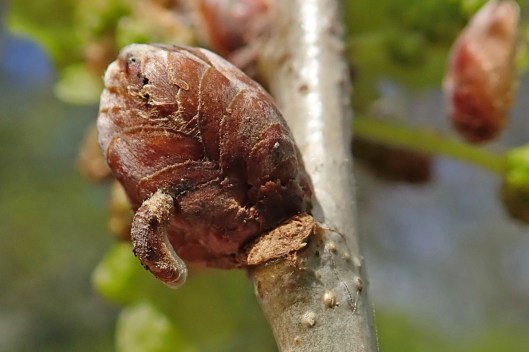
It’s often the way that, while looking for one thing, I find another. In this case, I was checking for eggs or larvae on the newly opening buds and flowers of an Oak tree where I’ve previously seen Purple hairstreak butterflies. No luck with those but I did find this …
It’s the larva of the Common oak case-bearer moth (Coleophora lutipennella) – you can see the pretty little adult moth on the UK Moths website here. These case-bearing moths remind me a bit of snails, spending their larval stage in a home they carry around with them, though the moths don’t grow their own – they weave theirs from bits of vegetation and silk. In the photo below, you can see the larva poking its head out from the bottom of its case.
It can be difficult to distinguish between the larvae of two very similar case-bearing moths, this one and Coleophora flavipennella. I had my find confirmed by expert Rob Edmunds, who manages the British Leafminers website. The difference between the two cases is minor but fascinating, the presence or not of a small hump of leaf tissue built in to the case – there’s an explanation and some excellent photos on the website’s June 2004 newsletter.
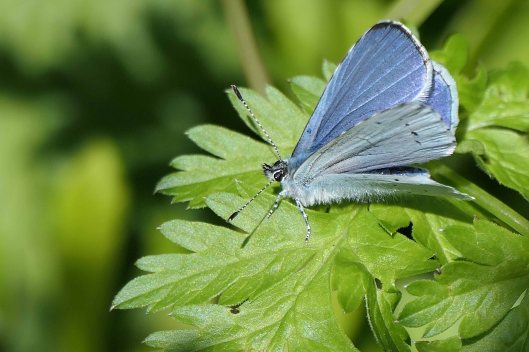
I saw my first Holly blue of the year on 15 April but it took 10 more days to find one, this stunning female, sitting still long enough to take a reasonable photo.
I blogged about Dark-edged bee-flies earlier this month but, since then, I’ve noticed one doing something odd so thought I’d share what I’ve since found out about what it was doing. I spotted an area of miniature soil volcanoes where mining bees were active, digging out the tunnels in which they would lay their eggs, and, nearby, a sweet little bee-fly flicking its own eggs in to the holes of the bees it predates.
Then, that same bee-fly started hovering in one spot, frantically beating its wings but going nowhere (see video below). What was it doing? I asked on Twitter, and one of my followers suggested ‘It could be filling its rear-end up with sand’ – not a sentence I ever thought I’d read! But this was sort of right.
Someone from the Soldierflies and Allies Recording Scheme referred me to their website entry for bee-flies, which explains that ‘the adult females collect dust or sand at the tip of their abdomen, using it to coat their eggs, which helps protect the eggs from drying out.’ I’m guessing the sandy coating also means the eggs roll more easily into the bees’ tunnels. It was a fascinating insight into what is an extraordinary lifecycle, though I can’t help but feel some sympathy for the hard-working mining bee victims.
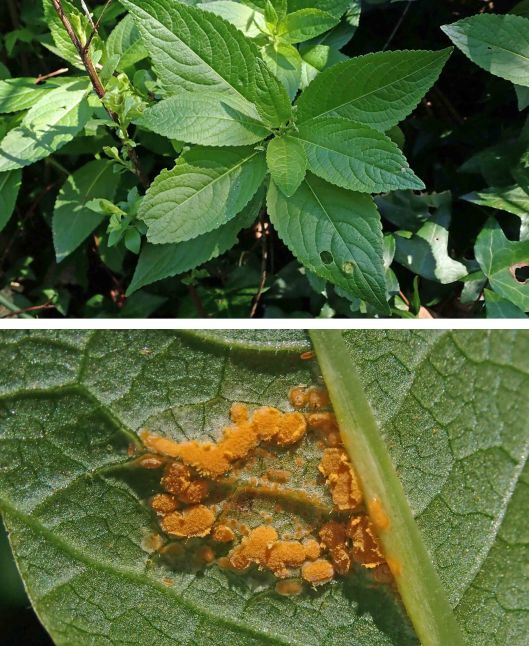
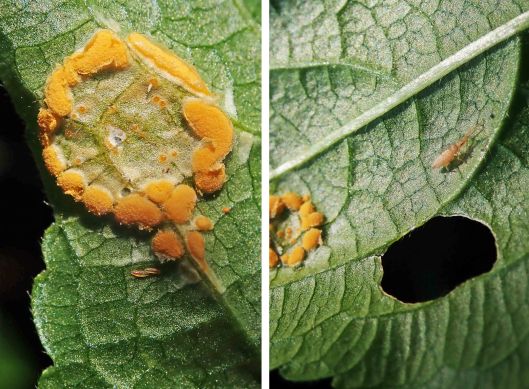
We’ve seen springtails and slime a couple of times previously on this blog; now here’s the next instalment in the springtails series: springtails and rust fungi. I spotted this rust, Melampsora populnea, on Dog’s mercury (Merculiaris perennis) during yesterday’s walk. From the top of the leaf, all you see is a small area of puckering and some pale spots (near the hole on the leaf in the lower part of the first photograph below). But, on the underside of the leaf, it’s a different story, with the orange blobs typical of a rust fungus.
At the time, I didn’t notice the tiny creatures munching on the fungus, neither the minuscule orange ones nor the relatively large pale orange ones. I presume the smaller ones are the offspring of the larger, which are definitely springtails, though I don’t know which species of Collembola these are, and my photos aren’t precise enough to identify them more precisely.
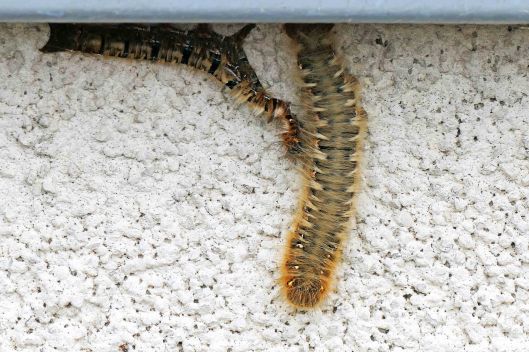
Though I was actually searching for migrating birds, the most exciting thing I found during last Sunday’s six-mile walk was this caterpillar that had just shed its skin. This is the larva of an Oak eggar moth (Lasiocampa quercus), now in the final instar of a one-year life cycle (some Oak eggar larvae have two-year life cycles) and due to pupate in June.
Though it’s often difficult to tell Buff-tailed from White-tailed, I think this is a queen White-tailed bumblebee. I caught her giving herself a good clean, and found her motions both fascinating and relaxing. In this short video, I slowed her movements down to half the actual speed the better to see more clearly what she was doing. What a beautiful creature she is!
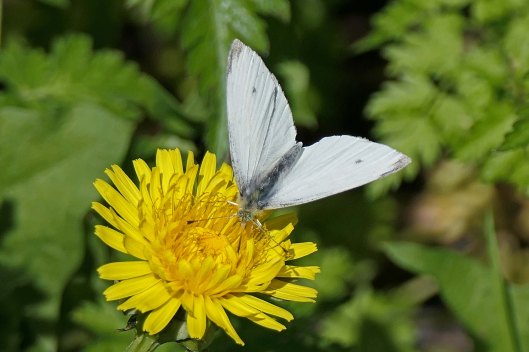
I think I was probably a little later to the Small white party than most locals this year, possibly because they have gardens and/or allotments, which the Small white butterfly (Pieris rapae) very much enjoys (though, I hasten to add that the Small white is not as destructive as many gardeners might think and it is actually the Large white, which lays its eggs in batches rather than singly, whose larvae can quickly strip those precious cabbage leaves to their veins).
This particular Small white, one of my first three seen on 7 April, has the typical markings of a female hatching from her over-wintering pupa in the springtime, with very pale grey markings on her wing tips and a small pale grey dot on her upper wings. The butterflies that hatch in the summer will have much darker, almost black markings. These differences are known as seasonal dimorphism.
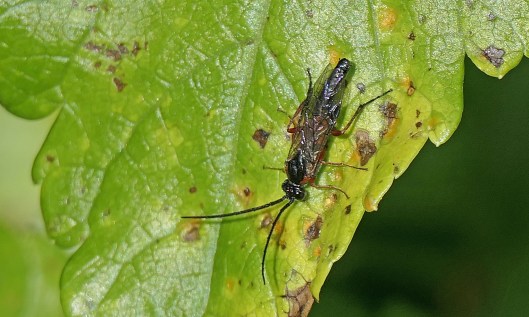
Meet Nematus lucidus, a sawfly that can be recognised both by the reddish-brown markings on its mostly black body and the torpedo shape of its abdomen.
Nematus lucidus can be seen around Blackthorn and Hawthorn, as those are the plants its larvae feed on, and the adults can be seen any time from April to June. It’s thought to be common though there aren’t a lot of records in the national databases, probably because it’s under-recorded.







 earthstar
You must be logged in to post a comment.