Tags
Angle shades, Angle shades caterpillar, Angle shades larva, caterpillar eating, moth caterpillar
Is there anything more relaxing than watching a caterpillar eating?

02 Wednesday Feb 2022
Posted in insects
Tags
Angle shades, Angle shades caterpillar, Angle shades larva, caterpillar eating, moth caterpillar
Is there anything more relaxing than watching a caterpillar eating?
31 Monday Jan 2022
Tags
Endothenia gentianaeana larvae, Endothenia marginana larvae, Endothenia moth species, insects in Teasel seed heads, moth larvae in Teasel seed heads, Teasel, Teasel seed heads
I’ve never looked inside a Teasel seed head before but I’m glad I braved the spines for a peek because each of the three I pulled open were occupied and, judging by the amount of frass, they’d been occupied for some time.

I think these are the larvae of one of the Endothenia species of moth, either E. marginana or E. gentianaeana, the former presumably being the more likely as there are more records of that species in south Wales. However, to be sure which is which you need to check each larva’s rear end to see if it has an anal comb. Not knowing this, I didn’t.
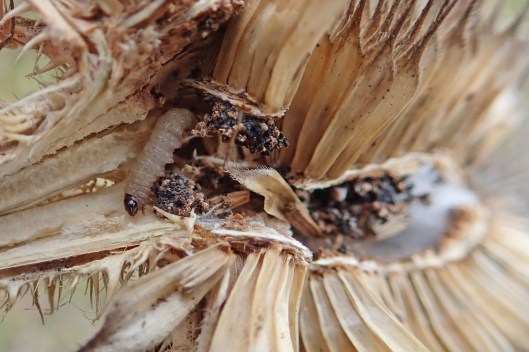
If you want to learn more about that anal comb, there’s a very detailed description, and clear photos, of the larvae of these two Endothenia species on the UK Moths website (E. marginana here and E. gentianaeana here). And, just to reassure you, I was able to close the seed heads (and wound stems of long grass around them, which should hopefully keep them closed so the larvae can complete their lifecycles) (I read later of someone who uses small rubber bands for the same purpose).
24 Monday Jan 2022
Posted in insects
I didn’t expect to post about any leafminers for a while but saw these mines on a Cherry laurel hedge I passed yesterday and realised this was one I hadn’t shared before. Though the mines are now empty and the moth pupae tucked up cosily in their cocoons for the winter, the mines created by the larvae are still visible.

These are the mines of the Apple leaf miner moth (Lyonetia clerkella). As the name suggests, the larvae of this moth mine the leaves of Apple and other fruit trees, as well as quite a long list of other plant species. You can read more about them on the British leafminers website and see the tiny adult moth on the UK Moths website.

18 Tuesday Jan 2022
Here’s another recent surprise find, a Common green shieldbug (Palomena prasina) covered in early morning dewdrops. Obviously, it’s not green: these bugs overwinter as adults, changing their colouring from green to dark brown before the winter weather really sets in, usually around November. The British bugs website says these shieldbugs usually hibernate – perhaps this little beastie was caught out by the previously milder-than-usual temperatures.

15 Saturday Jan 2022
Tags
Angle shades caterpillar, Angle shades larvae, moth caterpillars, moth larvae, moth larvae in winter, Phlogophora meticulosa
These were a surprise on a chilly and very foggy early morning walk earlier this week.


I suppose I should have realised that some caterpillars overwinter as larvae but I was still amazed to find all but one of these four sitting in plain sight, fully exposed to the weather, covered in dew drops. I’m reliably informed these are the larvae of the Angle shades moth (Phlogophora meticulosa).
10 Monday Jan 2022
Tags
Chromatomyia lonicerae, Himalayan honeysuckle, leaf-mining fly larvae, leaf-mining moth larvae, leafmines on Evergreen oak, leafmines on Himalayan honeysuckle, Leycesteria formosa, Phyllonorycter emberizaepenella
Two for the price of one this week. The plant is Himalayan honeysuckle (Leycesteria formosa), not a British native as you can guess from its name, but a plant that’s now naturalised quite extensively in the wild, at least in my local area. The leafmines were found on 18 December, quite late in the year but a sign of how mild our weather has been so far this winter.


These first mines were made by the larvae of the tiny fly Chromatomyia lonicerae. I like the description of this mine on the Nature Spot website: ‘The leafmine starts with an irregular star-like blotch with a later linear section’. You can see that in my photo on the left below, and, in the photo on the right, you can see a pupa, which remains in the mine until it emerges as an adult fly.


This second mine is the creation of the larva of the moth Phyllonorycter emberizaepenella, a beautiful little brown-and-white creature that you can see on the UK Moths website. The larva spins itself a blotch mine, which pulls the underside of the leaf together, as you can see in the photos below: top of the leaf on the left, bottom on the right.


03 Monday Jan 2022
Tags
British leafmines, Hart's tongue, leaf-mining moths, leafmines on Hart's-tongue, moth larvae on Hart's-tongue, Psychoides filicivora
Once again, I was alerted to this little leafminer by a tweet from Rob Edmunds (@leafminerman), one of the brains behind the British Leafminers website, and I’ve now found it at three local sites where Hart’s-tongue fern (Phyllitis scolopendrium) is plentiful, though it can also be found on a couple of other fern species.

These are the larvae of Psychoides filicivora, a tiny brown moth (you can see the adult on the UK Moths website here), whose larvae munch on the fern fronds and hide away under little ‘nests’ of sporangia on the undersides of the fronds.


There is another very similar moth species that also lives on fern fronds, Psychoides verhuella – so far, I’ve only found P. filicivora – but the British Leafminers website has very good information on both, as well as an excellent side-by-side comparison image of their larvae.
31 Friday Dec 2021
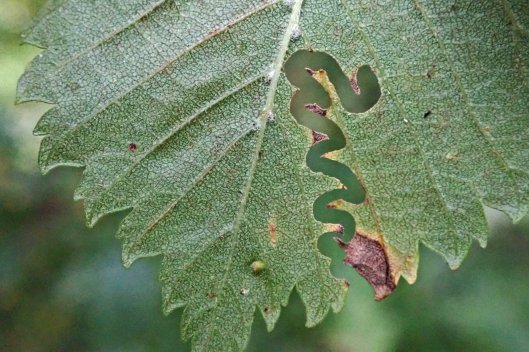
And so we come to the end of my A-to-Z showcase of some of the highlights of my ‘wild life’ in 2021. There was only ever one contender for the letter Z, Zorro, my find of Elm zigzag sawfly larval feeding tracks on a Wych elm leaf, a first record for this species in Wales.
Thanks, everyone, for following along on my journey through the wildlife of south Wales again this year. I truly appreciate all your likes and comments that inspire me to continue seeking and learning. And I hope these posts encourage you to look more closely at and appreciate the amazing natural world around us.
I hope to continue my daily posts in 2022, though I already know there will be some changes to my personal circumstances in the coming year, which may affect my ability to post or, quite possibly, the location I post from. I’ll write more about this when things become clearer.
One immediate change takes effect today – to save money I’ve cancelled my personalised domain name. I’m assured this should automatically revert to a generic wordpress domain – fingers crossed! – but I don’t know how this will affect, amongst other things, links in prior posts. I’ll be checking.
29 Wednesday Dec 2021
Posted in insects
If it weren’t for hoverflies, this letter might well have proven rather tricky. Fortunately, there are three genera of hoverfly in Britain with names beginning with X: Xanthandrus, Xanthogramma and Xylota. I have seen none of the first but I have seen one of the Xanthogramma species, X. pedissequum (there are two others that have so far eluded me, X. stackelbergi and X. citrofasciatum).

There are seven British species of Xylota, of which I have so far encountered only two, X. segnis (below left) and X. sylvarum (below right). I’m still finding hoverflies a rather tricky family to identify but these particular finds have been confirmed through a series of photos by those much more expert than I will ever be.


26 Sunday Dec 2021
Posted in fungi, insects, lichen, wildflowers
This post is really an acknowledgment of my lack of knowledge – everything shown in the photos below remains unidentified, and these are just some photos I’ve kept. Most photos get deleted once I’ve spent a little time trying to put a name to their subject, but failed. It may sometimes seem as if I can put a name to most flora and fauna I see but that’s definitely not the case. And I’m okay with that. I don’t need to identify everything – in fact, unless I’m searching for something specific, it’s often much nicer simply to look and admire, be amazed and enjoy.


 earthstar
You must be logged in to post a comment.