• ABOUT
  • BIRDING 2018
  • Birding 2019
  • BLOG POSTS
  • Butterflies 2018
  • Resources

earthstar

~ a celebration of nature

earthstar

Category Archives: insects

Oak: mothy goodness

27 Thursday May 2021

Posted by sconzani in insects, leaves, trees

≈ Leave a comment

Tags

Brindled green, British moths, Case-bearing moth, Coleophora flavipennella, Coleophora lutipennella, Dryobotodes eremite, moth larvae, moth larvae on Oak, moths on Oak, Oak leaves

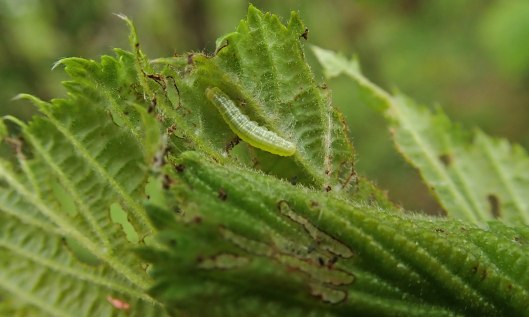
As you can see from the last two days’ blogs, there was much to be found on Oak leaves in my local woodlands on Sunday. These are two more finds, both relating to moths. This first was found on the same tree as the Purple hairstreak larva and, thanks to some help from Twitter moth-ers, I can tell you this is the larva of the Brindled green moth (Dryobotodes eremite) (you can see the adult moth on the UK Moths website here).
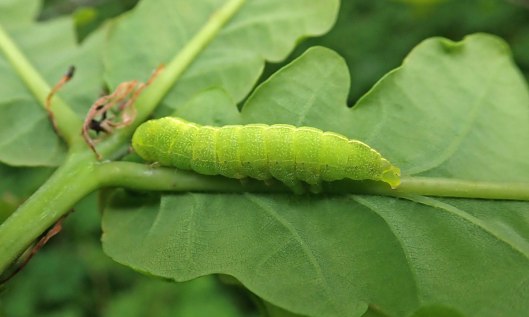
210527 brindled green larva

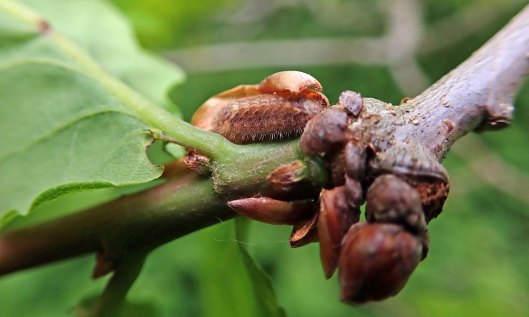
The wonderfully crafted cases in the photos below contain the larvae of either Coleophora lutipennella or Coleophora flavipennella – apparently, it’s not possible to determine the species without waiting for the adult moths to hatch and then dissecting their genitalia, which I’m not going to do. I’m happy just to admire their silk-weaving skills.

210527 Coleophora lutipennella or flavipennella (1)
210527 Coleophora lutipennella or flavipennella (2)
210527 Coleophora lutipennella or flavipennella (3)
Like Loading...

Oak: Purple hairstreak larva

26 Wednesday May 2021

Posted by sconzani in insects, trees

≈ Leave a comment

Tags

British butterflies, butterfly larva on Oak tree, butterfly larvae, Purple hairstreak, Purple hairstreak larva

While examining the galls on Oak leaves that I blogged about yesterday, I also made a very exciting find, my first Purple hairstreak butterfly larva. It was so well camouflaged that I’m sure I wouldn’t normally have noticed it.

210526 purple hairstreak larva

This particular woodland contains some huge ancient Oak trees but also many younger trees planted to mark the turn of the millennium and I’ve always thought it would be good habitat for Purple hairstreak. Now that I know they’re definitely here, I’ll be looking for the stunning little butterflies when they emerge in a month or so, and also for more larvae in the meantime.

Like Loading...

Oak: a new gall

25 Tuesday May 2021

Posted by sconzani in insects, leaves, spring, trees

≈ Leave a comment

Tags

Andricus curvator, British galls, galls on Oak leaves, galls on oak trees, Oak gall wasps, oak galls, oak tree

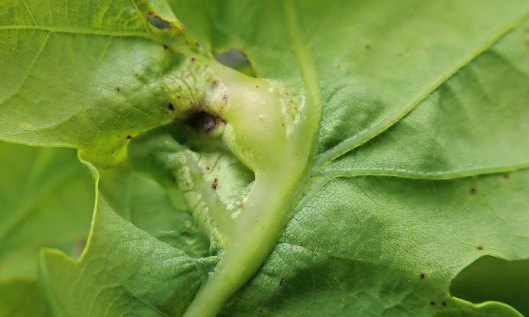
With heavy cloud and occasional rain, Sunday was not a day for finding butterflies in the woodland. So, I decided to look more closely at Oak leaves to see what I might find, and that strategy paid off in spades as the next few days’ blog posts will show. First up, I found a gall I hadn’t seen before, which turns out to be the sexual generation of the gall wasp Andricus curvator.

210525 Andricus curvator (1)

When the adult wasps emerge in the spring from the agamic (asexual) generation galls, which are formed on buds in the autumn and fall to the ground to over-winter, they lay their eggs mostly on Oak leaves but also, sometimes, on twigs or catkins, so these galls can take several forms. The ones I found (and they were numerous) were all on leaves, causing malformations and swellings, as you can see from the photos above and below.

210525 Andricus curvator (2)
210525 Andricus curvator (3)

I was tempted to split a gall open to see what was inside but it turns out I didn’t have to, as something had nibbled away at one gall, revealing a second round gall inside (see below). The larvae within this inner gall will emerge in the autumn to lay its eggs on Oak buds, and so the process will continue.

210525 Andricus curvator (4)

Like Loading...

Butterfly courtship

24 Monday May 2021

Posted by sconzani in insects

≈ Leave a comment

Tags

Brimstone butterfly, British butterflies, butterfly courtship, butterfly mating, Green-veined white butterfly, Orange-tip butterfly

Some recent moments of butterfly courtship I’ve managed to catch on camera …
The dance of the Brimstones: the butter-yellow male flies in to check if the paler female is ready and willing to mate. And he’s in luck, so their (to human eyes) romantic dance begins, with the male whirling around the female, wafting his pheromones in her direction to encourage her to settle and let mating begin. This ‘dance’ can continue quite a while, as I discovered while watching this pair.

210524 brimstone (1)
210524 brimstone (2)

Mating was already underway when I spotted this pair of Green-veined whites. And it is not just sperm that is passing between them. The Butterfly Conservation website reports that the male also transfers ‘a so-called “nuptial gift” of nutrients that the female can assimilate and use to increase egg production. Exceptionally, male Green-veined Whites may transfer 25% of their own body mass to females during mating, though typically this is more like 15%.’

210524 green-veined whites

Sometimes males don’t know when to take ‘No’ for an answer! By pointing her abdomen in the air, this Orange-tip female is refusing to mate, presumably because she has already mated and needs to get on with the important task of egg-laying. But the male simply wasn’t getting the message and continued fluttering around the female, even landing on her outspread wings. Eventually, she flew off at speed to escape his advances.

210524 orange-tip (1)
210524 orange-tip (2)
210524 orange-tip (3)
210524 orange-tip (4)
Like Loading...

First Common blue

21 Friday May 2021

Posted by sconzani in insects

≈ 2 Comments

Tags

blue butterfly, British butterflies, Common blue, Common blue butterfly

This has been a strange spring, with frequent cool winds, a lack of rain that was restricting plant growth and cracking the ground, and now a couple of weeks of frequent rain that is saturating the land. This unseasonal weather has had a definite effect on wildlife, with some insects out and about early, but others emerging a week or more later than usual.

210522 common blue (2)

I would usually expect to see my first Common blue butterfly in mid May but this year’s first sighting came on Wednesday 19th and, somewhat surprisingly, it was high in the Welsh valleys, where the weather is often a few degrees cooler than my usual coastal patches. In fact, in between the sunny spells on Wednesday’s walk, I got hailed on. Go figure!

210522 common blue (1)

Like Loading...

Finally, odonata

19 Wednesday May 2021

Posted by sconzani in insects

≈ Leave a comment

Tags

Azure damselfly, British damselflies, British odonata, Common blue damselfly, Cosmeston Lakes Country Park, damselfly

My first damselflies (still no dragonflies) of 2021 have been a long time coming but, finally, yesterday, at Cosmeston Lakes Country Park, before a thunderstorm drenched both the insects and me, I saw a small number of both Azure and Common blue damselflies in some of the more sheltered places around the fields … and it was magical!

Azure damselfly

Common blue damselfly

Like Loading...

Buttercups and beasties

18 Tuesday May 2021

Posted by sconzani in insects, spring, wildflowers

≈ Leave a comment

Tags

British wildflowers, buttercups, buttercups and insects, insects in buttercups, yellow wildflowers

It seems I’m not the only one who likes buttercups, judging by the quantity and variety of mini-beasties I’ve spotted in them in recent days: bees and hoverflies, earwigs and micro-moths, and even a slug.

210518 buttercup bee nomada
210518 buttercup earwig
210518 buttercup hoverfly (1)
210518 buttercup hoverfly (2)
210518 buttercup moths
210518 buttercup slug
Like Loading...

A treehopper

17 Monday May 2021

Posted by sconzani in insects

≈ 2 Comments

Tags

British bugs, British treehopper, Centrotus cornutus, treehopper

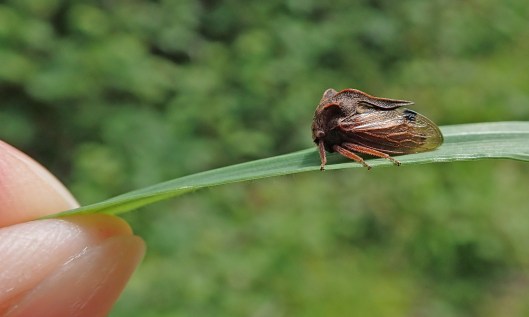
The highlight of yesterday’s walk was this little dude, a new insect for me and perhaps the coolest bug I’ve ever seen. Meet Centrotus cornutus, one of only two British species of treehopper.

210517 Centrotus cornutus (1)

As you can see from the relative size of my thumb and the fact that it’s sitting on a blade of grass, this bug is tiny, averaging just 10mm in length. The British Bugs website says they can be found ‘on a range of plants in woodland rides’ – this one was amongst scrubby vegetation under trees in a local park, and the adults can be seen between April and August.

210517 Centrotus cornutus (2)

Though I wouldn’t usually promote Wikipedia, their entry on this bug has some interesting, seemingly well-referenced information that includes the idea that ‘The bizarre horn-like extensions of the pronotum apparently help the camouflage. As a matter of fact, when this insect is at rest on a branch with the legs retracted, it looks like a part of the branch itself.’ I can imagine that camouflage works rather well.

210517 Centrotus cornutus (3)

Like Loading...

Caterpillar in a tent

15 Saturday May 2021

Posted by sconzani in insects, leaves, trees

≈ Leave a comment

Tags

British moths, damage to Hazel leaves, Hazel, Hazel leaves, moth caterpillar, Operophtera brumata, Winter moth

While wandering through my favourite woodland earlier this week, I noticed small areas of damage on some Hazel leaves. It looked like a little critter had been munching on them and, checking further, I soon discovered a lot of leaves had suffered similar damage.

Closer inspection of one particular leaf soon revealed the culprit, a caterpillar, tucked away in a snug little tent it had created by binding two leaves together with silken thread. From there it could easily venture out to eat, yet retreat when threatened by predators or bad weather. Smart thinking!

210515 winter moth (2)

I think the caterpillar may be the larva of a Winter moth (Operophtera brumata) but I haven’t yet been able to confirm my identification (Update 16/5: ID now confirmed as Winter moth). Once I was alert to their presence, I noticed more leaf damage and several more ‘tents’, as well as a smaller caterpillar feeding out in the open.

210515 winter moth (3)
OLYMPUS DIGITAL CAMERA
Like Loading...

Brimstone eggs

04 Tuesday May 2021

Posted by sconzani in insects

≈ 2 Comments

Tags

Brimstone, Brimstone butterfly, Brimstone eggs, British butterflies, butterfly eggs

This was exciting – or should that be eggs-citing?!

210504 brimstone eggs (1)

I was watching this female Brimstone, first sitting on a patch of brambles, then flying, seemingly haphazardly, through and around bushes along a woodland ride. I thought those bushes were Blackthorn but it turns out they were probably Buckthorn.

210504 brimstone eggs (2)

Then I realised the butterfly was egg-laying. In his Life Cycles of British & Irish Butterflies, Peter Eeles describes the process:

Females are particularly choosy about the plants on which they lay their eggs – even on sites with many buckthorns present, only a very small proportion are used by females, who typically lay on plants that are isolated, sheltered and growing in sunny areas, such as at the edge of a woodland ride.

210504 brimstone eggs (3)
210504 brimstone eggs (4)

The eggs start off pale green, as shown here, but soon turn yellow and then grey, as the little caterpillar develops. This is the first time I’ve seen Brimstone eggs and I’m fairly sure I’ll be able to find them again so I’m hoping to keep an eye on their progress.

Like Loading...
← Older posts
Newer posts →

About me

sconzani

sconzani

I'm a writer and photographer; researcher and blogger; birder and nature lover; countryside rambler and city strider; volunteer and biodiversity recorder.

View Full Profile →

Follow earthstar on WordPress.com

Enter your email address to follow this blog and receive notifications of new posts by email.

Recent blog posts

  • A surprise Slow-worm April 11, 2026
  • My first Holly blue April 10, 2026
  • Alder flies April 9, 2026
  • Lily beetle April 8, 2026
  • First bee-flies April 7, 2026

From the archives

COPYRIGHT

Unless otherwise acknowledged, the text and photographs on this blog are my own and are subject to international copyright. Nothing may be downloaded or copied without my permission.

Fellow Earth Stars!

  • Unknown's avatar
  • Unknown's avatar
  • Unknown's avatar
  • Unknown's avatar
  • Unknown's avatar
  • Unknown's avatar
  • Unknown's avatar
  • Unknown's avatar
  • Unknown's avatar
  • Unknown's avatar
  • Unknown's avatar
  • Unknown's avatar
  • Unknown's avatar
  • Unknown's avatar
  • Unknown's avatar
  • Unknown's avatar
  • Unknown's avatar
  • Unknown's avatar
  • Unknown's avatar
  • Unknown's avatar
  • Unknown's avatar
  • Unknown's avatar
  • Unknown's avatar
  • Unknown's avatar
  • Unknown's avatar
  • Unknown's avatar
  • Unknown's avatar
  • Unknown's avatar
  • Unknown's avatar
  • Unknown's avatar
  • Unknown's avatar
  • Unknown's avatar
  • Unknown's avatar
  • Unknown's avatar
  • Unknown's avatar
  • Unknown's avatar
  • Unknown's avatar
  • Unknown's avatar
  • Unknown's avatar
  • Unknown's avatar
  • Unknown's avatar
  • Unknown's avatar
  • Unknown's avatar
  • Unknown's avatar
  • Unknown's avatar
  • Unknown's avatar
  • Unknown's avatar
  • Unknown's avatar
  • Unknown's avatar
  • Unknown's avatar

Blog at WordPress.com.

Privacy & Cookies: This site uses cookies. By continuing to use this website, you agree to their use.
To find out more, including how to control cookies, see here: Cookie Policy
  • Subscribe Subscribed
    • earthstar
    • Join 642 other subscribers
    • Already have a WordPress.com account? Log in now.
    • earthstar
    • Subscribe Subscribed
    • Sign up
    • Log in
    • Report this content
    • View site in Reader
    • Manage subscriptions
    • Collapse this bar
 

Loading Comments...
 

You must be logged in to post a comment.

    %d