• ABOUT
  • BIRDING 2018
  • Birding 2019
  • BLOG POSTS
  • Butterflies 2018
  • Resources

earthstar

~ a celebration of nature

earthstar

Category Archives: insects

356/366 Leaf mines: Euleia heraclei

21 Monday Dec 2020

Posted by sconzani in insects, plants

≈ Leave a comment

Tags

Alexanders, Alexanders plants, British leaf mines, Celery fly, Celery leaf fly, Euleia heraclei, leaf mines, leaf-mining fly larvae, leafminers

Finally, a leaf mine where I’ve actually seen the adult – in this case, a fly rather than a moth – and not the specific adult that laid the eggs that hatched into the larvae that made these particular leaf mines, but rather adult flies seen on other occasions. And very pretty little flies they are too!

201221 Euleia heraclei (1)

These are Euleia heraclei, also known as Celery flies or Celery leaf flies because one of the plants their larvae feed on is Celery. Other plants include Parsley, Hogweed, Angelica, Lovage, Wild parsnip and, the plant I found these leaf mines on, Alexanders (Smyrnium olusatrum). In the photos below, the fly on the left is the male, the one on the right the female.

201221 Euleia heraclei male
201221 Euleia heraclei female

According to the Nature Spot website, the adult flies are usually seen between April and November, and the British Leafminers website says that the larval mines can be seen throughout summer and into early autumn, though one of my photos below was taken as recently as 27 November and the larva is clearly visible so perhaps they have a longer season when the weather conditions are mild.

201221 Euleia heraclei (4)
201221 Euleia heraclei (5)
Like Loading...

349/366 Leaf mines: Amauromyza verbasci

14 Monday Dec 2020

Posted by sconzani in insects, leaves, plants, winter

≈ 2 Comments

Tags

Amauromyza verbasci, Buddleja davidii, leaf mines, leaf-mining fly larvae, leafminer

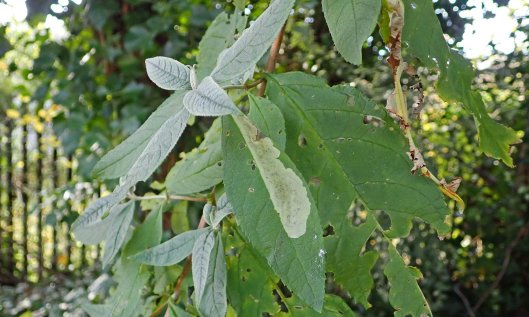
It’s #LeafmineMonday again on social media so here’s another leaf mine to look for when you’re out walking. And this is an easy plant to recognise because I’m sure everyone knows what the Butterfly bush (Buddleja davidii) looks like, right?

201214 Amauromyza verbasci (1)

These mines on Buddleja leaves, which start as a narrow corridor and quickly develop into a large blotch, are caused by the larvae of a tiny fly, Amauromyza verbasci. The fly also lays its eggs on several other plants, including Mullein and Common figwort.

201214 Amauromyza verbasci (3)

Mines can be seen from June to November, so it’s almost too late to see these now. The Buddleja plants in my area are already generating new growth but, as you can see from the photo above, the mines may still be seen on the older leaves before they drop.

201214 Amauromyza verbasci (2)

According to the UK Fly mines website, Amauromyza verbasci is widespread in Britain, though I have to say that I have only seen these mines once, despite a lot of looking at Buddleja bushes. And this sighting was a particularly lucky one for me, as this turned out to be the 1000th species (of flora and fauna) I had recorded on my local biodiversity records centre database.

Like Loading...

345/366 Italian Alder aphid

10 Thursday Dec 2020

Posted by sconzani in insects, leaves, nature, trees

≈ 3 Comments

Tags

aphids, Crypturaphis grassii, Italian Alder, Italian Alder aphid

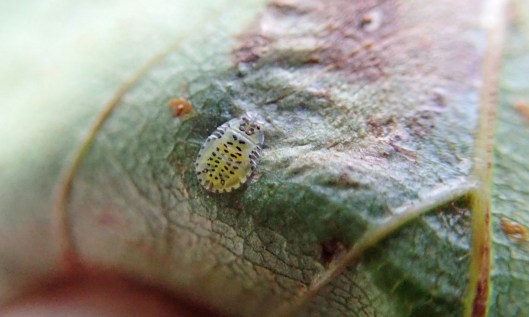
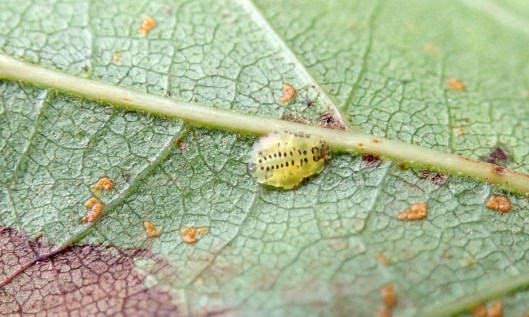
At first I thought this incredibly tiny creature was the early instar of a shield bug but, when I couldn’t find any pictures that resembled it on the British Bugs website, I turned to Twitter for help. Luckily, a botanist I know, Karen, had seen something similar posted recently in a Facebook group and very quickly supplied me with a name, Crypturaphis grassii, the Italian Alder aphid, so named because it’s only ever found on Italian Alder trees (Alnus cordata).

201210 Crypturaphis grassii (1)

I found online a report published in 2011, on the first records of this species in Cornwall, which provides some interesting detail about these aphids. Apparently, Crypturaphis grassii is ‘native to southern Italy and Corsica and [was] first recorded in the UK in 1998’. Intrigued, I returned to the tree I’d found my first specimen on and found many more of these creatures, with variations in colour and markings. The report explains that:

Viviparous individuals [those able to birth live young] are yellowish-green to yellowish-brown, with brown spots extending along the dorsal surface, around the edge of the abdomen and on the head. Compound eyes are reddish in colour. … Immature apterae [wingless individuals] are similar but smaller, paler and lacking in dark spots, more translucent and slightly more elongate in shape. Oviparous apterae [wingless individuals that are able to lay eggs] are similar in size and shape to viviparous apterae but are brown in colour, with transverse darker abdominal stripes, rather than spots.
201210 Crypturaphis grassii (3)

201210 Crypturaphis grassii (4)
201210 Crypturaphis grassii (5)

The Italian Alder, on which the aphid feeds, was ‘commonly planted as a roadside, waterside and/or windbreak species’ during the 1980s, and, by 2011 when the report was published, the aphids had already spread widely throughout Britain, including having established colonies in the Vale of Glamorgan, which is where I found the aphids in my photographs.

201210 Crypturaphis grassii (2)

Citation: Luker, Sally. (2011). CRYPTURAPHIS GRASSII (STERNORRYNCHA: APHIDIDAE): FIRST RECORDS FOR CORNWALL. British Journal of Entomology and Natural History. 24. 205.

Like Loading...

342/366 Leaf mines: Cerodontha iridis

07 Monday Dec 2020

Posted by sconzani in insects, leaves, plants, winter

≈ 1 Comment

Tags

Cerodontha iridis, Iris foetidissima, Iris leaf miner, leaf mines, leaf-mining fly larvae, leafminer, Stinking iris

When I first recorded this leaf mine (found on 24 November at Cosmeston Lakes Country Park, where there is rather a lot of it in one particular area), it was named ‘Record of the Week’ by SEWBReC, the local biodiversity records centre, and hailed as only the third Welsh record (though the national recorder for this species later corrected this, as it seems several records from north Wales had not been added to the Welsh database at that stage). Since then, I’ve found these mines in five more locations, proving that once again this is an under-recorded leaf-mining species.

201207 Cerodontha iridis (1)

These leaf mines were made on Stinking iris (Iris foetidissima) by the fly Cerodontha iridis, and they can also be found in Britain on other Iris species, though I haven’t seen any of those. The mines occur in early autumn, though they can still be seen on Iris leaves later than that – I’m seeing them now, in early winter. Often the adult fly lays several eggs on one leaf and, after the larvae hatch and start munching, they create blotch mines, which may be quite large when several mines coalesce.

201207 Cerodontha iridis (2)
OLYMPUS DIGITAL CAMERA

You can read more detailed information about this species and see some excellent images, including close-ups of the larvae and their puparia, on the Bladmineerders website here.

201207 Cerodontha iridis (4)

Like Loading...

338/366 Leaf mines: Acidia cognata

03 Thursday Dec 2020

Posted by sconzani in insects, leaves, plants, wildflowers

≈ Leave a comment

Tags

Acidia cognata, British flies, leaf mines, leaf-mining fly larvae, leaf-mining larvae, leafminer, Petasites fragrans, Winter heliotrope

Though the UK Fly mines website says the leaf mines of the little orange fly Acidia cognata are made in October-November, I’m sure the mines will still be visible this month, and possibly further into the winter, so this is one to look out for now when you’re out walking.

201203 acidia cognata (1)

One of the plants this fly mines – this is the one I’ve found these mines on – is Winter heliotrope (Petasites fragrans), which is particularly noticeable now, due to the pretty pink flowers that appear from November to February. Other favoured larval plants are Butterbur (Petasites hybridus), a plant very similar to Winter heliotrope, and Colt’s-foot (Tussilago farfara), the leaves of which don’t appear till after the flowers, so approximately from April onwards.

201203 acidia cognata (6)
201203 acidia cognata (7)

After hatching, the Acidia cognata larvae create a corridor on the upper surface of the leaf. As the larvae grow, the mine widens and eventually becomes more of a blotch, especially if there are several larvae on a single leaf and their mines meet. I’ve found these mines in two local patches of Winter heliotrope but not found any sign of them in other locations, so distribution does seem a little random. If you spot any, please do record your sightings as, like many leaf-miners where the adult flies are not often seen, this species is probably under-recorded.

201203 acidia cognata (2)
201203 acidia cognata (3)
201203 acidia cognata (4)
201203 acidia cognata (5)
Like Loading...

331/366 Leafmines: Phyllonorycter leucographella

26 Thursday Nov 2020

Posted by sconzani in autumn, insects, plants

≈ Leave a comment

Tags

British moths, Firethorn leaf miner, leaf mines, leaf mines on Pyracantha, leaf-mining larvae, leaf-mining moth, leafminer, moth larvae, moth larvae in leaf mines, Phyllonorycter leucographella

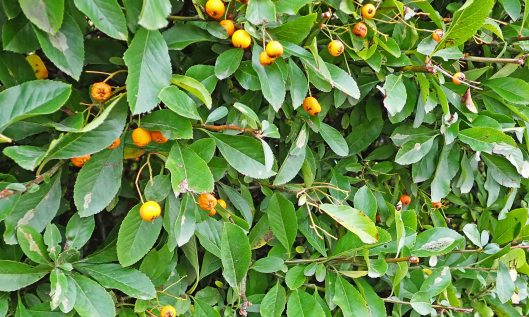
I stumbled across these leaf mines by accident but I simply can’t resist including them … because the tiny striped larvae are so darn cute!

201126 phyllonorycter leucographella (1)

These are the larvae of the moth Phyllonorycter leucographella, the adult of which is also rather striking – you can see photos of it on the UK Moths website here. As the website reports, this moth is a recent arrival to Britain, first spotted in Essex just 40 years ago, but for such a small creature – its wingspan is only 7-9mm – it’s managed to fly and settle far and wide, from Yorkshire in the north of England to Pembrokeshire in the west of Wales, and all points in between. This may partly be due to the fact that its larvae feed on many garden plants: I found an abundance of leaf mines on an orange-berried variety of Firethorn (Pyracantha coccinea), which explains why the moth’s common name is Firethorn leaf miner.

201126 phyllonorycter leucographella (2)
201126 phyllonorycter leucographella (3)
201126 phyllonorycter leucographella (4)
201126 phyllonorycter leucographella (5)

As you can see from my pictures, the larval ‘mine’ is like a blister, centred over the midrib on the upper side of the leaf. The larva, which, with black blobs on a white body, is very distinctive, can often be seen through the membrane of the mine, especially when it’s feeding at the edge of the blister. You can read more about this leaf miner, its life cycle and preferred larval plants on the UK Fly Mines website here.

201126 pyracantha

Like Loading...

326/366 Leaf mines: on Beech

21 Saturday Nov 2020

Posted by sconzani in autumn, insects, leaves, trees

≈ Leave a comment

Tags

beech, leaf mines on Beech, moth larvae in leaf mines, moth leafmines, Parornix fagivora, Phyllonorycter maestingella, Phyllonorycter messaniella, Stigmella hemargyrella, Stigmella tityrella

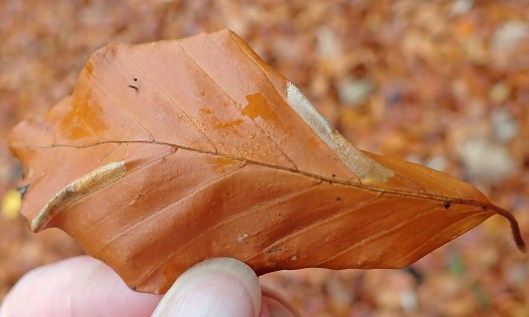
Five species of Lepidoptera larvae can be found in the leaves of Beech (Fagus species) and, with a lot of searching, much head-scratching, some rejections, and the much appreciated assistance of our county moth recorder Dave, I’ve now found and positively identified all five in my local area.

201121 beech (1)
201121 beech (2)

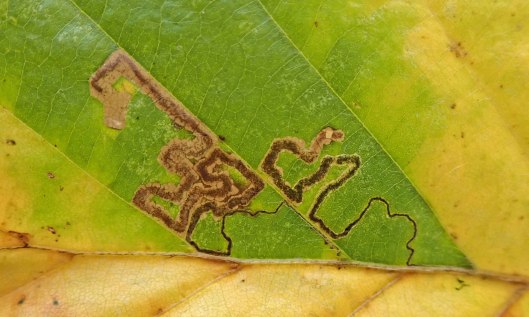
Stigmella tityrella: This moth’s larval leaf mines featured in last week’s post about green islands. The gallery (like a corridor) mine is usually compact and angular and, in particular, the larva stays between the veins when creating its mine – that is the feature I find helps most with its identification. As you can see from the two mines below, the galleries are very narrow to begin with, then broaden as the larvae grow.

OLYMPUS DIGITAL CAMERA

Stigmella hemargyrella: These larvae also create a gallery mine, but the mine is most often wider and longer than that of S. tityrella, and the larvae have no issue with crossing over the leaf veins.

201121 Stigmella hemargyrella (1)
201121 Stigmella hemargyrella (2)

Parornix fagivora: This is the mine I’ve found least in my local area, though I’m not sure if that’s a reflection on the moth’s rarity or my finding skills. Look for a blister, where the larva lives at first, and then a folded leaf edge, which it inhabits a bit like a cave.

201121 Parornix fagivora (1)
201121 Parornix fagivora (2)

Phyllonorycter messaniella: Both Phyllonorycter species on Beech create blisters; this one is usually an oval shape, almost rectangular, and quite broad. I’ve found the upper side of the leaf can be almost featureless but the blister on the underside is quite obvious so, if recording these, it’s best to include a photo of both sides of the leaf.

201121 Phyllonorycter messaniella (1)
201121 Phyllonorycter messaniella (2)
201121 Phyllonorycter messaniella (4)
201121 Phyllonorycter messaniella (3)

Phyllonorycter maestingella: This blister mine is long and quite narrow, and often placed between leaf veins. By spinning silk, the larva draws the leaf together to create a cosy tunnel, which looks a bit like a crease on the upper side of the leaf.

201121 Phyllonorycter maestingella (1)

201121 Phyllonorycter maestingella (2)
201121 Phyllonorycter maestingella (3)

I’ve attached to each of the moths’ names a link to the species description on the British Leafminers website, which is an excellent resource for anyone wanting to learn more.

Like Loading...

322/366 Leaf mines: Phytomyza agromyzina

17 Tuesday Nov 2020

Posted by sconzani in autumn, insects, leaves, plants

≈ Leave a comment

Tags

Cornus sanguinea, Dogwood, fly leaf mines, leaf mines, leaf mines on Dogwood, leaf-mining fly larvae, leaf-mining larvae, leafminers, Phytomyza agromyzidae

So far, in my recent posts on leaf mines, I’ve only covered a few of the many micro moths whose larvae make mines in leaves. But many fly species also inhabit leaves in their larval stage, and today’s post is about one of those, Phytomyza agromyzina.

201117 Phytomyza agromyzina (1)

You will probably never see the tiny adult fly (and, in fact, I haven’t even been able to find an illustration of one online, though this Wiki page shows an example of one member of the Agromyzidae fly family, which will give you a general idea.) but, anytime between July and November, you should be able to find its larvae’s leaf mines, as it’s probably widespread in Britain (though under-recorded, so if you do find some, please record your sighting).

201117 Phytomyza agromyzina (2)
201117 Phytomyza agromyzina (3)

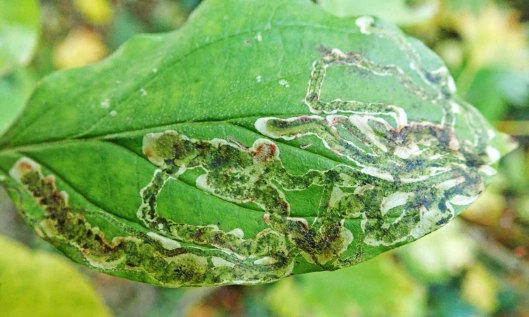
The mines I’ve found have all been on the leaves of Dogwood (Cornus sanguinea), though it is known to mine other species of Cornus. They’re gallery mines (i.e. forming corridors), long and meandering through the upper side of the leaf surface, and almost completely filled with frass (i.e. poo).

201117 Phytomyza agromyzina (4)

The UK Fly Mines website provides more detailed information on this, and the many other types of leaf mines you can find in Britain.

Like Loading...

321/366 Springtails and slime

16 Monday Nov 2020

Posted by sconzani in fungi, insects

≈ Leave a comment

Tags

Comatricha nigra, Comatricha slime mould, Dicyrtomina saundersi, fungi on rotting wood, Neanura muscorum, slime, slime mould, springtail, Trichia persimilis, Trichia slime mould

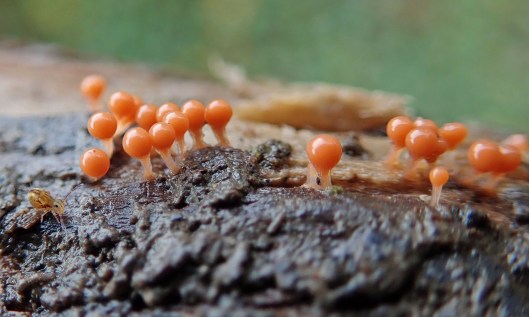
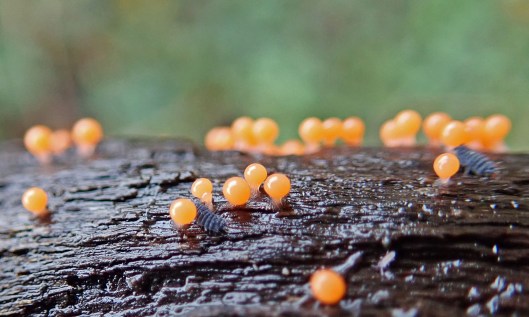
Springtails and slime, a colourful combination, currently to be found on and under many old branches and rotting logs, in a saturated woodland near you, right now!

201116 springtails and slime (1)

The orange slime is probably one of the Trichia species, possibly Trichia persimilis, and the white blobs on black sticks are one of the Comatricha species, perhaps Comatricha nigra.

201116 springtails and slime (2)

And the springtails? The brownish one with the hairy bottom is likely to be Dicyrtomina saundersi, and the blue-grey-coloured ones may be Neanura muscorum, but my photos are not good enough to make positive identifications.

201116 springtails and slime (3)

Like Loading...

319/366 Current critters

14 Saturday Nov 2020

Posted by sconzani in autumn, insects, spiders

≈ 2 Comments

Tags

Araneus diadematus, British insects, Chrysoperla carnea, Common wasp, earwig, Garden spider, Lacewing, Vespula vulgaris

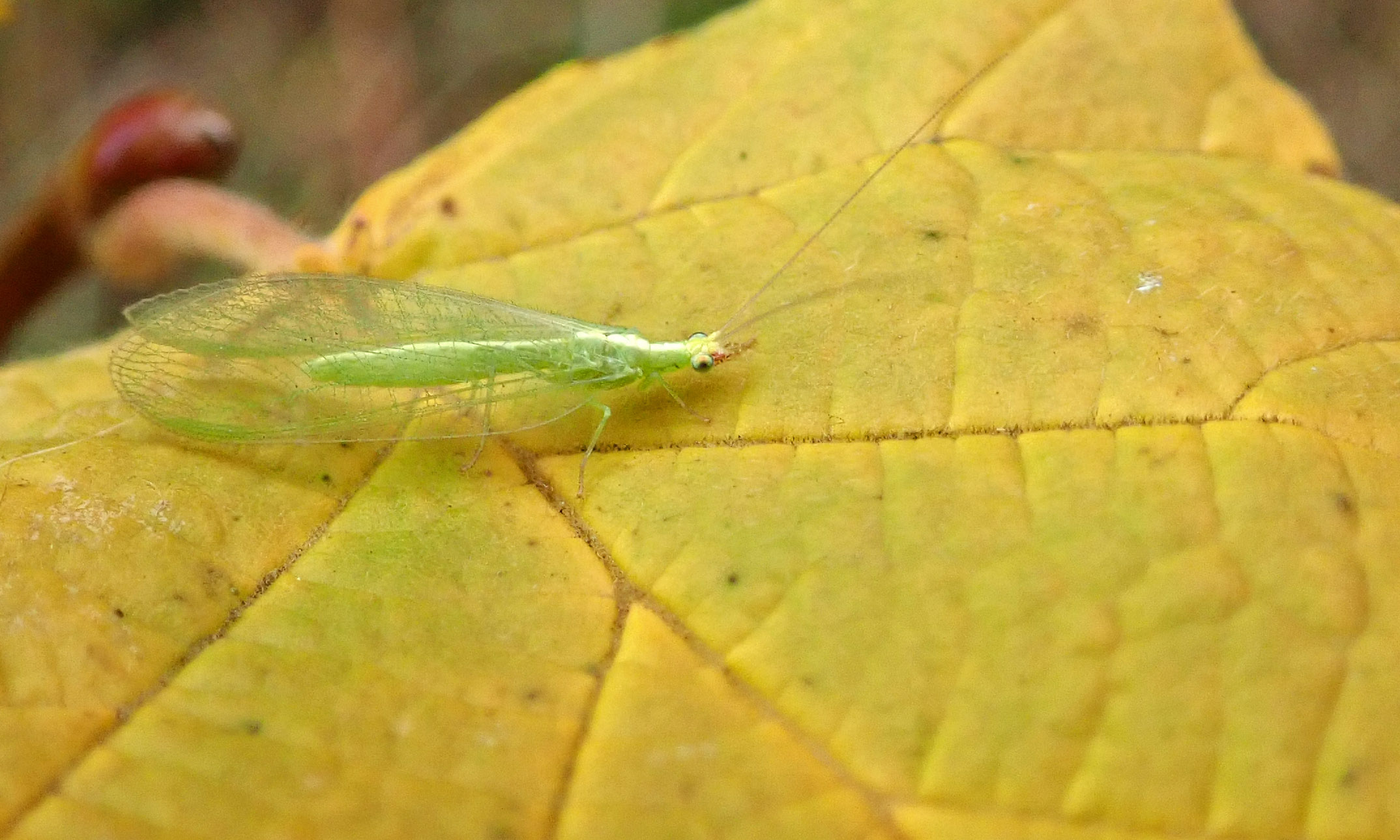
Just a few of the little critters I’ve come across this week …

201114 lacewing

I can’t be entirely sure but this is probably Chrysoperla carnea, Britain’s most common Lacewing. Their transparent wings lend these creatures a fragile air so I was surprised to see one still out and about as these Lacewings usually find a cosy spot indoors to hibernate come the autumn weather.

201114 common wasp (1)
201114 common wasp (2)

I think these are Common wasps (Vespula vulgaris)  that I’m seeing frequently on and around Ivy, and basking in our rare glimpses of sunshine, but I don’t have any face-on shots to properly separate them from German wasps (Vespula germanica). At this time of year, these are likely to be male wasps, which apparently are not able to sting – only female queens and workers have the anatomy for that.

201114 earwig

We saw Earwigs hiding in umbellifer seedheads in a recent post (Insecting, 31 October). It seems they like to hide, though I’m not sure how effective this earwig’s hiding place is, its head tucked into a gorse seed but the length of its body exposed. Still, I doubt anyone – insect, bird or human – was going to argue with those pincers.

201114 spider 1
201114 spider 2

Spiders have been much in evidence lately. Garden spiders (Araneus diadematus) sit ready to pounce in their strategically strung webs, and, in the right photo, I only spotted the tiny, unidentified spider lurking under the Creeping thistle flower when I got home and started looking through my photos.

Like Loading...
← Older posts
Newer posts →

About me

sconzani

sconzani

I'm a writer and photographer; researcher and blogger; birder and nature lover; countryside rambler and city strider; volunteer and biodiversity recorder.

View Full Profile →

Follow earthstar on WordPress.com

Enter your email address to follow this blog and receive notifications of new posts by email.

Recent blog posts

  • A surprise Slow-worm April 11, 2026
  • My first Holly blue April 10, 2026
  • Alder flies April 9, 2026
  • Lily beetle April 8, 2026
  • First bee-flies April 7, 2026

From the archives

COPYRIGHT

Unless otherwise acknowledged, the text and photographs on this blog are my own and are subject to international copyright. Nothing may be downloaded or copied without my permission.

Fellow Earth Stars!

  • Unknown's avatar
  • Unknown's avatar
  • Unknown's avatar
  • Unknown's avatar
  • Unknown's avatar
  • Unknown's avatar
  • Unknown's avatar
  • Unknown's avatar
  • Unknown's avatar
  • Unknown's avatar
  • Unknown's avatar
  • Unknown's avatar
  • Unknown's avatar
  • Unknown's avatar
  • Unknown's avatar
  • Unknown's avatar
  • Unknown's avatar
  • Unknown's avatar
  • Unknown's avatar
  • Unknown's avatar
  • Unknown's avatar
  • Unknown's avatar
  • Unknown's avatar
  • Unknown's avatar
  • Unknown's avatar
  • Unknown's avatar
  • Unknown's avatar
  • Unknown's avatar
  • Unknown's avatar
  • Unknown's avatar
  • Unknown's avatar
  • Unknown's avatar
  • Unknown's avatar
  • Unknown's avatar
  • Unknown's avatar
  • Unknown's avatar
  • Unknown's avatar
  • Unknown's avatar
  • Unknown's avatar
  • Unknown's avatar
  • Unknown's avatar
  • Unknown's avatar
  • Unknown's avatar
  • Unknown's avatar
  • Unknown's avatar
  • Unknown's avatar
  • Unknown's avatar
  • Unknown's avatar
  • Unknown's avatar
  • Unknown's avatar

Blog at WordPress.com.

Privacy & Cookies: This site uses cookies. By continuing to use this website, you agree to their use.
To find out more, including how to control cookies, see here: Cookie Policy
  • Subscribe Subscribed
    • earthstar
    • Join 642 other subscribers
    • Already have a WordPress.com account? Log in now.
    • earthstar
    • Subscribe Subscribed
    • Sign up
    • Log in
    • Report this content
    • View site in Reader
    • Manage subscriptions
    • Collapse this bar
 

Loading Comments...
 

You must be logged in to post a comment.

    %d