• ABOUT
  • BIRDING 2018
  • Birding 2019
  • BLOG POSTS
  • Butterflies 2018
  • Resources

earthstar

~ a celebration of nature

earthstar

Category Archives: nature

Birding at Chesil Beach

21 Saturday Oct 2017

Posted by sconzani in birds, coastal fauna, nature

≈ Leave a comment

Tags

birding, birdwatching, Brent geese, British birds, Chesil Beach, Dorset Wildlife Trust Centre, Little egret, Mediterranean gulls, Oystercatchers, Sandwich terns, The Fleet

171021 Chesil Beach (2)

After exploring RSPB Lodmoor, our birding road trip moved on to Chesil Beach, and what an amazing place it is!

171021 Chesil Beach (1)

To quote a brochure I picked up: ‘Chesil Beach is a natural wonder – a bank of 180 billion pebbles stretching for 18 miles along Dorset’s coast, linking Portland to the mainland. Trapped behind the beach is the Fleet, one of the largest saline lagoons in the country and a haven for bird and marine life’.
171021 Med gulls Sandwich terns171021 Brent geese Med gulls

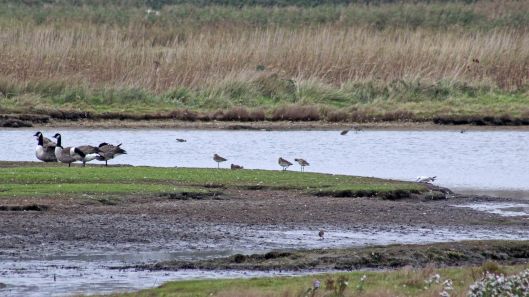
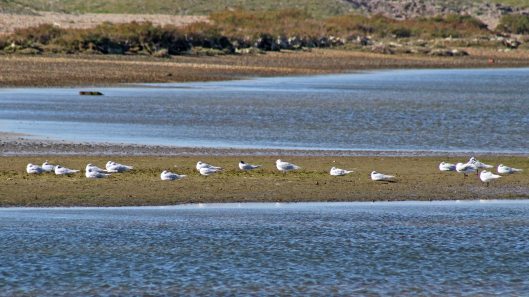
Here we staked ourselves out behind the Dorset Wildlife Trust Centre, trying, somewhat ineffectually, to shelter from the bracing winds. The wind chill was worth it though, as we had good views of a gaggle of Brent geese and a large flock of Mediterranean gulls.
171021 Sandwich terns

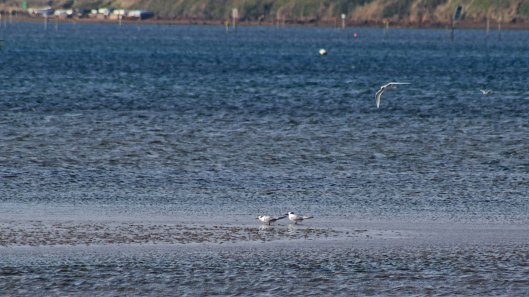
Amongst the gulls were two Sandwich terns, and the beach was also hosting the ubiquitous Oystercatchers and more common gulls, a Bar-tailed godwit and a solitary Dunlin.

171021 Oystercatchers Gull

A Wheatear dotted about on the grass below the pebble bank and, when we briefly stopped here again on our way home on Sunday, a Little egret entertained with its fishing antics, paddling about very successfully in the waterways. Next time I need to climb that bank!

171021 Little egret

Like Loading...

A Milky blob

20 Friday Oct 2017

Posted by sconzani in flowers, nature, wildflowers

≈ 2 Comments

Tags

Bee-bread, British wildflowers, Milky blobs, Sheepy-maa's, Trifolium repens, White clover

For today’s Floral Friday theme, we have a very common wildflower White clover (Trifolium repens), which is also known by the vernacular names Milky blobs, Sheepy-maa’s and Bee-bread.

171020 White clover

It seems I had a deprived childhood because, according to Richard Mabey’s Flora Britannica, ‘Almost all children learn two traditions about white clover: that the white flowers can be pulled out of the heads and sucked for a bead of honey (hence ‘bee-bread’ …); and that four- and, even better, five-leaved clovers are lucky, though you must ideally come across them by accident.’ Okay, so I knew about four-leaved clovers being lucky but I’d never heard about sucking the flowers for honey. Did you?

Like Loading...

Birding at RSPB Lodmoor

19 Thursday Oct 2017

Posted by sconzani in birds, nature

≈ Leave a comment

Tags

birding, birdwatching, British birds, Canada goose, Great white egret, Kingfisher, Lesser yellowlegs, Mediterranean gull, RSPB Lodmoor, Teal, Tringa flavipes

171019 RSPB Lodmoor

On the way to Portland Bird Observatory last Friday we called in at the RSPB’s Lodmoor Reserve, just outside of Weymouth, to see if we could catch a glimpse of one of their rare visitors, a Lesser yellowlegs (Tringa flavipes), a bird that’s usually more at home in the Americas. Our views weren’t super clear – my photos were taken through tall grasses and bramble – but it was great to see one of these occasional visitors to Europe.

171019 Lesser yellow-legs (1)
171019 Lesser yellow-legs (2)

As well as the Lesser yellowlegs (and the Gadwall I blogged about earlier in the week), there was an abundance of other birdlife.

171019 Various birds

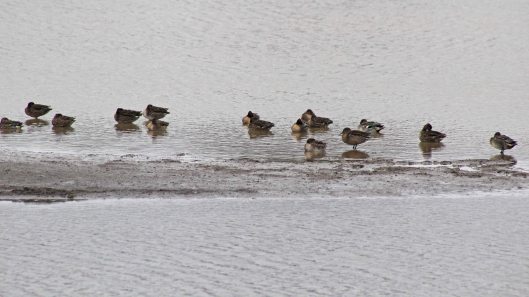
Large numbers of Canada geese flew in while we walked the trails, and there were numerous Teal and Tufted ducks.

171019 Canada geese

171019 Teal

A few Mediterranean as well as the more common gull species …

171019 Assorted gulls (1)
171019 Assorted gulls (2)
171019 Assorted gulls (3)

Ruff, Snipe, Little and Great white egrets puddled about in the lagoons; a very confiding Kingfisher posed for photos; two Marsh harriers glided over the distant reed beds; and a Spoonbill was a nice, though distant sighting. I recorded over 30 species of birds at Lodmoor and that was without walking right around the reserve.

171019 Great white egret
171019 Kingfisher
Like Loading...

Wild words: marcescent

18 Wednesday Oct 2017

Posted by sconzani in autumn, fungi, leaves, nature, trees, winter

≈ 1 Comment

Tags

botanical words, marcescent, wild words

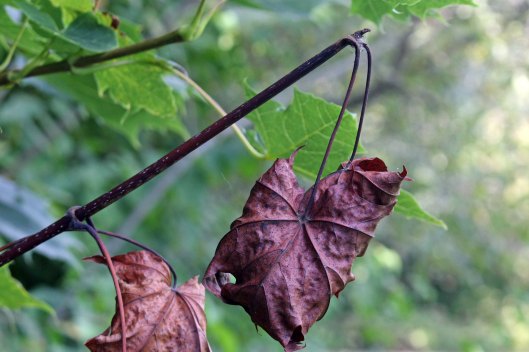
Thanks in part to following favourite author Robert Macfarlane (@RobGMacfarlane) on Twitter (he tweets a daily word) and in part to working through naturalist extraordinaire Dr Mary Gillham’s archives, I’ve been learning a lot of new words so I thought I would share the occasional one here. To start the stone rolling, we have marcescent, an adjective, which the Oxford Dictionary defines as ‘withering but remaining attached to the stem’. This is particularly noticeable during autumn and winter, as the leaves of some trees wilt and fade but remained attached to their branches. Some palms continuously retain a marcescent ‘skirt’ of dried fronds, and the term is, apparently, also used to refer to those species of fungi that can dry out but subsequently be rehydrated and continue to shed spores.

171018 marcescent

Like Loading...

Gadding about

17 Tuesday Oct 2017

Posted by sconzani in birds, nature

≈ 1 Comment

Tags

Anas strepera, birding, birdwatching, British birds, dabbling duck, duck, Gadwall, Glamorgan Bird Club, Lodmoor, RSPB Lodmoor

Here’s another beauty from last weekend’s wonderful birding trip with the Glamorgan Bird Club. Though this bird is not the rarity of yesterday’s Rustic bunting, it’s not terribly common either, and is ‘Amber listed’, meaning its population has declined in recent years and its situation is being monitored.

171017 Gadwall (1)

This is a male Gadwall (Anas strepera), a very handsome dabbling duck, a little smaller than a Mallard. Sitting on one of the ponds at the RSPB’s Lodmoor Reserve near Weymouth in Dorset, he was looking a little sleepy. Perhaps that’s why he wasn’t bothered about us looking at him, as he actually approached quite near – a bonus for me trying to get reasonable photos. We didn’t hear a peep out of him but, apparently, it’s their chattering call that originally gave the Gadwalls their imitative name.

171017 Gadwall (2)
171017 Gadwall (3)
171017 Gadwall (4)
171017 Gadwall (5)
Like Loading...

A bird in the hand

16 Monday Oct 2017

Posted by sconzani in birds, nature

≈ 6 Comments

Tags

birding, birdwatching, British birds, Emberiza rustica, Glamorgan Bird Club, Portland Bird Observatory, Portland Obs, rare bird, Rustic bunting

I’ve just had a fantastic long weekend’s birding with the Glamorgan Bird Club at the Portland Bird Observatory in Dorset. Not only did we stay in an old lighthouse but we saw an incredible number of amazing birds. I haven’t typed up my list yet but I do know I had fifteen (yes, 15!!!) lifers (for non-birders, I saw fifteen species I had never seen before).

171016 Rustic bunting (3)

This little beauty was one of them: it’s a Rustic bunting (Emberiza rustica), a bird that breeds in northern Europe and in Asia and normally migrates to Japan and parts of China and south-east Asia to over-winter. This little one may have been blown the wrong way by strong winds or perhaps, by mistake, it joined up with a group of other small birds heading for Britain.

171016 Rustic bunting (1)

It was both an amazing experience and a real privilege to see such a rarity up close. (You can read more about this bird and see more pictures on the Portland Obs blog here.)

171016 Rustic bunting (2)

Like Loading...

Autumn migration: Stonechats

15 Sunday Oct 2017

Posted by sconzani in autumn, birds, nature

≈ Leave a comment

Tags

autumn, autumn migration, birding, birdwatching, Cardiff Bay Wetland Reserve, Cosmeston Lakes Country Park, Grangemoor Park, migrant birds, Saxicola torquata, Stonechat

Meet the Stonechat (Saxicola torquata), the bird whose song sounds like two pebbles being rapped together, hence its common name.

171015 Stonechat (4)

These little birds, about the size of your average Robin, usually live a little north of where I live in south Wales, preferring the plantations of conifers that grow in the Welsh valleys and the heathland of the Brecon Beacons. But, come the cooler temperatures of autumn they begin to move south to over-winter in slightly warmer climes.

171015 Stonechat (3)

I saw my first local bird at the Cardiff Bay Wetland Reserve on 17 September, a pair at Cosmeston Lakes Country Park on 6 October, and then a solitary female at Grangemoor Park last Sunday, 8 October.

171015 Stonechat (1)

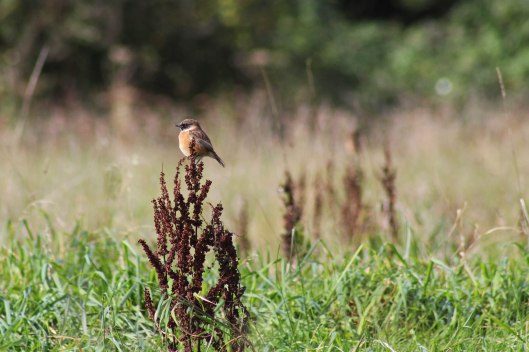
Stonechats are not always easy to spot, as they duck down amongst tall grass and wildflowers in their search for insects and seeds, and their colours act as good camouflage. But, luckily, they also have a habit of perching on the tops of those grasses and wildflowers and on low shrubs so they can keep an eye out for threats – and humans with cameras! – so I have managed to get a few distant photos.

171015 Stonechat (2)

Like Loading...

Psychedelic seeds

14 Saturday Oct 2017

Posted by sconzani in autumn, birds, nature, trees

≈ 3 Comments

Tags

autumn colour, autumn fruit, autumn seeds, Euonymus europaea, fruit, orange seeds, pink fruit, seeds, Spindle

I’m still pretty useless at identifying native British trees: I can get most of the more common big species, like Oak and Ash and Beech, but I probably couldn’t identify a Spindle if you paid me … except at this time of year. Because in the autumn, the Spindle (Euonymus europaea) lights up in psychedelic colours that remind me of a dress I had in the ’70s (yes, I am that old!).

171014 spindle seeds (1)

The Spindle (so named because its wood was used to make the spindles used to hold wool and in spinning) has fruits that are hot pink. And not only that … when those fruits open up, the seed inside is bright orange. It’s such an outrageous colour combination that it makes me wonder why it’s so very bright … and I haven’t found the answer. I thought perhaps the orange was a way to attract birds and many websites say the seeds are eaten by small birds like Robins and Tits but, when I google images, I can’t find any showing birds actually eating them. The other alternative is that the colour is a ‘don’t touch me I’m poisonous’ warning – and certainly the fruits are poisonous to humans but to birds? If anyone has any information about this eye-popping colour combination, I’d love to hear it. Meantime, put on your shades and check out these psychedelics, man.

171014 spindle seeds (2)
171014 spindle seeds (3)
171014 spindle seeds (4)
171014 spindle seeds (5)
171014 spindle seeds (6)
171014 spindle seeds (7)
Like Loading...

‘Like a flight of butterflies’

13 Friday Oct 2017

Posted by sconzani in flowers, nature

≈ 2 Comments

Tags

#FloralFriday, cyclamen, houseplant

171013 Cyclamen (3)

‘… a cyclamen that looks like a flight of butterflies, frozen for a single, exquisite moment in the white heart of Time …’ ~ Beverley Nichols, Down the Garden Path, 1931

171013 Cyclamen (1)
171013 Cyclamen (2)

As you may have guessed, this is not a wild cyclamen but rather one of my houseplants. I bought it in flower back in February and it has just started flowering again. I actually have two this colour – the other has buds but they’re not yet open, and another cyclamen that has white blooms, also in bud. I love the little burst of colour they bring to my bedroom windowsill.

Like Loading...

Sitting on the fence

12 Thursday Oct 2017

Posted by sconzani in insects, nature

≈ 2 Comments

Tags

Black darter, Common Darter, dragonflies, flies, hoverflies, Myathropa florea, sitting on the fence

Have you ever noticed that some small beasties like to sit on fences?

171012 Common darter (3)

I guess fences are often a good spot to sunbathe, and to keep a look out, and they probably resemble logs and branches to the mini-beasts.

171012 Common darter (1)
171012 Common darter (2)

Common darter dragonflies are keen fence-sitters – they don’t even mind barbed-wire fences. And I was particularly delighted to find the Black darter dragonfly (below) sitting on a fence at Cosmeston the other day – my first sighting of this species.

171012 Black darter

Flies and hoverflies also enjoy a spot of fence-sitting and can often be found taking care of their ablutions in such places. So, the next time you decide to sit on the fence, make sure some other creature hasn’t beaten you to it! 

171012 fly (1)
171012 fly (2)
171012 Myathropa florea
171012 Pollenia rudis
Like Loading...
← Older posts
Newer posts →

About me

sconzani

sconzani

I'm a writer and photographer; researcher and blogger; birder and nature lover; countryside rambler and city strider; volunteer and biodiversity recorder.

View Full Profile →

Follow earthstar on WordPress.com

Enter your email address to follow this blog and receive notifications of new posts by email.

Recent blog posts

  • Peak Wild garlic April 26, 2026
  • First damsels of 2026 April 25, 2026
  • NFY: Green-veined white April 24, 2026
  • The return of the Willow warblers April 23, 2026
  • Bug: Harpocera thoracica April 22, 2026

From the archives

COPYRIGHT

Unless otherwise acknowledged, the text and photographs on this blog are my own and are subject to international copyright. Nothing may be downloaded or copied without my permission.

Fellow Earth Stars!

  • Unknown's avatar
  • Unknown's avatar
  • Unknown's avatar
  • Unknown's avatar
  • Unknown's avatar
  • Unknown's avatar
  • Unknown's avatar
  • Unknown's avatar
  • Unknown's avatar
  • Unknown's avatar
  • Unknown's avatar
  • Unknown's avatar
  • Unknown's avatar
  • Unknown's avatar
  • Unknown's avatar
  • Unknown's avatar
  • Unknown's avatar
  • Unknown's avatar
  • Unknown's avatar
  • Unknown's avatar
  • Unknown's avatar
  • Unknown's avatar
  • Unknown's avatar
  • Unknown's avatar
  • Unknown's avatar
  • Unknown's avatar
  • Unknown's avatar
  • Unknown's avatar
  • Unknown's avatar
  • Unknown's avatar
  • Unknown's avatar
  • Unknown's avatar
  • Unknown's avatar
  • Unknown's avatar
  • Unknown's avatar
  • Unknown's avatar
  • Unknown's avatar
  • Unknown's avatar
  • Unknown's avatar
  • Unknown's avatar
  • Unknown's avatar
  • Unknown's avatar
  • Unknown's avatar
  • Unknown's avatar
  • Unknown's avatar
  • Unknown's avatar
  • Unknown's avatar
  • Unknown's avatar
  • Unknown's avatar
  • Unknown's avatar

Blog at WordPress.com.

Privacy & Cookies: This site uses cookies. By continuing to use this website, you agree to their use.
To find out more, including how to control cookies, see here: Cookie Policy
  • Subscribe Subscribed
    • earthstar
    • Join 642 other subscribers
    • Already have a WordPress.com account? Log in now.
    • earthstar
    • Subscribe Subscribed
    • Sign up
    • Log in
    • Report this content
    • View site in Reader
    • Manage subscriptions
    • Collapse this bar
 

Loading Comments...
 

You must be logged in to post a comment.

    %d