• ABOUT
  • BIRDING 2018
  • Birding 2019
  • BLOG POSTS
  • Butterflies 2018
  • Resources

earthstar

~ a celebration of nature

earthstar

Category Archives: nature

Looking frazzled!

03 Saturday Jun 2017

Posted by sconzani in flowers, nature, wildflowers

≈ Leave a comment

Tags

British flora, British native flowers, British wildflowers, Ragged robin, Silene flos-cuculi

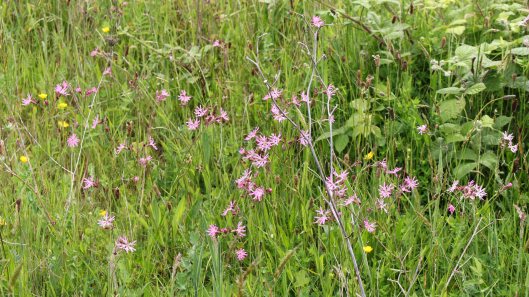
Ragged robin (Silene flos-cuculi) certainly lives up to its name. To me, it always looks a tad stressed, a touch frayed around the edges, a bit frazzled, as if it’s had a long hard day in the meadows, but its distinctive ragged shape does at least make it one of the easiest British wildflowers to identify.

Ragged robin (4)

I say ‘always’ but I don’t actually see this pretty native very often. Perhaps that’s because it prefers to dip its feet into the damper grass- and woodlands, though the word is that it has declined in recent years in many parts of Britain, mostly due to agriculture taking over its habitats.

Ragged robin (2)
Ragged robin (3)

It was, then, even more special to spot these plants in one of my local wild places this week, and I wasn’t the only one smiling at the sight. The bees were obviously pleased to see them too! Ragged Robin flowers from May through to August so I hope you’re lucky enough to spot some too.

Ragged robin (1)

Like Loading...

The bees that don’t buzz

02 Friday Jun 2017

Posted by sconzani in flowers, nature, wildflowers

≈ 6 Comments

Tags

Bee orchid, British orchids, British wildflowers, native orchids, Ophrys apifera), orchid

Finding my very first Bee orchids (Ophrys apifera) in a local park this week made my day! I know they’re designed to entice male bees to attempt mating with their flowers in order to facilitate pollination but to me they actually look like jolly smiling and laughing mouths.

170602 Bee orchid Ophrys apifera (1)
170602 Bee orchid Ophrys apifera (2)

I had to find out more, and I have to say that, when it comes to wild plants, I love the Plantlife website – as well as giving you the straight facts and figures about British plants, they also include the most interesting fact-lets, like these:

*  The aim of the mimicry is to attract passing male bees in the hope they will try to mate and thus aid pollination. In Britain, however, Bee orchids self-pollinate so the deception is not really required.
*  This wild flower was once called the “Humble Bee” orchid (Humble being a variation of Bumble).
*  According to Roman natural historian Pliny the Elder it was used by womenfolk to darken their eyebrows.
*  The Bee orchid is the County Flower of Bedfordshire.
*  In the Language of Flowers it stands for error and industry.

170602 Bee orchid Ophrys apifera (3)
170602 Bee orchid Ophrys apifera (4)
Like Loading...

Moths in the light of day

01 Thursday Jun 2017

Posted by sconzani in insects, nature

≈ 5 Comments

Tags

British moth, Camptogramma bilineata, Euclidia mi, moth, Mother Shipton, Silver-ground Carpet, Spilosoma lubricipeda, White Ermine, Xanthorhoe montanata, Yellow Shell

In the absence of butterflies, I seem to be discovering more moths. (I’m not sure why I’m not seeing many butterflies, though a friend says there’s often a May lull before a June explosion – let’s hope that’s true.)

170601 White ermine (1)
170601 White ermine (2)

White Ermine (Spilosoma lubricipeda)
I found this beauty, wearing the rather regal furry coat that gives it its name, lurking in a clump of tall grass. Flying between May and July, with an occasional second generation appearing in September–October, the White Ermine can be found throughout Britain in a variety of habitats, from heath- and moorland to gardens, hedgerows and woodlands.

170601 Silver-ground Carpet

Silver-ground Carpet (Xanthorhoe montanata)
This pretty member of the carpet group of moths was a lucky find at Cosmeston Lakes Country Park, where I chanced to spot it resting in a clump of grass in a small woodland area. It’s another May to July flier, and its caterpillars enjoy nothing better than a good munch on bedstraws, the plants of the Galium species.

170601 Yellow shell
170601 Mother Shipton

Yellow Shell and Mother Shipton
Both of these images were grab shots from a recent walk around the former rubbish tip that is now Grangemoor Park, in Cardiff. Moths have a habit of not wanting to be disturbed by camera lenses thrust in their direction, I notice, so my apologies that my photos are not very sharp.

I wish the Yellow shell (Camptogramma bilineata) (above left) hadn’t flitted off so quickly as I love its bright markings that resemble the line patterns found on some seashells, hence its name. It’s another common find throughout Britain, though it does have a preference for damper places. Its larvae feed on low-growing plants like sorrel and chickweed so look for it around that type of vegetation, usually between May and August.

Can you see why Mother Shipton (Euclidia mi) (above right) is so named? Those markings on her wings supposedly resemble a witch’s face and she is named for Old Mother Shipton, a 16th-century witch from Yorkshire who produced a series of dire prophecies. The moth, on the other hand, can be found all over Britain and Ireland, though has a particular fondness for the flower-rich meadows where grow the clovers, medics and lucernes its caterpillars like to eat.

Like Loading...

Southover Grange Gardens

31 Wednesday May 2017

Posted by sconzani in flowers, nature, parks, plants, trees

≈ Leave a comment

Tags

350-year-old Mulberry tree, garden in Lewes, public gardens in East Sussex, Southover Grange Gardens

Curiosity can be a good thing. You look through a grill in a stone wall and spy a magical garden. You see people walking to and fro so you think, ‘maybe it’s open to the public’. You walk further along the walls until, at the corner of the street, you find an entrance and, hey presto, you discover the glorious Southover Grange Gardens in Lewes.
170531 Southover Grange Gardens Lewes (1)

The Grange was built by one William Newton in 1572, with stone filched from the old Lewes Priory, but the gardens are the creation of more recent owners. Highlights include a 350-year-old Mulberry tree, one of the oldest in England, as well as many other magnificent old trees; herbaceous borders and formal bedding displays; a box-hedged knot garden full of the scent of roses; a wildflower area; and an impressive collection of public artworks. If you’re ever in Lewes, do pay a visit to this tranquil oasis.

This slideshow requires JavaScript.

Like Loading...

Botanising, with insects

30 Tuesday May 2017

Posted by sconzani in animals, birds, insects, molluscs, nature, slugs

≈ 4 Comments

Tags

Bloody-nosed beetle, Brynna, Click beetle, Glamorgan Botany Group, grasshopper, moths, Nettle weevil, rooster, sheep, slugs

As I mentioned a couple of days ago, I returned from my last Botany Group walk with more photos of insects – and other living creatures – than plants. The Gorse weevil got a blog of its own yesterday; now here are some of our other finds.

170531 1 weevil
170531 2 Nettle Weevil
170531 3 Click beetle

Firstly, a couple more weevils, both on nettle and the second one is definitely a Neetle weevil (Phyllobius pomacues) but I’m not sure about the first. The Click beetle was also found on nettle.

170531 4 sheep
170531 5 rooster

These two were at a farm we passed through; the sheep was lording it over the home paddock and the rooster was king of the farmyard. Both handsome dudes!

170531 6 slugs
170531 7 grasshopper

A nice little grouping of slug species, with their small friend, the Granny Grey, and a grasshopper. There were lots of these hopping round on grass and rushes in a boggy field. It may be a juvenile Meadow grasshopper but I’m not 100% sure.

170531 8 Micropterix calthella
170531 9 Moth Bactra sp
170531 10 spider

A little flock of Micropterix cathella moths were feasting on this grass flower, and there were lots of other small moths, probably one of the Bactra species, plus an unidentified spider with a distinctive striped body.

170531 11 Bloody-nose beetle larva
170531 12 Bloody-nose beetle

And last, but certainly not least, these Bloody-nosed beetles (Timarcha tenebricosa). The photo on the left shows the chubby larva and on the right is the adult beetle munching on a grass stalk.

Like Loading...

Weevil as biological controller

29 Monday May 2017

Posted by sconzani in insects, nature, plants

≈ 6 Comments

Tags

Exapion ulicis, gorse, Gorse weevil, insects on gorse, weevil, weevil as biological control, weevil introduced to New Zealand

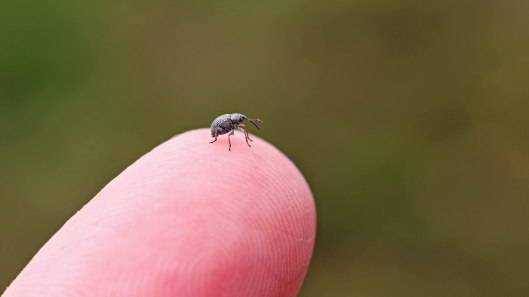
It was lunchtime on our Glamorgan botany group walk and, rather than get a wet bum from sitting on the damp grass, I was eating my roll and cheese while poking around the flowers of a nearby gorse bush. I was looking for Gorse shieldbugs, of which I found not a sign, but I did find this tiny creature and, after a bit more poking, a couple of its friends.

170529 Gorse weevil (2)

It’s a Gorse weevil (Exapion ulicis) and, as you can judge from its size relative to my finger, it’s tiny, only 2 to 3mm long. Its snout is (relatively) enormous, about half as long as its body, making it look like a cross between an elephant (without the ears) and a spider (those legs!). And that snout is its secret weapon – the weevil uses its snout to burrow into the stem and spines of the gorse bush to eat the soft tissue inside.

170529 Gorse weevil (1)

Apparently this little weevil was introduced to my homeland, New Zealand, back in 1931 in an effort to control the introduced (by British migrants as cheap hedging) gorse bushes that were thriving in New Zealand’s favourable climate. The weevil’s larvae live inside and eat gorse seeds, thus preventing the bushes from reproducing. The little gorse weevil has done its job well but it seems the scientists hadn’t banked on the fact that the weevil larvae only eat gorse seeds in the springtime and the gorse also flowers and seeds in the autumn.

170529 Gorse weevil (3)

Like Loading...

Botanising: A walk above Brynna

28 Sunday May 2017

Posted by sconzani in nature, plants, wildflowers

≈ 5 Comments

Tags

botany mentee, British flora, Bush vetch, Common vetch, Field horsetail, Glamorgan Botany Group, Mouse-ear hawkweed, Welsh poppy, Zigzag clover

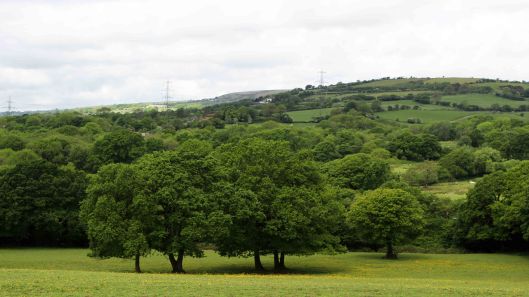
Last weekend I enjoyed another full day’s walk with the Glamorgan Botany Group in the hills and vales above Brynna, in south Wales, and, though I am the first to admit that I came home with more photos of insects than plants, I am learning. It’s just that, for someone who wasn’t brought up in Britain and so didn’t learn from an early age the names of even the most common wildflowers, there’s a huge amount to take in.

170528 Brynna

So, what have I learnt? I can now tell the difference between Common vetch (Vicia sativa), on the left, and Bush vetch (Vicia sepium), on the right below.

170528 2 Common vetch
170528 3 Bush vetch

I know this is Field horsetail (Equisetum arvense) because the first joints of the leaves (which form a skirt around the stem when you break them off) are longer than the stem section (the little dark v-shaped marks on the stem in this photo).

170528 1 Field horsetail

Though the two species are very similar, I know this is not Red clover (Trifolium pratense) but rather Zigzag clover (Trifolium medium) partly because the white marks on its leaves are not as obvious but, most definitively, because at the widest part of the leaf the veins meet the edge at a 90 degree angle.

170528 4 Zigzag clover (1)
170528 4 Zigzag clover (2)

I know that the plant on the left is Mouse-ear hawkweed (Hieracium pilosella) and that beautiful flower on the right is my very first Welsh poppy (Meconopsis cambrica) growing in the wild!

170528 Mouse-ear hawkweed
170528 Welsh poppy
Like Loading...

A little fox love

27 Saturday May 2017

Posted by sconzani in animals, nature

≈ 4 Comments

Tags

fox, Red fox, Rye Harbour Nature Reserve

170527 Red fox cub (1)

Across clearings, an eye,
A widening deepening greenness,
Brilliantly, concentratedly,
Coming about its own business
~ from ‘The Thought Fox’ by English poet and children’s writer Ted Hughes (1930-1998), from his 1957 collection The Hawk in the Rain

170527 Red fox cub (2)
170527 Red fox cub (3)
170527 Red fox cub (4)
170527 Red fox cub (5)
Like Loading...

Two orchids

26 Friday May 2017

Posted by sconzani in flowers, nature, wildflowers

≈ Leave a comment

Tags

Common twayblade, Dactylorhiza maculata, Heath spotted-orchid, Merthyr Mawr National Nature Reserve, native orchids, Neottia ovata, orchid, Twayblade

Of the estimated 25,000 different species of orchid that can be found around the world, 56 are native to Britain and, as some of those 56 are now coming in to bloom, I thought I’d share a couple for this week’s Floral Friday.

170526 Twayblade (2)
170526 Twayblade (1)

Twayblade (Neottia ovata)
First up is the Twayblade I saw growing quite prolifically in the woodland at Merthyr Mawr a couple of weeks ago. It’s one of Britain’s most common species but is often overlooked, perhaps because its yellow-green flowers often blend in with their woodland, scrub or grassland habitats. Twayblade means two leaves, as there usually are just two leaves, from the centre of which sprouts the flower stalk, though, like all living things, there are exceptions to the rule and plants with three to five leaves are sometimes found. The thing that most fascinates me about these orchids is the manikin-shaped flower.

170526 Heath spotted-orchid (1)
170526 Heath spotted-orchid (2)

Heath spotted-orchid (Dactylorhiza maculata)
Luckily I was with a group of botanists when I saw my first Heath spotted-orchids last weekend, as they can easily be confused with Common spotted-orchids, though the fact that we were in a damp boggy field at the time was probably also a good species indicator. As the name ‘heath’ implies, this orchid likes to get its feet wet, relishing the sogginess of peaty moors and boggy heaths. As well as being common throughout Europe, this orchid can also be found throughout the British Isles, though it does show a marked preference for northern and western areas. Its gorgeous flowers can be seen from around the middle of May through to mid July.

Like Loading...

Two go cuckoo at Camber

25 Thursday May 2017

Posted by sconzani in birds, coastal fauna, nature, walks

≈ 2 Comments

Tags

birding, birdwatching, Black-headed gull, Common tern, Gadwall, Lapwing, Marsh harrier, Oystercatchers, Ringed plover, Rye Harbour Nature Reserve, sheep, Shelduck, Skylark, Sussex Wildlife Trust guided walk

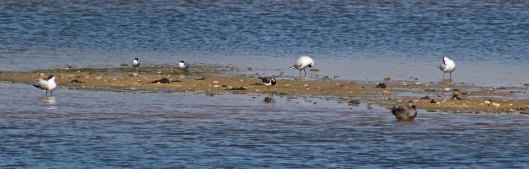
I celebrated my birthday, with my friend Jill, with a quick morning romp around the bird hides at Rye Harbour Nature Reserve, followed by an afternoon Sussex Wildlife Trust guided walk around the inland part of the reserve, including a peek inside the normally locked Camber Castle. And what a superb day it was!

170524 Rye Harbour fauna (10)

I’ve already blogged about one of the highlights, the gorgeous Avocets and their chicks; another was hearing, and catching a fleeting glimpse of my very first Cuckoo. Here are a few more (not so crisp) photos of the wonderful (but mostly distant) wildlife we saw: Common terns, Skylark, Oystercatchers and Dunlin, Black-headed gull, Ringed plover, Gadwall and Shelduck, Lapwing and a Pied wagtail, Marsh harrier, and a number 72; plus, not pictured, Redshank, Coot, Cormorant, Tufted duck, Mallard, Little ringed plover, Grey heron, Kestrel and Whitethroat, as well as the more common birds. A birthday to remember!

170524 Rye Harbour fauna (1)
170524 Rye Harbour fauna (2)
170524 Rye Harbour fauna (3)
170524 Rye Harbour fauna (4)
170524 Rye Harbour fauna (5)
170524 Rye Harbour fauna (6)
170524 Rye Harbour fauna (7)
170524 Rye Harbour fauna (8)
170524 Rye Harbour fauna (9)
Like Loading...
← Older posts
Newer posts →

About me

sconzani

sconzani

I'm a writer and photographer; researcher and blogger; birder and nature lover; countryside rambler and city strider; volunteer and biodiversity recorder.

View Full Profile →

Follow earthstar on WordPress.com

Enter your email address to follow this blog and receive notifications of new posts by email.

Recent blog posts

  • Lifer: Box bug April 27, 2026
  • Peak Wild garlic April 26, 2026
  • First damsels of 2026 April 25, 2026
  • NFY: Green-veined white April 24, 2026
  • The return of the Willow warblers April 23, 2026

From the archives

COPYRIGHT

Unless otherwise acknowledged, the text and photographs on this blog are my own and are subject to international copyright. Nothing may be downloaded or copied without my permission.

Fellow Earth Stars!

  • Unknown's avatar
  • Unknown's avatar
  • Unknown's avatar
  • Unknown's avatar
  • Unknown's avatar
  • Unknown's avatar
  • Unknown's avatar
  • Unknown's avatar
  • Unknown's avatar
  • Unknown's avatar
  • Unknown's avatar
  • Unknown's avatar
  • Unknown's avatar
  • Unknown's avatar
  • Unknown's avatar
  • Unknown's avatar
  • Unknown's avatar
  • Unknown's avatar
  • Unknown's avatar
  • Unknown's avatar
  • Unknown's avatar
  • Unknown's avatar
  • Unknown's avatar
  • Unknown's avatar
  • Unknown's avatar
  • Unknown's avatar
  • Unknown's avatar
  • Unknown's avatar
  • Unknown's avatar
  • Unknown's avatar
  • Unknown's avatar
  • Unknown's avatar
  • Unknown's avatar
  • Unknown's avatar
  • Unknown's avatar
  • Unknown's avatar
  • Unknown's avatar
  • Unknown's avatar
  • Unknown's avatar
  • Unknown's avatar
  • Unknown's avatar
  • Unknown's avatar
  • Unknown's avatar
  • Unknown's avatar
  • Unknown's avatar
  • Unknown's avatar
  • Unknown's avatar
  • Unknown's avatar
  • Unknown's avatar
  • Unknown's avatar

Blog at WordPress.com.

Privacy & Cookies: This site uses cookies. By continuing to use this website, you agree to their use.
To find out more, including how to control cookies, see here: Cookie Policy
  • Subscribe Subscribed
    • earthstar
    • Join 642 other subscribers
    • Already have a WordPress.com account? Log in now.
    • earthstar
    • Subscribe Subscribed
    • Sign up
    • Log in
    • Report this content
    • View site in Reader
    • Manage subscriptions
    • Collapse this bar
 

Loading Comments...
 

You must be logged in to post a comment.

    %d