• ABOUT
  • BIRDING 2018
  • Birding 2019
  • BLOG POSTS
  • Butterflies 2018
  • Resources

earthstar

~ a celebration of nature

earthstar

Category Archives: nature

Hawthorn: did you know … ?

04 Thursday May 2017

Posted by sconzani in flowers, nature, spring, trees

≈ 6 Comments

Tags

Crataegus monogyna, Hawthorn, Hawthorn wood, May-tree, uses for hawthorn berries

170504 Hawthorn (3)

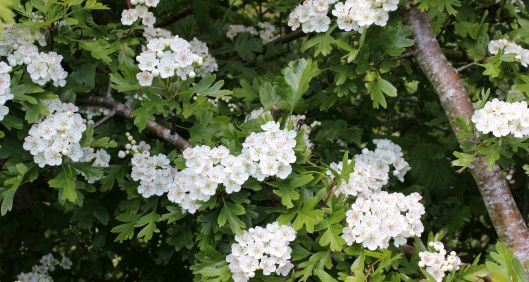
>   Hawthorn’s scientific name is Crataegus monogyna. Crataegus comes from the Greek kratos, meaning strength, and akis, meaning sharp, and monogyna is derived from mono, meaning one or single, and gyna, meaning seed or ovary.
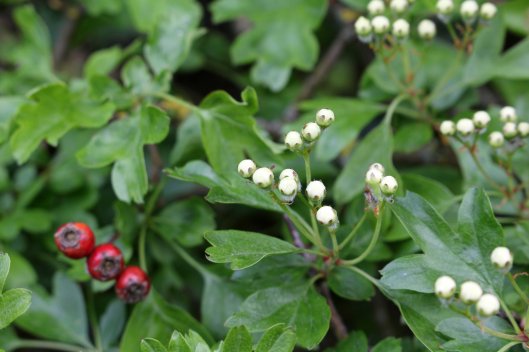
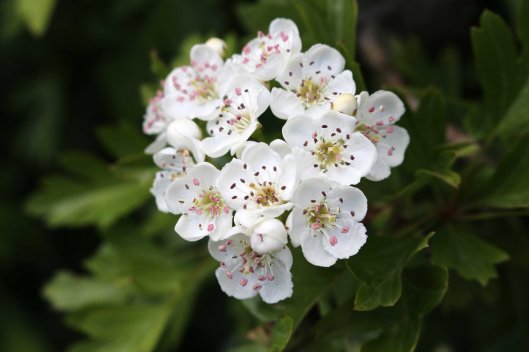
>   Hawthorn is also known as the May-tree, Mayblossom and Maythorn, not surprisingly because it usually flowers during May. It is the only British plant named after the month in which it blooms.

170504 Hawthorn (4)
170504 Hawthorn (1)

>   The Hawthorn’s white flowers can be either male or female. You can tell the male flowers by their pink-tipped stamens.
>   Hawthorn’s red berries, the haws, not only serve as food for birds, particularly the thrushes, they can also be used to make jams and jellies and wine.
>   The Hawthorn provides food for more than 150 different species of insect, like the hawthorn shield bug, the common earwig and common flower bug, bumblebees and cockchafers, to name just a few.
170504 Hawthorn (5)

>   Due to its dense growth and long thorns, Hawthorn has served as the perfect impenetrable hedge for thousands of years. Individual trees can live for 400 years or more.
>   In years gone by, the wood of the Hawthorn, because it has a very fine grain and is very hard, was used for making things like tool handles and engravers’ blocks. The root wood was also used to make combs and small boxes.
170504 Hawthorn (2)

Like Loading...

Praying or preying?

03 Wednesday May 2017

Posted by sconzani in insects, nature

≈ 2 Comments

Tags

#WorldWildlifeWednesday, insects, Mantids, Praying mantis, Praying mantis Cambodia, Praying mantis New Zealand, Preying mantis

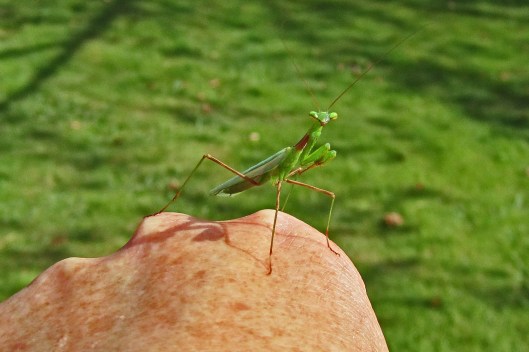
The correct name for this insect is Praying mantis (or, in fact, Praying mantid as my photos were taken in New Zealand (above) and Cambodia (below) and I’m not sure which species these are), the word ‘praying’ coming from its stance – with its large front legs bent and resting together, the insect looks like it’s praying. However, the word ‘preying’ seems equally appropriate for the mantis as it’s a formidable hunter.

170503 Praying mantis New Zealand

Mantids are masters of camouflage and use this ability to change their colouration to blend in with their surroundings, partly as a way to avoid being eaten by their predators but also, as they are mostly ambush predators themselves, as a way to more easily capture their own victims. They are also masters of the rapid pounce and their diet includes living insects like flies and aphids, crickets, moths, grasshoppers and even cockroaches.

170503 Praying mantis Cambodia

But wait, there’s more. The Praying mantis can also be cannibalistic. When food is scarce, they will eat their own kind, though male mantids are most at risk from the females at mating time. It seems hungry females have a tendency to eat their mates if the males don’t dismount and run away as rapidly as possible after copulation.

Like Loading...

Bishy-barnabee & Co

02 Tuesday May 2017

Posted by sconzani in insects, ladybird, nature

≈ 3 Comments

Tags

14-spot ladybird, 18-spot ladybird, 22-spot ladybird, 7-spot ladybird, Bishy-barnabee, harlequin ladybird, ladybird, Orange ladybird, Robert Macfarlane, vernacular names for ladybird

If you’re on Twitter and follow one of my favourite authors, Robert Macfarlane, you’ll know that he tweets a ‘word of the day’. Yesterday’s was ‘Bishy-barnabee’, a vernacular name for the ladybird used by folk who live in the English county of Norfolk. I adore these common names – they are often old, come from a time when folk paid more attention to the natural world, observing the habits and customs of the creatures around them, or they named creatures after concepts and ideas that were important to them. Macfarlane listed other ladybird names too: cushcow, goldie-bird, red-sodger, and kingcollawa. In Fauna Britannica, Stefan Buczacki lists even more: as well as bishie barni-bee, he has bishop barnabee, bishop is burning, bishop that burneth (all from Norfolk); clock-o’clay and cow lady (from Yorkshire); God Almighty’s cow, God’s little cow and King Galowa (from Scotland); and ladycow, lady fly, lady lanners, Mary gold and sodger (from Northumberland). I’m sure there are many many more.

Here is a selection of the Bishy-barnabees I have photographed (using the mostly numerical descriptions we more commonly use these days: two 7-spots, a 14-spot, an 18-spot, a 22-spot, 3 Harlequins and an Orange).

170501 ladybird 7-spot (1)
170501 ladybird 7-spot (2)
170501 ladybird 14-spot
170501 ladybird 18-spot
170501 ladybird 22-spot
170501 ladybird Harlequin (1)
170501 ladybird Harlequin (2)
170501 ladybird Harlequin (3)
170501 ladybird Orange
Like Loading...

The Sanderlings and the Dunlins

01 Monday May 2017

Posted by sconzani in birds, nature, spring

≈ 2 Comments

Tags

birding, birdwatching, British birds, Calidris alba, Calidris alpina, Dunlin, passage migrant, Sanderling

Yesterday I told you about my chilly but super exciting birdwatching morning on Saturday and showcased two of the highlights, the Whimbrel and the Bar-tailed Godwit. Today, we have the Sanderlings and the Dunlins, both so well camouflaged against the stones on the seashore that, if they hadn’t been almost constantly moving about in their search for insects, they would’ve been very hard to spot.

170501 sanderling (2)
170501 sanderling (3)
170501 sanderling (1)

Sanderlings to the left, Turnstones to the right

Like yesterday’s birds, the Sanderling (Calidris alba) is a passage migrant, seen in parts of coastal Britain during the spring as it heads to its breeding grounds in the Arctic and in the autumn as it heads south to tropical beaches around the world, a journey that can be as long as 6000 miles. During the breeding season, the birds’ grey plumage takes on a much redder hue on the head, neck and back, which you can clearly see on one of these birds (particularly in the photo top left).

170501 dunlin (1)

The Dunlin (Calidris alpina) – like the Sanderling, a member of the Sandpiper family – is a very common sight on Britain’s coast throughout the year, though breeding birds head to the upland areas of Wales, Scotland and England to nest between April and July. The Dunlin also becomes a more rufous colour during the breeding season and acquires the dark tummy feathers you can see on these birds. I’m guessing they’ll be heading for the hills shortly to find a mate.

170501 dunlin (2)
170501 dunlin (3)
Like Loading...

The Whimbrel and the Barwit

30 Sunday Apr 2017

Posted by sconzani in birds, nature, spring

≈ 2 Comments

Tags

Bar-tailed Godwit, birding, birdwatching, British birds, British seabirds, Limosa lapponica, Numenius phaeopus, passage migrants, Whimbrel

170430 whimbrel (1)

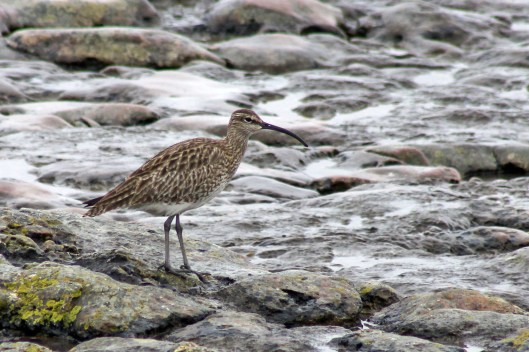
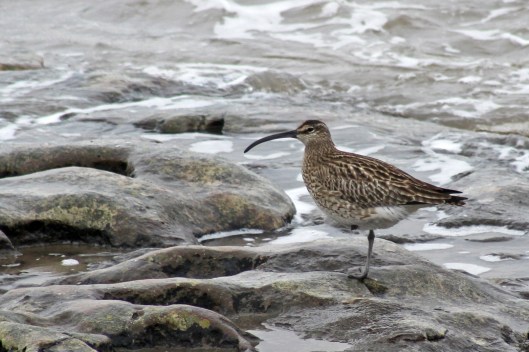
I was in my element yesterday morning, stealthily stalking along the stony coastal path at Sully in a shiver-inducing chilly wind, trying to observe and photograph a wonderful variety of seabirds. And I got lucky, really really lucky, as by the time I decided I needed to get walking to ward off hypothermia, I had seen noisy fly-pasts of Oystercatchers; Dunlins and Turnstones and, an unexpected bonus, two Sanderlings foraging along the tide-deposited seaweed; several rather skittish Whimbrels; and a fleeting glimpse of one also unexpected but rather beautiful Bar-tailed Godwit.

170430 Whimbrel and bar-tailed godwit (1)
170430 Whimbrel and bar-tailed godwit (2)

Both the Whimbrels and the Bar-tailed godwit are passage migrants. The Whimbrel (Numenius phaeopus) (the bird with the curved beak) can be seen around Britain’s coastline during spring as it flies north to Shetland and Orkney to breed and again in autumn when it heads back to South Africa to enjoy a warmer winter. The Bar-tailed Godwit (affectionately abbreviated amongst birders to Barwit) (Limosa lapponica) passes through Britain on its way to its breeding grounds in the Scandinavian and Siberian Arctic, though does sometimes over-winter in Britain.

p.s. See tomorrow’s post for the Sanderlings and the Dunlins.

170430 whimbrel (2)

Like Loading...

Lackey me!

29 Saturday Apr 2017

Posted by sconzani in insects, nature

≈ 3 Comments

Tags

British moth, caterpillar, Lackey caterpillars, Malacosoma neustria, moth, moth caterpillar web, The Lackey

To the arachnophobes out there, I just want to reassure you that not all webs are made by spiders. Some are home to really cute caterpillars like these that I was lucky enough to spot on a recent walk.

170429 Lackey moth Malacosoma neustria caterpillars (3)

Native to central Europe and southern Britain, these are Lackey moth (Malacosoma neustria) caterpillars, pretty little blue-and-orange-and-white-striped crawlies that live happily together in a silken web they’ve spun for themselves amongst the blackthorn, hawthorn and other trees and shrubs that are their food plants. They began life as eggs that were laid towards the end of last summer but didn’t hatch until this spring, meaning these little creatures will have spent around half their lives as eggs. In a few weeks, when they’re munched their way through plenty of leaves and moulted a few times, these caterpillars will drop to the ground and pupate. Once the summer comes, they’ll hatch and the adult moths will be seen flying in and around these hedgerows during July and August – something to look forward to, though the moth is a little drab in comparison to its offspring.

170429 Lackey moth Malacosoma neustria caterpillars (1)
170429 Lackey moth Malacosoma neustria caterpillars (2)

p.s. I cannot take the credit for today’s catchy title. I pinched it from my friend Mark, who used it to comment on another friend’s Lackey web find on Facebook.

Like Loading...

Fungi Friday: The rust challenge

28 Friday Apr 2017

Posted by sconzani in fungi, nature, wildflowers

≈ 7 Comments

Tags

Bluebell, citizen science, Glamorgan Fungus Group, Lesser Celandine, Nettle, Puccinia urtica, rust, rust fungi, Uromyces dactylis, Uromyces muscari

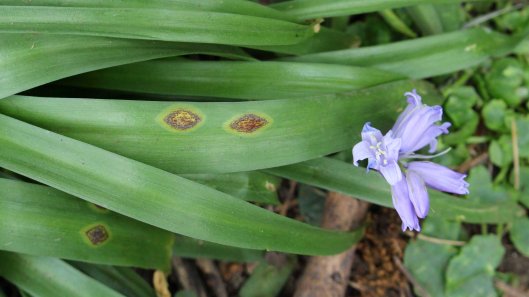
Back in January I posted about the Cobalt crust-finding challenge I was taking part in with my friends from the Glamorgan Fungus Group. This month we’ve been at it again but our challenge species are rusts, specifically Uromyces dactylis (below right) and Uromyces ficaria which are both found on Lesser Celandine; Puccinia urtica (below left) on Nettles; Uromyces muscari (the other four photos) on native, cultivated and hybrid Bluebells; and on Nipplewort Lapsana communis.

170428 Puccinia urtica on Nettle
170428 Uromyces dactylis on Lesser celandine

Though finding and photographing the Nettle rust is more for the masochist than the faint-hearted – our group has joked about buying thick rubber gloves up to our elbows(!), the other rusts are less dangerous though no less of a challenge. I’ve had most success with the Bluebell rust – probably a reflection of the fact that everyone loves Bluebells so they’ve been planted almost everywhere, but have found only one specimen of one of the rusts on Lesser Celandine, despite the flowers being very plentiful and numerous in my local parks and wild areas. And I have yet to find a specimen of Nipplewort rust – probably because I have yet to positively identify Nipplewort (this is why I’ve taken up a botany menteeship!).

170428 Uromyces muscari on bluebell (1)
170428 Uromyces muscari on bluebell (2)
170428 Uromyces muscari on bluebell (3)

Still, just as we did with Cobalt crust, our group members have thrown themselves into this challenge and, to date, our combined total stands at over 140 separate finds. And, just like last time, our finds are being fed into our local biodiversity database so our challenge is helping to increase the knowledge base for these under-recorded fungi. Citizen science rocks!

170428 Uromyces muscari on bluebell (4)

Like Loading...

Ivy-leaved toadflax

27 Thursday Apr 2017

Posted by sconzani in flowers, nature, wildflowers

≈ 4 Comments

Tags

coliseum ivy, Cymbalaria muralis, Ivy-leaved toadflax, Kenilworth ivy, mother of thousands, non-native British wildflowers, Oxford weed, pennywort

170427 Ivy-leaved toadflax (4)

I see this plant so very often that I would’ve sworn it was a native British wildflower but no! Ivy-leaved toadflax (Cymbalaria muralis) only came to Britain in the early 1600s. In his excellent book Weeds: How vagabond plants gatecrashed and changed the way we think about nature (Profile Books, London, 2010), author Richard Mabey relates the story that the plant’s seeds ‘were caught up in the packing of some marble statuary imported from Italy to Oxford, whence, like the city’s eponymous ragwort, they migrated into the wider world via the college walls’. This explains why Ivy-leaved toadflax was, for a time, known as ‘Oxford weed’, though it has accumulated several other common names as well: Kenilworth ivy, coliseum ivy, mother of thousands, and pennywort.

170427 Ivy-leaved toadflax (3)

Ivy-leaved toadflax came originally from the mountains of southern Europe but, in Britain and many other parts of the world, it has swapped alpine rocks and stones for the bricks and stones of man-made walls. Its pretty little snapdragon-like flowers can be seen from April through to September.

170427 Ivy-leaved toadflax (1)
170427 Ivy-leaved toadflax (5)
170427 Ivy-leaved toadflax (2)
Like Loading...

From mud comes beauty

26 Wednesday Apr 2017

Posted by sconzani in flowers, nature

≈ Leave a comment

Tags

Buddhist proverb, Cambodia, Flowers of Cambodia, Lotus, Lotus flower, lotus grows from mud, No mud no lotus

170426 Lotus

The lotus flower blooms most beautifully from the deepest and thickest mud.
~ Buddhist Proverb

Like Loading...

Check out these shades

25 Tuesday Apr 2017

Posted by sconzani in insects, nature

≈ 8 Comments

Tags

Angle shades, British moth, moth, Phlogophora meticulosa

170425 Phlogophora meticulosa Angle shades moth (1)

Isn’t this a beauty? I don’t manage to see many moths (and, as I live in a first-floor flat, I can’t use a moth trap) so I was delighted to see my first Angle shades moth (Phlogophora meticulosa), sunbathing on south-facing stone wall the other day. Its common name is a reference both to the sharp angle of the darker patterns on its wings and to the numerous shades of colour in those patterns. The UK Moths website likens it to a withered autumn leaf, not a very flattering comparison for such a lovely creature.

170425 Phlogophora meticulosa Angle shades moth (2)

Angle shades moths are usually seen flying from May through to October so this one, like so many insects this year, is out and about a little early. They can be found throughout Europe and in parts of the Middle East and are, apparently, strongly migratory, as a result of which they are sometimes seen in large numbers in southern coastal areas of Britain. Wouldn’t that be a sight to see!

Like Loading...
← Older posts
Newer posts →

About me

sconzani

sconzani

I'm a writer and photographer; researcher and blogger; birder and nature lover; countryside rambler and city strider; volunteer and biodiversity recorder.

View Full Profile →

Follow earthstar on WordPress.com

Enter your email address to follow this blog and receive notifications of new posts by email.

Recent blog posts

  • Lifer: Box bug April 27, 2026
  • Peak Wild garlic April 26, 2026
  • First damsels of 2026 April 25, 2026
  • NFY: Green-veined white April 24, 2026
  • The return of the Willow warblers April 23, 2026

From the archives

COPYRIGHT

Unless otherwise acknowledged, the text and photographs on this blog are my own and are subject to international copyright. Nothing may be downloaded or copied without my permission.

Fellow Earth Stars!

  • Unknown's avatar
  • Unknown's avatar
  • Unknown's avatar
  • Unknown's avatar
  • Unknown's avatar
  • Unknown's avatar
  • Unknown's avatar
  • Unknown's avatar
  • Unknown's avatar
  • Unknown's avatar
  • Unknown's avatar
  • Unknown's avatar
  • Unknown's avatar
  • Unknown's avatar
  • Unknown's avatar
  • Unknown's avatar
  • Unknown's avatar
  • Unknown's avatar
  • Unknown's avatar
  • Unknown's avatar
  • Unknown's avatar
  • Unknown's avatar
  • Unknown's avatar
  • Unknown's avatar
  • Unknown's avatar
  • Unknown's avatar
  • Unknown's avatar
  • Unknown's avatar
  • Unknown's avatar
  • Unknown's avatar
  • Unknown's avatar
  • Unknown's avatar
  • Unknown's avatar
  • Unknown's avatar
  • Unknown's avatar
  • Unknown's avatar
  • Unknown's avatar
  • Unknown's avatar
  • Unknown's avatar
  • Unknown's avatar
  • Unknown's avatar
  • Unknown's avatar
  • Unknown's avatar
  • Unknown's avatar
  • Unknown's avatar
  • Unknown's avatar
  • Unknown's avatar
  • Unknown's avatar
  • Unknown's avatar
  • Unknown's avatar

Blog at WordPress.com.

Privacy & Cookies: This site uses cookies. By continuing to use this website, you agree to their use.
To find out more, including how to control cookies, see here: Cookie Policy
  • Subscribe Subscribed
    • earthstar
    • Join 642 other subscribers
    • Already have a WordPress.com account? Log in now.
    • earthstar
    • Subscribe Subscribed
    • Sign up
    • Log in
    • Report this content
    • View site in Reader
    • Manage subscriptions
    • Collapse this bar
 

Loading Comments...
 

You must be logged in to post a comment.

    %d