‘How beautifully leaves grow old.
How full of light and colour are their last days.’
~ John Burroughs



05 Saturday Nov 2016
‘How beautifully leaves grow old.
How full of light and colour are their last days.’
~ John Burroughs
03 Thursday Nov 2016
Tags
Ballerina waxcap, Blackening waxcap, Fibrous waxcap, Golden waxcap, Hygrocybe, parrot waxcap, Persistent waxcap, Pink waxcap, Scarlet waxcap, Slimy waxcap, Snowy waxcap, waxcap
Waxcaps can be wavy, waxen, wanton, waterlogged, weathered, wee, weensy, wet, whimsical, winsome, wispy, withered, wing-like, willowy, windblown, wobbling, wonderful, worshipful, wordless, worshipped, wondrous, wonky, wraithlike, and wrinkly!
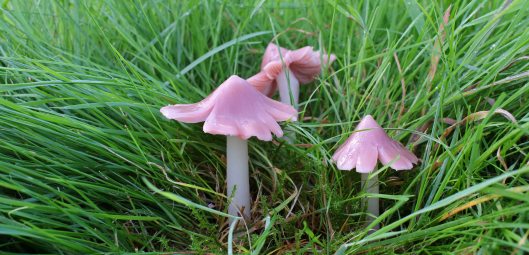
These beauties, and their friends and families, are displaying many of those characteristics right now at my local cemetery. They are the Blackening waxcap (Hygrocybe conica), Fibrous (Hygrocybe intermedia), Golden (Hygrocybe chlorophana), Parrot (Gliophorus psittacinus), Persistent (Hygrocybe acutoconica), Pink (Porpolomopsis calyptriformis), Scarlet (Hygrocybe coccinea), Slimy (Gliophorus irrigatus), and Snowy waxcap (Cuphophyllus virgineus).


02 Wednesday Nov 2016
Posted in nature, wildflowers
… and blow!

02 Wednesday Nov 2016
Colca Canyon, in southern Peru, is the deepest canyon in the world, so the drive to see its world-famous birds is heart-in-the-mouth stuff, but the heebie-jeebies, and having to get up in the freezing hour before dawn, are well worth it.

We reached Cruz del Condor, 1000 metres above the canyon floor, at about 8.30 am and scrambled over the rocks of the viewpoint to find a good spot to wait. Andean Condors (Vultur gryphus) are big birds, weighing up to 15 kgs and with a wingspan of around 3 metres, so they need the thermals to glide up the canyon each morning, before flying off for up to 250 kms in search of their day’s food – dead animals! Patience is required – how quickly they come depends on what the weather’s like, when the sun hits the bottom of the canyon, how quickly the air warms up … But, eventually, we saw some small birds a long way below and kept watching until, by 10.30am, they had reached our level and were gliding past us just metres away.


There were several adult birds and two brown-feathered juveniles. The young birds seemed to tire and settled for a while on a rock very close to the canyon edge – a rare treat to have them so close to us. And the whole spectacle was marvellous to watch – I filled up a memory card with photos but eventually stopped clicking and stood enthralled by the condors’ seemingly effortless flight. One of nature’s miracles!


01 Tuesday Nov 2016

From the poem ‘Autumn’ by my delightful cousin Jan Gemmell:
Autumn is fast approaching, and the leaves turn into gold,
The days becoming shorter, the soil becoming cold,
Yet it’s not all that depressing; glorious gifts abound,
There’s much to fill the heart with joy if one just looks around.

The trees are shedding mantles to prepare for season spring,
Brisk winds rustle dying leaves, and make the wind chimes ring,
I clothe my feet in sturdy shoes and crunch the falling leaves
Which tumble from the bushes and whirl around the eaves.


31 Monday Oct 2016
I couldn’t find any big orange pumpkins to carve up to make Jack o’lanterns for today’s Halloween celebrations so I improvised and took photos of Chinese lanterns instead. Though the carving of pumpkins has its roots in ancient harvest celebrations, I don’t much care for the modern commercialisation of seasonal celebrations like All Hallows’ Eve anyway, whereas I do very much like the beautiful Chinese lantern plant (Physalis alkekengi) (particularly in the autumn when it produces such a wonderful display of vivid orange seedpods), so for me this choice was a no-brainer.

As a garden plant, the Chinese lantern can be invasive, sending its roots out far and wide, so you do need to keep it in check a little, but the effort is worth it. When most of the summer colour has faded from the flower bed, this plant’s bursts of brilliant orange are a visual delight. And the ‘lanterns’ are just as pretty when the papery covering falls away from the seedpod, making its intricate lacy structure visible. The stems of orange pods make a lovely addition to a dried flower arrangement, retaining their colour for a long time, and, even without their orange skin, the seedpods look pretty in a bowl or mingled with other ingredients in a potpourri.


30 Sunday Oct 2016
Tags
Brittlestem, Burgundydrop bonnet, fungus, Hairy curtain crust, honey fungus, Oysterling, Porcelain Fungus, slime mould, Trichia varia, Turkeytail
It’s always sad to see a mighty old tree fall, no more to see its bare branches flush with green in early spring or hear the blackbird singing in the evening dusk from its high branches.

This huge old tree came down one wild and stormy night last winter and was soon sawn into manageable, though still huge logs by council staff. Fortunately, those logs were not removed, but merely hauled off the woodland path so, though the tree is dead, its wood is now home to an amazing display of fungi.


I suspect fungi may have contributed to its demise as there is an enormous amount of wood-rotting Honey fungus spouting forth around its roots. It’s a little difficult to separate out this tree and its branches from the surrounding small trees and old stumps but the whole small area is now awash with fungal growth, including Burgundydrop bonnet, Hairy curtain crust and Turkeytail, the Porcelain fungus that I blogged about recently, a species of Oysterling and another of Brittlestem, as well as at least one slime mould, Trichia varia. The poor old tree lives on by providing nutrients to all these other living organisms.


29 Saturday Oct 2016
Tags
autumn fruit, berries, fruit, haws, hips, rose hips, wild fruit
‘On the motionless branches of some trees, autumn berries hung
like clusters of coral beads, as in those fabled orchards where the fruits were jewels …’
~ Charles Dickens, Life and Adventures of Martin Chuzzlewit, chapter 2


28 Friday Oct 2016
Tags
biodiversity recording, biological recording, Lycoperdon pyriforme, SEWBReC, species of the month, Stump puffballs
I’m a dedicated wildlife recorder, inputting my sightings of flora and fauna into the database of my local records centre, SEWBReC (the South East Wales Biodiversity Records Centre). Each month the team at SEWBReC nominates a species that is poorly recorded in their system, in that hope that recorders like me will search high and low to help augment their records. The reason is that if record numbers are low, you can’t tell whether a species is endangered or just under-recorded, so it’s important to record even the most common things.

The October species of the month is a case in point. The Stump puffball (Lycoperdon pyriforme) is really common throughout Britain, yet the SEWBReC database had only 167 records at the start of the month. Well, I can tell you it will have a whole lot more by the end of October, because I’ve seen them almost everywhere I go and I’ve been photographing and recording them all. It’s the only British puffball to grow on wood so it’s easy to identify, and it often grows in large colonies – as one fungi expert put it, it’s ‘the banana of the fungi world, its bunches create impressive vistas’.


For more on SEWBReC’s species of the month, see here. If you live in the area, or even if you’re just visiting, you can help by recording your sightings.


27 Thursday Oct 2016
If I were more domesticated, I would be even busier at this time of year than I normally am, making jams and pickles and chutneys, freezing and drying, and doing whatever I could to preserve the bounty Nature provides in the autumn. (I have begun keeping glass lidded jars – it’s a beginning!)
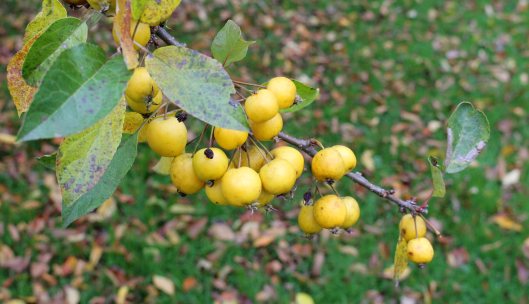
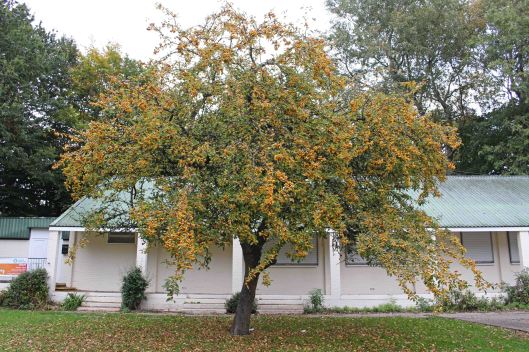
Out front of the house where I live there’s a tree, which I think is a type of crab apple, though its fruit have ripened to a golden yellow colour rather than red. (My photos here are actually of another tree and its fruit, found in a local park, but they’re exactly the same.) Crab apple jelly is the recipe that appears most often when I google, though the huge quantities of sugar in those recipes horrify me just a little. Crab apple cider seems to be another possibility – and I do quite like a nice glass of cider – but that requires lots of fancy equipment. I think you can tell that taking photos is as far as I’ll get to doing anything with the crab apples this year but at least that means the birds get to enjoy them instead. (If you have some suggestions for what to do with crab apples for next year, do feel free to share them in the comments.)


 earthstar
You must be logged in to post a comment.