• ABOUT
  • BIRDING 2018
  • Birding 2019
  • BLOG POSTS
  • Butterflies 2018
  • Resources

earthstar

~ a celebration of nature

earthstar

Category Archives: nature

It’s a biggie

05 Sunday Aug 2018

Posted by sconzani in insects, nature

≈ 4 Comments

Tags

Britain's largest tachnid fly, British flies, diptera, flies, fly, Tachina grossa

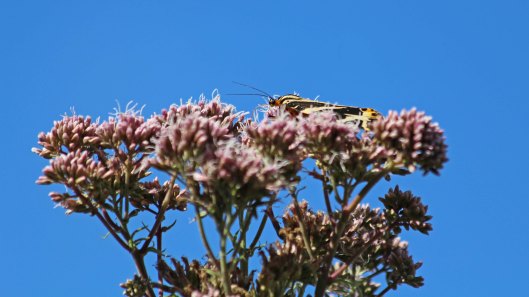
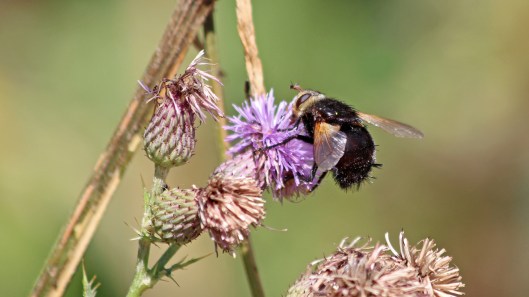
At first glance I thought this big brute was a hoverfly, ’cause I know there are some very large hoverflies, but one look at those eyes told me otherwise. Meet Tachina grossa, the largest Tachnid fly in Britain and Europe.

180805 Tachina grossa (4)

As you can see, it feeds on pollen and nectar and, though it’s harmless to us humans, it’s no friend of moths. The female Tachina grossa lays her eggs on living larvae, in particular the large hairy caterpillars of the Oak eggar moth and the Fox moth. The fly larvae eat the caterpillars from the inside, eventually but not immediately killing them.

180805 Tachina grossa (1)
180805 Tachina grossa (3)

So, it may look kind of cute in the photograph below but I’m just glad I’m not a large hairy caterpillar.

180805 Tachina grossa (2)

Like Loading...

Three in one day

04 Saturday Aug 2018

Posted by sconzani in insects, nature

≈ Leave a comment

Tags

British moths, Jersey tiger, Jersey tiger moth, Lavernock Nature Reserve, moths, tiger moth

Many of you probably knew that last Sunday 29 July was International Tiger Day but I’ll bet you didn’t know that Tuesday the 31st was Jersey Tiger Day!

180804 Jersey tiger (1)

Well, of course you didn’t because I just made that up. And why?

180804 Jersey tiger (2)

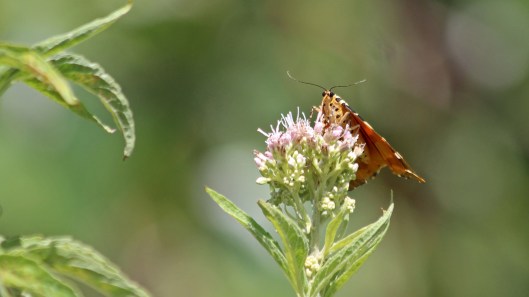
Because that was the day I saw my first Jersey Tiger moths for the year.

180804 Jersey tiger (3)

And I didn’t just see one – I saw three of these most gorgeous of moths.

180804 Jersey tiger (4)

Want to know why I was so delighted to see them? Read on …

Like Loading...

The flower of the moment is …

03 Friday Aug 2018

Posted by sconzani in flowers, insects, nature, wildflowers

≈ 2 Comments

Tags

British butterflies, British wildflowers, butterflies, Common fleabane, fleabane, insects on fleabane, Lavernock Nature Reserve, Pulicaria dysenterica

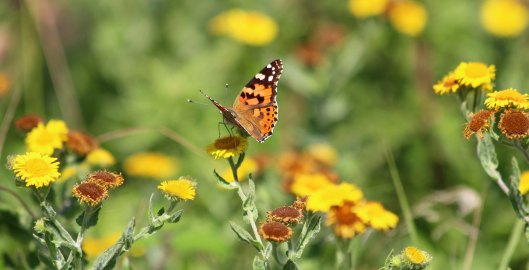
The flower of the moment is Fleabane (Pulicaria dysenterica) or, at least it is at Lavernock Nature Reserve.

180803 fleabane

I’ve read that Fleabane usually grows in ditches and damp meadows so, despite the recent drought conditions, I guess there must be water somewhere below the wildflower meadows at Lavernock, as they are currently awash with these bright golden flowers. And, at a time when most other wildflowers have dried up and died off, the Fleabane is providing a much-needed source of pollen and nectar for butterflies and other assorted mini-beasties.

180803 bee on fleabane
180803 brimstone on fleabane
180803 comma on fleabane (1)
180803 common blue on fleabane (4)
180803 cricket on fleabane
180803 small white on fleabane
180803 small copper on fleabane
180803 gatekeeper on fleabane
180803 meadow brown on fleabane
180803 green-veined white on fleabane
180803 painted lady on fleabane
180803 red admiral on fleabane
180803 speckled wood on fleabane
180803 six-spot burnet on fleabane
Like Loading...

Gordon the Gull

02 Thursday Aug 2018

Posted by sconzani in birds, nature

≈ Leave a comment

Tags

bird behaviour, birdwatching, British birds, Gordon the gull, gull, gull eating chips, Herring gull

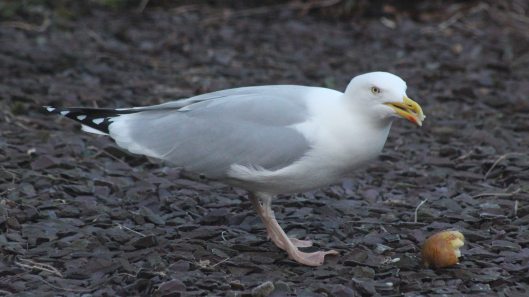
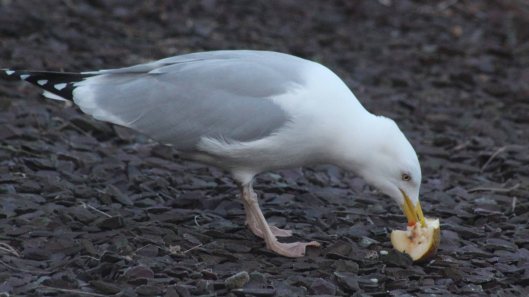
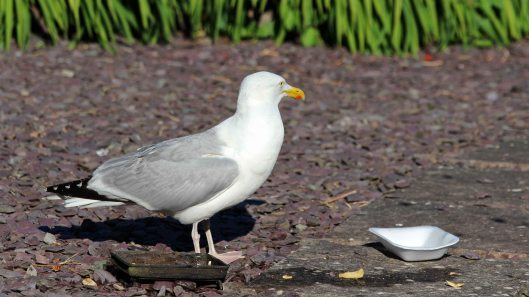
Gordon is a bit of a character.

180802 Gordon the gull (4)

He taps on the floor-to-ceiling windows in my friend Jill’s bedroom some mornings, early, to check whether she might have any food for him.

180802 Gordon the gull (1)

Jill doesn’t actually feed him anything but, as a Herring gull, he’s a master scavenger and a skilled opportunist, so will pounce on anything tasty looking that she puts out for the smaller birds.

180802 Gordon the gull (3)

Gordon also vigorously defends Jill’s backyard from potential gull interlopers, mostly by screeching loudly from the roof when they come near.

180802 Gordon the gull (7)

Gordon may sound like a nuisance but he’s also a bit of a charmer.

180802 Gordon the gull (6)

I mean he is rather handsome, don’t you think?

180802 Gordon the gull (2)

I succumbed immediately to his charms so, when we bought ourselves fish and chips after a particularly long day out and about, I insisted we got a portion of chips for Gordon.

180802 Gordon the gull (10)

And, the next morning, when I put them out for him, Gordon was in seagull heaven. He wolfed those chips down like only a ravenous, greedy gull can.

180802 Gordon the gull (9)

I think Jill’s very glad I don’t visit too often as Gordon might easily come to expect such preferential treatment.

180802 Gordon the gull (8)

Like Loading...

Banded demoiselles

01 Wednesday Aug 2018

Posted by sconzani in insects, nature, walks

≈ Leave a comment

Tags

Arlington Reservoir, Banded Demoiselle, British damselflies, Cuckmere River, damselflies

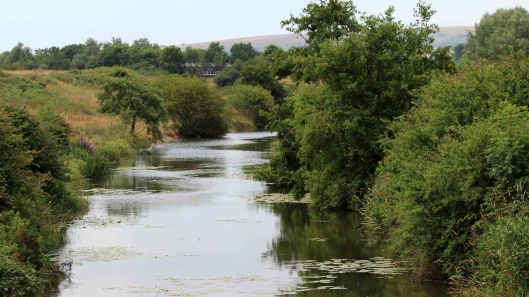
One of the many highlights of my recent walk around Arlington Reservoir in East Sussex with my friend Jill was being able to get quite close to several pairs of Banded demoiselle damselflies (while simultaneously heeding Jill’s warning that if I fell in the stream – actually the Cuckmere River – she wasn’t going to rescue me – ha!).

180801 Arlington stream

And actually this was off the main Arlington trail, as there was an old church that looked interesting not far away and we’d headed off down a public footpath towards it.

180801 Banded demoiselle (1)

Although I’ve seen a number of Beautiful demoiselles at my local nature reserves in Wales, I haven’t seen any Banded … and they are such gorgeous creatures, especially the bright blue males when they’re flying. Makes me believe in fairies!

180801 Banded demoiselle (2)

If you’re ever in the area, Arlington is a lovely place for a walk, with colourful and insect-rich wildflower meadows and plenty of birdlife, just the right amount of exercise in its circular walk and a cafe with icecreams at the end.

Like Loading...

Birding at RSPB Dungeness

31 Tuesday Jul 2018

Posted by sconzani in birds, insects, nature

≈ 4 Comments

Tags

birding, birdwatching, British birds, British butterflies, Common tern, Egyptian Goose, Emperor dragonfly, RSPB Dungeness, Snipe, Wood sandpiper

I had never been to RSPB Dungeness until my visit with my friend Jill two weeks ago but, if you can get past the fact that there’s a nuclear power station buzzing away just down the road, then you should be able to appreciate what a wonderful place it is. (British people seem to take nuclear power stations for granted but, as a nuclear-free New Zealander, I still find them quite scary places and really rather menacing!)

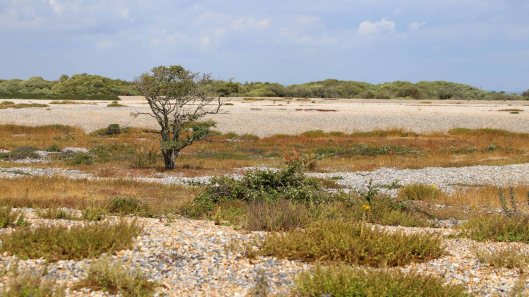
180731 Dungeness nuclear power station180731 RSPB Dungeness

This is a unique landscape of low rolling shingle banks, interspersed with patchy areas of low scrub and large shallow pools – it’s water bird heaven!

180731 Common terns (2)
180731 Common terns (1)

180731 Common terns (3)

Our first highlight was seeing the Common terns that breed at Dungeness. Terns are such agile flyers and to see their young fledglings was a real treat.
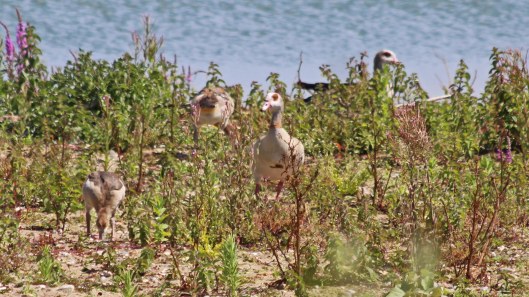
180731 Egyptian geese

Eqyptian geese have also bred here, and we saw a pair with two well-grown goslings.

180731 snipe

I had my best-ever views of a Snipe that decided to come out and poke around the muddy edges of one of the pools. These are normally such secretive birds so it was a real pleasure to watch this bird foraging.
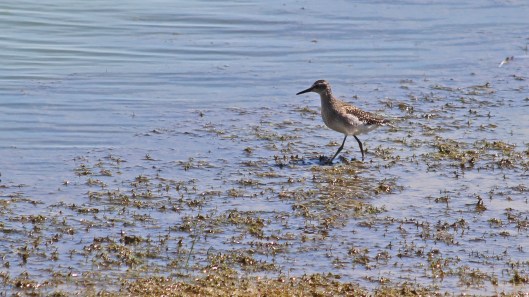
180731 wood sandpiper

And the Snipe was joined by not one but two Wood sandpipers.

180731 water birds galore

Each of the six hides on the two-mile-long main trail offers different views, different birds, and, after motoring down to a cafe near the lighthouse (and that power station), we also stopped off on our return to check out the two shorter trails and hides on the opposite side of the road. Here we had good, though distant views of a Greenshank and a Bar-tailed godwit. Cracking!

180731 b Painted lady
180731 b peacock
180731 b small copper

As well as the birds, the wildflowers added lots of pretty colour to our wander, and we were entertained as we walked by large numbers of beautiful butterflies and debonaire dragonflies, though it wasn’t quite so pleasant watching an Emperor dragon biting the wings off a Gatekeeper.
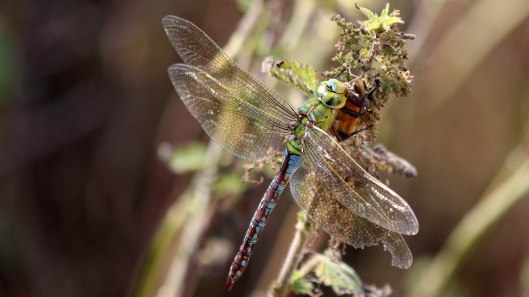
180731 b emperor

Here’s my bird list for the day (not including a lot of smaller birds that were flitting about the bushes while I was marvelling at the butterflies): Teal, Lesser black-backed gull, Tufted duck, Mallard, Herring gull, Common tern (with young), Cormorant, Sandwich tern, Common sandpiper, Wood sandpiper (2), Snipe, Egyptian goose (and goslings), Ringed plover, Pochard, Little grebe, Great crested grebe, Lapwing,Coot, Dunlin, Goldeneye, Reed warbler, Redshank, Woodpigeon, Oystercatcher, Grey heron, Great white egret (2), Greylag goose, Mute swan, Black-headed gull, Shelduck, Shoveler, Carrion crow, Swallow, House martin, Greenshank, Bar-tailed godwit, Pied wagtail, Gadwall and Magpie.

Like Loading...

An ancient Yew

30 Monday Jul 2018

Posted by sconzani in nature, trees

≈ Leave a comment

Tags

1600-year-old yew tree, ancient tree, Church of St Mary and St Peter in Wilmington, Wilmington yew tree, yew tree

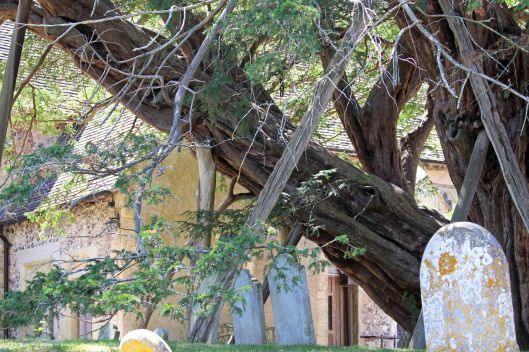
The Church of St Mary and St Peter in Wilmington, and the adjacent priory to which it was once attached, date from about 1100AD. You might think that’s pretty old – and it is – but the Yew tree in the church grounds is even older – it is truly ancient.

180730 1600-yr-old yew (2)

Scientific testing has dated the Yew to around 1600 years old, meaning it must have been planted around 400AD. Its girth measures approximately 23 feet (7m), though the trunk has now split in two, and both its trunks and huge branches are supported by a variety of posts and chains. As I only had my zoom lens, I wasn’t able to get a good photo of the entire tree but I hope to revisit next time I’m in East Sussex. It was a truly humbling experience to see such an incredible tree.

180730 1600-yr-old yew (1)

Like Loading...

Big butterfly count

29 Sunday Jul 2018

Posted by sconzani in insects, nature

≈ Leave a comment

Tags

Big Butterfly Count, British butterflies, butterflies, butterfly, butterfly conservation, count butterflies, help the butterflies

Just before we move away from this week of butterfly blogs, I do want to put in a plug for Butterfly Conservation’s Big Butterfly Count that is happening right now. It runs from 20 July to 12 August, so there’s still plenty of time to join in, and it’s super easy. Even if you’re not too crash hot on identifying butterflies, I’m sure you can count from one to, say, twenty, and there’s a handy pictorial chart you can easily download to help you work out which flutterby is which. And, for the smartphoners, which is probably most of you, there’s even a handy app you can download to help identify and record your sightings – though I do think you should at least try to work them out for yourselves.

180729 comma
180729 common blue
180729 gatekeeper
180729 meadow brown
180729 peacock
180729 red admiral
180729 small tortoiseshell
180729 small white
OLYMPUS DIGITAL CAMERA

And if you won’t take my word for the fact that it’s a truly wonderful feeling to sit quietly somewhere and watch and count butterflies, then maybe you’ll listen to / watch Sir David Attenborough.


Like Loading...

Singing the Chalk hill blues

28 Saturday Jul 2018

Posted by sconzani in insects, nature

≈ 5 Comments

Tags

British butterflies, butterflies, butterflies of Sussex, Chalk hill blue, Chalkhill blue, Polyommatus coridon, Seaford Head Local Nature Reserve

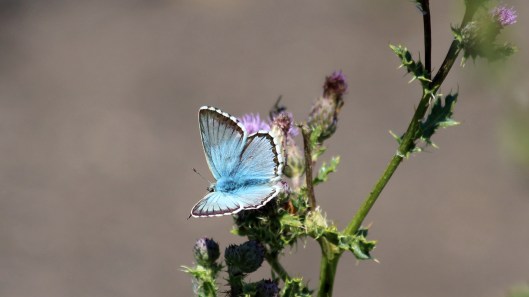
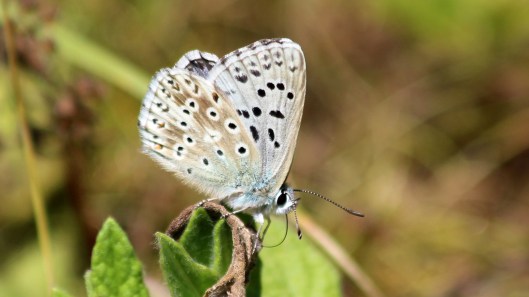
This is the last of the seven new butterflies I saw during my seven days in Sussex and the second from my walk around Seaford Head (see yesterday’s blog for the first). This stunner used to be known as the Chalkhill blue and is now the Chalk hill blue – I haven’t been able to find out why the change was made but the name does indicate their preferred location, the grasslands found on the chalk hills and downs of southern England. (Its scientific name, Polyommatus coridon, hasn’t changed.)

180728 Chalk Hill blue (1)

Luckily, the two butterflies I saw were both males – I say luckily because the female looks an awful lot like a Brown argus / Common blue female, and we all know how tricky those are to distinguish.

180728 Chalk Hill blue (2)

Apparently, these stunning males are often seen in large numbers, many hundreds together, flying low over vegetation in search of females. What a glorious sight that would be!

180728 Chalk hill blue (3)

Like Loading...

Small and blue

27 Friday Jul 2018

Posted by sconzani in insects, nature

≈ 3 Comments

Tags

Britain’s smallest butterfly, British butterflies, butterflies, Cupido minimus, Seaford Head Local Nature Reserve, Small blue, Small blue butterfly

Nine days ago, when I was staying with my friend Jill in East Sussex, we decided to re-enact a walk we had done on 12 May 2017, a wildlife walk led by Michael Blencowe of the Sussex Wildlife Trust, an expert lepidopterist and co-author of The Butterflies of Sussex.

180727 May 2017

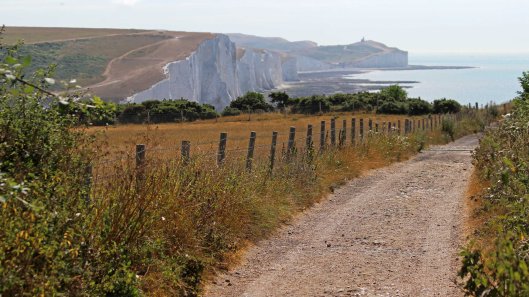
May 2017, looking from Hope Bottom on Seaford Head towards the Seven Sisters

On that previous occasion the day was cool, windy and sometimes wet so we didn’t see any butterflies. This time Britain was in the grip of a scorching heatwave so it was almost too hot and dry for butterflies….

180727 July 2018

I didn’t quite match the framing but this is the same view in July 2017

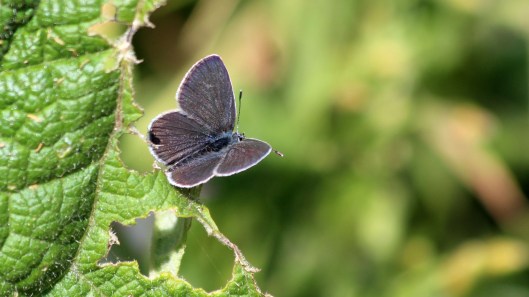
Almost, but not quite. As luck would have it, I managed to spot two more new butterflies this day, and I almost missed the first as it was so tiny. This is the very appropriately named Small blue (Cupido minimus), Britain’s smallest butterfly and one that is becoming increasingly scarce.

180727 Small blue (2)

These lovelies are often found in small colonies, in areas of scrub and grassland near where their food plant grows. I don’t recall seeing any Kidney vetch (Anthyllis vulneraria) during our walk through the Seaford Head Local Nature Reserve but, luckily for the Small blue and for me, it must have been there.

180727 Small blue (1)

Like Loading...
← Older posts
Newer posts →

About me

sconzani

sconzani

I'm a writer and photographer; researcher and blogger; birder and nature lover; countryside rambler and city strider; volunteer and biodiversity recorder.

View Full Profile →

Follow earthstar on WordPress.com

Enter your email address to follow this blog and receive notifications of new posts by email.

Recent blog posts

  • NFY: Orange-tip April 20, 2026
  • All the yellows April 19, 2026
  • Spider: Dysdera crocata April 18, 2026
  • Recent Reed buntings April 17, 2026
  • Tiny but feisty April 16, 2026

From the archives

COPYRIGHT

Unless otherwise acknowledged, the text and photographs on this blog are my own and are subject to international copyright. Nothing may be downloaded or copied without my permission.

Fellow Earth Stars!

  • Unknown's avatar
  • Unknown's avatar
  • Unknown's avatar
  • Unknown's avatar
  • Unknown's avatar
  • Unknown's avatar
  • Unknown's avatar
  • Unknown's avatar
  • Unknown's avatar
  • Unknown's avatar
  • Unknown's avatar
  • Unknown's avatar
  • Unknown's avatar
  • Unknown's avatar
  • Unknown's avatar
  • Unknown's avatar
  • Unknown's avatar
  • Unknown's avatar
  • Unknown's avatar
  • Unknown's avatar
  • Unknown's avatar
  • Unknown's avatar
  • Unknown's avatar
  • Unknown's avatar
  • Unknown's avatar
  • Unknown's avatar
  • Unknown's avatar
  • Unknown's avatar
  • Unknown's avatar
  • Unknown's avatar
  • Unknown's avatar
  • Unknown's avatar
  • Unknown's avatar
  • Unknown's avatar
  • Unknown's avatar
  • Unknown's avatar
  • Unknown's avatar
  • Unknown's avatar
  • Unknown's avatar
  • Unknown's avatar
  • Unknown's avatar
  • Unknown's avatar
  • Unknown's avatar
  • Unknown's avatar
  • Unknown's avatar
  • Unknown's avatar
  • Unknown's avatar
  • Unknown's avatar
  • Unknown's avatar
  • Unknown's avatar

Blog at WordPress.com.

Privacy & Cookies: This site uses cookies. By continuing to use this website, you agree to their use.
To find out more, including how to control cookies, see here: Cookie Policy
  • Subscribe Subscribed
    • earthstar
    • Join 642 other subscribers
    • Already have a WordPress.com account? Log in now.
    • earthstar
    • Subscribe Subscribed
    • Sign up
    • Log in
    • Report this content
    • View site in Reader
    • Manage subscriptions
    • Collapse this bar
 

Loading Comments...
 

You must be logged in to post a comment.

    %d