• ABOUT
  • BIRDING 2018
  • Birding 2019
  • BLOG POSTS
  • Butterflies 2018
  • Resources

earthstar

~ a celebration of nature

earthstar

Category Archives: nature

Flying on the wings of confusion

26 Thursday Jul 2018

Posted by sconzani in insects, nature

≈ 4 Comments

Tags

Aricia agestis, British butterflies, Brown argus, butterflies, Common blue, Common blue butterfly, confusing butterflies, Polyommatus icarus

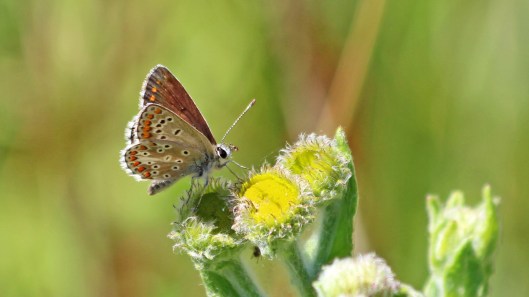
In yesterday’s blog I mentioned my confusion in identifying the Brown argus butterfly. Here’s why, plus some tips on how to defuse that confusion.

One of these butterflies is a Brown argus (Aricia agestis), the other five are female Common blues (Polyommatus icarus). Can you spot the odd one out?

180726 confusing butterflies underwings (1)
180726 confusing butterflies underwings (2)
180726 confusing butterflies underwings (3)
180726 confusing butterflies underwings (4)
180726 confusing butterflies underwings (5)
180726 confusing butterflies underwings (6)

If you have keen eyes, you will have noticed a difference in the patterns of spots of the butterfly in the last photo, which is the Brown argus. The Common blues all have an extra spot on their forewings (below right) and, on their hind wings, the two spots on the leading edge are more spaced out than those of the Brown argus – its two spots have been described as being close to a ‘figure of eight’ shape (below left).

180726 underwing patterns

Now, let’s look at the open wing patterns, which I find even trickier. Two of these butterflies are Brown argus, four are Common blue females. Which are which?

180726 confusing butterflies open wings (1)
180726 confusing butterflies open wings (2)
180726 confusing butterflies open wings (3)
180726 confusing butterflies open wings (4)
180726 confusing butterflies open wings (5)
180726 confusing butterflies open wings (6)

Firstly, as you can no doubt see, the amount of blue on Common blue females is very variable and that alone cannot help you identify them, as the Brown argus can also have a slight blue sheen to its wings sometimes. What I have found is that there is much less, sometimes no white colouration below the orange markings on the lower wings of the Brown argus (below left) and, though the Common blue can show a slight dark spot in the middle of its forewings (below right), that spot is much less obvious than the Brown argus’s spot.

180726 open wing patterns

So, did you work out which was which in the open wing photos? The middle butterfly in each row (photos two and five) are the Brown argus butterflies. Top marks if you spotted them!

Like Loading...

Brown argus

25 Wednesday Jul 2018

Posted by sconzani in insects, nature

≈ Leave a comment

Tags

Aricia agestis, British butterflies, Brown argus, butterflies, confusing species of butterflies, Cosmeston Lakes Country Park, Cuckmere Valley, RSPB Dungeness

When I spotted this little Brown argus butterfly (Aricia agestis) in the RSPB reserve at Dungeness in Kent, I thought it was a first for me, but I was wrong.

180724 Brown argus Dungeness

It turns out I had actually seen one two days earlier during a walk along ancient footpaths in the Cuckmere Valley in East Sussex, but I hadn’t realised until I’d had a really good look at my photos.

180724 Brown argus CuckmereValley

And then, when I got home and rechecked the photos on my computer of another very similar butterfly, it turned out that I had actually seen my very first Brown argus at Cosmeston, my local country park, back in August 2017.

180724 Brown argus Cosmeston

Why was I so confused? Check back in tomorrow and I’ll show you.

Like Loading...

White admirals

24 Tuesday Jul 2018

Posted by sconzani in insects, nature

≈ 4 Comments

Tags

Abbot's Wood, British butterflies, butterflies, Limenitis camilla, White admiral

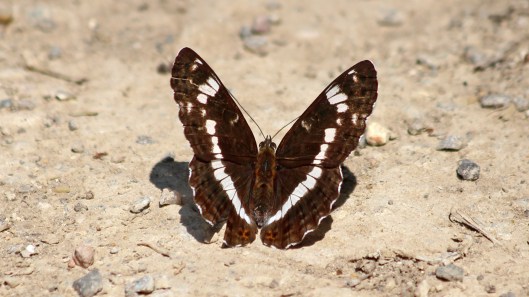
These lovely creatures, White admirals (Limenitis camilla), were the fourth new species of butterfly I saw while on holiday in East Sussex last week, and the third new species we found at Abbot’s Wood, a lovely Forestry Commission woodland near Polegate that we chose for a walk primarily because the towering trees would provide shelter from the burning sun. Little did we realise what wonders lay within!

180724 white admiral (1)

I knew this was a new-to-me species when I saw it gliding low along the woodland path in front of me, as I’d not seen a butterfly flying like that before. This first White admiral was rather tatty looking, with much of its lower wings missing. Was it a poor flyer or had it been tangling with other butterflies in the hunt for a mate?

180724 white admiral (2)

Almost immediately we saw a second White admiral and, though this one had a small nick out of one wing, it was in much better overall condition and seemed quite happy to sit and pose for photos. These glorious butterflies live mostly in southern Britain, in mature woodland where there is an abundance of their caterpillar food plant, the Honeysuckle (Lonicera periclymenum).

Like Loading...

A tale of two Hairstreaks

23 Monday Jul 2018

Posted by sconzani in insects, nature, trees

≈ Leave a comment

Tags

British butterflies, butterflies, butterflies in elm trees, butterflies in oak trees, Favonius quercus, Purple hairstreak, Satyrium w-album, White-letter hairstreak

First off, let me just say I have not started blogging about hairstyling: the Hairstreaks are a group of butterflies, so named because of the thin streak of white across their underwings, that usually live their whole lives in the upper canopies of various trees. This year, due to the extremely hot dry weather, their tree-top food sources have dried up, forcing them to come down to ground level for sustenance.

180723 white-letter hairstreak

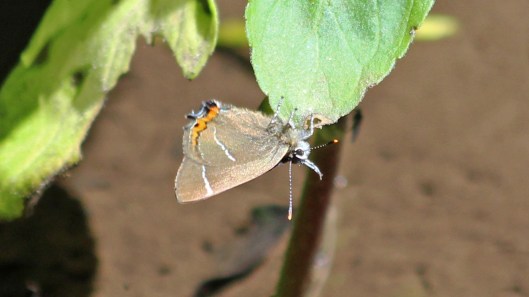
I spotted this lovely little butterfly purely by chance. I was wandering along the Glamorgan Canal in Forest Farm Nature Reserve, north of Cardiff, taking photos of the Demoiselle damselflies, when something small and brown fluttered down to water level, settled briefly on a leaf, then was chased off by one of the Demoiselles (hence the poor images). The White-letter hairstreak (Satyrium w-album) can usually be found in the tops of Elm trees and suffered a severe decline in numbers due to Dutch Elm disease killing off so many Elm trees in the 1970s but it seems slowly to be recovering. Its name comes from the shape of the letter W on its lower underwing.

180723 purple hairstreak

I can’t take the credit for spotting this Purple hairstreak (Favonius quercus) – my friend Jill noticed it sitting on the woodland trail as we explored Abbot’s Wood in East Sussex last week. (This was my third new butterfly of the week!) Purple hairstreaks usually live in the tops of Oak trees, mostly in southern areas of Britain. Unfortunately, I only managed a couple of quick photos and didn’t get to see its purple-coloured upper wings.

Like Loading...

Silver-washed fritillaries

22 Sunday Jul 2018

Posted by sconzani in insects, nature

≈ 5 Comments

Tags

Abbot's Wood, Argynnis paphia, British butterflies, butterflies, fritillaries, Silver-washed fritillary

What an absolute delight it was to see these beauties during my recent visit to Sussex, my second new butterfly sighting for the week!

180722 Silver-washed fritillary (3)

My friend Jill can testify to the fact that I was grinning from ear to ear as we followed the Abbot’s Amble trail through Abbot’s Wood, a Forestry Commission site near Polegate, and were entertained at every sunlit spot by Silver-washed fritillaries (Argynnis paphia) flitting about the bracken, bramble, thistles and burdock.

180722 Silver-washed fritillary (5)

With a wingspan between 7 and 8 cms, they’re large butterflies, and so very vibrant.

180722 Silver-washed fritillary (4)

These are woodland butterflies, feeding on the flowers that grow along the edges of paths and trails in wooded areas. Apparently, they also lay their eggs on tree trunks, rather than on their caterpillar’s food plant. Once hatched, the caterpillars hibernate through the winter, awakening and descending to the forest floor come the springtime to feed on the leaves of violets.

180722 Silver-washed fritillary (1)

The bumblebee has its eye on that flower but the fritillary isn’t moving!

180722 Silver-washed fritillary (2)

Like Loading...

Marbled whites

21 Saturday Jul 2018

Posted by sconzani in insects, nature

≈ Leave a comment

Tags

Arlington Reservoir, British butterflies, butterflies, Half-mourner, Marbled white, Marmoress, Melanargia galathea, West Park Local Nature Reserve, Woods Mill Nature Reserve

The week before I went down to visit my friend Jill in East Sussex I thought I spotted a Marbled white butterfly at Lavernock Nature Reserve but it flew off before I could get close and I couldn’t find it again.

180721 Marbled white at Arlington

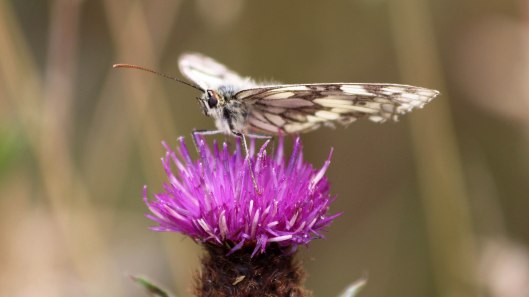
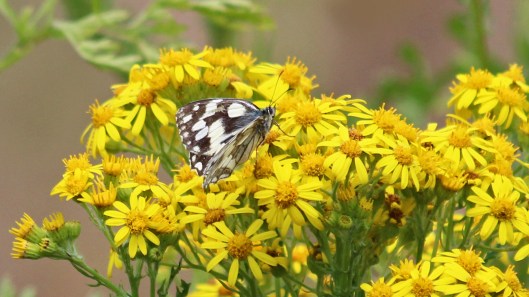
In Sussex, a Marbled white (Melanargia galathea) was the first of seven new species of butterfly I saw in just seven days, and I managed to see three of them at three different places. The first was at Arlington Reservoir, the second at Sussex Wildlife Trust’s Woods Mill Reserve, and the third was at West Park Local Nature Reserve near Uckfield.

180721 Marbled white at Woods Mill

According to Patrick Coulder’s book A Natural History of the Cuckmere Valley:

… 200 years ago, this butterfly was known as the half-mourner, because women then wore black and white dresses during the period of ‘half-mourning’ which followed full mourning for a dead relative. Its name then changed to marmoress, meaning ‘marble-like’, and finally about a hundred years ago it became known as the marbled white.

180721 Marbled white at West Park

Like Loading...

Kittiwakes

20 Friday Jul 2018

Posted by sconzani in birds, nature

≈ 2 Comments

Tags

birding, birds in Dunbar Harbour, birds on Farne Islands, birdwatching, British birds, Farne Islands, Kittiwake

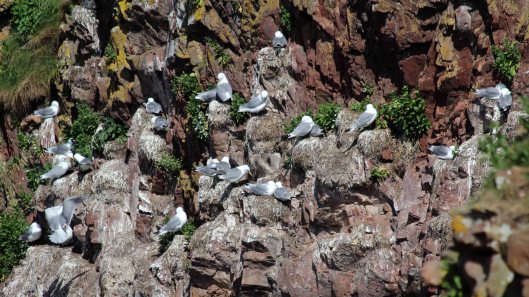
I realised today, when looking through my folder of photos for prepping blogs, that I have a couple of birds from my trip to Northumberland back in May that I haven’t yet blogged about. So, let’s put that right.

180710 kittiwakes (1)
180710 kittiwakes (3)

180712 kittiwakes (2)

I actually saw – and heard – my first Kittiwakes in Scotland, in Dunbar, where the birds nest on cliffs right on the edge of the town’s harbour. It’s a precarious site but that doesn’t bother these noisy birds, who seem constantly to remind you of their name with their onomatopoeic call.

180712 kittiwakes (4)

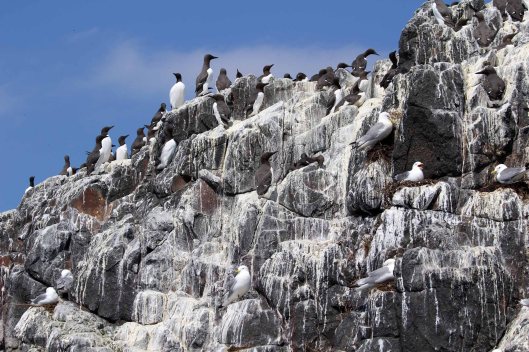
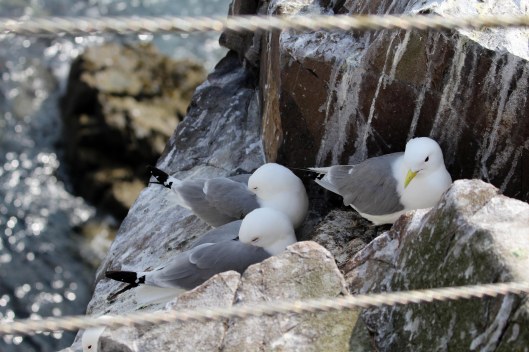
I next saw Kittiwakes when we sailed out to the Farne Islands. Once again, they were perched on impossibly small ledges of rock, sharing these spots on the tall craggy cliffs with Guillemots and Razorbills and Cormorants.

180712 kittiwakes (5)
180712 kittiwakes (6)

On the Farnes, I managed to get a much closer look at these beautiful gulls. Something about their face makes them look softer and more gentle than their Herring gull cousins – perhaps it’s their smaller, less savage-looking beak.

180712 kittiwakes (7)

Kittiwakes only come to the Farnes during the summer months to breed. Once their young are fledged, they’ll all head back to the Atlantic to spend the winter, dipping down into the deep waters for fish and shrimps to eat, then soaring high above the ocean waves.

Like Loading...

Here’s lookin’ at you back, Skippy!

19 Thursday Jul 2018

Posted by sconzani in insects, nature

≈ Leave a comment

Tags

British butterflies, butterflies, butterfly, Large skipper, Lycaena dispar

180719 large skipper (1)

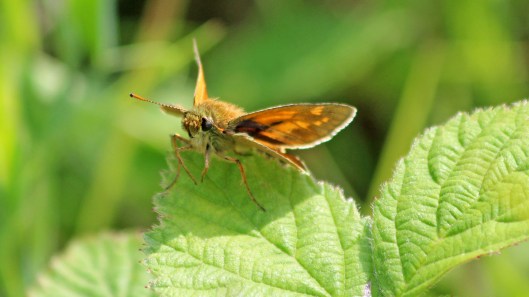
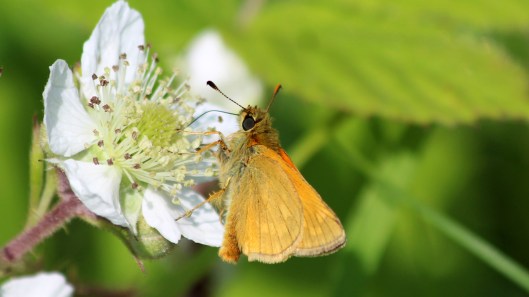
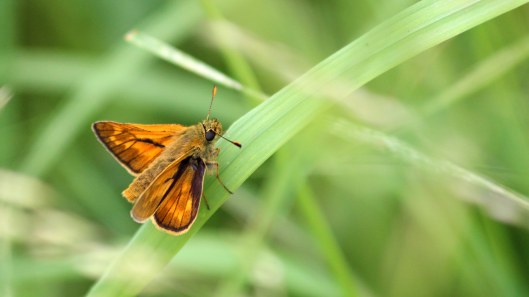
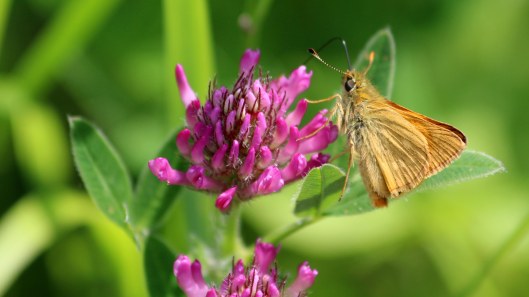
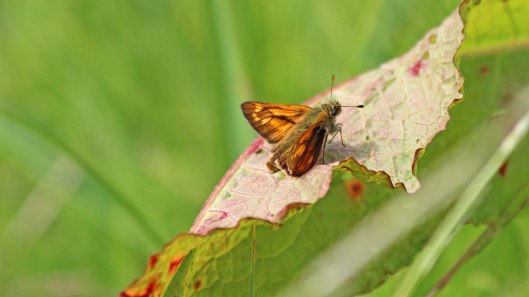
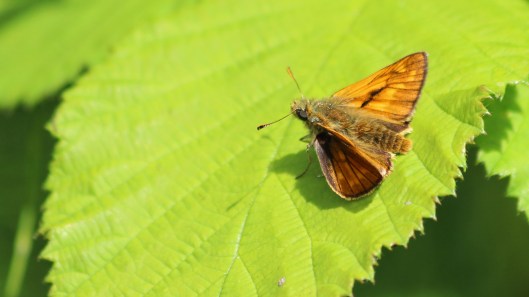
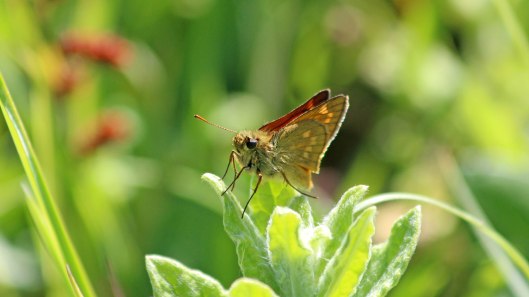
I know I’ve already posted a lot of Large skipper (Lycaena dispar) butterfly photos over the past couple of months but I just can’t help myself.

180719 large skipper (2)180719 large skipper (4)

They are so adorable, especially the males when they’re posing.

180719 large skipper (3)180719 large skipper (5)

Of course, I do know they’re not actually posing – it’s more likely that they’re holding a territory and are trying to look intimidating to scare me off.

180719 large skipper (6)180719 large skipper (7)

Or perhaps they’re just as curious about me as I am about them?

180719 large skipper (8)180719 large skipper (9)

Well, here’s lookin’ at you back, Skippy!

Like Loading...

Horse chestnut leafminer

18 Wednesday Jul 2018

Posted by sconzani in insects, leaves, nature, trees

≈ 6 Comments

Tags

Cameraria ohridella, Horse chestnut leaf-mining moth, Horse chestnut tree, leaf mines, leaf-mining larvae, leafminer, moth larvae, moths

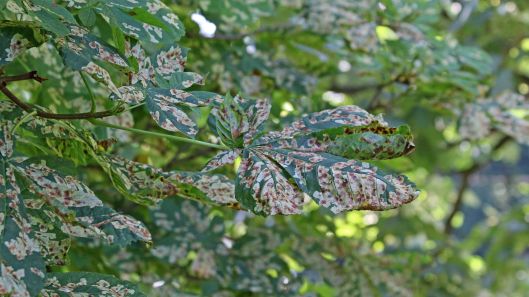
You may well have noticed that many (most?) of the Horse chestnut trees around you are starting to look a bit manky. Their leaves have become covered in white and brown blotches.

180718 Horse chestnut leafminer (4)

Those blotches are actually leaf mines, home to the larvae of Cameraria ohridella, the Horse chestnut leaf-mining moth (the brown blobs in the mines). According to the UK moths website

This species was discovered near Macedonia in 1985, and since then has spread rapidly to other countries in Europe. It was first discovered in Britain at Wimbledon in south-west London in 2002, but possibly had arrived the previous year, as it was quite plentiful. It is thought that the species may be expanding partially due to accidental transportation by man, either by road or rail. It has now been found quite extensively in the south-east of England.


180718 Horse chestnut leafminer (2)
180718 Horse chestnut leafminer (3)

Obviously, since that website entry was written, the moths have now spread from south-east England to south Wales and, indeed, to parts much further north. You’re mostly likely to see the blotches between June and September and, though you might not like the look of them, they’re not thought to inflict any permanent damage on the tree because, of course, the leaves are shed in the autumn anyway.

180718 Horse chestnut leafminer (1)

Like Loading...

The Spotted longhorns

17 Tuesday Jul 2018

Posted by sconzani in insects, nature

≈ Leave a comment

Tags

British beetles, British insects, Longhorn beetles, longhorns, Rutpela maculata, Spotted longhorn beetle

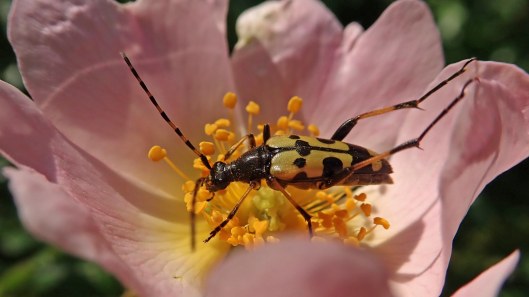
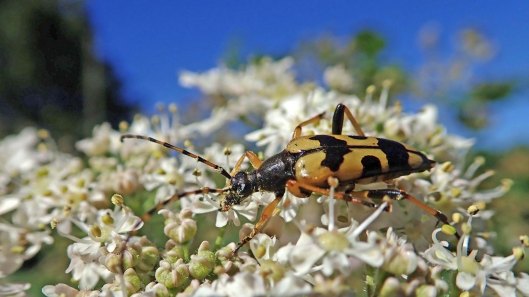
I’ve been seeing quite a few of these handsome mini-beasties recently, the Spotted longhorn beetles (Rutpela maculata).

180717 Spotted longhorn beetle (1)

Though the pattern of their black-and-yellow markings can vary a bit, they’re really quite unmistakeable.

180717 Spotted longhorn beetle (2)

They’re large beetles and look quite fierce, but they’re harmless.

180717 Spotted longhorn beetle (3)
180717 Spotted longhorn beetle (4)

Spotted longhorns are most often found feasting on the pollen of the umbellifer and other flowers that grow in hedgerows and alongside woodland paths.

180717 Spotted longhorn beetle (5)

Their larvae overwinter in rotten wood, then emerge as adults in late Spring, so these lovely longhorns can be seen from May through till around the end of August.

Like Loading...
← Older posts
Newer posts →

About me

sconzani

sconzani

I'm a writer and photographer; researcher and blogger; birder and nature lover; countryside rambler and city strider; volunteer and biodiversity recorder.

View Full Profile →

Follow earthstar on WordPress.com

Enter your email address to follow this blog and receive notifications of new posts by email.

Recent blog posts

  • NFY: Orange-tip April 20, 2026
  • All the yellows April 19, 2026
  • Spider: Dysdera crocata April 18, 2026
  • Recent Reed buntings April 17, 2026
  • Tiny but feisty April 16, 2026

From the archives

COPYRIGHT

Unless otherwise acknowledged, the text and photographs on this blog are my own and are subject to international copyright. Nothing may be downloaded or copied without my permission.

Fellow Earth Stars!

  • Unknown's avatar
  • Unknown's avatar
  • Unknown's avatar
  • Unknown's avatar
  • Unknown's avatar
  • Unknown's avatar
  • Unknown's avatar
  • Unknown's avatar
  • Unknown's avatar
  • Unknown's avatar
  • Unknown's avatar
  • Unknown's avatar
  • Unknown's avatar
  • Unknown's avatar
  • Unknown's avatar
  • Unknown's avatar
  • Unknown's avatar
  • Unknown's avatar
  • Unknown's avatar
  • Unknown's avatar
  • Unknown's avatar
  • Unknown's avatar
  • Unknown's avatar
  • Unknown's avatar
  • Unknown's avatar
  • Unknown's avatar
  • Unknown's avatar
  • Unknown's avatar
  • Unknown's avatar
  • Unknown's avatar
  • Unknown's avatar
  • Unknown's avatar
  • Unknown's avatar
  • Unknown's avatar
  • Unknown's avatar
  • Unknown's avatar
  • Unknown's avatar
  • Unknown's avatar
  • Unknown's avatar
  • Unknown's avatar
  • Unknown's avatar
  • Unknown's avatar
  • Unknown's avatar
  • Unknown's avatar
  • Unknown's avatar
  • Unknown's avatar
  • Unknown's avatar
  • Unknown's avatar
  • Unknown's avatar
  • Unknown's avatar

Blog at WordPress.com.

Privacy & Cookies: This site uses cookies. By continuing to use this website, you agree to their use.
To find out more, including how to control cookies, see here: Cookie Policy
  • Subscribe Subscribed
    • earthstar
    • Join 642 other subscribers
    • Already have a WordPress.com account? Log in now.
    • earthstar
    • Subscribe Subscribed
    • Sign up
    • Log in
    • Report this content
    • View site in Reader
    • Manage subscriptions
    • Collapse this bar
 

Loading Comments...
 

You must be logged in to post a comment.

    %d