• ABOUT
  • BIRDING 2018
  • Birding 2019
  • BLOG POSTS
  • Butterflies 2018
  • Resources

earthstar

~ a celebration of nature

earthstar

Category Archives: nature

Some recent moths

16 Monday Jul 2018

Posted by sconzani in insects, nature

≈ 2 Comments

Tags

Blood-vein, British moths, Burnet companion, Common purple & gold, Glyphipterix thrasonella, moths, Orange-spot piercer, Riband wave, Riband wave banded form, Scarlet tiger

Though they seem to have disappeared now, the Burnet companions (Euclidia glyphica) were out in force at Cosmeston for about six weeks, from the last day of May until early July.

180716 1 Burnet companion

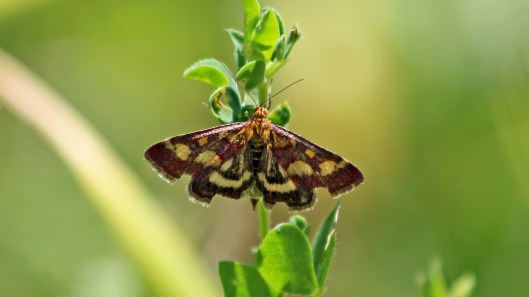
The Common purple & gold (Pyrausta purpuralis) is a tiny but very colourful moth – a rich maroon-purple base with pretty gold markings.
180716 2 Pyrausta purpuralis

With a thin red line running horizontally from one wing tip to the other, it’s easy to see how the Blood-vein (Timandra comae) got its name.

180716 3 Blood-vein

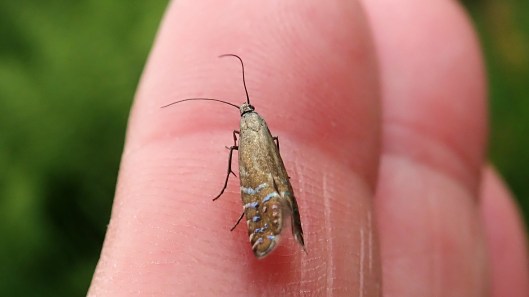
Glyphipterix thrasonella (no common name) is another very small moth, as you can tell from its size relative to my fingers, and is another with attractive markings, this time bright light blue on a gold base.
OLYMPUS DIGITAL CAMERA

In Bute Park recently I spotted two different species of moth. The first was this tiny micro on Hogweed, an Orange-spot piercer (Pammene aurana).

180716 5 Orange-spot piercer

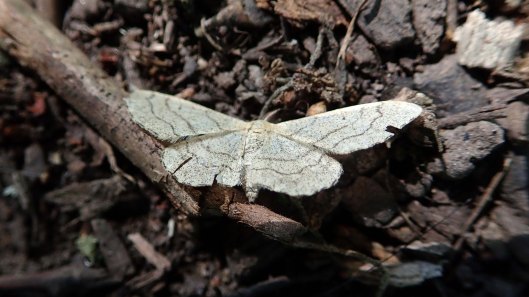
I didn’t have to try hard to see the second moth as it fluttered down from a tree on to the earth in front of me. This is a Riband wave (Idaea aversata).
OLYMPUS DIGITAL CAMERA

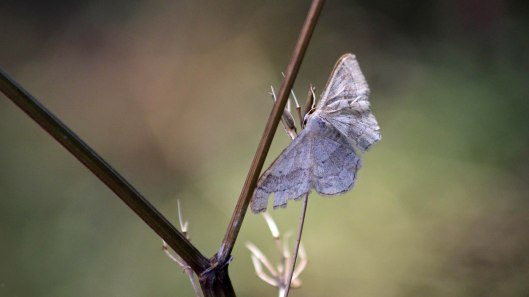
And, while we’re on the subject of Riband waves, here’s another but this is the banded form – note how the area between the two lines on its wings has been ‘coloured in’.
180716 7 Riband wave banded form

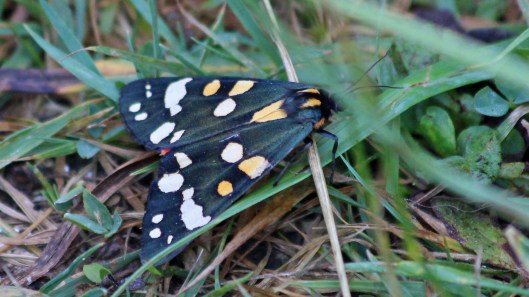
Last but certainly not least is this stunning Scarlet tiger (Callimorpha dominula), which was sitting on the grassy path in front of me during a recent meander around Lavernock Nature Reserve.
180716 8 Scarlet tiger

Like Loading...

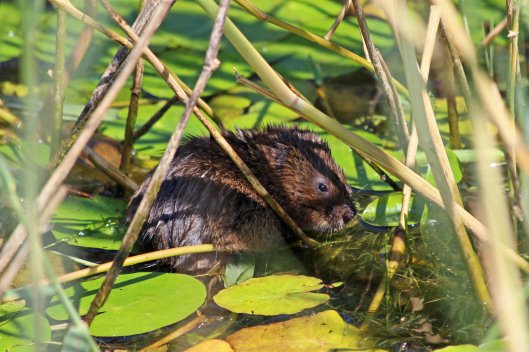
Ratty’s back

15 Sunday Jul 2018

Posted by sconzani in animals, mammal, nature

≈ Leave a comment

Tags

British mammals, Cosmeston, Cosmeston Lakes Country Park, Water vole

180715 water vole (1)

Well, the truth is Ratty probably never went away. Water voles might disappear from sight during the cold months of winter but they don’t actually hibernate – they simply burrow deeper underground to keep warm, and they spend a lot of time sleeping, which means they don’t need to snack too often from the larder they stock in autumn, full of bulbs, roots and tubers. They also bung up the entrance to their burrows with a mix of vegetation and mud, which helps keep the heat inside.

180715 water vole (2)

Come the Spring, they emerge and spend more time out and about, though it’s only in the past month or so that I’ve seen them again at Cosmeston. That may just be the timing of my visits, though the few I’ve seen have also seemed a bit less confident about being out and about than last year’s Water voles, possibly because some idiot people have let their dogs jump into the dipping pond, an area where they are obviously forbidden.

180715 water vole (3)

It’s probably impossible to tell how many of last year’s release of 100 Water voles have survived the winter but another 40-odd were released a few weeks back to supplement the local population.

180715 water vole (4)

People love to watch them, young and old alike, so let’s hope we can all enjoy them chewing away at the vegetation for the days, weeks, months to come.

180715 water vole (5)

Like Loading...

One smart critter

14 Saturday Jul 2018

Posted by sconzani in flowers, insects, nature, wildflowers

≈ 2 Comments

Tags

British insects, Oedemera nobilis, Swollen-thighed beetle, wildflowers

OLYMPUS DIGITAL CAMERA

The Swollen-thighed beetle (Oedemera nobilis) is very easy going when it comes to what nectar or pollen it eats. Judging by the number of different flowers I’ve seen it on, my conclusion is that it will slurp and snack almost anywhere, and this would seem to be a very good tactic for its future survival because the more specific the dietary requirements of an insect, the greater the chance it will suffer from changes to its environment and food plants. Being a generalist makes the Swollen-thighed beetle one smart critter!

This slideshow requires JavaScript.

Like Loading...

More crane’s-bills and a stork’s-bill

13 Friday Jul 2018

Posted by sconzani in flowers, nature, wildflowers

≈ 2 Comments

Tags

#FloralFriday, British flora, Common Stork's-bill, Crane's-bill, Cut-Leaved Cranesbill, geranium, Meadow crane's-bill, Pencilled crane’s-bill, Stork's-bill, wildflowers

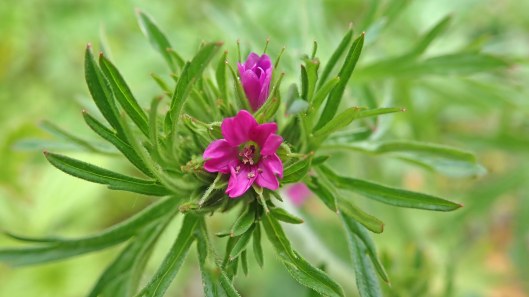
It’s Floral Friday so I thought we’d take a look at a few more of the beautiful Crane’s-bill family and one of their cousins, a Stork’s-bill. I think you’ll agree that they’re all rather lovely.

180713 Cut-Leaved Cranesbill

Cut-Leaved Cranesbill (Geranium dissectum)

180713 Meadow Crane's-bill

Meadow Crane’s-bill (Geranium pratense)

180713 Pencilled crane's-bill

Pencilled crane’s-bill (Geranium versicolor)

180713 Common stork's bill

Common stork’s bill (Erodium cicutarium)

Like Loading...

Birding at Peterston & Pendoylan Moors

12 Thursday Jul 2018

Posted by sconzani in animals, birds, insects, nature, walks

≈ 2 Comments

Tags

birding, birdwatching, British birds, British butterflies, butterflies, Cinnabar caterpillars, Comma, Cows, Glamorgan Bird Club, Green-veined white, Meadow Brown, Peacock, Red fox, Red kite, River Ely, Sand martin, Small tortoiseshell, Stock dove

Yesterday I enjoyed another wonderful, if rather hot day’s birding with my friends from the Glamorgan Bird Club, this time wandering a trail alongside the River Ely near Peterston-super-Ely and Pendoylan.

180711 2 red kites

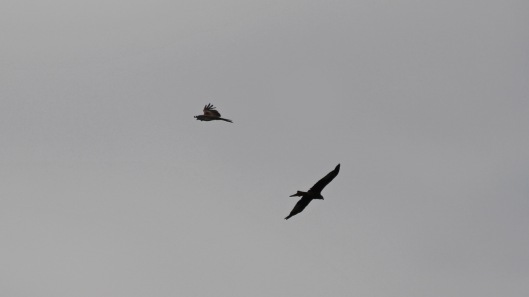
On the way there, my friend John and I had incredibly close views of three Red kites and more of these magnificent birds of prey were gliding overhead during our walk.

180711 1 stock dove

We saw Stock doves (one pictured above) sitting obligingly close to Woodpigeons so we could see the differences in the two species.

180711 2 red fox

A Red fox was spotted trotting along in a distant field, its lunch in its mouth.

180711 4 meeting the locals

A large herd of large cows moved reluctantly away from the river so we could pass by. You’d have to be crazy to mess with this lady, who was keeping a steady eye on us in case we ventured too close to her calves.

180711 5 participants

The fifteen participants … well, fourteen really, as I was taking the photo.

180711 6 river ely

The meandering River Ely was running low due to the recent drought conditions here in south Wales.

180711 b cinnabar caterpillars
180711 b comma
180711 b green-veined white
180711 b meadow brown
180711 b peacock
180711 b small tortoiseshell

As well as birds, we also saw lots of butterflies, including these: Cinnabar caterpillars, Comma, Green-veined white, Meadow brown, Peacock, and more Small tortoiseshell than I’ve ever seen in one day before.

180711 7 sandmartins

The highlight of the day for me was watching these Sand martins hawking for food over the fields and then returning to their burrows in the river bank to feed their hungry young. Magic!

Like Loading...

Wild word: fasciated

11 Wednesday Jul 2018

Posted by sconzani in flowers, nature, wildflowers

≈ 3 Comments

Tags

#WildWords, fasciated, fasciated thistle, fasciation, thistle, wild words

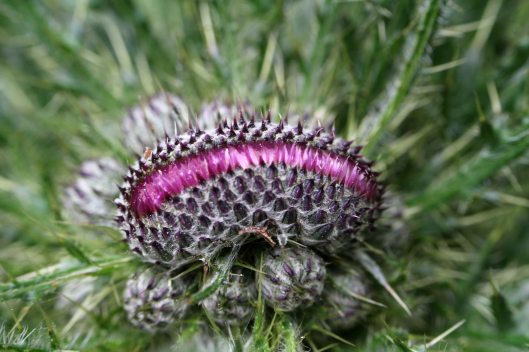
Fasciated: Adjective; (Botany) Showing abnormal fusion of parts or organs, resulting in a flattened ribbon-like structure (Oxford Dictionary).

The thistle in my photo is an example; instead of developing in the circular shape that is usual for this plant, the flower has, for some unknown reason, become distorted into a flattened and elongated, almost oblong shape.

180711 fasciated

Like Loading...

Six-spots love Ragwort

10 Tuesday Jul 2018

Posted by sconzani in flowers, insects, nature, wildflowers

≈ 4 Comments

Tags

British moths, Burnet moths, moths on ragwort, Ragwort, Six-spot burnet

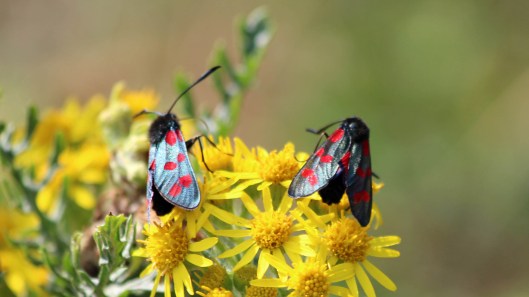
Self-evident, really. Nom, nom, nom!

180712 Six-spot burnet moths on ragwort(2)

180712 Six-spot burnet moths on ragwort(1)
180712 Six-spot burnet moths on ragwort(3)
180712 Six-spot burnet moths on ragwort(5)
180712 Six-spot burnet moths on ragwort(6)

180712 Six-spot burnet moths on ragwort(4)

Like Loading...

Hogweed bonking beetle

09 Monday Jul 2018

Posted by sconzani in insects, nature

≈ 1 Comment

Tags

bonking beetle, British beetles, British insects, Common red soldier beetle, Hogweed bonking beetle, Rhagonycha fulva, soldier beetle

180712 hogweed bonking beetle (1).jpg

Officially, this is Rhagonycha fulva, the Common red soldier beetle, but I think you can see why it is known throughout Britain as the Hogweed bonking beetle. Out now on a Hogweed near you!

This slideshow requires JavaScript.

Like Loading...

I’m following a tree: July 2018

08 Sunday Jul 2018

Posted by sconzani in nature, parks, trees

≈ 5 Comments

Tags

#treefollowing, Acer mono, Acer pictum, Bute Park, I'm following a tree

I paid a visit to Mono, my tree, yesterday and was slightly surprised but much relieved to see it didn’t appear to be suffering any ill effects from the continued heatwave and drought we’re having here in south Wales and, indeed, throughout much of Britain. I guess the tree has very deep roots and will also benefit from the shelter of the trees around it.

180708 tree following (1).jpg

I was certainly enjoying the shelter its canopy afforded me from the fierce sunshine.

180708 tree following (4)
180708 tree following (3)

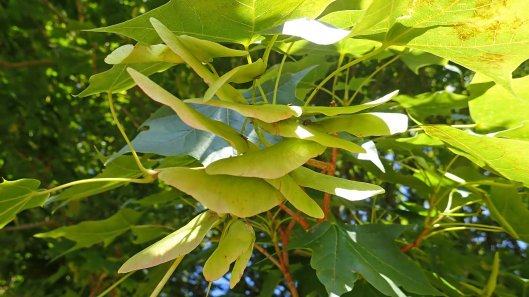
And looking up into its branches, I noticed my tree now has seeds, which means I obviously missed its flowering. Apparently, the greenish-yellow flowers appear in April-May in upright clusters.

180708 tree following (2)

180708 tree following (5).jpg

The seeds – actually called samaras – are really winged nuts, of the type that are commonly found on ash and maple trees. Mono’s are between 2 and 3cm long, inclusive of the wing, and are greenish in colour when still hanging on the tree, though those seeds that have already dropped off have dried to a light brown, with their wing-like structure clearly visible. All the better to spread those seeds on the wind when the time is right!

180708 tree following (6).jpg

Like Loading...

A sunbathing Blackbird

07 Saturday Jul 2018

Posted by sconzani in birds, nature

≈ 4 Comments

Tags

bird behaviour, bird sunbathing, birding, birdwatching, blackbird, British birds, Bute Park, sunbathing bird

180707 sunbathing blackbird (3)

I spotted this Blackbird during a wander along the woodland trail in Cardiff’s Bute Park today, and it was concentrating so hard on its sunbathing that it didn’t notice me at first.

180707 sunbathing blackbird (1)

The sun was fierce, which I think accounts for the bird sitting with its mouth open, trying to cool itself down. As for the sunbathing itself, here’s the explanation from the British Trust for Ornithology website:

‘Sunbathing’ is used by some birds as part of their routine feather maintenance and is most commonly seen … in Blackbirds and Robins. The birds invariably adopt a posture in which the body feathers are fluffed up and one or both wings are held out from the body, with feathers spread. It is thought that using the sun in this way does two things. It both helps the preen oil to spread across the feathers and drives parasites out from within the plumage. Some of these parasites feed on the feathers themselves and all are highly specialised, with many only found on a single species of bird.

 180707 sunbathing blackbird (2)

Like Loading...
← Older posts
Newer posts →

About me

sconzani

sconzani

I'm a writer and photographer; researcher and blogger; birder and nature lover; countryside rambler and city strider; volunteer and biodiversity recorder.

View Full Profile →

Follow earthstar on WordPress.com

Enter your email address to follow this blog and receive notifications of new posts by email.

Recent blog posts

  • NFY: Orange-tip April 20, 2026
  • All the yellows April 19, 2026
  • Spider: Dysdera crocata April 18, 2026
  • Recent Reed buntings April 17, 2026
  • Tiny but feisty April 16, 2026

From the archives

COPYRIGHT

Unless otherwise acknowledged, the text and photographs on this blog are my own and are subject to international copyright. Nothing may be downloaded or copied without my permission.

Fellow Earth Stars!

  • Unknown's avatar
  • Unknown's avatar
  • Unknown's avatar
  • Unknown's avatar
  • Unknown's avatar
  • Unknown's avatar
  • Unknown's avatar
  • Unknown's avatar
  • Unknown's avatar
  • Unknown's avatar
  • Unknown's avatar
  • Unknown's avatar
  • Unknown's avatar
  • Unknown's avatar
  • Unknown's avatar
  • Unknown's avatar
  • Unknown's avatar
  • Unknown's avatar
  • Unknown's avatar
  • Unknown's avatar
  • Unknown's avatar
  • Unknown's avatar
  • Unknown's avatar
  • Unknown's avatar
  • Unknown's avatar
  • Unknown's avatar
  • Unknown's avatar
  • Unknown's avatar
  • Unknown's avatar
  • Unknown's avatar
  • Unknown's avatar
  • Unknown's avatar
  • Unknown's avatar
  • Unknown's avatar
  • Unknown's avatar
  • Unknown's avatar
  • Unknown's avatar
  • Unknown's avatar
  • Unknown's avatar
  • Unknown's avatar
  • Unknown's avatar
  • Unknown's avatar
  • Unknown's avatar
  • Unknown's avatar
  • Unknown's avatar
  • Unknown's avatar
  • Unknown's avatar
  • Unknown's avatar
  • Unknown's avatar
  • Unknown's avatar

Blog at WordPress.com.

Privacy & Cookies: This site uses cookies. By continuing to use this website, you agree to their use.
To find out more, including how to control cookies, see here: Cookie Policy
  • Subscribe Subscribed
    • earthstar
    • Join 642 other subscribers
    • Already have a WordPress.com account? Log in now.
    • earthstar
    • Subscribe Subscribed
    • Sign up
    • Log in
    • Report this content
    • View site in Reader
    • Manage subscriptions
    • Collapse this bar
 

Loading Comments...
 

You must be logged in to post a comment.

    %d