• ABOUT
  • BIRDING 2018
  • Birding 2019
  • BLOG POSTS
  • Butterflies 2018
  • Resources

earthstar

~ a celebration of nature

earthstar

Category Archives: plants

Shieldbugs on gorse

22 Thursday Apr 2021

Posted by sconzani in insects, plants

≈ Leave a comment

Tags

British insects, British shieldbugs, Dolycoris baccarum, gorse, Gorse shieldbug, Hairy shieldbug, Piezodorus lituratus, shieldbugs on gorse

I had expected to find Gorse shieldbugs on these glowing gorse bushes (the clue’s in the name) but, in fact, the most numerous were the Hairy shieldbugs (of which there must have been at least 20).

210422 gorse shieldbug
210422 hairy shieldbug (1)

The Gorse shieldbug (Piezodorus lituratus) (above left) looks very like a Common green shieldbug but its red antennae are a distinctive identification feature. The Hairy shieldbug (Dolycoris baccarum) (above right, and below) is a much more colourful character, a stylish combination of purple-brown and green, and it also has distinctive antennae, this time three white bands on a black base.

210422 hairy shieldbug (2)

Like Loading...

Devil-in-a-bush

09 Friday Apr 2021

Posted by sconzani in flowers, plants, spring, wildflowers

≈ 2 Comments

Tags

ancient woodland, British wildflowers, Herb-Paris, Paris quadrifolia, spring wildflowers, wildflowers in ancient woodland

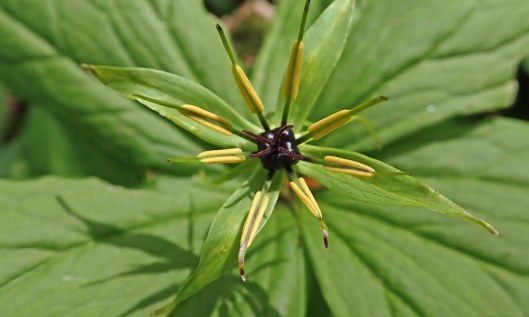
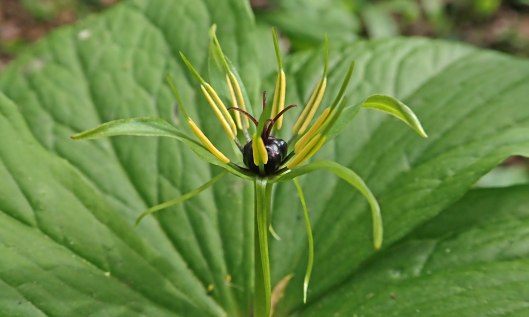
During my weekly walks in local ancient woodland, I’ve been monitoring the development of this plant, watching it arise from the damp soil, waiting for its leaves to grow and its flower to emerge … and yesterday the first of the blooms were finally open.

210409 herb-paris (1)

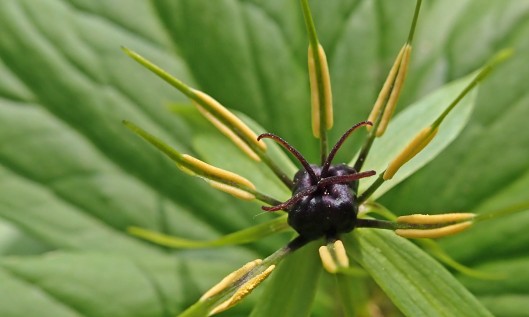
This is Herb-paris (Paris quadrifolia), and I think you can see the reason I have been so keen to see these stunning flowers again.

210409 herb-paris (2)

Their structure is remarkable, a combination that Richard Mabey describes thus in Flora Britannica: ‘a star of four very narrow yellow-green petals and four wider sepals, topped by a crown of eight golden stamens, and later a single shining black berry – the “devil-in-the-bush” that was one of the plant’s obsolete names’.

210409 herb-paris (3)

The plants are looking particularly abundant this year and many flowers have yet to open so I will definitely be returning to feast my eyes on these beauties many times before they disappear for another year.

Like Loading...

Good Friday plant

02 Friday Apr 2021

Posted by sconzani in plants, spring, wildflowers

≈ 2 Comments

Tags

Adoxa moschatellina, British wildflowers, Good Friday plant, Moschatel, Spring colour, Town Hall clock

This couldn’t have been more appropriate if I’d planned it, which I assure you I didn’t. Until yesterday’s wander through a local woodland, I’d never seen Moschatel before. Its scientific name is Adoxa moschatellina but one of its vernacular names is Good Friday plant, because it usually begins flowering at the beginning of April and is often first seen in bloom at Easter.

Another of its common names is Townhall clock, which Richard Mabey explains in Flora Britannica is because the small flowers ‘are arranged in a remarkable fashion, at right angles to one another, like the faces of a town clock – except that there is a fifth on top, pointing towards the sky’. My photos don’t show this very well so I might have to revisit to get more.

210402 moschatel (2)

Like Loading...

Fern not fungi

05 Friday Mar 2021

Posted by sconzani in plants

≈ Leave a comment

Tags

fern, fern frond

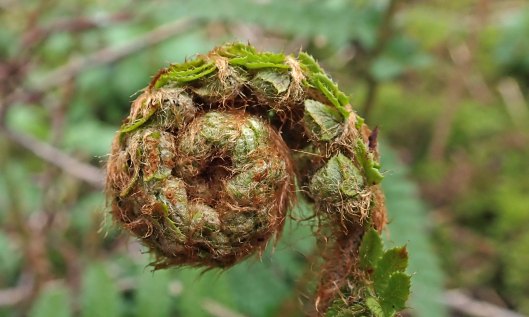
Each week I try to find some new or interesting fungi for my Friday post but this week I’ve failed miserably. So, here’s a lovely fresh ready-to-unroll fern frond instead.

210305 fern

Like Loading...

Leaf mines: Chromatomyia scolopendri

01 Monday Mar 2021

Posted by sconzani in insects, plants

≈ Leave a comment

Tags

Agromyzidae, Chromatomyia scolopendri, Hart's tongue, leaf mine on Hart's tongue, leaf miners, leaf mines, leaf-mining fly larvae

Another week, another leaf mine – in fact, lots of mines in the glossy, lush leaves of Hart’s-tongue ferns (Asplenium scolopendrium).

210301 Chromatomyia scolopendri (1)

I have actually blogged about these before (Leaf mine in Hart’s-tongue, January 2018) but those finds were made in Somerset and I’m now finding lots of these mines in my local area in south Wales. The mines are made by the larvae of the fly Chromatomyia scolopendri, one of the Agromyzidae family of flies, and their long, winding gallery mines are unmistakeable.

210301 Chromatomyia scolopendri (2)
210301 Chromatomyia scolopendri (3)
210301 Chromatomyia scolopendri (4)
210301 Chromatomyia scolopendri (5)

You can read more about these flies on the newly launched Agromyzidae Recording Scheme website, and, if you’re interested in finding out which leaf mines to look out for and when, the scheme has a page that lists which species are most commonly recorded each month. Can you find Chromatomyia scolopendri mines in your area?

Like Loading...

Wild blooms

28 Sunday Feb 2021

Posted by sconzani in flowers, plants, wildflowers, winter

≈ 4 Comments

Tags

British wildflowers, wildflowers in bloom, winter colour, winter wildflowers

The results are in! After a concerted effort to check as many different local habitats as possible, walking 31.5 miles over 5 days, I managed to find 29 different wildflowers in bloom this week. Two (Ragwort and Smooth sow-thistle) were too distant for good photos; the other 27 feature in this week’s little video. I hope you’re also seeing plenty of flowers in your areas now too.

The 27 are: Alexanders, Barren strawberry, Colt’s-foot, Cow parsley, Cowslip, Creeping buttercup, Daisy, Dandelion, Dog’s mercury, Field speedwell, Forget-me-not, Gorse, Groundsel, Ivy-leaved toadflax, Lesser celandine, Opposite-leaved golden-saxifrage, Petty spurge (with little yellow spots of the rust Melampsora euphorbiae), Primrose, Red dead-nettle, Red valerian, Shepherd’s-purse, Snowdrop, Spurge laurel (a shrub really but I’m including it), Sweet violet, Three-cornered leek, Wavy bitter-cress, and Winter heliotrope.

Like Loading...

Mossy gravestone

27 Saturday Feb 2021

Posted by sconzani in bryophytes, nature, plants

≈ 10 Comments

Tags

moss, moss on gravestone, mosses

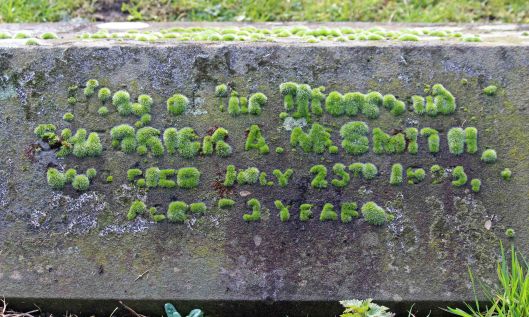
Graves may not be everyone’s idea of wildlife-friendly spaces but I’ve found cemeteries and grave-filled churchyards can hold some interesting, often unusual flora and fauna.

210227 mossy gravestone (1)

Mosses grow very easily on next to nothing. They have no roots, and only need moisture and shady conditions to grow.

210227 mossy gravestone (2)

I presume the indentations of the inscription on the gravestone, though shallow, would be deep enough to accumulate a little moisture and a modicum of dusty soil, and that’s all these little mosses required to thrive. The churchyard is also well shaded by hedges and tall trees, as well as the church building itself – again, perfect for the mosses.

210227 mossy gravestone (3)

Some people might think mosses and lichens should be scrubbed off gravestones or sprayed with chemicals to kill them. Not me. I can think of nothing nicer than to have my gravestone be home to little beauties like these, and my personal details spelled out in mosses.

210227 mossy gravestone (4)

Like Loading...

Nipplewort Rust

26 Friday Feb 2021

Posted by sconzani in fungi, plants

≈ Leave a comment

Tags

British fungi, Lapsana communis, Nipplewort, Nipplewort rust, Puccinia lapsanae, rust fungus

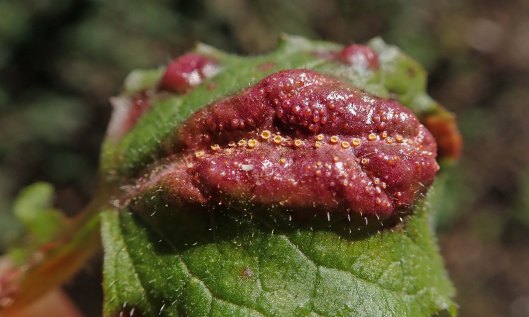
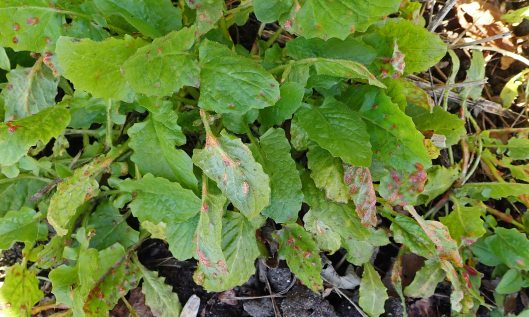
I was almost home from today’s 7-mile walk when I spotted the subject of this post, lots of pink gall-like bumps on the leaves of a group of plants I quickly realised were Nipplewort (Lapsana communis).

210226 nipplewort rust (2)

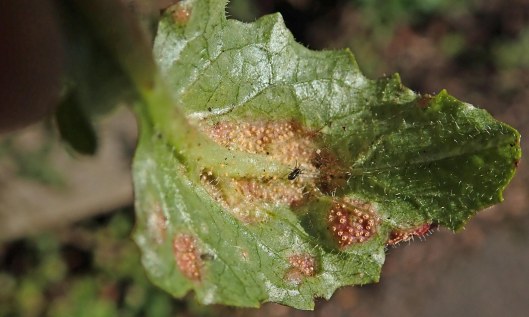
And that clinched the identification of the bumps, especially when I turned a leaf over and spotted the little yellow dots. These are the aecia, cup-shaped structures in which aeciospores are produced. (And, as you can see, this particular leaf was also home to a tiny spider.)

210226 nipplewort rust (3)

These Nipplewort plants were absolutely covered in rust fungi, Nipplewort Rust (Puccinia lapsanae), a rust I’ve seen before but never in such quantity.

210226 nipplewort rust (1)

Like Loading...

Leaf mines: Phytomyza ilicis

23 Tuesday Feb 2021

Posted by sconzani in insects, plants

≈ Leave a comment

Tags

British leaf mines, Holly, Holly leaf-miner, Ilex aquifolium, leaf mines, leaf-mining fly larvae, Phytomyza ilicis

The tale of the Holly leaf miner (Phytomyza ilicis) is a tangled one. Way back in December 2016, I blogged about the leaf-mining life of this tiny fly’s larvae. Then, early in 2020, doubt was cast on the true identity of this leaf miner, when two scientists published a paper, stating that, through genital examination of one particular Phytomyza ilicis specimen, they had determined there were in fact two very similar species to be found in Britain. Of course, this called into question the true identification of all prior records, and no subsequent records could be confirmed without genital examination of specimens.

210223 phytomyza ilicis (1)
210223 phytomyza ilicis (2)

At that stage, I stopped recording leaf mines on Holly. But now I can start again because the work of those earlier scientists has recently been disproved. The organiser of the Agromyzidae Recording Scheme (the family to which Phytomyza ilicis belongs) re-examined the questionable specimen and found the genitals had actually been damaged, which had led to them being wrongly identified.

210223 phytomyza ilicis (4)
210223 phytomyza ilicis (3)

So, until that ‘other’ Holly leaf miner (Phytomyza jucunda) makes its way from Europe to Britain and so long as the mines look similar to the various ones I’ve included here, it is safe to record the Holly leaf mines we see as Phytomyza ilicis.

210223 phytomyza ilicis (5)
210223 phytomyza ilicis (6)

You can access the splendid new website of the Agromyzidae Recording Scheme here, and read more about the story of the Holly leaf miner in a recent newsletter here.

Like Loading...

Leaf mine: Chromatomyia primulae

18 Thursday Feb 2021

Posted by sconzani in insects, plants, wildflowers

≈ Leave a comment

Tags

Chromatomyia primulae, leaf mine on Primrose, leaf mines, leaf-mining fly, leaf-mining fly larvae, leaf-mining larvae, leafminers, primrose

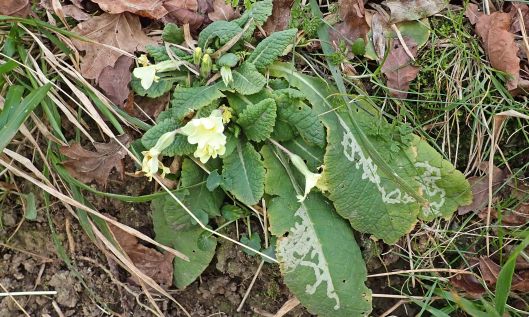
I was feeling a little miffed that my walk plans have been stymied by a slippery sided stream that I didn’t fancy trying to jump and was retracing my steps when I spotted this flowering Primrose (Primula vulgaris) – and it made my day, partly because I love these buttery yellow flowers, but also because of the mines on its leaves, a new species for me.

210218 Chromatomyia primulae (1)

These are the mines of a tiny fly, Chromatomyia primulae, whose larvae also mine the leaves of Cowslip (Primula veris). I couldn’t see any larvae in the mines, which concurs with the information on the British Leafminers website that says the larvae are active in January, and then again from June to November. If I’d known, I could’ve looked for any pupae, which apparently lodge themselves in the mine next to a leaf vein. I might have to go back for a closer look.

210218 Chromatomyia primulae (2)
210218 Chromatomyia primulae (3)

Very few of these mines have been recorded in south Wales – only 1 record in each of the 1km-squares around me – though that is probably because they are under-recorded. And that may be the same in other parts of Britain, so do please record any you see. You can read more about these leaf miners on the British Leafminers site referenced above and on the UK Fly mines website here.

Like Loading...
← Older posts
Newer posts →

About me

sconzani

sconzani

I'm a writer and photographer; researcher and blogger; birder and nature lover; countryside rambler and city strider; volunteer and biodiversity recorder.

View Full Profile →

Follow earthstar on WordPress.com

Enter your email address to follow this blog and receive notifications of new posts by email.

Recent blog posts

  • Busy Blue tits March 17, 2026
  • Cuttlebones March 16, 2026
  • No woodland here March 15, 2026
  • Family comes first March 14, 2026
  • Local Little egrets March 13, 2026

From the archives

COPYRIGHT

Unless otherwise acknowledged, the text and photographs on this blog are my own and are subject to international copyright. Nothing may be downloaded or copied without my permission.

Fellow Earth Stars!

  • Unknown's avatar
  • Unknown's avatar
  • Unknown's avatar
  • Unknown's avatar
  • Unknown's avatar
  • Unknown's avatar
  • Unknown's avatar
  • Unknown's avatar
  • Unknown's avatar
  • Unknown's avatar
  • Unknown's avatar
  • Unknown's avatar
  • Unknown's avatar
  • Unknown's avatar
  • Unknown's avatar
  • Unknown's avatar
  • Unknown's avatar
  • Unknown's avatar
  • Unknown's avatar
  • Unknown's avatar
  • Unknown's avatar
  • Unknown's avatar
  • Unknown's avatar
  • Unknown's avatar
  • Unknown's avatar
  • Unknown's avatar
  • Unknown's avatar
  • Unknown's avatar
  • Unknown's avatar
  • Unknown's avatar
  • Unknown's avatar
  • Unknown's avatar
  • Unknown's avatar
  • Unknown's avatar
  • Unknown's avatar
  • Unknown's avatar
  • Unknown's avatar
  • Unknown's avatar
  • Unknown's avatar
  • Unknown's avatar
  • Unknown's avatar
  • Unknown's avatar
  • Unknown's avatar
  • Unknown's avatar
  • Unknown's avatar
  • Unknown's avatar
  • Unknown's avatar
  • Unknown's avatar
  • Unknown's avatar
  • Unknown's avatar

Blog at WordPress.com.

Privacy & Cookies: This site uses cookies. By continuing to use this website, you agree to their use.
To find out more, including how to control cookies, see here: Cookie Policy
  • Subscribe Subscribed
    • earthstar
    • Join 668 other subscribers
    • Already have a WordPress.com account? Log in now.
    • earthstar
    • Subscribe Subscribed
    • Sign up
    • Log in
    • Report this content
    • View site in Reader
    • Manage subscriptions
    • Collapse this bar
 

Loading Comments...
 

You must be logged in to post a comment.

    %d