• ABOUT
  • BIRDING 2018
  • Birding 2019
  • BLOG POSTS
  • Butterflies 2018
  • Resources

earthstar

~ a celebration of nature

earthstar

Category Archives: plants

Berries full to bursting

26 Sunday Nov 2017

Posted by sconzani in autumn, nature, plants, wildflowers, winter

≈ Leave a comment

Tags

autumn colour, Black bryony, British flora, bryony, poisonous berries, red berries, Tamus communis, winter colour

The name ‘bryony’ is entirely appropriate for this plant as it comes from the Greek word bruein which, apparently, means ‘to be full to bursting’. However, though the berries of Black bryony (Tamus communis) are cherry-red and luscious-looking, please don’t be tempted to eat them as they are deadly poisonous.

171126 Black bryony berries (2)

There are, in fact, two plants with the bryony name in Britain, White bryony and Black, but they are not part of the same plant family. Rather surprisingly, Black bryony is the only member of the yam family to grow here but, again, don’t be tempted to eat its roots. In spring and summer, Black bryony’s long tangling vines can be found rambling over, under and through the shrubs and bushes of hedgerows and scrub-lands, and in autumn and winter, though the heart-shaped leaves brown and drop, the masses of red berries brighten up the countryside for many months.

171126 Black bryony berries (3)
171126 Black bryony berries (1)
Like Loading...

Berries and birds

25 Saturday Nov 2017

Posted by sconzani in autumn, birds, nature, plants

≈ 1 Comment

Tags

autumn berries, berries, berries and birds, berry eating birds, birding, birdwatching, Song thrush, thrush

In recent days, on my regular walks, whether in suburban streets or in the local parks and nature reserves, wherever I see berries there are birds, usually thrushes, gobbling down as many berries as they can find.

171125 Thrush and berries (1)

A Song thrush found its golden treasure trove in a tiny, but well-planted-for-wildlife garden amongst the apartments of Penarth Marina, and, below, this thrush, at Cosmeston Lakes Country Park, looked to have chosen a berry far too big for its beak but it persevered and, eventually, by applying a little pressure to squash the berry a fraction, down the hatch it went.

171125 Thrush and berries (2)

Like Loading...

One for the rock …

07 Tuesday Nov 2017

Posted by sconzani in autumn, flowers, nature, plants

≈ 2 Comments

Tags

flower seeds, plant seeds, quotes about seeds, seed capsules, seed quotations, seeds

‘One for the rock, one for the crow, one to die, and one to grow.’
~ an old English saying

171107 seeds (1)
171107 seeds (2)
171107 seeds (3)
171107 seeds (4)
171107 seeds (5)
171107 seeds (6)
171107 seeds (7)
171107 seeds (8)
Like Loading...

More galls, part 2

04 Wednesday Oct 2017

Posted by sconzani in insects, nature, plants

≈ 1 Comment

Tags

galls, Galls on Cirsium cardui, galls on Creeping thistle, Thistle gall fly, Urophora cardui

Following on from yesterday’s More galls, part 1 …

This second gall’s host is not a tree, it’s a thistle, Creeping thistle (Cirsium cardui) to be precise, and the gorgeous little fly that causes the gall is Urophora cardui, the Thistle gall fly, a member of the Tephritidae or fruit fly family. Interestingly, this fly has been introduced into Canada, from populations originating in Austria, Germany, France and Finland, in an attempt to control Creeping thistle, which is there called Canada thistle and is regarded as an invasive weed. The gall production initiated by the flies disrupts the development of flowers and also significantly reduces the vigour of the thistle by diverting nutrients into the gall.

171003 Urophora cardui Thistle gall fly (1)
171003 Urophora cardui Thistle gall fly (2)

In Britain, the adult Urophora cardui fly can be seen between May and September when, after mating, it lays its eggs on a nearby Creeping thistle. The larvae burrow into the thistle’s stem, often causing a single gall to develop to house several larvae. The larvae also pupate inside the gall, emerging as flies between June and October. I’ll be checking all the Creeping thistles I see for a glimpse of them.

Like Loading...

More galls, part 1

03 Tuesday Oct 2017

Posted by sconzani in insects, nature, plants, trees

≈ 4 Comments

Tags

Cecidomyia salicis-folii, gall flies, gall midges, gall on Salix caprea, gall on willow, galls, Iteomyia capraea

Today’s and tomorrow’s galls are not on the gall-beleaguered Oak tree and, for a change, they are not caused by wasps, as so many galls seem to be. These two galls are caused by tiny members of the enormous order of flies, the Diptera.

171003 Iteomyia capraea on Salix capraea (1)

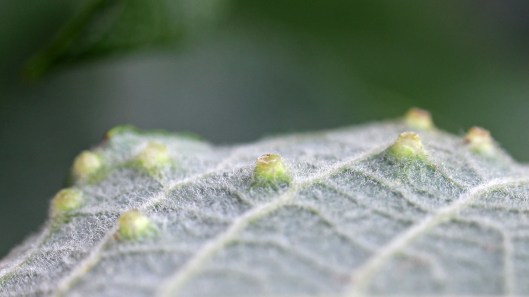
Today’s is Iteomyia capraea (sometimes known as Cecidomyia salicis-folii) (Cecidomyiidae is the family name for gall midges or gall flies). I think I would need better specs to actually see the midge that laid its eggs on this Goat willow (Salix caprea) leaf as it’s only 2-3mm long. Indeed, the galls themselves were pretty small (5-8mm), as you can see from the leafy picture below. When they hatch, the larvae of the midge feed within the leaf tissue causing the willow to develop a gall, sometimes on the midrib of the leaf, sometimes on a thick side vein. I’ve read one report that the larvae are white, another that they are an orange-red colour but I didn’t open up any of the galls for a look at the larva inside so I can’t confirm either report.

171003 Iteomyia capraea on Salix capraea (2)
171003 Iteomyia capraea on Salix capraea (3)

I’ve not been able to discover much about Iteomyia capraea. There are only 215 records showing in the NBN (National Biodiversity Network) database for the whole of Britain, 45 of which are in Wales, but I think that is more a reflection on the under-recording of galls that the rarity of the midge itself. Apparently, the species only breeds a single generation per year and they hibernate over winter in the soil underneath their host tree.

Like Loading...

All the colours of the rainbow

02 Monday Oct 2017

Posted by sconzani in autumn, nature, plants, trees

≈ Leave a comment

Tags

autumn colour, berries, berry, Black Bryony berries, fruit, Hawthorn berries, Sloe

 171002 fruit (1)

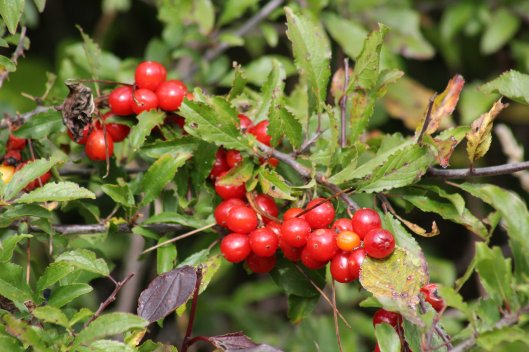
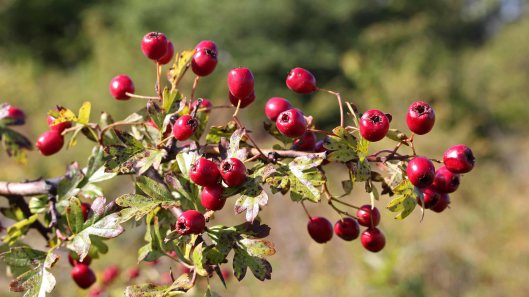
‘Autumn is the mellower season, and what we lose in flowers we more than gain in fruits.’ ~ Samuel Butler, though in this case it’s more about what all the birds and mini-beasts gain in fruits.

171002 fruit (2)
171002 fruit (3)
171002 fruit (4)
171002 fruit (5)
171002 fruit (6)
171002 fruit (7)
Like Loading...

The seeds of success

26 Tuesday Sep 2017

Posted by sconzani in autumn, nature, plants, wildflowers

≈ 2 Comments

Tags

flower seeds, plant seeds, quotes about seeds, seed quotations, seeds, seeds of success

‘The vegetable life does not content itself with casting from the flower or the tree a single seed, but it fills the air and earth with a prodigality of seeds, that, if thousands perish, thousands may plant themselves, that hundreds may come up, that tens may live to maturity; that, at least one may replace the parent.’
~ Ralph Waldo Emerson

170926 seeds (6)
170926 seeds (5)
170926 seeds (1)
170926 seeds (2)
170926 seeds (3)
170926 seeds (4)
Like Loading...

An Ivy bee mating ball

24 Sunday Sep 2017

Posted by sconzani in insects, nature, plants

≈ 5 Comments

Tags

bee mating frenzy, bees, bees on ivy, British bees, Colletes hederae, Ivy bee, Ivy bee mating ball, ivy flowers

Some days are just magical! I went out looking for birds – instead I got mobbed by Red admiral butterflies while walking along the coastal path, which made me grin like a Cheshire cat, and then I found these little buzzers.

170924 Ivy bees Colletes hederae (4)
170924 Ivy bees Colletes hederae (5)

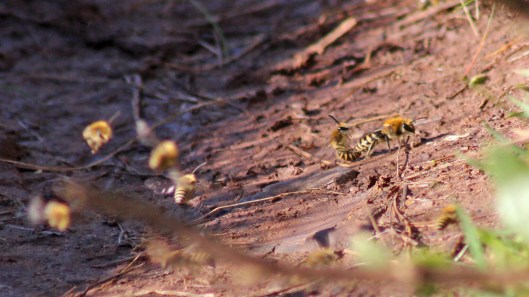
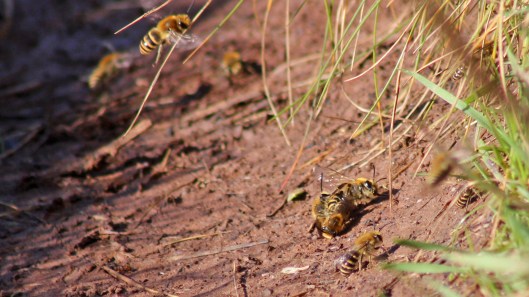
They’re Ivy bees (Colletes hederae) and, as their name suggests, they feed on ivy flowers so they don’t appear until early autumn, when most other bees are winding down activities for the year. With an orange woolly thorax and orange-and-black striped abdomen, these bees are easy to identify, though Colletes hederae was only described as a separate species back in 1993 (before that it was confused with two other species of Colletes). Ivy bees only arrived in Britain from Europe in 2001 but have since gradually spread across southern England and in to south Wales: the extent of their spread is being tracked by BWARS, the Bees, Wasps and Ants Recording Society, so please do log your sightings, either on their website here or with your local records centre.

170924 Ivy bees Colletes hederae (6)
170924 Ivy bees Colletes hederae (7)

I had seen my first Ivy bees for the year the previous week but this new sighting was more special because it was a colony. Though the Ivy bee is a solitary bee (it doesn’t form a hive), a group of females will often excavate their individual burrows and underground chambers together in a sandy bank or similar area of loose earth. And, as the BWARS website explains, male bees often wait by the burrows for females to return and then pounce on them. When the other males spot what’s happening, they also want a piece of the action, jumping on the mating couple to form a writhing mass or mating ball. I was lucky enough to see one of these happen, as shown below.

170924 Ivy bees Colletes hederae (1)170924 Ivy bees Colletes hederae (2)170924 Ivy bees Colletes hederae (3)

Like Loading...

Traveller’s joy

22 Friday Sep 2017

Posted by sconzani in flowers, nature, plants, wildflowers

≈ 2 Comments

Tags

biological recording, clematis vitalba, Old Man's Beard, SEWBReC, species of the month, Traveller's joy

The joy of this plant is that you see it wherever you travel in Britain. See what I did there?

170922 Travellers joy (1)

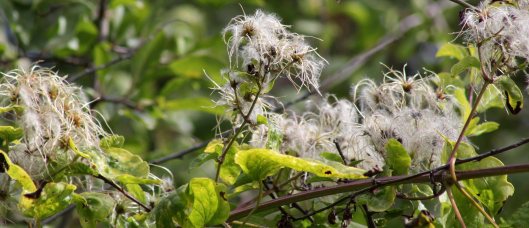
Clematis vitalba is most commonly called Traveller’s-joy but you might also know it as Old-man’s-beard, Father Christmas, Smokewood or Woodbine. Its feathery white seed heads are its most distinctive feature, making it easy to recognise and identify, and this really is a plant that you’ll see draped over hedges and fences almost everywhere in Britain.

170922 Travellers joy (4)
170922 Travellers joy (3)

Yet SEWBReC, the South East Wales Biodiversity Records Centre, have revealed that Traveller’s-joy is not well recorded: they have less than 2000 records in their database. And so they have made this plant their species of the month for September. If you spot Traveller’s-joy this month (or next, or the month after), please make a point of recording it with your local records centre – almost every county in Britain has its own records centre where you can log your biological sightings and those of you based in south-east Wales can find out more about biological recording, and the species of the month, on SEWBReC’s website.

170922 Travellers joy (2)

Like Loading...

Viburnum beetles

04 Monday Sep 2017

Posted by sconzani in insects, nature, plants

≈ 4 Comments

Tags

British insects, Pyrrhalta viburni, viburnum, Viburnum beetle

If you’re a gardener who cultivates any of the viburnum species of plant for their frothy flowers, vibrant berries and heady scent, then you probably won’t be very keen on these little beetles as they can make a pretty good job of chewing up all the leaves on your viburnum shrubs, as you can see from my photos.

170904 Viburnum beetle (4)

Rather unimaginatively but most accurately, they’re called Viburnum beetles (Pyrrhalta viburni) and, as a flat-living non-gardener, I find them rather cute. Both the voracious larvae (when they hatch in spring and early summer) and the less hungry adults (when they emerge from pupation in late summer) like to feed on viburnum leaves though it seems plants usually survive ‘even the most severe defoliation’. Personally, I think it would be best to enjoy the lacy appearance of the chewed leaves rather than resort to killing the beetles – all creatures have their place in the overall scheme of things, and the beetles won’t affect the stunning flowers and berries.

170904 Viburnum beetle (1)
170904 Viburnum beetle (2)
170904 Viburnum beetle (3)
170904 Viburnum beetle (5)
Like Loading...
← Older posts
Newer posts →

About me

sconzani

sconzani

I'm a writer and photographer; researcher and blogger; birder and nature lover; countryside rambler and city strider; volunteer and biodiversity recorder.

View Full Profile →

Follow earthstar on WordPress.com

Enter your email address to follow this blog and receive notifications of new posts by email.

Recent blog posts

  • A huddle of 7-spots March 18, 2026
  • Busy Blue tits March 17, 2026
  • Cuttlebones March 16, 2026
  • No woodland here March 15, 2026
  • Family comes first March 14, 2026

From the archives

COPYRIGHT

Unless otherwise acknowledged, the text and photographs on this blog are my own and are subject to international copyright. Nothing may be downloaded or copied without my permission.

Fellow Earth Stars!

  • Unknown's avatar
  • Unknown's avatar
  • Unknown's avatar
  • Unknown's avatar
  • Unknown's avatar
  • Unknown's avatar
  • Unknown's avatar
  • Unknown's avatar
  • Unknown's avatar
  • Unknown's avatar
  • Unknown's avatar
  • Unknown's avatar
  • Unknown's avatar
  • Unknown's avatar
  • Unknown's avatar
  • Unknown's avatar
  • Unknown's avatar
  • Unknown's avatar
  • Unknown's avatar
  • Unknown's avatar
  • Unknown's avatar
  • Unknown's avatar
  • Unknown's avatar
  • Unknown's avatar
  • Unknown's avatar
  • Unknown's avatar
  • Unknown's avatar
  • Unknown's avatar
  • Unknown's avatar
  • Unknown's avatar
  • Unknown's avatar
  • Unknown's avatar
  • Unknown's avatar
  • Unknown's avatar
  • Unknown's avatar
  • Unknown's avatar
  • Unknown's avatar
  • Unknown's avatar
  • Unknown's avatar
  • Unknown's avatar
  • Unknown's avatar
  • Unknown's avatar
  • Unknown's avatar
  • Unknown's avatar
  • Unknown's avatar
  • Unknown's avatar
  • Unknown's avatar
  • Unknown's avatar
  • Unknown's avatar
  • Unknown's avatar

Blog at WordPress.com.

Privacy & Cookies: This site uses cookies. By continuing to use this website, you agree to their use.
To find out more, including how to control cookies, see here: Cookie Policy
  • Subscribe Subscribed
    • earthstar
    • Join 668 other subscribers
    • Already have a WordPress.com account? Log in now.
    • earthstar
    • Subscribe Subscribed
    • Sign up
    • Log in
    • Report this content
    • View site in Reader
    • Manage subscriptions
    • Collapse this bar
 

Loading Comments...
 

You must be logged in to post a comment.

    %d