• ABOUT
  • BIRDING 2018
  • Birding 2019
  • BLOG POSTS
  • Butterflies 2018
  • Resources

earthstar

~ a celebration of nature

earthstar

Category Archives: plants

Depressaria daucella larvae

30 Monday Jun 2025

Posted by sconzani in insects, plants, wildflowers

≈ 2 Comments

Tags

British moths, caterpillar eating Hemlock water-dropwort, Depressaria daucella, Hemlock water-dropwort, moth larvae, Oenanthe crocata, Water-dropwort brown, Water-dropwort brown larvae

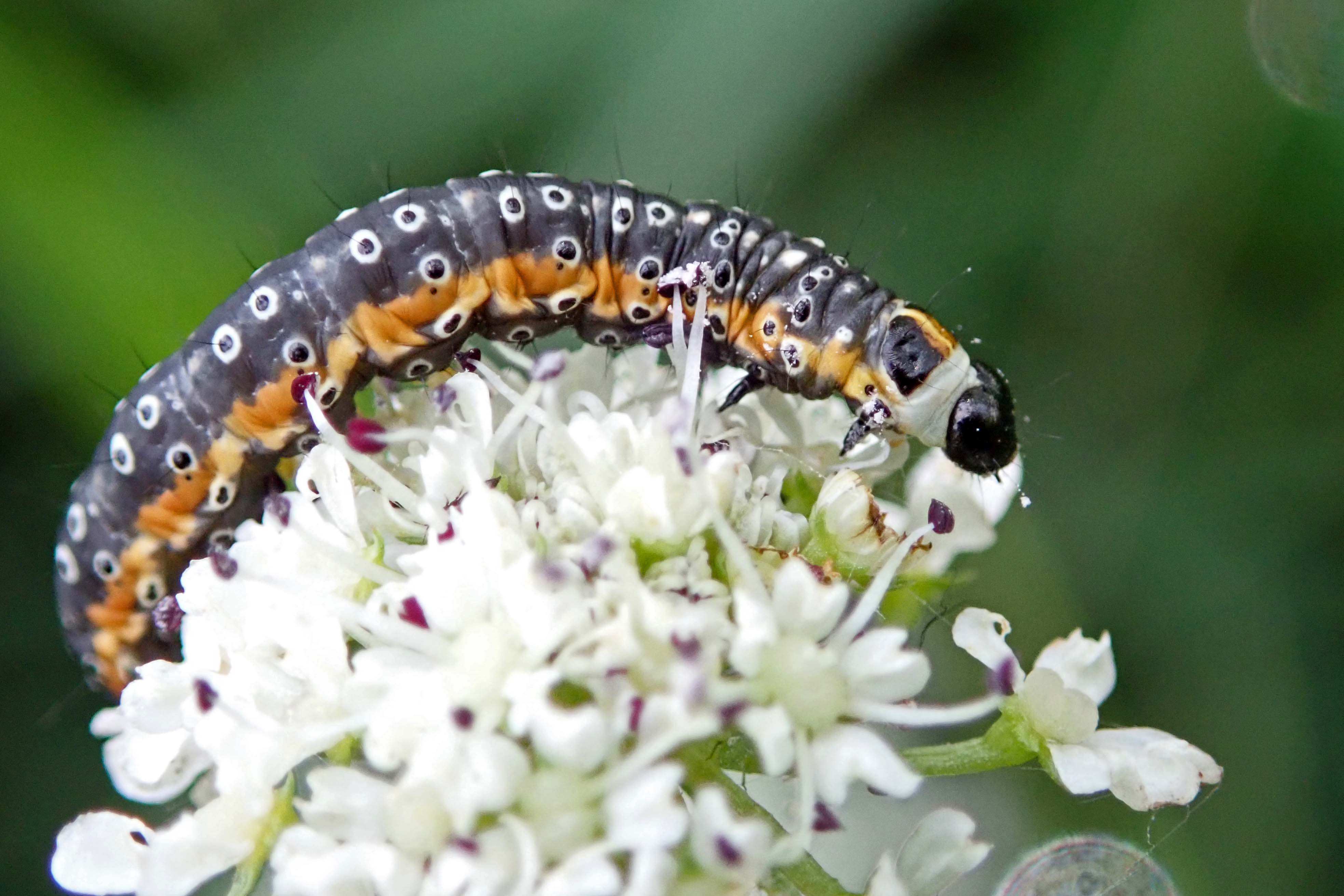
All parts of Hemlock water-dropwort (Oenanthe crocata) are highly poisonous; from the roots to the leaves, no part of it should be ingested, and the Royal Horticultural Society even recommends wearing gloves to handle the plant. Yet, somewhat surprisingly, when I was wandering around the RSPB Radipole Lakes reserve, where Hemlock water-dropwort is abundant, I found a huge number of these small caterpillars happily munching away on its stems and flowers.

These very attractive creatures are the larvae of the moth Depressaria daucella, common name Water-dropwort brown. They can be seen, on this and a few other species of plants, in the months of June and July, either out in the open when eating or resting within a loosely woven silken spinning.

The UK Moths website rather flatteringly says that the adult moth is a ‘fairly distinctive species with its chestnut-brown ground colour and darker streaking’; all I see is yet another little brown job, rather drab when compared to its caterpillars.

Like Loading...

Leafmines: Coleophora paripennella

09 Monday Jun 2025

Posted by sconzani in insects, plants

≈ Leave a comment

Tags

British coleophora, British moths, case-bearing moth larva, case-bearing moth larva on Knapweed, Coleophora, Coleophora paripennella, leaf-mining moth larvae, moth larva on Knapweed

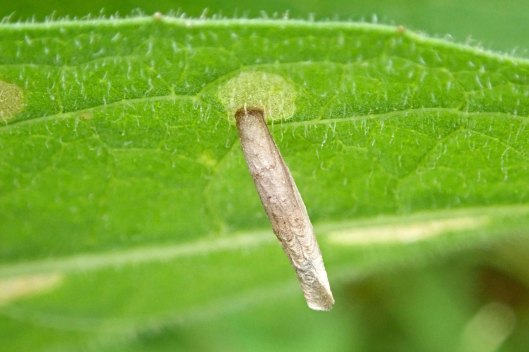
When I got home and checked my photos of this Coleophora, much head scratching ensued. From the British Leafminers website, I could see that there are only three species of case-bearing moth larvae known to feed on Knapweed (Centaurea nigra) and this case didn’t look like any of them. The case of Coleophora conspicuella is described as black and glossy, and has a peculiar almost keel-like shape. Coleophora peribenanderi mostly mines thistle species, is only occasionally seen on Knapweed, and the larvae is active from August to October. Coleophora paripennella‘s case looked the most likely, but is also usually much darker, almost black. So, I ‘phoned a friend’.

And my friendly expert from British Leafminers also ‘phoned a friend’, checking with another moth larvae expert. Their opinions concurred: this was Coleophora paripennella, just with a much lighter-coloured case than usual. Like C. peribenanderi, C. paripennella uses both thistles and Knapweed as larval plants, but in this case, those larvae that use thistle are fully grown by the autumn, whereas those that munch on Knapweed, top up their larval development by feeding again from April to May/June. You can see the sleek and glossy adult moth that eventually results from all this leaf munching on the UK Moths website here.

Like Loading...

Herb-Paris revisited

04 Sunday May 2025

Posted by sconzani in plants, spring, wildflowers

≈ Leave a comment

Tags

British wildflowers, Cwm George, Herb Paris, Herb-Paris, Paris quadrifolia, wildflower, woodland wildflowers

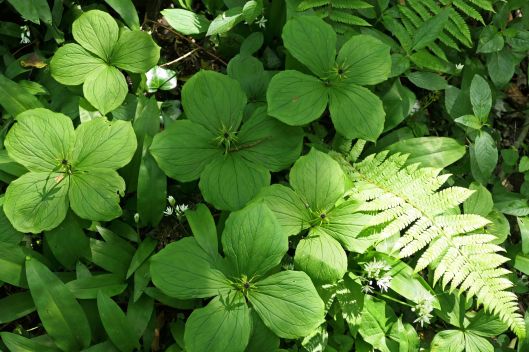
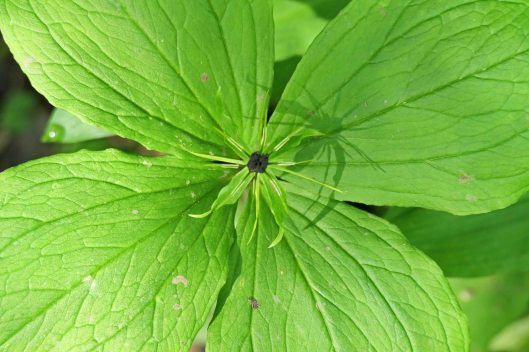
I’ve written about Herb-Paris (Paris quadrifolia) a couple of times before (Herb-Paris, May 2017 and Devil-in-a-bush, April 2021) but it’s such a lovely and unusual plant that I feel it deserves another post, this time primarily of images that I captured when I went on my annual Herb-Paris pilgrimage to Cwm George woodland, in Dinas Powys, earlier this week.

Like Loading...

Hoverfly: Portevinia maculata

30 Wednesday Apr 2025

Posted by sconzani in insects, plants

≈ 2 Comments

Tags

British hoverflies, hoverfly on Wild garlic, Portevinia maculata, Ramsons hoverfly, Wild garlic

I have one of you to thank for the inspiration for this post; through his comments on my recent post about Wild garlic, Philip Strange (who, if you don’t already know and follow him, produces a really interesting science and nature blog) reminded me to look for the hoverfly associated with that plant. And so I did. And here it is.

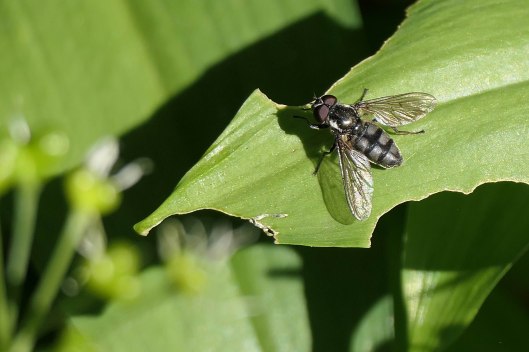
For those of you who don’t live in Britain, we are currently experiencing a week of high (for us) temperatures (this is probably our summer, and normal conditions will resume shortly), so, yesterday, a walk through a shady woodland seemed like a good plan. When I arrived at Cwm George, in the nearby town of Dinas Powys, I was delighted to find it was peak garlic time and, when I stood watching those patches of flowering Wild garlic on which sunshine streamed through the tree canopy, I was even more delighted to spot several small grey-patterned hoverflies, both perched on and hovering around the plants.

These are Portevinia maculata hoverflies, and they have a very strong association with Wild garlic (aka Ramsons), as their larvae mine the bulbs and stem bases of those plants. My guide book says that ‘Where Ramsons is abundant, this hoverfly is usually also abundant’ but Philip and I might both dispute that statement. In my local park, where I took the photos for my recent blog and where Wild garlic is prolific, I’ve never seen this hoverfly. So, I was really pleased to find it in good numbers at Cwm George.

Like Loading...

Common nettle bugs

29 Tuesday Apr 2025

Posted by sconzani in insects, plants

≈ Leave a comment

Tags

bugs on Stinging nettle, Common nettle bug, insect on Stinging nettle, Liocoris tripustulatus, Miridae, plant bugs

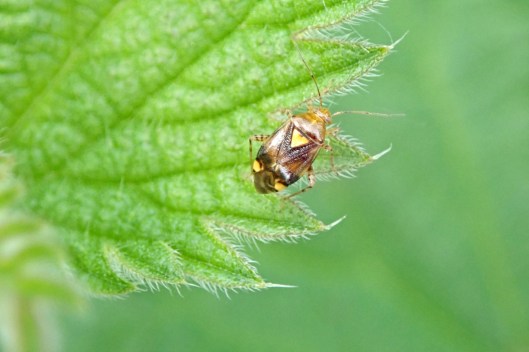
I’ve been finding a few new insects recently and this is one of them, the supposedly common Common nettle bug (Liocoris tripustulatus). Perhaps I’ve never noticed them because they tend to live mainly on Stinging nettle (and you know by now that I find nettles challenging – those stings!). This month I’ve seen them twice and they can, apparently, be seen all year round. And, fortunately, with their three yellow dots, these little (4 to 5 mm long) plant bugs are easy to identify.

Like Loading...

Rust on roses

25 Friday Apr 2025

Posted by sconzani in fungi, plants

≈ Leave a comment

Tags

Phragmidium mucronatum, Phragmidium tuberculatum, rust fungi, rust on Field rose, rust on roses

I haven’t seen many fungi lately but this blob of bright orange rust really stood out amongst the greenery of this Field rose. The two possible species that might have caused this spectacular sight, Phragmidium mucronatum and Phragmidium tuberculatum, can be tricky to separate so I haven’t tried. If you’re interested in reading a discussion on the subject, check out this link to the UK Fungi Forum.

Like Loading...

Leafmines: Cerodontha species

21 Monday Apr 2025

Posted by sconzani in insects, plants

≈ Leave a comment

Tags

British flies, British leafmines, Cerodontha, fly pupa, leaf-mining flies, leafmines on Carex flacca, leafmines on Glaucous sedge

While checking Glaucous sedge (Carex flacca) for the leaf-mining moth larva I featured in last Monday’s post (Leafmines: Elachista cinereopunctella), this time at a different location, I found an altogether different leafminer. This larva had also munched a linear gallery inside the leaf but I knew when I saw the tiny black speck within the mine that this miner was a fly and the black speck was likely to be a pupa. I also guessed that it would be difficult to identify as fly miners often are so I brought home two of several pupae I found.

When I got home, I opened up one of the leaves to get a look at the pupa, took a few photos then popped the two snippets of sedge in a jar on my kitchen window sill to see what might emerge. Rob, from the British Leafminers website was able to confirm from my photo of the pupa that this was indeed a fly, likely belonging to the genus Cerodontha.

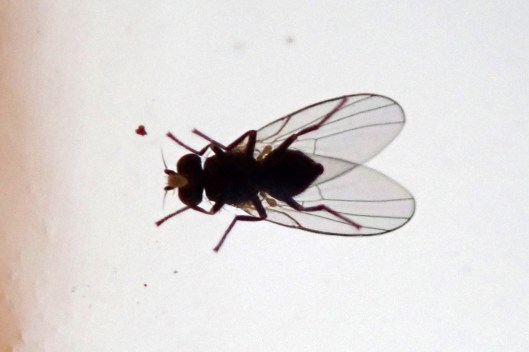
Twelve days later I was making my morning cup of tea when I noticed movement in the jar: a fly had emerged from the pupa I had photographed. Once again I took some photos and checked in with Rob – it was definitely a Cerodontha but a female, which are not as easy to pin to exact species as a male specimen (something to do with the genitalia, I suspect). Still, when I emailed Barry of the National Agromyzidae Recording Scheme, he thought an ID might be possible and volunteered to take a closer look. I’m waiting a few days to see if the second pupa hatches, then will send my specimens to him for further examination. If an exact identification results from that, I’ll update this post.

Like Loading...

Miniscule nymphs

17 Monday Mar 2025

Posted by sconzani in insects, plants

≈ Leave a comment

Tags

Homoptera nymphs, insect nymphs, insects on Polypody, nymphs on Polypody, Polypody fern

During yesterday’s walk, I was looking for a particular species of fern (I’ll explain more about that in a future post) but got sidetracked for ten minutes or so when I spotted this Polypody (not the species I was searching for).

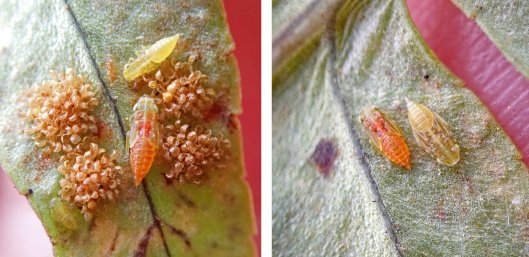
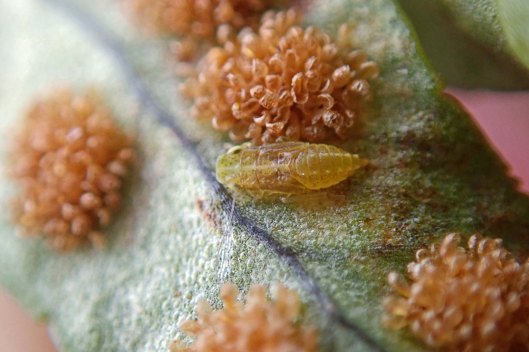
The larvae of a couple of species of moth can often be found amongst the sori, the small clusters on the underside of the fronds where spores are produced, but that is not what I found when I checked these fronds. Instead, I saw several of the tiniest insect nymphs I’ve ever seen. I’m not sure if they were feeding on the spores or just finding shelter amongst them the sori.

They are undoubtedly too small to identify but, to my inexpert eye, they look to be a species of Homoptera, i.e. some kind of leafhopper or planthopper. I’ve already made a note in my diary to go back for another look in a week’s time to see how they are developing, if I can re-find them.

Like Loading...

Blooming Spurge-laurel

09 Sunday Mar 2025

Posted by sconzani in flowers, plants, wildflowers

≈ Leave a comment

Tags

British flora, Daphne laureola, Lavernock Nature Reserve, native Daphne, Spurge-laurel

The highlight of my first visit of the year to Lavernock Nature Reserve was seeing, and smelling, the Spurge-laurel (Daphne laureola) in bloom.

This beautiful plant is one of only two Daphnes that are native to Britain; the other is Mezereon (Daphne mezereum), a plant I’ve never seen and which has only been recorded once in the wider Cardiff area, and that was 25 years ago.

Though its flowers are lovely and emit a scent like honey, they are quite understated, and it is the glossy evergreen of this shrub’s fleshy leaves that make Spurge-laurel stand out.

Like Loading...

Leafmining in the dead of winter

03 Monday Feb 2025

Posted by sconzani in insects, plants, winter

≈ Leave a comment

Tags

British leafminers, British leafmines, Chromatomyia ramosa, Euleia heraclei, leafmines, leafmining flies, leafmining moths, Phyllonorycter leucographella, Phytomyza chaerophylli

I reminded myself during Saturday’s meander around local trails and pathways that leafmining can be a year round pastime. I didn’t find anything new but I did find several miners that I’ve seen and blogged about before. So, if you’ve a mind to get started on your personal journey of discovering leafmines, there’s no need to wait until the warmer months.

Phyllonorycter leucographella on one of the Pyracantha species. The tiny larva, with its black on white markings, is just visible within the mine.

Chromatomyia ramosa just getting started on a new Teasel rosette

Phytomyza chaerophylli on newly sprouted Cow parsley

Euleia heraclei on Alexanders, a plant that grows almost constantly and very prolifically here in coastal south Wales. I held the leaf up to the light so as to show the larva within.

Like Loading...
← Older posts
Newer posts →

About me

sconzani

sconzani

I'm a writer and photographer; researcher and blogger; birder and nature lover; countryside rambler and city strider; volunteer and biodiversity recorder.

View Full Profile →

Follow earthstar on WordPress.com

Enter your email address to follow this blog and receive notifications of new posts by email.

Recent blog posts

  • N is for nest December 19, 2025
  • M is for mite December 18, 2025
  • L is for lepidopteran lifers December 17, 2025
  • K is for Keeled skimmers December 16, 2025
  • J is for Jersey tiger December 15, 2025

From the archives

COPYRIGHT

Unless otherwise acknowledged, the text and photographs on this blog are my own and are subject to international copyright. Nothing may be downloaded or copied without my permission.

Fellow Earth Stars!

  • Unknown's avatar
  • Unknown's avatar
  • Unknown's avatar
  • Unknown's avatar
  • Unknown's avatar
  • Unknown's avatar
  • Unknown's avatar
  • Unknown's avatar
  • Unknown's avatar
  • Unknown's avatar
  • Unknown's avatar
  • Unknown's avatar
  • Unknown's avatar
  • Unknown's avatar
  • Unknown's avatar
  • Unknown's avatar
  • Unknown's avatar
  • Unknown's avatar
  • Unknown's avatar
  • Unknown's avatar
  • Unknown's avatar
  • Unknown's avatar
  • Unknown's avatar
  • Unknown's avatar
  • Unknown's avatar
  • Unknown's avatar
  • Unknown's avatar
  • Unknown's avatar
  • Unknown's avatar
  • Unknown's avatar
  • Unknown's avatar
  • Unknown's avatar
  • Unknown's avatar
  • Unknown's avatar
  • Unknown's avatar
  • Unknown's avatar
  • Unknown's avatar
  • Unknown's avatar
  • Unknown's avatar
  • Unknown's avatar
  • Unknown's avatar
  • Unknown's avatar
  • Unknown's avatar
  • Unknown's avatar
  • Unknown's avatar
  • Unknown's avatar
  • Unknown's avatar
  • Unknown's avatar
  • Unknown's avatar
  • Unknown's avatar

Blog at WordPress.com.

Privacy & Cookies: This site uses cookies. By continuing to use this website, you agree to their use.
To find out more, including how to control cookies, see here: Cookie Policy
  • Subscribe Subscribed
    • earthstar
    • Join 667 other subscribers
    • Already have a WordPress.com account? Log in now.
    • earthstar
    • Subscribe Subscribed
    • Sign up
    • Log in
    • Report this content
    • View site in Reader
    • Manage subscriptions
    • Collapse this bar
 

Loading Comments...
 

You must be logged in to post a comment.

    %d