• ABOUT
  • BIRDING 2018
  • Birding 2019
  • BLOG POSTS
  • Butterflies 2018
  • Resources

earthstar

~ a celebration of nature

earthstar

Category Archives: plants

The Pimpernels

21 Friday Jul 2017

Posted by sconzani in flowers, nature, plants, wildflowers

≈ 5 Comments

Tags

Anagallis arvensis, Anagallis arvensis ssp. foemina, Anagallis tenella, Blue pimpernel, Bog pimpernel, British flora, Lysimachia nemorum, pimpernel, Scarlet pimpernel, Yellow pimpernel

For Floral Friday this week I bring you the Pimpernels.

170721 Scarlet pimpernel

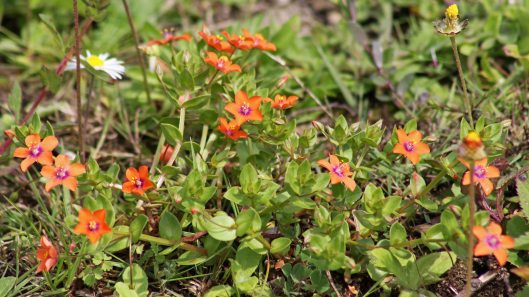
First, the pimpernel flower many of you will be familiar with, Scarlet pimpernel (Anagallis arvensis), also known as Old man’s weathervane and Poor man’s weatherglass due to its habit of shutting its petals when the weather becomes wet or dull. (I imagine they will be very firmly shut against today’s wind and rain!) The flower also functions as a timekeeper as it opens its petals around 8am and closes them at 2pm, even when the weather’s fine.

170721 Blue-flowered Scarlet pimpernel (1)
170721 Blue-flowered Scarlet pimpernel (2)

I only learned quite recently that the Scarlet has a subspecies, the Blue pimpernel (Anagallis arvensis ssp. foemina). This is supposedly quite rare and mostly found in southern England, though the one in my photographs is growing in my friend Hilary’s south Wales garden.

170721 Bog pimpernel

As its name suggests, the Bog pimpernel (Anagallis tenella) prefers watery places, marshy areas and soggy peat bogs. Its delicate pink flowers sprinkle the ground like petals under a blossoming cherry tree.

170721 Yellow pimpernel

There is also a yellow-flowered pimpernel – you guessed it, the Yellow pimpernel (Lysimachia nemorum) – that is commonly seen in established deciduous woodland and alongside shaded streams. Although it carries the name pimpernel, this lovely little plant is actually a separate genus and is more closely related to plants like Creeping-Jenny (Lysimachia nummularia) and Yellow loosestrife (L. vulgaris).

How many of these lovely pimpernels have you managed to see?

Like Loading...

Aliens in a Cardiff park

19 Wednesday Jul 2017

Posted by sconzani in nature, plants, wildflowers

≈ 4 Comments

Tags

alien flora, alien plants, Canadian Fleabane, Fennel, French bartsia, Himalayan Balsam, Himalayan blackberry, Hoary mustard, Large-flowered evening primrose, Mary Gillham Archive Project, Small-flowered evening primrose, Tansy, White mignonette, Wild radish

On Sunday the Mary Gillham Archive Project teamed up with the Cardiff Naturalists’ Society to replicate a walk that Mary Gillham had participated in many moons ago, looking for aliens in Cardiff. Of course, I don’t mean the little-green-man type of alien – these were alien plants, though the definition of alien in this case seemed quite diverse. They may have been non-native plants that had arrived in Cardiff in the sand that served as ballast in the days of sailing ships, like Canadian Fleabane (Conyza canadensis).

170719 Cardiff naturalists
170719 Canadian fleabane

They may arrived in shipments of imported grain or bird seed or perhaps in bales of wool, like Hoary mustard (Hirschfeldia incana) and White mignonette (Reseda alba). Or they may have initially been decorative plants, like the Large-flowered evening primrose (Oenothera glazoviana) that was introduced from North America in the early 17th century and has since become naturalised.

170719 Hoary mustard
170719 Large-flowered evening primrose

As well as those plants named above, we also saw the following aliens: Small-flowered evening primrose (Oenothera cambrica) (introduced to cultivation in Britain in 1775); Himalayan blackberry (Rubus armeniacus) (a garden escapee); French bartsia (Odontites jaubertianus) (mode of introduction unknown); Wild radish (Raphanus raphanistrum subsp. raphanistrum) (presumed to have spread as a weed of cultivation); Fennel (Foeniculum vulgare) (probably introduced by the Romans); Tansy (Tanacetum vulgare) (an escapee from cultivation); and, of course, the notorious Himalayan balsam (Impatiens glandulifera) (introduced as an ornamental garden plant in 1839).

The aliens are among us and they’re thriving!

170719 Fennel
170719 Himalayan balsam
170719 Himalayan blackberry
170719 Small-flowered evening primrose
170719 Tansy
170719 Wild radish

Much of the information about the origins of these plants came from the Online Atlas of the British and Irish Flora.

Like Loading...

‘A Natural History of the Hedgerow’

08 Saturday Jul 2017

Posted by sconzani in animals, birds, fungi, nature, plants, trees, wildflowers

≈ 8 Comments

Tags

British countryside, British hedgerows, field boundaries, hedge, hedgerow, hedgerow trees

170708 hedgerows (1)

Reading John Wright’s excellent book A Natural History of the Hedgerow and ditches, dykes and dry stone walls (Profile Books, London, 2016) has led me to look at the countryside with slightly more knowledgeable eyes, at least when it comes to field boundaries.

170708 hedgerows (6)

Not only does Wright’s book provide a superbly researched history of the hedges, dykes, ditches and dry stone walls that divide up the countryside, it also provides detailed information on the plants, birds, invertebrates and animals that inhabit Britain’s hedgerows, as well as including practical details on how the various boundaries are constructed and maintained.

170708 hedgerows (2)
170708 hedgerows (3)
170708 hedgerows (5)

Now, when I go out on my rural rambles or I’m being transported through the countryside by train, car or bus, I can recognise where hedges must once have grown by the broken line of mature trees marching across a field, I shake my head at the neglect of the hedgerows on so many farms (though I can appreciate the sculptural beauty of ancient hedgerow trees), I can spot where farmers have removed existing boundaries to create huge open fields, and I can appreciate how well-maintained hedges add an extra dimension to the landscape.

170708 hedgerows (4)

Wales and England now have legislation in place to protect hedgerows that meet certain criteria but it would be good if all hedgerows were protected and if more was done to ensure existing hedges were also properly nurtured and maintained.

Like Loading...

In praise of hogweed

30 Friday Jun 2017

Posted by sconzani in insects, nature, plants, wildflowers

≈ 2 Comments

Tags

British flora, British wildflowers, food for insects, Heracleum sphondylium, Hogweed

170630 hogweed (1)

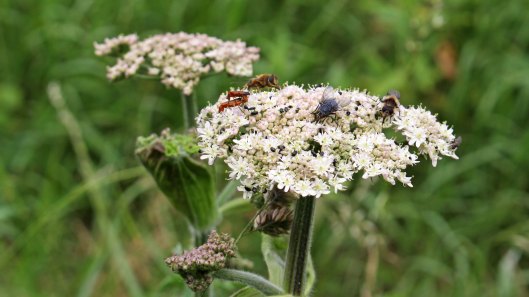
Hogweed is so named because the flowers are said to have a pig-like smell, though I can’t say that I’ve noticed. It has a ton of interesting-sounding common names, of which Bilers, Caddy, Eltrot, Limperscrimps, Cow-weed, Kirk, Chirk and Kek are just a few. Its Latin name, Heracleum sphondylium, is also interesting: Heracleum is a reference to the mythical Greek hero Heracles, who was said to have introduced the medicinal use of the plant to humans, and sphondylium comes from the Greek sphondylo, meaning backbone, and refers to the plant’s segmented stem.

170630 hogweed (3)

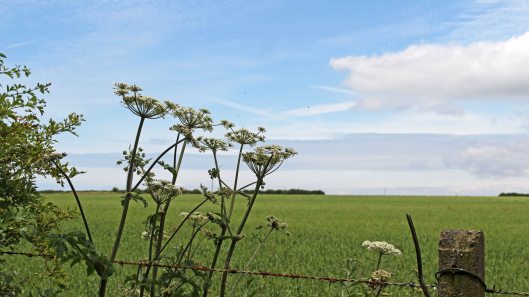
Hogweed is just coming in to flower now, adorning the roadsides, hedgerows and track edges in many of the parts of south Wales that I’ve visited recently.

170630 hogweed (2)

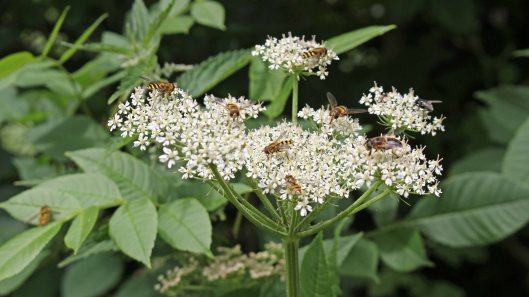
The statuesque purple-coloured-when-young stalks and those large white flower heads are glorious, indeed, but the very best thing about Hogweed, I think, is the food it provides for all manner of creatures, from flies and hoverflies to ants, bees and wasps, bugs and beetles.

170630 1 Common red soldier beetle
170630 2 Swollen-thighed beetle
170630 3 Cheilosia illustrata
170630 4 Noon fly
170630 5 Hogweed
170630 6 Broad centurion female
170630 7 Willow mason-wasp
170630 8 Stilt bug
170630 9 Hogweed leafminer
Like Loading...

The peace of wild things

29 Thursday Jun 2017

Posted by sconzani in nature, plants

≈ Leave a comment

Tags

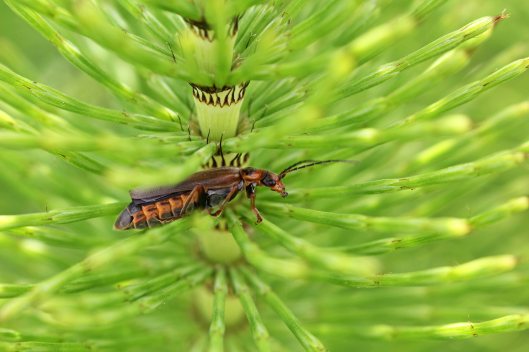
beetle, beetle in equisetum, Equisetum, Peace of wild things, Wendall Berry poem

170629 Peace of wild things

When despair for the world grows in me
and I wake in the night at the least sound
in fear of what my life and my children’s lives may be,
I go and lie down where the wood drake
rests in his beauty on the water, and the great heron feeds.
I come into the peace of wild things
who do not tax their lives with forethought
of grief. I come into the presence of still water.
And I feel above me the day-blind stars
waiting with their light. For a time
I rest in the grace of the world, and am free.

~ Wendell Berry (1934 – ), American poet, novelist and environmental activist

Like Loading...

Roots

15 Thursday Jun 2017

Posted by sconzani in nature, plants

≈ 7 Comments

Tags

Chlorophytum comosum, how to grow spider plant, plant roots, roots growing, Spider plant

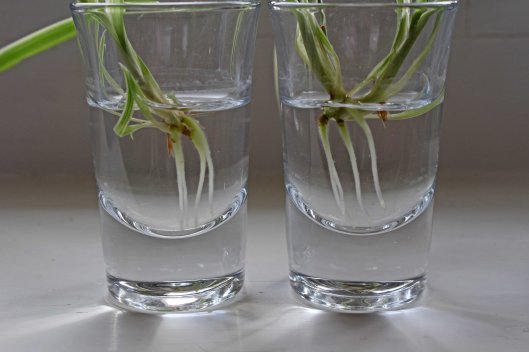
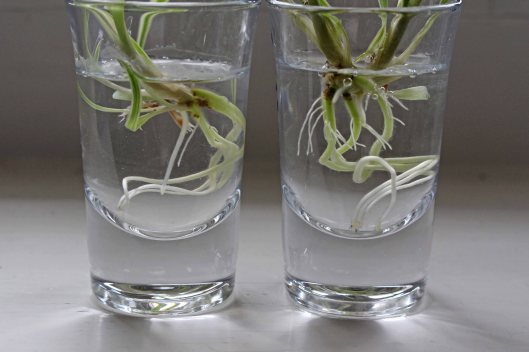
Wanting to have more houseplants in my flat and knowing that Spider plants (Chlorophytum comosum) are very easy to grow, I … ahem … pinched a couple of spiderlings from a much neglected plant in the office toilet and popped them into some water to get them started. I knew they would quickly develop roots but their speed amazed me. The photos below show their development after 2 days, 4 days, 6 days, and 16 days. Time to buy some potting mix, me thinks!

170615 roots (1)170615 roots (2)170615 roots (3)170615 roots (4)

Like Loading...

Southover Grange Gardens

31 Wednesday May 2017

Posted by sconzani in flowers, nature, parks, plants, trees

≈ Leave a comment

Tags

350-year-old Mulberry tree, garden in Lewes, public gardens in East Sussex, Southover Grange Gardens

Curiosity can be a good thing. You look through a grill in a stone wall and spy a magical garden. You see people walking to and fro so you think, ‘maybe it’s open to the public’. You walk further along the walls until, at the corner of the street, you find an entrance and, hey presto, you discover the glorious Southover Grange Gardens in Lewes.
170531 Southover Grange Gardens Lewes (1)

The Grange was built by one William Newton in 1572, with stone filched from the old Lewes Priory, but the gardens are the creation of more recent owners. Highlights include a 350-year-old Mulberry tree, one of the oldest in England, as well as many other magnificent old trees; herbaceous borders and formal bedding displays; a box-hedged knot garden full of the scent of roses; a wildflower area; and an impressive collection of public artworks. If you’re ever in Lewes, do pay a visit to this tranquil oasis.

This slideshow requires JavaScript.

Like Loading...

Weevil as biological controller

29 Monday May 2017

Posted by sconzani in insects, nature, plants

≈ 6 Comments

Tags

Exapion ulicis, gorse, Gorse weevil, insects on gorse, weevil, weevil as biological control, weevil introduced to New Zealand

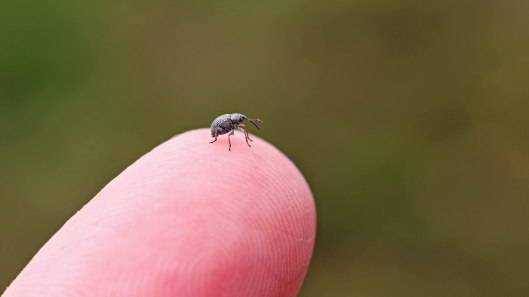
It was lunchtime on our Glamorgan botany group walk and, rather than get a wet bum from sitting on the damp grass, I was eating my roll and cheese while poking around the flowers of a nearby gorse bush. I was looking for Gorse shieldbugs, of which I found not a sign, but I did find this tiny creature and, after a bit more poking, a couple of its friends.

170529 Gorse weevil (2)

It’s a Gorse weevil (Exapion ulicis) and, as you can judge from its size relative to my finger, it’s tiny, only 2 to 3mm long. Its snout is (relatively) enormous, about half as long as its body, making it look like a cross between an elephant (without the ears) and a spider (those legs!). And that snout is its secret weapon – the weevil uses its snout to burrow into the stem and spines of the gorse bush to eat the soft tissue inside.

170529 Gorse weevil (1)

Apparently this little weevil was introduced to my homeland, New Zealand, back in 1931 in an effort to control the introduced (by British migrants as cheap hedging) gorse bushes that were thriving in New Zealand’s favourable climate. The weevil’s larvae live inside and eat gorse seeds, thus preventing the bushes from reproducing. The little gorse weevil has done its job well but it seems the scientists hadn’t banked on the fact that the weevil larvae only eat gorse seeds in the springtime and the gorse also flowers and seeds in the autumn.

170529 Gorse weevil (3)

Like Loading...

Botanising: A walk above Brynna

28 Sunday May 2017

Posted by sconzani in nature, plants, wildflowers

≈ 5 Comments

Tags

botany mentee, British flora, Bush vetch, Common vetch, Field horsetail, Glamorgan Botany Group, Mouse-ear hawkweed, Welsh poppy, Zigzag clover

Last weekend I enjoyed another full day’s walk with the Glamorgan Botany Group in the hills and vales above Brynna, in south Wales, and, though I am the first to admit that I came home with more photos of insects than plants, I am learning. It’s just that, for someone who wasn’t brought up in Britain and so didn’t learn from an early age the names of even the most common wildflowers, there’s a huge amount to take in.

170528 Brynna

So, what have I learnt? I can now tell the difference between Common vetch (Vicia sativa), on the left, and Bush vetch (Vicia sepium), on the right below.

170528 2 Common vetch
170528 3 Bush vetch

I know this is Field horsetail (Equisetum arvense) because the first joints of the leaves (which form a skirt around the stem when you break them off) are longer than the stem section (the little dark v-shaped marks on the stem in this photo).

170528 1 Field horsetail

Though the two species are very similar, I know this is not Red clover (Trifolium pratense) but rather Zigzag clover (Trifolium medium) partly because the white marks on its leaves are not as obvious but, most definitively, because at the widest part of the leaf the veins meet the edge at a 90 degree angle.

170528 4 Zigzag clover (1)
170528 4 Zigzag clover (2)

I know that the plant on the left is Mouse-ear hawkweed (Hieracium pilosella) and that beautiful flower on the right is my very first Welsh poppy (Meconopsis cambrica) growing in the wild!

170528 Mouse-ear hawkweed
170528 Welsh poppy
Like Loading...

Seaford Head wildlife walk

21 Sunday May 2017

Posted by sconzani in birds, coastal fauna, nature, plants, wildflowers

≈ Leave a comment

Tags

Brown-tail moth caterpillars, Fulmar, Green-winged orchid, Rock pipit, Rook, Seaford Head Nature Reserve, Seaford Head wildlife walk, Stonechat, Sussex Wildlife Trust, Thrift

One of the highlights of my recent short break in Sussex was a guided wildlife walk around Seaford Head, organised by the Sussex Wildlife Trust and led by knowledgeable and amusing local naturalist Michael Blencowe.

170521 1 Seaford Head walk

The day was very windy and scattered showers kept us clad in rain jackets until lunchtime but that didn’t spoil the walk. The scenery on this coast is magnificent and it’s one of my favourite places in the whole of Britain so, even if we’d not seen any wildlife, I would’ve been happy. As it was, we saw more than I expected, and our guide was a mine of funny stories and fascinating facts.

170521 2 Seaford Head Hound's-tongue
170521 3 Seaford Head Stonechat
170521 4 Seaford Head Fulmar
170521 5 Seaford Head group
170521 6 Seaford Head Rock pipit
170521 7 Seaford Head Flower
170521 8 Seaford Head Brown-tail moth
170521 9 Seaford Head Green-winged orchid
170521 10 Seaford Head Rook

Our flora and fauna sightings included many different plants in flower, like Green alkanet, Hound’s-tongue and Thrift; plus several Stonechats and Linnets, and Rock pipits and Rooks aplenty. We had Fulmars soaring up from the cliffs to the left of us and Skylarks serenading us high in the sky to the right. A grass snake was discovered snoozing under a sheet of corrugated iron, the webs of Brown-tail moth caterpillars adorned the bramble bushes, and Green-winged orchids provided striking bursts of colour in the rough alongside the local golf course. If you ever get the chance, I’d highly recommend this walk.

170521 11 Seaford Head Thrift

Like Loading...
← Older posts
Newer posts →

About me

sconzani

sconzani

I'm a writer and photographer; researcher and blogger; birder and nature lover; countryside rambler and city strider; volunteer and biodiversity recorder.

View Full Profile →

Follow earthstar on WordPress.com

Enter your email address to follow this blog and receive notifications of new posts by email.

Recent blog posts

  • A huddle of 7-spots March 18, 2026
  • Busy Blue tits March 17, 2026
  • Cuttlebones March 16, 2026
  • No woodland here March 15, 2026
  • Family comes first March 14, 2026

From the archives

COPYRIGHT

Unless otherwise acknowledged, the text and photographs on this blog are my own and are subject to international copyright. Nothing may be downloaded or copied without my permission.

Fellow Earth Stars!

  • Unknown's avatar
  • Unknown's avatar
  • Unknown's avatar
  • Unknown's avatar
  • Unknown's avatar
  • Unknown's avatar
  • Unknown's avatar
  • Unknown's avatar
  • Unknown's avatar
  • Unknown's avatar
  • Unknown's avatar
  • Unknown's avatar
  • Unknown's avatar
  • Unknown's avatar
  • Unknown's avatar
  • Unknown's avatar
  • Unknown's avatar
  • Unknown's avatar
  • Unknown's avatar
  • Unknown's avatar
  • Unknown's avatar
  • Unknown's avatar
  • Unknown's avatar
  • Unknown's avatar
  • Unknown's avatar
  • Unknown's avatar
  • Unknown's avatar
  • Unknown's avatar
  • Unknown's avatar
  • Unknown's avatar
  • Unknown's avatar
  • Unknown's avatar
  • Unknown's avatar
  • Unknown's avatar
  • Unknown's avatar
  • Unknown's avatar
  • Unknown's avatar
  • Unknown's avatar
  • Unknown's avatar
  • Unknown's avatar
  • Unknown's avatar
  • Unknown's avatar
  • Unknown's avatar
  • Unknown's avatar
  • Unknown's avatar
  • Unknown's avatar
  • Unknown's avatar
  • Unknown's avatar
  • Unknown's avatar
  • Unknown's avatar

Blog at WordPress.com.

Privacy & Cookies: This site uses cookies. By continuing to use this website, you agree to their use.
To find out more, including how to control cookies, see here: Cookie Policy
  • Subscribe Subscribed
    • earthstar
    • Join 668 other subscribers
    • Already have a WordPress.com account? Log in now.
    • earthstar
    • Subscribe Subscribed
    • Sign up
    • Log in
    • Report this content
    • View site in Reader
    • Manage subscriptions
    • Collapse this bar
 

Loading Comments...
 

You must be logged in to post a comment.

    %d