• ABOUT
  • BIRDING 2018
  • Birding 2019
  • BLOG POSTS
  • Butterflies 2018
  • Resources

earthstar

~ a celebration of nature

earthstar

Category Archives: spring

What an effort!

11 Friday Apr 2025

Posted by sconzani in insects, spring

≈ Leave a comment

Tags

British butterflies, butterfly, butterfly eggs, butterfly eggs on nettle, Peacock, Peacock butterfly, Peacock butterfly eggs, Peacock butterfly laying eggs, Stinging nettle

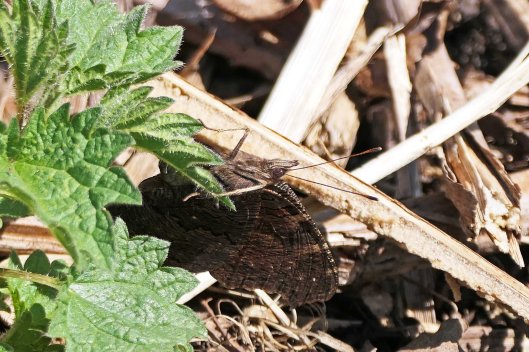
As I write this, my fingers are still stinging. And none of my photos are sharp, partly because ‘Ouch!’ but also because I didn’t want to disturb the clutch so was trying to move the leaf as little as possible. But, when I watched their beautiful mother laying the first of these yesterday, I knew I had to go back today to see how many she’d produced.

And here she is, the gorgeous female Peacock butterfly, clinging on to a Stinging nettle leaf. You might just be able to see how her abdomen is curved up towards the underside of the leaf where she is depositing her eggs. My guide book tells me that a female Peacock ‘lays her eggs in batches of up to 400 eggs, a process that can take over two hours’. What an effort! I will, of course, be looking out for when the tiny caterpillars emerge, in approximately two weeks’ time.

Like Loading...

Mining bees

08 Tuesday Apr 2025

Posted by sconzani in insects, spring

≈ 4 Comments

Tags

Andrena species, Andrenidae, bees, British bees, mining bees, solitary bees

Mining bees, the Adrenidae, are notoriously difficult to identify I find, and, as my brain is already swimming with factors to consider when identifying spiders (and other life stuff that is happening in the background), I don’t have the mental capacity to tackle bees at the moment. Maybe they can be next year’s project.

In the meantime though, I can still appreciate how exceedingly cute they are, especially when they sit still for a few moments (which isn’t often) and allow me to get some close up photos (also not often).

Like Loading...

Pretty drooping weeping flowers

06 Sunday Apr 2025

Posted by sconzani in flowers, spring, wildflowers

≈ 2 Comments

Tags

British wildflowers, Spring colour, spring wildflowers, Wood anemone, woodland flowers

‘The Wood anemone’, a poem by John Clare (1793-1864)

The wood anemone through dead oak leaves
And in the thickest woods now blooms anew,

And where the green briar and the bramble weaves
Thick clumps o’green, anemones thicker grew,

And weeping flowers in thousands pearled in dew
People the woods and brakes, hid hollows there,

White, yellow and purple-hued the wide wood through.
What pretty drooping weeping flowers they are:

The clipt-frilled leaves, the slender stalk they bear
On which the drooping flower hangs weeping dew,

How beautiful through April time and May
The woods look, filled with wild anemone;

And every little spinney now looks gay
With flowers mid brushwood and the huge oak tree.

Like Loading...

Finally, a Wheatear

03 Thursday Apr 2025

Posted by sconzani in birds, spring

≈ Leave a comment

Tags

birding, birdwatching, British birds, Cardiff Bay birding, migrating birds, spring migration, Wheatear

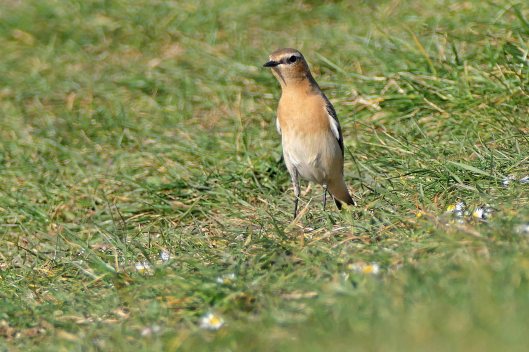
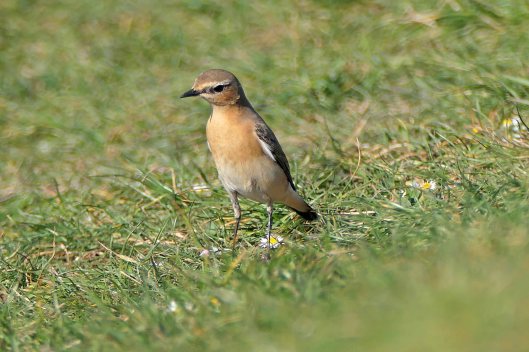
Maybe it’s because we’ve had a lot of fine clear weather and, rather than dropping down to rest in Cardiff Bay, they’ve continued their flights north. Maybe they just don’t like the look of the place, with the increasing numbers of people and out-of-control dogs. Whatever the reason, there’s been a notable absence of migrating Wheatears around the Bay this year, with just one bird noted a couple of days ago and then two, a male and a female, this morning. And that’s around two weeks later than usual – for three of the past four years, I’ve seen my first Wheatears on 20 March. Fortunately, I had already decided to walk around part of the Bay this morning so was there when I bumped in to the birder who’d just seen the male Wheatear, and here he is (the bird not the birder) …

Like Loading...

A new rookery

02 Wednesday Apr 2025

Posted by sconzani in birds, spring

≈ Leave a comment

Tags

birding, birdwatching, breeding Rooks, British birds, nesting Rooks, Rook, rookery

During the Springs of 2022 and 2023, birders throughout Wales volunteered their time to check suitable locations for rookeries, the multi-nest colonies where Rooks raise their young. The survey, organised by the Welsh Ornithological Society, was conducted to establish concrete information about the breeding population in Wales because Rooks are now red-listed, their numbers threatened by changing land use and human occupation, amongst other things.

I didn’t take part in the survey as one of my birding friends had already put his hand up for my local area and, as I don’t drive, getting around an alternative 2-square-kilometre tetrad would have proven difficult, but I did chat about where I’d seen Rooks with my friend. His searches of the local area only produced one rookery, which is well known locally and has been established for a very long time – the street where it’s located is called Rookery Lane!

So, you can perhaps imagine my surprise and delight when, during Sunday’s local meander, I spotted a new rookery. It’s adjacent to a series of fields where horses graze and where I’ve often seen Rooks feeding – in fact, the photo and video I included in my post Rook pair-bonding behaviour, 18 February, were taken at that location. I think this new Rookery has only been established very recently, perhaps even this year, as it certainly wasn’t around in Spring 2023 when the survey took place, and I’ve never noticed it when I’ve walked that way previously.

I counted just 5 nests, and at least 8 Rooks – others may have been off looking for food. Not being familiar with Rook breeding behaviour, I initially thought the adult birds were feeding well-grown young but I’ve since been informed that, as Rooks only begin breeding in March, this was more likely to be adults feeding their partners so they don’t have to leave the nest when they’re sitting on eggs or raising their young. I’ll certainly be keeping a close eye on these trees during the next couple of months, hoping to catch glimpses of any chicks as they grow and fledge.

Like Loading...

Speckled woods on the wing

01 Tuesday Apr 2025

Posted by sconzani in insects, nature, spring

≈ Leave a comment

Tags

British butterflies, butterfly, Speckled wood, spring butterflies, Spring colour, Wood argus

Sunday was a brilliant day for butterflies, with my first three Speckled woods of the year, each in a different location, all basking on hedgerows and flitting out to defend their territories as I passed by.

With its rich chocolately brown background colour mixed with small circular dollops of creamy yellow, it’s almost like a living crème egg … or is my imagination just being overly affected by the bombarding of pre-Easter advertisements?

My brilliant guide book, Life Cycles of British & Irish Butterflies, tells me that the Speckled wood was once called the Wood argus, the name Argus coming from the ‘many-eyed shepherd of Greek mythology’. That seems a very apt name for this beautiful creature.

Like Loading...

Mad with joy

30 Sunday Mar 2025

Posted by sconzani in flowers, spring

≈ 3 Comments

Tags

British wildflowers, Spring colour, spring wildflowers, wildflowers

People from a planet without flowers would think we must be
mad with joy the whole time to have such things about us.
~ Iris Murdoch, from the novel A Fairly Honourable Defeat, Vintage, 1970

Mad as a hatter, me, as the Spring wildflowers begin to bloom. I hope you’re enjoying them too!


Like Loading...

Hairy violets

23 Sunday Mar 2025

Posted by sconzani in flowers, spring, wildflowers

≈ Leave a comment

Tags

British wildflowers, Hairy violet, Spring colour, spring wildflowers, Viola hirta, violet species, violets

As I wrote in last Sunday’s post, it’s violet time, and I’ve since realised that I’ve not previously blogged about one violet species I see very often, the Hairy violet (Viola hirta).

This species and the Sweet violet (Viola odorata) are the only two to have rounded sepals, which narrows down the possibilities for identification purposes. Also, the sepal appendages are different: in Sweet violet, these are angled away from the flower’s stem, while the sepal appendages of the Hairy violet are pressed towards the stem.

Another distinguishing feature is the petal colour: the petals of the Hairy violet are paler, with a lilac hue, whereas those of the Sweet violet are a deep purple (unless they’re the white-coloured sub-species, of course).

The two violet species also grow in different environments. Sweet violets prefer the edges of woodland rides, and churchyards, and roadside verges, while Hairy violets are mostly found on dry calcareous grasslands, like those found in two of the fields at my local country park, Cosmeston Lakes, which is where I took these photos earlier today.

Like Loading...

Belting out its song

22 Saturday Mar 2025

Posted by sconzani in birds, spring

≈ Leave a comment

Tags

birding, birdwatching, British birds, singing Wren, wren

Can you hear it?

I can’t remember where I read it but I’m fairly sure the Wren has one of the loudest voices of any birds in Britain, though even its song is eclipsed by the boom of the Bittern, which can be heard around 2 miles away. At this time of year, male Wrens in particular sing regularly and loudly, to advertise themselves and their territories in order to attract any available females. The Wren in my photo has a very nice seaside territory amongst the large boulders of Cardiff Bay’s outer Barrage breakwater – if I were a female Wren, I’d certainly be interested. If you’re not familiar with the song of the Wren, you can hear it on the RSPB website.

Like Loading...

Staring at willows

21 Friday Mar 2025

Posted by sconzani in insects, spring, trees

≈ Leave a comment

Tags

Bombus hypnorum, Bombus terrestris, Brimstone, British butterflies, Buff-tailed bumblebee, butterflies feeding on willow flowers, insects feeding on willow flowers, insects on willow, Small tortoiseshell, Tree bumblebee, willow

This is your occasional reminder, if you are interested in spotting flying insects, that it is a very good idea at this time of year, when the various willows (Salix species) are coming in to flower, to spend a little staring at these trees. That is partly how I came to find so many butterflies yesterday. Several of the Brimstones I saw, in particular the two females that were feeding up prior to egg-laying, and the beautiful Small tortoiseshell were all found initially on willow flowers.

The fluffy yellow flowers were also providing much needed sustenance for a variety of flies, for honey bees and hoverflies. Due to their larger size, I was also able to see at least two species of bumblebee, Buff-tailed (Bombus terrestris) (left below) and Tree bumblebee (Bombus hypnorum) (below right).

Like Loading...
← Older posts
Newer posts →

About me

sconzani

sconzani

I'm a writer and photographer; researcher and blogger; birder and nature lover; countryside rambler and city strider; volunteer and biodiversity recorder.

View Full Profile →

Follow earthstar on WordPress.com

Enter your email address to follow this blog and receive notifications of new posts by email.

Recent blog posts

  • No booming Bittern but … March 9, 2026
  • Danish scurvygrass March 8, 2026
  • Four weeks early March 7, 2026
  • Three shieldbug species March 6, 2026
  • Toad spawn March 5, 2026

From the archives

COPYRIGHT

Unless otherwise acknowledged, the text and photographs on this blog are my own and are subject to international copyright. Nothing may be downloaded or copied without my permission.

Fellow Earth Stars!

  • Unknown's avatar
  • Unknown's avatar
  • Unknown's avatar
  • Unknown's avatar
  • Unknown's avatar
  • Unknown's avatar
  • Unknown's avatar
  • Unknown's avatar
  • Unknown's avatar
  • Unknown's avatar
  • Unknown's avatar
  • Unknown's avatar
  • Unknown's avatar
  • Unknown's avatar
  • Unknown's avatar
  • Unknown's avatar
  • Unknown's avatar
  • Unknown's avatar
  • Unknown's avatar
  • Unknown's avatar
  • Unknown's avatar
  • Unknown's avatar
  • Unknown's avatar
  • Unknown's avatar
  • Unknown's avatar
  • Unknown's avatar
  • Unknown's avatar
  • Unknown's avatar
  • Unknown's avatar
  • Unknown's avatar
  • Unknown's avatar
  • Unknown's avatar
  • Unknown's avatar
  • Unknown's avatar
  • Unknown's avatar
  • Unknown's avatar
  • Unknown's avatar
  • Unknown's avatar
  • Unknown's avatar
  • Unknown's avatar
  • Unknown's avatar
  • Unknown's avatar
  • Unknown's avatar
  • Unknown's avatar
  • Unknown's avatar
  • Unknown's avatar
  • Unknown's avatar
  • Unknown's avatar
  • Unknown's avatar
  • Unknown's avatar

Blog at WordPress.com.

Privacy & Cookies: This site uses cookies. By continuing to use this website, you agree to their use.
To find out more, including how to control cookies, see here: Cookie Policy
  • Subscribe Subscribed
    • earthstar
    • Join 669 other subscribers
    • Already have a WordPress.com account? Log in now.
    • earthstar
    • Subscribe Subscribed
    • Sign up
    • Log in
    • Report this content
    • View site in Reader
    • Manage subscriptions
    • Collapse this bar
 

Loading Comments...
 

You must be logged in to post a comment.

    %d