• ABOUT
  • BIRDING 2018
  • Birding 2019
  • BLOG POSTS
  • Butterflies 2018
  • Resources

earthstar

~ a celebration of nature

earthstar

Category Archives: wildflowers

Common calamint

27 Sunday Aug 2023

Posted by sconzani in wildflowers

≈ Leave a comment

Tags

British wildflowers, Clinopodium ascendens, Common calamint

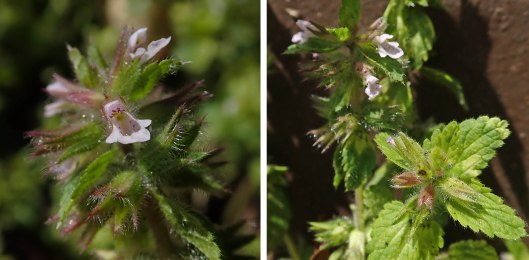
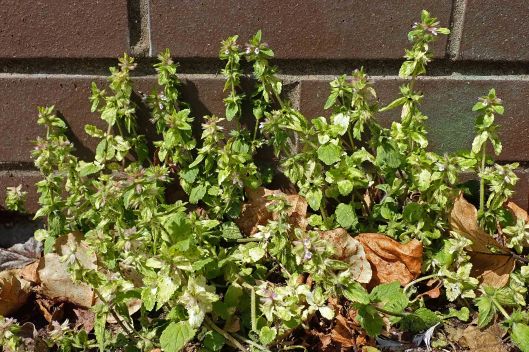
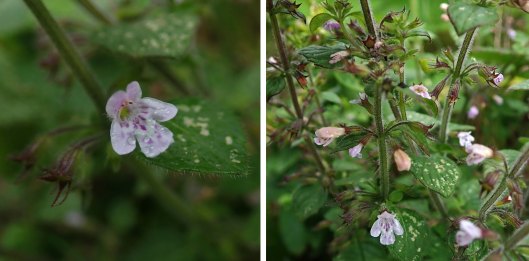
This is a new plant for me, and I freely admit to having walked past it several times before finally noticing it, perhaps because it only flowers from July to September. It’s Common calamint (Clinopodium ascendens), a member of the mint family, the Lamiaceae, and, not surprisingly, its leaves when crushed smell deliciously of mint.

230827 common calamint (1)

The plant in question, in the photo above, is the one with small greyish-looking leaves (though they’re actually green with white speckles) and even smaller pink flowers. My wildflower book says it can be found in a variety of habitats, from hedge banks and bushy areas to dry grassy scrubland and roadside verges. The plants I found were growing alongside an under-cliff path that leads to a local beach, so it seems this mint is very adaptable. Despite that, there are only 199 records in the Welsh biodiversity database, so perhaps I’m not the only person to walk past these plants without noticing them.
230827 common calamint (2)

Like Loading...

Midweek treat

24 Thursday Aug 2023

Posted by sconzani in autumn, flowers, wildflowers

≈ Leave a comment

Tags

Autumn Lady’s-tresses, autumn orchids, autumn-flowering orchid, British native orchids, orchid, Spiranthes spiralis

Think of them as a palate cleanser; a floral pick-me-up; a Thursday tonic; a spiralling shot in the arm – the cheerful sight of Autumn lady’s tresses (Spiranthes spiralis) in full bloom amongst the lush grasses and wildflowers at my local country park. I hope you have some growing near you to help brighten your day!

Like Loading...

By the sea

20 Sunday Aug 2023

Posted by sconzani in plants, seaside, wildflowers

≈ Leave a comment

Tags

#WildflowerHour, British wildflowers, Echium vulgare, seaside wildflowers, Silene latifolia, Tanacetum vulgare, Tansy, Teucrium scorodonia, Viper's-bugloss, White campion, Wood sage

This week’s challenge for #WildflowerHour was ‘What can you find blooming along the coast?’. I’ve had a couple of walks around parts of Cardiff Bay this week and could’ve included a lot of plants but have selected just four.

230820 vipers-bugloss

As Cardiff Council has (amazingly!) refrained from cutting the Barrage grass in recent months, the few Viper’s-bugloss (Echium vulgare) plants that were previously growing there have increased markedly. There must be over 50 plants now spread across the expanse of the Barrage, and the blue flowers make a lovely contrast against the grass green.

230820 tansy

I rarely see Tansy (Tanacetum vulgare), so this single plant, thriving on the sandy slope below the children’s playground on the Barrage, was a delightful surprise.

230820 white campion

Growing just along from that Tansy plant, was this lone White campion (Silene latifolia) plant. It wasn’t looking as healthy as the Tansy but was covered in seed heads so I think it was just past its best.

230820 wood sage

This Wood sage (Teucrium scorodonia) was a total surprise as you wouldn’t necessarily expect a plant with ‘wood’ in its name to be growing alongside a seaside path. My book says it prefers acid soils but, when I googled, I found many examples of Wood sage growing on scree slopes, amongst limestone, and close to sand dunes, so I guess it’s very adaptable.

Like Loading...

The mystery of the white thistles

16 Wednesday Aug 2023

Posted by sconzani in plants, wildflowers

≈ Leave a comment

Tags

bacteria on Creeping thistle, Creeping thistle, Pseudomonas syringae, white shoots on Creeping thistle

I’ve noticed in previous years that the top shoots of many Creeping Thistle plants (Cirsium arvense) sometimes turn white at this time of year and I’ve only recently found out that this is caused by Pseudomonas syringae, a bacteria that produces a chemical called tagetitoxin, which poison chloroplasts and causes chlorosis.

230816 white thistle (1)

There’s an excellent article on the Llanelli Naturalists website, entitled ‘The Mystery of the “White” Thistles’, which includes the following explanatory paragraph (nb this article was uploaded in January 2009 so the situation has probably changed since it was written).

This bacterial disease was recorded in the UK for the first time by a retired plant pathologist, Dr John Fletcher, in the vicinity of his home in Canterbury, Kent, only six years ago. The bacterium causing the disease is now thought to be a pathological variety of Pseudomonas syringiae – a complex of bacterial types that affects over 180 species of fruit, vegetable, forage and horticultural plants. The infection on creeping thistle was found for the first time in Canada in 2003. Scientists from Alberta (Zhang et al, 2004) recorded the disease at several locations across Canada and have named it the “White‐colour disease of Canadian Thistle”. Their diseased plants showed apical chlorosis and these symptoms were associated with stunted growth, fewer shoots, inhibition of flowering and/or sterility. These are exactly the same symptoms found on the local populations of Creeping Thistle at Burry Port.

230816 white thistle (2)

Like Loading...

An interlude of orchids

13 Sunday Aug 2023

Posted by sconzani in flowers, wildflowers

≈ Leave a comment

Tags

British orchids, British wildflowers, Broad-leaved helleborine, Native British orchid, orchid

When I first spotted these Broad-leaved helleborines sprouting back in June, I despaired for their survival in the dry heat. But several weeks of intermittent rain have brought them back to life, and they look as beautiful as ever.

230813 broad-leaved helleborine

Like Loading...

Field woundwort

06 Sunday Aug 2023

Posted by sconzani in wildflowers

≈ Leave a comment

Tags

British wildflowers, Field woundwort, pavement plants, Stachys arvensis

During Friday’s walk I was vaguely hoping to see the Otter that’s been visiting Cardiff Bay wetlands during recent weeks (I didn’t – and I’m not one to stand around for hours on the off chance) but my secondary purpose was to look for pavement plants, those wildflowers that manage to colonise the cracks between bricks or slabs of tarmac and the subject of today’s Wildflower Hour on social media.

230806 field woundwort (2)

Fortunately, I bumped in to a local birding friend who is also a keen botanist and he was able to point me in the direction of this plant, a new one for me, Field woundwort (Stachys arvensis). Though its natural habitat is fields and hedge edges, especially on sandy soils and mostly in the southern parts of Britain, this plant has extended its range to include some urban locations, like allotments and, as shown here, the tiny cracks between a building and the pavement.

230806 field woundwort (1)

Like Loading...

Carrot mining bee

05 Saturday Aug 2023

Posted by sconzani in insects, plants, wildflowers

≈ Leave a comment

Tags

Andrena nitidiuscula, bees on Wild carrot, British mining bees, Carrot mining bee, Cosmeston Lakes Country Park, Daucus carota, Lavernock Nature Reserve, Wild carrot

In August 2020, local entomologist Liam Olds made the amazing discovery of the first Carrot mining bees (Andrena nitidiuscula) for Wales at Lavernock Nature Reserve, and Liam later went on to find a population of the bees at nearby Cosmeston Lakes Country Park. Despite these parks both being relatively near where I live, it’s taken me three years to find my own Carrot mining bee, at Cosmeston on Thursday.

230805 Carrot mining bee (1)

As you might have guessed from the bee’s name, it can usually be found collecting pollen from the flowers of Wild carrot (Daucus carota). And therein lies one of the problem’s for this bee’s future, the preservation of the right habitat to ensure the bee’s conservation. Earlier this year, despite protests against what was happening, the Vale of Glamorgan Council, which operates Cosmeston, went ahead with planting trees across large areas of a wildflower meadow where the bee had previously been found by Liam Olds. Yes, the planet needs more trees, but those trees need to be planted in the right place. When they’re not, they risk destroying important local flora and fauna. Let’s hope the Carrot mining bee can survive the local council’s actions!

230805 Carrot mining bee (2)

Like Loading...

Jersey cudweed

30 Sunday Jul 2023

Posted by sconzani in plants, wildflowers

≈ Leave a comment

Tags

British wildflowers, Gnaphalium luteoalbum, Jersey cudweed

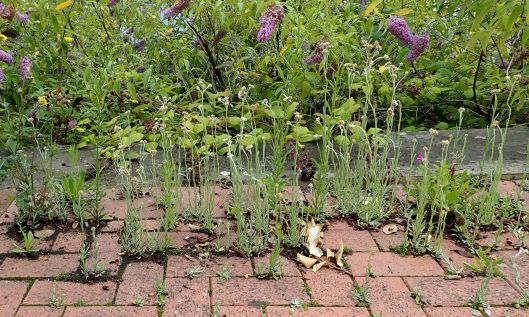
A year ago, one of my local birding acquaintances, who is also a keen botanist, discovered a small area of Jersey cudweed (Gnaphalium luteoalbum) growing along the edge of the Cardiff Bay walking and cycling trail. Though he quickly reported his find to Cardiff Council in an attempt to protect it, their contractors soon obliterated the plants in a typical ‘kill the weeds’ operation. So, I didn’t get to see this new plant then but I made myself a note to check back in a year’s time, which I did, last week, and was very pleased to see the plants have reappeared.

230730 jersey cudweed (1)

The NatureSpot website notes that Jersey cudweed is likely to have been ‘an ancient introduction’ to Britain that then ‘became almost extinct’ but is now bouncing back (despite the anti-weed brigade!). And, though traditionally a plant of sandy fields and dune slacks, it is now adapting to life as a pavement plant in our towns and cities.

230730 jersey cudweed (2)

Like Loading...

Yellow loosestrife

23 Sunday Jul 2023

Posted by sconzani in flowers, wildflowers

≈ 2 Comments

Tags

British wildflowers, Lysimachia vulgaris, medicinal plant, yellow flowers, Yellow loosestrife

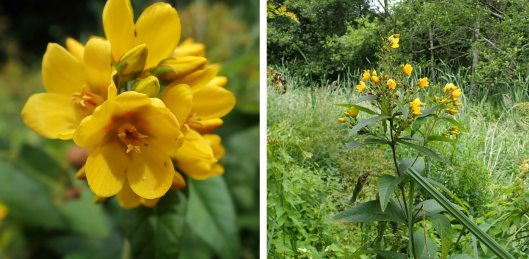
With their roots in the water along the edge of a local canal, these Yellow loosestrife (Lysimachia vulgaris) plants were so exuberant and lush I initially thought they were some other species. They had obviously found the damp niche that suited them best.

230723 yellow loosestrife (1)

Though I would never advocate the use of herbal medicine (just being cautious about matters I don’t understand or have knowledge of), Yellow loosestrife did, apparently, have a large number of traditional uses as a medicinal plant, from treating diarrhoea and haemorrhaging to cleaning wounds and being used as a mouthwash. And the First Nature website reports on other common uses:

Yellow Loosestrife tied around the necks of oxen was reputed to keep irritating flies away from them. In the distant past these and several other kinds of ‘loosestrife’ plants were also used to get rid of infestations of flies in houses. The plants were dried and burned indoors, and toxins in the smoke drove out the flies (and no doubt also any human occupants).

230723 yellow loosestrife (2)

Like Loading...

Back lane wildflowers

16 Sunday Jul 2023

Posted by sconzani in flowers, wildflowers

≈ 2 Comments

Tags

British wildflowers, summer wildflowers, urban wildflowers

I almost want to whisper this post, as it’s a miracle the local council hasn’t poisoned these wildflowers out of existence as they usually do a couple of times over the summer months, this despite the dangers of those herbicides to humans, insects and birds, even the dogs that get walked along the back lanes, and despite the council having declared a ‘nature emergency’! So, for now, the back lane between my street and the next is alive with wildflowers, some of which I’ve featured in this little video.

Like Loading...
← Older posts
Newer posts →

About me

sconzani

sconzani

I'm a writer and photographer; researcher and blogger; birder and nature lover; countryside rambler and city strider; volunteer and biodiversity recorder.

View Full Profile →

Follow earthstar on WordPress.com

Enter your email address to follow this blog and receive notifications of new posts by email.

Recent blog posts

  • A huddle of 7-spots March 18, 2026
  • Busy Blue tits March 17, 2026
  • Cuttlebones March 16, 2026
  • No woodland here March 15, 2026
  • Family comes first March 14, 2026

From the archives

COPYRIGHT

Unless otherwise acknowledged, the text and photographs on this blog are my own and are subject to international copyright. Nothing may be downloaded or copied without my permission.

Fellow Earth Stars!

  • Unknown's avatar
  • Unknown's avatar
  • Unknown's avatar
  • Unknown's avatar
  • Unknown's avatar
  • Unknown's avatar
  • Unknown's avatar
  • Unknown's avatar
  • Unknown's avatar
  • Unknown's avatar
  • Unknown's avatar
  • Unknown's avatar
  • Unknown's avatar
  • Unknown's avatar
  • Unknown's avatar
  • Unknown's avatar
  • Unknown's avatar
  • Unknown's avatar
  • Unknown's avatar
  • Unknown's avatar
  • Unknown's avatar
  • Unknown's avatar
  • Unknown's avatar
  • Unknown's avatar
  • Unknown's avatar
  • Unknown's avatar
  • Unknown's avatar
  • Unknown's avatar
  • Unknown's avatar
  • Unknown's avatar
  • Unknown's avatar
  • Unknown's avatar
  • Unknown's avatar
  • Unknown's avatar
  • Unknown's avatar
  • Unknown's avatar
  • Unknown's avatar
  • Unknown's avatar
  • Unknown's avatar
  • Unknown's avatar
  • Unknown's avatar
  • Unknown's avatar
  • Unknown's avatar
  • Unknown's avatar
  • Unknown's avatar
  • Unknown's avatar
  • Unknown's avatar
  • Unknown's avatar
  • Unknown's avatar
  • Unknown's avatar

Blog at WordPress.com.

Privacy & Cookies: This site uses cookies. By continuing to use this website, you agree to their use.
To find out more, including how to control cookies, see here: Cookie Policy
  • Subscribe Subscribed
    • earthstar
    • Join 668 other subscribers
    • Already have a WordPress.com account? Log in now.
    • earthstar
    • Subscribe Subscribed
    • Sign up
    • Log in
    • Report this content
    • View site in Reader
    • Manage subscriptions
    • Collapse this bar
 

Loading Comments...
 

You must be logged in to post a comment.

    %d