• ABOUT
  • BIRDING 2018
  • Birding 2019
  • BLOG POSTS
  • Butterflies 2018
  • Resources

earthstar

~ a celebration of nature

earthstar

Category Archives: wildflowers

Marjoram and sage

18 Sunday Jul 2021

Posted by sconzani in wildflowers

≈ 2 Comments

Tags

British wildflowers, Oregano, Origanum vulgare, Teucrium scorodonia, Wild marjoram, Wood sage

Two of this week’s wildflower finds are herbal so it makes sense to blend them together here. First up, is Wild marjoram (Origanum vulgare), known in the Mediterranean countries as Oregano, though it doesn’t smell quite as pungent when grown in Britain’s cooler climate. This lovely plant can often be found in chalk and limestone grasslands, under hedge rows and in roadside verges, where its flowers are favourites of butterflies and other insects.
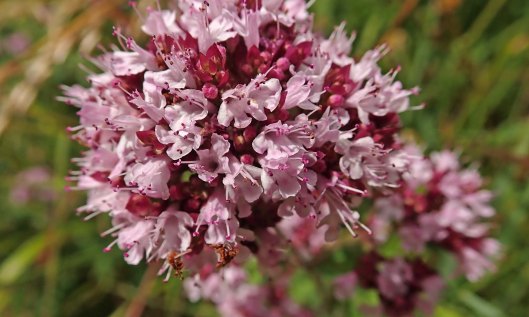
210718 wild marjoram (1)210718 wild marjoram (2)

The second plant, a new one for me, is Wood sage (Teucrium scorodonia), another wild herb that doesn’t have the strength of scent you find in the sage you use in cooking. As you might guess from its name, this plant thrives along dry woodland rides, but can also be found in coastal situations, in dunes and heaths and on cliffs.

210718 wood sage (1)
210718 wood sage (2)
Like Loading...

A summer selection

11 Sunday Jul 2021

Posted by sconzani in flowers, wildflowers

≈ 2 Comments

Tags

British wildflowers, summer colour, summer wildflowers

This week’s floral display is a selection of the latest summer wildflowers in bloom: Agrimony, Chicory, Everlasting pea, Field bindweed, Field madder, Field scabious, Honeysuckle, Mignonette, Milkwort, Restharrow, Scarlet pimpernel, Stinking iris, Woody nightshade, and Yellow rattle.

Like Loading...

Marsh helleborines

07 Wednesday Jul 2021

Posted by sconzani in flowers, plants, wildflowers

≈ 4 Comments

Tags

British orchids, Epipactis palustris, Marsh helleborine, native orchids

As their current conservation status in Britain is rated amber, meaning they are vulnerable and near-threatened, I feel privileged to have within easy travelling distance a large colony of Marsh helleborines (Epipactis palustris).

210707 marsh helleborine (1)

And, as our rainfall levels in Wales during May were the highest recorded since records began in 1862, this has been a very good year for a plant that thrives in the wet – hence, the ‘Marsh’ in its name.

210707 marsh helleborine (2)
210707 marsh helleborine (3)

These are low-growing orchids, no more than a foot in height, but it is well worth getting down to their level to appreciate more fully the elegant and delicate beauty of their flowers. To my fanciful eye, they sometimes resemble a woman dancing, her frilly white petticoats swirling about her. At other times, I see a white blouse, with an extravagant ruffle down the front, like the jabot worn by some judges. What do you see?

210707 marsh helleborine (4)

Like Loading...

Heath spotted-orchids

04 Sunday Jul 2021

Posted by sconzani in flowers, wildflowers

≈ 2 Comments

Tags

Aberbargoed Grasslands, British orchids, British wildflowers, Dactylorhiza maculata, Heath spotted-orchid, native orchids

From the often-boggy, mostly acid grasslands at Aberbargoed direct to your screens, this week’s native British orchid is the appropriately named Heath spotted-orchid (remember, the spotted part of that name refers to the marks on its leaves, not its petals). Its scientific name is Dactylorhiza maculata, which the Plantlife website explains as follows: ‘The genus name Dactylorhiza is formed from the Greek words daktylos meaning finger and rhiza meaning root’ – so, this orchid has a multi-fingered root, rather than a single tuber. And maculata means spotted – those leaves.

210704 Heath spotted-orchid (1)

As you can see from the flower spikes below, this is another orchid with some variation in both its colours, which range from white through pink to pale purple, and its markings, which, though they look spotted from a distance, actually have various combinations of streaks and little loops. The shape of the petals is also distinctive, the lower one in particular is less deeply lobed than, for example, the Common spotted-orchid, which the Heath spotted does superficially resemble.

210704 Heath spotted-orchid (2)
210704 Heath spotted-orchid (3)
210704 Heath spotted-orchid (4)
Like Loading...

A viperish plant

27 Sunday Jun 2021

Posted by sconzani in flowers, wildflowers

≈ 4 Comments

Tags

blue flowers, British wildflowers, Echium vulgare, Viper's-bugloss

Of Viper’s-bugloss (Echium vulgare), Richard Mabey writes in Flora Britannica:

[It] is a viperish plant in all its parts. The sprays of flowers that spiral up the stem are half-coiled; the long red stamens protrude from the mouths of the blue and purple flowers like tongues; the fruits resemble adders’ heads. Even the ‘speckled’ stem (it is hairy in fact) suggested snakes’ skins to early herbalists.

And like all members of the Echium family, this glorious plant is much loved and visited by insects, especially (from my own observations) bumblebees.

210627 viper's-bugloss (1)
210627 viper's-bugloss (2)
210627 viper's-bugloss (3)
Like Loading...

Variation

25 Friday Jun 2021

Posted by sconzani in flowers, wildflowers

≈ 4 Comments

Tags

British orchids, British wildflowers, Common spotted-orchid, Dactylorhiza fuchsia, native orchids

I mentioned recently how I sometimes find orchids difficult to identify. These photos illustrate why. As far as I can work out, as they all had spots on their leaves, and in spite of the variation in colours and patterns, these are all Common spotted-orchids (Dactylorhiza fuchsia).

210625 common spotted-orchid (1)
210625 common spotted-orchid (2)
210625 common spotted-orchid (3)
210625 common spotted-orchid (4)
210625 common spotted-orchid (5)
210625 common spotted-orchid (6)
210625 common spotted-orchid (7)
210625 common spotted-orchid (8)
210625 common spotted-orchid (9)
Like Loading...

A local woodland

23 Wednesday Jun 2021

Posted by sconzani in trees, walks, wildflowers

≈ Leave a comment

Tags

ancient woodland, Casehill Woods, Millennium Woodland, woodland walk

I write often about my wanderings in my local woodlands so I thought I’d share one of my walks in a series of landscape images. There are, in fact, several separate areas of woodland, sandwiched together, and this is just one of them, a combination of ancient woodland and a newer area of trees planted to mark the turn of the millennium. Not surprisingly, the ancient part has many huge old trees, is cool and dark in the summer when their foliage shades the paths. Above, along the plateau at the top of the hill, is the millennium woodland with its wide open rides and small meadows. This area has more wildflowers and is where I look for butterflies, dragonflies and other insects. Often, I don’t see a single soul when I walk here, which, for me, just adds to the attraction – it’s my own little piece of paradise.

Like Loading...

Summer yellow

20 Sunday Jun 2021

Posted by sconzani in flowers, wildflowers

≈ Leave a comment

Tags

British wildflowers, summer colour, yellow flowers, yellow wildflowers

We’ve rain today, the gentle soft rain that I’ve come to associate with life in Wales, but I’m not complaining. It’s much needed, by the land, its plants and its beasties, after a couple of weeks of strong sunshine and baking heat. To counteract the dull grey I see out my window, I’m about to compile today’s post, a little video full of summer sunshine, with some of the yellow-flowered wildflowers currently in bloom. I know I’ve done this before, and quite recently, but I do so enjoy the bright cheeriness of yellow.

Pictured today are: Bird’s-foot trefoil, Creeping buttercup, Creeping cinquefoil, a Dandelion species, Dyer’s greenweed, Evening primrose, Meadow buttercup, a Melilotus species, Mouse-ear hawkweed, Nipplewort, Pineapple weed, Reflexed stonecrop, Silverweed, Smooth sow-thistle, Tormentil, Wood avens, Yellow iris, Yellow loosestrife, Yellow pimpernel, Yellow water-lily, and Yellow-wort.

Like Loading...

A select club

19 Saturday Jun 2021

Posted by sconzani in insects, wildflowers

≈ 4 Comments

Tags

British moths, British wildflowers, Dyer’s greenweed, Mirificarma lentiginosella, Mirificarma lentiginosella larvae, moth larvae on Dyer's greenweed

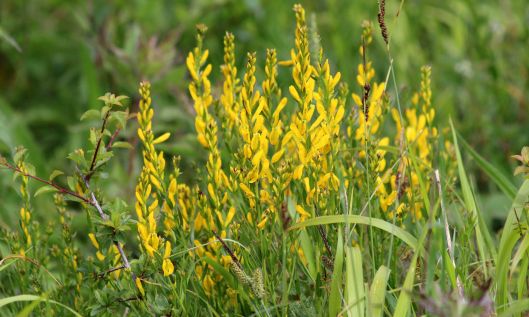
A couple of years ago, I discovered through chats to local Butterfly Conservation Senior moth ecologist George that three rare moths use Dyer’s greenweed (Genista tinctoria) as their larval food plant. (There’s a Butterfly Conservation factsheet about these here.)

210619 dyers greenweed

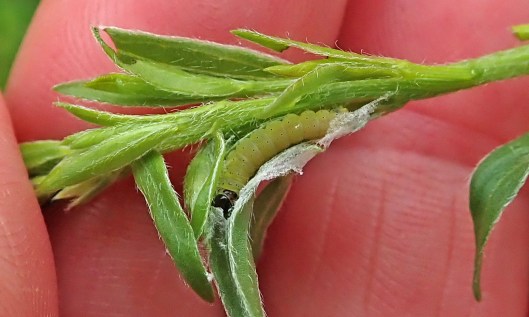
The larvae create little homes for themselves by spinning together the leaves at the tips of Dyer’s greenweed shoots, and, yesterday, after much careful searching, I finally found a ‘spinning’ that was occupied.

210619 Mirificarma lentiginosella (1)
210619 Mirificarma lentiginosella (2)

George has now confirmed for me that this little beauty is the larva of the nationally scarce moth Mirificarma lentiginosella. And he writes: ‘You now join the select club of people who have seen this species in Wales: you, me, and C.G. Barrett who recorded it in Pembrokeshire in the 1800s’. As you can imagine, I am extremely pleased to have joined this select club!

210619 Mirificarma lentiginosella (3)

Like Loading...

Southern marsh-orchids

16 Wednesday Jun 2021

Posted by sconzani in flowers, nature, wildflowers

≈ 4 Comments

Tags

British native orchids, British orchids, Dactylorhiza praetermissa, Grangemoor Park, native orchids, Southern Marsh-orchid

Mostly, I only see four species of orchid: Early purple, Common spotted, Bee and Pyramidal, so I find it tricky identifying other species. And the fact that many species of orchid hybridise with each other also complicates the identification picture. So, when a Twitter pal tagged me for help identifying a Southern marsh-orchid (Dactylorhiza praetermissa) I couldn’t assist, but decided to try to find some for myself to learn more about their appearance. I found one specimen during a recent visit to Aberbargoed (though not at the grasslands) and several at Cardiff’s Grangemoor Park.

The first thing I realised is that you can’t rely on colour. I found another orchid that looked the perfect shade of purple but didn’t have the right markings – perhaps a hybrid of Southern marsh and Common spotted. The two key things for Southern marsh-orchids, it seems to me, in non-botanist speak, are that the upper petals all reach skywards, like a person holding their arms in the air, and that the larger, lower petal has two cascades of spots that sometimes merge in to one but always fall in the centre of the petal, not spreading outwards. I’m sure there’s a more succinct way to phrase that but I think it’s best we each have our own ways to remember key points.

210616 southern marsh-orchid (2)
210616 southern marsh-orchid (3)
210616 southern marsh-orchid (4)

Like Loading...
← Older posts
Newer posts →

About me

sconzani

sconzani

I'm a writer and photographer; researcher and blogger; birder and nature lover; countryside rambler and city strider; volunteer and biodiversity recorder.

View Full Profile →

Follow earthstar on WordPress.com

Enter your email address to follow this blog and receive notifications of new posts by email.

Recent blog posts

  • Peak Wild garlic April 26, 2026
  • First damsels of 2026 April 25, 2026
  • NFY: Green-veined white April 24, 2026
  • The return of the Willow warblers April 23, 2026
  • Bug: Harpocera thoracica April 22, 2026

From the archives

COPYRIGHT

Unless otherwise acknowledged, the text and photographs on this blog are my own and are subject to international copyright. Nothing may be downloaded or copied without my permission.

Fellow Earth Stars!

  • Unknown's avatar
  • Unknown's avatar
  • Unknown's avatar
  • Unknown's avatar
  • Unknown's avatar
  • Unknown's avatar
  • Unknown's avatar
  • Unknown's avatar
  • Unknown's avatar
  • Unknown's avatar
  • Unknown's avatar
  • Unknown's avatar
  • Unknown's avatar
  • Unknown's avatar
  • Unknown's avatar
  • Unknown's avatar
  • Unknown's avatar
  • Unknown's avatar
  • Unknown's avatar
  • Unknown's avatar
  • Unknown's avatar
  • Unknown's avatar
  • Unknown's avatar
  • Unknown's avatar
  • Unknown's avatar
  • Unknown's avatar
  • Unknown's avatar
  • Unknown's avatar
  • Unknown's avatar
  • Unknown's avatar
  • Unknown's avatar
  • Unknown's avatar
  • Unknown's avatar
  • Unknown's avatar
  • Unknown's avatar
  • Unknown's avatar
  • Unknown's avatar
  • Unknown's avatar
  • Unknown's avatar
  • Unknown's avatar
  • Unknown's avatar
  • Unknown's avatar
  • Unknown's avatar
  • Unknown's avatar
  • Unknown's avatar
  • Unknown's avatar
  • Unknown's avatar
  • Unknown's avatar
  • Unknown's avatar
  • Unknown's avatar

Blog at WordPress.com.

Privacy & Cookies: This site uses cookies. By continuing to use this website, you agree to their use.
To find out more, including how to control cookies, see here: Cookie Policy
  • Subscribe Subscribed
    • earthstar
    • Join 642 other subscribers
    • Already have a WordPress.com account? Log in now.
    • earthstar
    • Subscribe Subscribed
    • Sign up
    • Log in
    • Report this content
    • View site in Reader
    • Manage subscriptions
    • Collapse this bar
 

Loading Comments...
 

You must be logged in to post a comment.

    %d