• ABOUT
  • BIRDING 2018
  • Birding 2019
  • BLOG POSTS
  • Butterflies 2018
  • Resources

earthstar

~ a celebration of nature

earthstar

Category Archives: wildflowers

236/366 On the fleabane

23 Sunday Aug 2020

Posted by sconzani in insects, nature, wildflowers

≈ 2 Comments

Tags

British butterflies, British insects, British wildflowers, Common fleabane, fleabane, insects on fleabane, Pulicaria dysenterica

The local fields are ablaze with Common fleabane (Pulicaria dysenterica), which the Plantlife website says has a
‘curious scent, with hints of carbolic soap and chrysanthemum, [which] is an insect repellent. In the past it was kept in houses specifically for the purpose of driving away fleas. Bunches were dried and burned as a fumigant or hung in rooms.’
Well, it may be the bane of fleas and it may act as an insect repellent when it’s been dried but, from what I can see, when it’s alive and fresh, most insects love it!
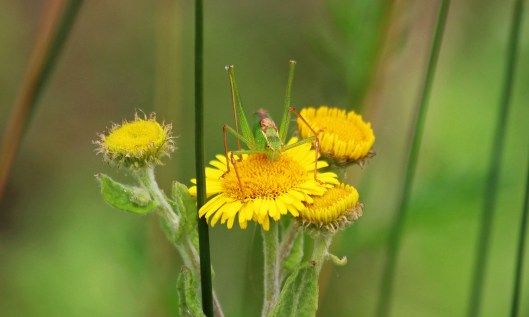
200823 speckled bush-cricket

As well as that Speckled bush-cricket, I’ve found 9 species of butterfly and 1 moth nectaring on Fleabane flowers.

200823 b brimstone
200823 b brown argus
200823 b common blue
200823 b gatekeeper
200823 b painted lady
200823 b meadow brown
200823 b pyrausta purpuralis
200823 b small copper
200823 b small tortoiseshell
200823 b small white

And then there are the hoverflies and assorted other flies, bees and bumbles. It’s more like a magnet than a repellent.

200823 syrphus sp
200823 eristalis pertinax
200823 eristalis horticola
200823 helophilus pendulus
200823 Chrysotoxum bicinctum
200823 fly sp
200823 picture-winged fly
200823 honey bee
200823 Sphaerophoria sp
200823 nomada sp
200823 buff-tailed bumble
Like Loading...

229/366 More peas please

16 Sunday Aug 2020

Posted by sconzani in nature, wildflowers

≈ Leave a comment

Tags

Black medick, British wildflowers, Common restharrow, Cosmeston Lakes Country Park, Ervilla hirsuta, Grangemoor Park, Hairy tare, Medicago lupulina, Ononis repens, Pea plant family

You’ll recall that a couple of weeks ago we had some members of the Pea family (A Pod of Peas, 26 July) – well, here are another three members of that extensive kin group.

Common restharrow (Ononis repens)
The name ‘restharrow’ comes from the fact that this wildflower’s thick long roots were ‘tough enough to stop a horse-drawn harrow in its tracks’ (Flora Britannica) and that esteemed publication also notes that those roots could be chewed, with a taste like liquorice. According to the Plantlife website, the plant’s shoots also had culinary uses: they could be boiled as a vegetable or eaten in salads.

200809 common restharrow (2)
200809 common restharrow (1)

200809 common restharrow (3)

Hairy tare (Ervilla hirsuta)
There’s an abundance of this little plant curling and winding itself through the rough grassland and wildflower fields at Grangemoor Park. As its flowers are rather small, it’s easy to miss how lovely they are but they’re definitely worth a closer look, anytime from May to August.

200816 hairy tare (3)200816 hairy tare (4)

Black medick (Medicago lupulina)
This is a plant I often see along the edges of roads but it’s also particularly numerous in one of the wildflower fields at Cosmeston Lakes Country Park. The First Nature website explains its scientific name thus:
‘The genus name Medicago refers to the region of Iran known as Media, where this plant was thought to have originated. The specific epithet lupulina means “wolf-like” – a reference to the flowers of the hop Humulus lupulus, which its inflorescence resembles.’

200816 black meddick (2)
200816 black meddick (4)

200816 black meddick (1)


Like Loading...

224/366 Burdock beasties

11 Tuesday Aug 2020

Posted by sconzani in insects, nature, plants, wildflowers

≈ 1 Comment

Tags

Arctium minus, Banded burdock fly, British insects, Common Green Shieldbug, Lesser burdock, Palomena prasina, Terellia tussilaginis

Lesser burdock (Arctium minus) seems to be having a good year as I’ve been finding lots of vigorous, flowering plants during my local walks, and they’re home to some interesting mini-beasties. One I always look for is the Banded burdock fly (Terellia tussilaginis), and it also seems to be thriving locally.

200811 lesser burdock (4)200811 lesser burdock (5)200811 lesser burdock (6)

And, on one particular clump of burdock, I found a bounty of Common green shieldbugs (Palomena prasina), as I’ve done before (see my previous post Keeping it in the family, from September 2017). Once again, these were a mix of juvenile stages, 3rd and 4th instars, I think.

200811 lesser burdock (1)
200811 lesser burdock (2)
200811 lesser burdock (3)

Of course, there are lots of other mini-beasties that also find Burdock flower nectar delicious – these two bees are just a couple of examples. What beasties have you seen on Burdock?

200811 lesser burdock (7)
200811 lesser burdock (8)
Like Loading...

222/366 Damp feet

09 Sunday Aug 2020

Posted by sconzani in flowers, nature, plants, wildflowers

≈ 4 Comments

Tags

British wildflowers, Common restharrow, Marsh woundwort, Purple loosestrife, wildflower

It’s Sunday – I think we need some wildflowers, and this week we have three plants that are all partial to living with damp feet, all with flowers in the pink-purple colour range.

200809 marsh woundwort (1)
200809 marsh woundwort (2)

200809 marsh woundwort (3)

Marsh woundwort (Stachys palustris)
As its common name implies, this wildflower thrives in locations where its roots can keep damp: near lakes and rivers, ponds and bogs. Its scientific name also refers to this: palustris means ‘of swamps’, while Stachys means ‘spike of flowers’, which is exactly what this lovely wildflower exhibits. And, of course, all the ‘woundworts’ were used extensively by herbalists, in this case, as an ointment to aid aching joints and as a dressing to help heal cuts and other wounds.

200809 purple loosestrife

Purple loosestrife (Lythrum salicaria)
Here’s another widespread plant of marshes and riversides, and that’s exactly where I found this example, alongside the River Ely in Cardiff. Unfortunately, I couldn’t get any closer for better photos of the individual flowers. In Flora Britannica, Richard Mabey gives this explanation for this plant’s intriguing name: ‘“Loose-strife” is a literal translation of the Greek name for the plants, which in classical times was believed to be so powerful “that if placed on the yoke of inharmonious oxen, [it] will restrain their quarrelling”.’

200809 mint (1)
200809 mint (2)
200809 mint (3)

200809 mint (4)

Water mint (Mentha aquatica)
And here’s another plant that prefers living with damp, not necessarily wet feet. Once again, this wildflower’s name tells the story: ‘Water’ and ‘aquatica’; and you only have to rub the leaves to release the delicious minty aroma, which is so refreshing. Insects love it too, as you can see from the hoverfly, butterfly and bee in the photos above.

Like Loading...

218/366 Vervain

05 Wednesday Aug 2020

Posted by sconzani in nature, plants, wildflowers

≈ Leave a comment

Tags

British wildflowers, Grangemoor Park, The Chief Herb, The Herb, Verbena officinalis, Vervain, wildflower

I’ve been trying, very slowly, to learn the names of more wildflowers so, when I couldn’t put a name to this plant at Grangemoor Park a couple of days ago, I made sure to take lots of photos of it. And today I found out this straggly, nondescript wildflower is not just any old plant, this is ‘The Herb’!

200805 vervain (1)

Vervain (Verbena officinalis) was so valued by herbalists in Anglo Saxon times that it was considered ‘The Chief Herb’, and was ‘a venerated plant, valued not just as a panacea (it was trumpeted as a cure for the plague in the Middle Ages) but as a magical charm, which could both protect against witches and demons and conjure up devilry of its own’ (Flora Britannica). 

200805 vervain (3)
200805 vervain (2)
Like Loading...

216/366 Red bartsia

03 Monday Aug 2020

Posted by sconzani in nature, plants, wildflowers

≈ 2 Comments

Tags

British wildflowers, Cosmeston Lakes Country Park, Odontites vernus, Red bartsia, wildflowers

Red bartsia (Odontites vernus) is an unobtrusive wildflower that I have tended to overlook until now but it’s very common in Cosmeston Lakes Country Park, one of my local haunts, so I thought I should take a closer look at it.

200803 red bartsia (1)

The Wildlife Trust website says Red bartsia can be found growing on low-fertility soils – places like waste ground, brownfield sites, along the edges of roads and railway tracks, and it survives in these more barren places because it’s semi-parasitic on the plants around it, tapping in to their root systems to gather extra nutrients.

200803 red bartsia (2)
200803 red bartsia (3)

Its scientific name is interesting: Odontites comes from Ancient Greek ὀδούς meaning tooth and apparently refers to the fact that Pliny the Elder used this plant to treat toothache; vernus refers to springtime, presumably when this plant comes to life for the year. It flowers for several months over the summer, providing a good nectar source for many species of bee and wasp.

200803 red bartsia (4)

Like Loading...

208/366 A pod of peas

26 Sunday Jul 2020

Posted by sconzani in nature, wildflowers

≈ 1 Comment

Tags

British wildflowers, Broad-leaved everlasting pea, Common bird's foot trefoil, Goat's-rue, Grass vetchling, Leguminosae, Meadow vetchling, Melilotus species, Pea family

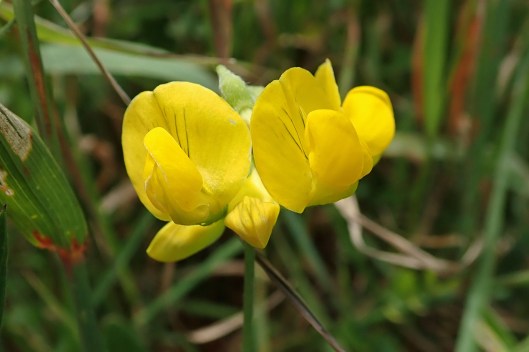
The Pea family (properly known as the Leguminosae) is a large one, and its members are easily recognised by their flower shape. I see them a lot during my meanders – Red and White clovers, the Bird’s-foot trefoil and Melilotus species, Tufted and Bush vetch are all common hereabouts.

200726 1 birds-foot trefoil
200726 1 melilotus sp
200726 2 tufted vetch
200726 2 bush vetch

Those that follow are the peas I see less often, starting with Meadow vetchling (Lathyrus pratensis), which is not an uncommon plant in my area – it’s just that I’ve seen it more often since lockdown started, as my walks have taken me along the less-used footpaths across local farm fields and meadows.

200726 3 meadow vetchling

Grass vetchling (Lathyrus nissolia) is less common – or, perhaps, less easily found, as it’s a delicate plant, easily lost amongst the long grass in which it grows, unless you manage to spot its one or two bright pink flowers on fine, tall stems.

200726 4 grass vetchling (2)
200726 4 grass vetchling (1)

Broad-leaved everlasting pea (Lathyrus latifolius): I’ve found this lovely, sprawling pea in two local parks, both former rubbish dumps. It seems an aggressive climber and rambler, adorning bramble and low scrub with its attractive blooms. It is a favourite plant of the Long-tailed blue butterfly so I know where to look if this pretty migrant butterfly ever decides to fly as far as south Wales.

200726 5 broad-leaved everlasting pea

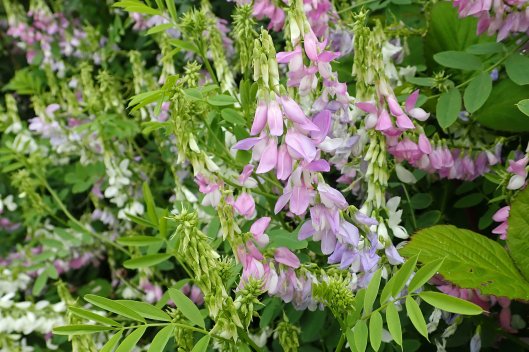
Goat’s rue (Galega officinalis) is new to me, and I’ve only seen it in one location, near a large local hospital, perhaps blown in by the constant comings and goings of traffic. My Flora Britannica says it ‘was introduced … in the sixteenth century as a vegetable and medicinal herb, and later grown for ornament’. It certainly has very beautiful flowers.

200726 6 goats-rue

Like Loading...

207/366 At home in the bindweed

25 Saturday Jul 2020

Posted by sconzani in flowers, molluscs, nature, wildflowers

≈ Leave a comment

Tags

Bindweed flower, slugs, slugs in bindweed flowers

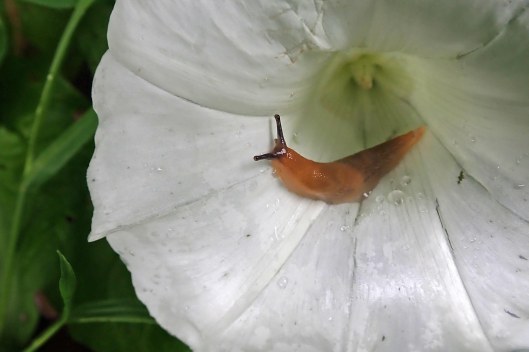
I had to chuckle during this morning’s brief stomp between bouts of heavy rain. The local slugs, which I thought would be at home in such conditions, sliding on the grass, slithering over leaves, were more literally ‘at home’, sheltering in the deep flower cups of bindweed.

200725 slugs in bindweed (1)200725 slugs in bindweed (2)200725 slugs in bindweed (3)

Like Loading...

204/366 Musk thistle

22 Wednesday Jul 2020

Posted by sconzani in nature, plants, wildflowers

≈ 4 Comments

Tags

British wildflowers, Carduus nutans, Musk thistle, Nodding thistle, thistle

This gorgeous thistle was a new plant for me when I discovered it in a local farm field a couple of days ago. It’s a Musk thistle (Carduus nutans), also known as Nodding thistle, and it’s precisely the nodding habit of its growth that alerted me to something new.

200722 musk thistle (1)

Its flowers, though a glorious and vibrant pinky purple, droop downwards, nodding on long spineless stems and, in fact, compared to the upright habit of other thistles I see, this one’s growth habit overall is very droopy. It’s a bit of a sloucher, though, as its name suggests, those flowers have a musky smell that bees find particularly attractive, and several butterflies seemed to like it too.

200722 musk thistle (2)

The Plantlife website provides some interesting facts about the Musk thistle: apparently ‘its fleshy stem is edible and said to be delicious after peeling and boiling’ and ‘medicinally, the leaves have been used as a tonic to stimulate liver function, whereas the flowers have been used to reduce fevers and purify the blood.’

200722 musk thistle (3)

Like Loading...

201/366 Small and white

19 Sunday Jul 2020

Posted by sconzani in nature, wildflowers

≈ 2 Comments

Tags

British wildflowers, Common centaury, Common mouse-ear, Eyebright, Fairy flax, Hedge bedstraw, white-flowered wildflowers

Many of the local wildflowers currently in bloom have small, white flowers. These are some of them …

200719 fairy flax

Fairy flax (Linum catharticum): this is the smallest, a tiny delicate plant that appears to shake and quiver even in the lightest breeze. It is also known as Purging flax as, in past times, herbalists prescribed it as a laxative.

200719 hedge bedstraw (1)
200719 hedge bedstraw (2)

Hedge bedstraw (Galium mollugo): not the bedstraw that was used to sweeten the smell of straw mattresses (which is the yellow-flowered Lady’s bedstraw), but its close cousin, which can be found scrambling along hedgerows, particularly on calcareous soils.

200719 common eyebright (1)
200719 common eyebright (2)

Eyebright (Euphrasia sp.): I didn’t know until I checked this plant on the Plantlife website that the various species of Eyebright are semi-parasitic, stealing the nutrients of other plants, like grasses.

200719 common mouse ear

Common mouse-ear (Cerastium fontanum): A type of chickweed, which many gardeners will know as a persistent ‘weed’, this little plant gets its mouse-ear name from its hairy leaves that grow in pairs on either side of the plant’s stem.

200719 common centaury (1)

Common centaury (Centaurium erythraea) is usually pink flowered (see the variations below) but many of the plants I see locally, like those above, have white flowers. The Plantlife website gives the fascinating information that centaury is ‘named after the centaur Chiron, who, according to legend, discovered its healing power and used it to cure himself from the effects of a poisoned arrow.’

200719 common centaury (2)
200719 common centaury (3)
Like Loading...
← Older posts
Newer posts →

About me

sconzani

sconzani

I'm a writer and photographer; researcher and blogger; birder and nature lover; countryside rambler and city strider; volunteer and biodiversity recorder.

View Full Profile →

Follow earthstar on WordPress.com

Enter your email address to follow this blog and receive notifications of new posts by email.

Recent blog posts

  • Nesting material April 28, 2026
  • Lifer: Box bug April 27, 2026
  • Peak Wild garlic April 26, 2026
  • First damsels of 2026 April 25, 2026
  • NFY: Green-veined white April 24, 2026

From the archives

COPYRIGHT

Unless otherwise acknowledged, the text and photographs on this blog are my own and are subject to international copyright. Nothing may be downloaded or copied without my permission.

Fellow Earth Stars!

  • Unknown's avatar
  • Unknown's avatar
  • Unknown's avatar
  • Unknown's avatar
  • Unknown's avatar
  • Unknown's avatar
  • Unknown's avatar
  • Unknown's avatar
  • Unknown's avatar
  • Unknown's avatar
  • Unknown's avatar
  • Unknown's avatar
  • Unknown's avatar
  • Unknown's avatar
  • Unknown's avatar
  • Unknown's avatar
  • Unknown's avatar
  • Unknown's avatar
  • Unknown's avatar
  • Unknown's avatar
  • Unknown's avatar
  • Unknown's avatar
  • Unknown's avatar
  • Unknown's avatar
  • Unknown's avatar
  • Unknown's avatar
  • Unknown's avatar
  • Unknown's avatar
  • Unknown's avatar
  • Unknown's avatar
  • Unknown's avatar
  • Unknown's avatar
  • Unknown's avatar
  • Unknown's avatar
  • Unknown's avatar
  • Unknown's avatar
  • Unknown's avatar
  • Unknown's avatar
  • Unknown's avatar
  • Unknown's avatar
  • Unknown's avatar
  • Unknown's avatar
  • Unknown's avatar
  • Unknown's avatar
  • Unknown's avatar
  • Unknown's avatar
  • Unknown's avatar
  • Unknown's avatar
  • Unknown's avatar
  • Unknown's avatar

Blog at WordPress.com.

Privacy & Cookies: This site uses cookies. By continuing to use this website, you agree to their use.
To find out more, including how to control cookies, see here: Cookie Policy
  • Subscribe Subscribed
    • earthstar
    • Join 642 other subscribers
    • Already have a WordPress.com account? Log in now.
    • earthstar
    • Subscribe Subscribed
    • Sign up
    • Log in
    • Report this content
    • View site in Reader
    • Manage subscriptions
    • Collapse this bar

Loading Comments...

You must be logged in to post a comment.

    %d