• ABOUT
  • BIRDING 2018
  • Birding 2019
  • BLOG POSTS
  • Butterflies 2018
  • Resources

earthstar

~ a celebration of nature

earthstar

Category Archives: wildflowers

Welsh biodiversity: Roath Wild Gardens

11 Saturday Jun 2016

Posted by sconzani in birds, insects, nature, wildflowers

≈ Leave a comment

Tags

biodiversity, Roath Park, Roath Park Wild Gardens, Wales Biodiversity Week

You’ve heard of the baker’s dozen? Well, today let me introduce you to the Welsh week. In Wales, it seems, a week actually consists of nine days (!) so here is my selection for day eight of Wales Biodiversity Week.

I am lucky to live opposite Roath Park, here in Cardiff, but it’s a large and varied place, with recreation grounds and a botanical garden, as well as a lake, so I’ve chosen just one smallish area for my biodiversity challenge, the Wild Gardens at the northern end of the lake.

160611 roath wild (2)160611 roath wild (1)

Developed slightly later than the rest of the park, in 1896, the Wild Gardens have seen many changes in their lifetime. In the early days there was a summer house in the centre and during 1910-11 three ponds for trout-rearing were constructed. Nowadays the Gardens live up to their ‘wild’ name, with a network of dirt footpaths winding back and forth amongst a canopy of mature trees with shrubby growth beneath. A few weeks ago this place was awash with wild garlic – a most gIorious, if smelly spectacle, and now it’s lush with blackberry bushes and ferns, grasses and wildflowers. I love its wildness and so does the wildlife, as you can see from these photos, all taken on yesterday’s wander.

160611 roath wild (3)
160611 roath wild (4)
160611 roath wild (5)
160611 roath wild (6)
160611 roath wild (7)
160611 roath wild (8)
160611 roath wild (9)
160611 roath wild (10)
160611 roath wild (11)
160611 roath wild (12)
160611 roath wild (13)
160611 roath wild (14)
Like Loading...

Welsh biodiversity: Coryton roundabout

10 Friday Jun 2016

Posted by sconzani in insects, nature, wildflowers

≈ 8 Comments

Tags

biodiversity, Coryton roundabout, native orchids, Wales Biodiversity Week

160610 coryton roundabout (1)

You might think I’ve gone a little bonkers with today’s choice of site for day seven of Wales Biodiversity Week, but you’d be wrong. Officially known as Juncton 32, the Coryton roundabout, where the M4 motorway and the A470 spin around together, is the large roundabout in Wales and one of the largest in Britain. That means it contains large areas of green space within its boundaries and, as the Cardiff Naturalists Society can verify, it is a very rich habitat for all manner of plants and insects.

160610 coryton roundabout (2)

Yesterday was my first visit to this place. If you can ignore the constant traffic noise and the buzz from the large power pylons, it is a lovely patch for a wander, with parcels of mature trees and wedges of flower-filled meadows, which have the added bonus of an abundance of native orchids. Several species can be found here apparently, the Common spotted and Bee orchids, Twayblade and Broad-leaved helloborines, as well as the Pyramidal orchid. I also found quite a few critters enjoying their efflorescent surroundings. It was a most unexpectedly biodiverse location!

160610 coryton roundabout (3)
160610 coryton roundabout (4)
160610 coryton roundabout (5)
160610 coryton roundabout (6)
160610 coryton roundabout (7)
160610 coryton roundabout (8)
160610 coryton roundabout (9)
160610 coryton roundabout (10)
160610 coryton roundabout (11)
160610 coryton roundabout (12)
160610 coryton roundabout (13)
160610 coryton roundabout (14)


Like Loading...

Welsh biodiversity: Howardian NR

06 Monday Jun 2016

Posted by sconzani in nature, wildflowers

≈ 7 Comments

Tags

30 Days Wild, biodiversity, Howardian Nature Reserve, Wales Biodiversity Week

Another day, more biodiversity! On day three of Wales Biodiversity Week I explored another of my local nature reserves, Howardian, a 30-odd-acre triangle of woods and meadows, at the intersection of two major Cardiff roads, which was once a domestic rubbish tip. Oh how times have changed for the better!

160606 howardian (2)

After more than 40 years of tireless labour, firstly by the pupils of the Howardian High School Natural History Society and now by the Friends of Howardian LNR (where would the environment be without these Friends groups!), the reserve is a treasure trove of biodiversity. You only need to look at the website galleries and the impressive species’ lists to get an idea of the richness of life in this reserve: field voles and dormice (!); slow worms and palmate newts; bees, butterflies and damselflies; chiffchaffs and whitethroats; moths and hoverflies; fungi, lichen and mosses; and, during the months of June and July (now!), a breathtaking display of native orchids.

160606 howardian (1)

Howardian is a superb testament to how a former urban wasteland can, with time and a ton of hard work, be revitalised into a shining example of a biodiverse environment.

160606 howardian (3)
160606 howardian (4)
160606 howardian (5)
160606 howardian (6)
160606 howardian (7)
160606 howardian (8)
160606 howardian (9)
160606 howardian (10)
160606 howardian (11)
160606 howardian (12)
160606 howardian (13)
160606 howardian (14)
Like Loading...

Floral Friday: The yellowing

03 Friday Jun 2016

Posted by sconzani in flowers, nature, wildflowers

≈ Leave a comment

Tags

spring flowers, summer flowers, yellow flowers, yellow wildflowers

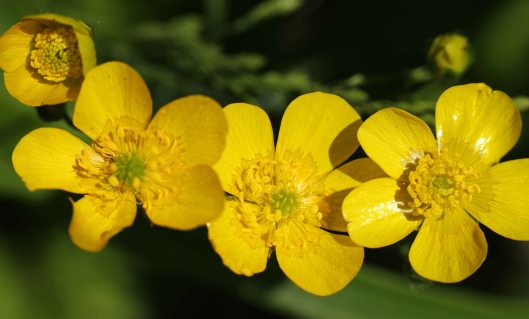
Yellow is the colour of happiness, optimism, enlightenment, creativity, hope, cheerfulness, sunshine … and the quintessential colour of Spring.

160603 yellow wildflowers (1)

Yellow is also the most luminous in the colour spectrum – the colour that most easily catches the human eye but, more importantly, the eyes of bees, so it’s no surprise that yellow is the most common flower colour. Here in Wales, after experiencing only my second British winter in thirty-odd years, I have been delighted by the coming of Spring, and both charmed and uplifted by the yellow wildflowers everywhere. First came the Dandelion and Daffodil, the Lesser celandine and the paler shade of the Primrose and, in boggy places, the Marsh marigold.

Now, as spring becomes summer, the succession of yellow continues with fields and meadows carpeted in yellow. We have the many varieties of Buttercup, vibrant Bird’s foot trefoil and Yellow archangel, the Dandelion look-alike Cat’s ear and Nipplewort, and in boggy places, Yellow flag iris. It is truly glorious.

160603 yellow wildflowers (10)
160603 yellow wildflowers (5)
160603 yellow wildflowers (12)
160603 yellow wildflowers (11)
160603 yellow wildflowers (3)
160603 yellow wildflowers (6)
160603 yellow wildflowers (8)
160603 yellow wildflowers (7)
160603 yellow wildflowers (2)
160603 yellow wildflowers (4)
160603 yellow wildflowers (9)
Like Loading...

Long live Biological Diversity!

21 Saturday May 2016

Posted by sconzani in flowers, fungi, insects, nature, plants, wildflowers

≈ 5 Comments

Tags

biological diversity, biological recording, biological recording centre, International Bay for Biological Diversity

Tomorrow it will be 24 years since the Convention on Biological Diversity was adopted by the United Nations. To commemorate that momentous day back in 1992, 22 May is now celebrated as the International Day for Biological Diversity. Around the world, events of various kinds – from seminars, exhibitions and leaflets to more hands-on programmes of tree-planting – are organised to promote awareness of the importance of biodiversity, to spread the word that a high variety of plant and animal life is crucial in all habitats.

160521 biodiversity (10)

For my personal celebration, I visited a local nature reserve to see what species of plants, animals, insects, molluscs, etc I could find. And what a treasure trove there was waiting to be discovered! I’ve included some photos here to show you how diverse the area is but I haven’t yet identified everything I saw. I am slowly working my way through my 400 photos. And, as it’s extremely important to record what can be found around us, as a responsible Citizen Scientist, I will also be entering my records into the database of the local biological records centre.

So, here’s a challenge for you. Head out tomorrow, 22 May, and see what you can find in your local park, nature reserve, or even your own garden … and don’t forget to record what you see.

160521 biodiversity (1)
160521 biodiversity (2)
160521 biodiversity (9)
160521 biodiversity (3)
160521 biodiversity (4)
160521 biodiversity (5)
160521 biodiversity (11)
160521 biodiversity (6)
160521 biodiversity (12)
160521 biodiversity (7)
160521 biodiversity (13)
160521 biodiversity (8)
160521 biodiversity (14)
Like Loading...

Wildflowers at the cemetery

13 Friday May 2016

Posted by sconzani in nature, spring, wildflowers

≈ 6 Comments

Tags

#FloralFriday, Cathays Cemetery, spring flowers

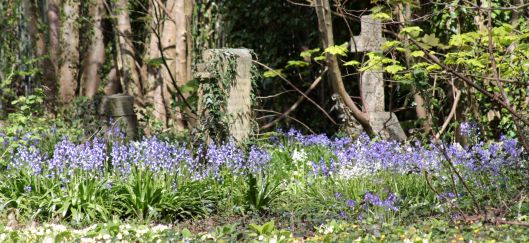
I am fortunate to have a magnificent location for wildflowers just a short walk from where I live. Cathays Cemetery’s 110-acre grounds have remained largely undisturbed since the cemetery closed to new burials about 35 years ago so it has the perfect habitat for wild plants to thrive… as long as the mowers and strimmers aren’t used too often.

160513 cemetery

There are native Bluebells (Hyacinthoides non-scripta) though many of the Spanish variety have also been planted here. The Bulbous buttercups (Ranunculus bulbosus) are always cheerful, as is the Cuckooflower or Lady’s smock (Cardamine pratensis). They may be common but I’m a big fan of the Daisy (Bellis perennis) and the Dandelion in its many forms (Taraxacum officinale agg.). Dog violets (Viola riviniana) and Germander speedwell (Veronica chamaedrys) give pretty bursts of blue and lilac, and Herb Robert (Geranium robertianum) add its special touch of pink. Though now past their best, Lesser celandine (Ficaria verna) and Primrose (Primula vulgaris) are both still flowering, while the Red clover (Trifolium pratense) is just beginning to bloom. Ribwort plantain (Plantago lanceolata) is abundant, as is Wild strawberry (Fragaria vesca). And the last flower I couldn’t identify, so if anyone can help with that, I’d be grateful.

160513 Bluebell Hyacinthoides non-scripta
160513 bulbous buttercup Ranunculus bulbosus
160513 Cardamine pratensis Cuckooflower or lady's smock
160513 daisy bellis perennis
160513 dandelion Taraxacum officinale agg
160513 Dog violet Viola riviniana
160513 germander speedwell Veronica chamaedrys
160513 lesser celandine Ficaria verna
160513 primrose primula vulgaris
160513 red clover Trifolium pratense
160513 ribwort plantain Plantago lanceolata
160513 Wild strawberry Fragaria vesca
160513 zz unknown
Like Loading...

Foreign-looking fritillaries

19 Tuesday Apr 2016

Posted by sconzani in nature, wildflowers

≈ 12 Comments

Tags

Fritillaria meleagris, fritillary, Snake’s head fritillary, Vita Sackville West

And then I came to a field where the springing grass
Was dulled by the hanging cups of fritillaries,
Sullen and foreign-looking, the snaky flower,
Scarfed in dull purple, like Egyptian girls
~ from Vita Sackville West, The Land, 1926

Vita was writing about the Snake’s head fritillary (Fritillaria meleagris), also known by a multitude of other common names, including chequered daffodil, chess flower, frog-cup, guinea-hen flower, Lazarus bell, chequered lily, drooping tulip, and leper lily (because its shape resembles the bell once carried by lepers).

fritillary (5)

Perhaps that association with lepers is why the fritillary is considered by some to be a little sinister. Sackville West certainly wrote negatively of it in The Land and, according to the Poison Garden website, she declared the fritillary to be ‘a sinister little flower, in the mournful colour of decay’. I certainly can’t agree with Vita’s negative opinion of this most unusual of flowers, as I find the combination of unusual chequered pattern, delicate elegance and soft magenta colouring simply stunning.

fritillary (8)
fritillary (3)
Like Loading...

Bute Park wildflowers

17 Sunday Apr 2016

Posted by sconzani in nature, spring, wildflowers

≈ 2 Comments

Tags

Bluebell, Bute Park, Common dog-violet, Daisy, dandelion, Germander speedwell, Golden saxifrage, gorse, Greater stitchwort, Green alkanet, Herb Robert, Lesser Celandine, primrose, Red campion, Sweet violet, White deadnettle, Wild garlic, Wild strawberry, Wood anemone

This weekend I could have paid £12 to see what I’m sure would have been gorgeous flowers and inspirational displays at the Royal Horticultural Society’s Flower Show being held here in Cardiff’s Bute Park but, as I don’t have that kind of cash to splash at the moment, I decided to see what flowers I could find in Bute Park for nothing. With 18 different types of wildflowers currently in bloom I certainly wasn’t disappointed. Enjoy!

160417 bluebell
160417 daisy bellis perennis
160417 dandelion
160417 dead nettle white
160417 geranium robertianum herb robert
160417 germander speedwell
160417 gorse
160417 greater stitchwort Stellaria holostea
160417 Green Alkanet Pentaglottis sempervirens
160417 lesser celandine
160417 opposite leaved golden saxifrage
160417 primrose primula vulgaris
160417 red campion
160417 violet blue
160417 violet white
160417 wild garlic
160417 wild strawberry
160417 wood anemone

There were: Bluebell (mostly Spanish but I found a few natives) (Hyacinthoides non-scripta); Daisy (Bellis perennis); Dandelion (Taraxacum officinale); White deadnettle (Lamium album); Herb Robert (Geranium robertianum); Germander speedwell (Veronica Chamaedrys); Gorse (Ulex europaeus); Greater stitchwort (Stellaria holostea); Green alkanet (Pentaglottis sempervirens); Lesser celandine (Ranunculus ficaria); Opposite-leaved golden saxifrage (Chrysosplenium oppositifolium); Primrose (Primula vulgaris); Red campion (Silene dioica); Common dog-violet (Viola riviniana) and Sweet violet (Viola odorata); Wild garlic (Allium ursinum); Wild strawberry (Fragaria vesca); and Wood anemone (Anemone nemorosa).

Like Loading...

The stars that fell to earth

29 Tuesday Mar 2016

Posted by sconzani in flowers, nature, spring, wildflowers

≈ 11 Comments

Tags

Anemone nemorosa, Cathays Cemetery, spring flowers, Wood anemone

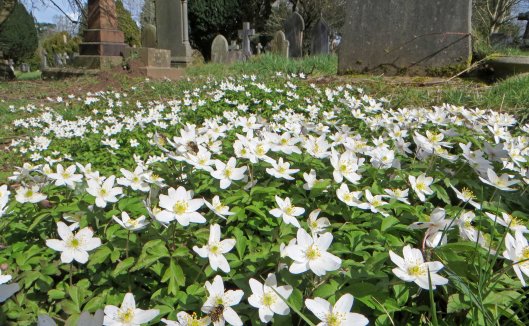
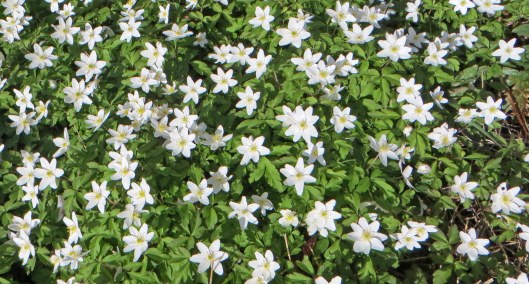
I saw my first wood anemones for this spring last weekend, dotted about the Nant Fawr woodland here in Cardiff, but it wasn’t until yesterday that I saw these wonderful lush displays in Cathays Cemetery. The wood anemone (Anemone nemorosa) is often to be found in the older graveyards throughout the British Isles, as well as in parks, gardens and ancient woodland. Its gorgeous white flowers, usually blooming from March through to May, have been likened by some to a late fall of snow blanketing the ground but, to my somewhat vivid imagination, it seems rather that the stars of the Milky Way have fallen to earth.

160329 wood anemone (1)

The wonderfully informative Plantlife website gives some interesting nuggets of information about this springtime favourite: it symbolises expectation, brevity and forlornness, and, in China, the flower’s pale, somewhat ghostly appearance has earned it the name ‘Flower of Death’. It is also the county flower of Middlesex.

160329 wood anemone (2)
160329 wood anemone (3)
160329 wood anemone (4)

I also discovered yesterday that the flowers of the wood anemone, though poisonous to humans, are favourites of hoverflies – in my ignorance I thought they were bees – and I got photos of 3 different species feasting on their pollen (but I’m saving those for a future blog.)

160329 wood anemone (5)

Like Loading...

Merry marsh marigolds

25 Friday Mar 2016

Posted by sconzani in flowers, nature, wildflowers

≈ 2 Comments

Tags

Caltha palustris, marsh marigold, spring, spring flowers

Yellow is the colour of happiness, optimism, enlightenment, creativity, hope, cheerfulness, and sunshine. Yellow is also the most luminous in the colour spectrum – the colour that most easily catches our eye and the eyes of bees so it’s no surprise that yellow is the most common flower colour, and the quintessential colour of Spring.

marsh marigold

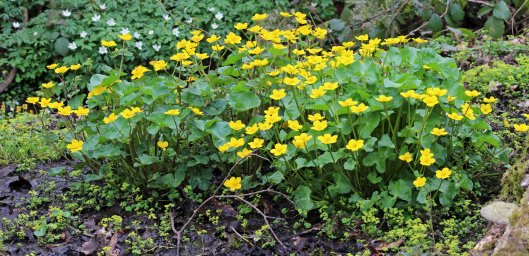
One of the wonderfully vibrant plants whose flowers have been catching my eye over the past couple of weeks is the Marsh marigold (Caltha palustris). As its name implies, this wildflower likes the dampness of marshes, fens, ditches and the wetter areas of my local woodlands. According to Wikipedia, it ‘is probably one of the most ancient native plants, surviving the glaciations and flourishing after the last retreat of the ice in a landscape inundated with glacial meltwaters.’

marsh marigold (1)

The Marsh marigold is commonly known as Kingcup – its Latin name Caltha comes from the Greek word for goblet and its large golden cup-shaped flowers certainly look glorious enough to adorn the table of a king.

marsh marigold (2)

Like Loading...
← Older posts
Newer posts →

About me

sconzani

sconzani

I'm a writer and photographer; researcher and blogger; birder and nature lover; countryside rambler and city strider; volunteer and biodiversity recorder.

View Full Profile →

Follow earthstar on WordPress.com

Enter your email address to follow this blog and receive notifications of new posts by email.

Recent blog posts

  • The day of the Wheatears March 28, 2026
  • Cetti’s warblers March 27, 2026
  • Goose barnacles March 26, 2026
  • Black-tailed godwits fighting March 25, 2026
  • Singing from every tree top March 24, 2026

From the archives

COPYRIGHT

Unless otherwise acknowledged, the text and photographs on this blog are my own and are subject to international copyright. Nothing may be downloaded or copied without my permission.

Fellow Earth Stars!

  • Unknown's avatar
  • Unknown's avatar
  • Unknown's avatar
  • Unknown's avatar
  • Unknown's avatar
  • Unknown's avatar
  • Unknown's avatar
  • Unknown's avatar
  • Unknown's avatar
  • Unknown's avatar
  • Unknown's avatar
  • Unknown's avatar
  • Unknown's avatar
  • Unknown's avatar
  • Unknown's avatar
  • Unknown's avatar
  • Unknown's avatar
  • Unknown's avatar
  • Unknown's avatar
  • Unknown's avatar
  • Unknown's avatar
  • Unknown's avatar
  • Unknown's avatar
  • Unknown's avatar
  • Unknown's avatar
  • Unknown's avatar
  • Unknown's avatar
  • Unknown's avatar
  • Unknown's avatar
  • Unknown's avatar
  • Unknown's avatar
  • Unknown's avatar
  • Unknown's avatar
  • Unknown's avatar
  • Unknown's avatar
  • Unknown's avatar
  • Unknown's avatar
  • Unknown's avatar
  • Unknown's avatar
  • Unknown's avatar
  • Unknown's avatar
  • Unknown's avatar
  • Unknown's avatar
  • Unknown's avatar
  • Unknown's avatar
  • Unknown's avatar
  • Unknown's avatar
  • Unknown's avatar
  • Unknown's avatar
  • Unknown's avatar

Blog at WordPress.com.

Privacy & Cookies: This site uses cookies. By continuing to use this website, you agree to their use.
To find out more, including how to control cookies, see here: Cookie Policy
  • Subscribe Subscribed
    • earthstar
    • Join 642 other subscribers
    • Already have a WordPress.com account? Log in now.
    • earthstar
    • Subscribe Subscribed
    • Sign up
    • Log in
    • Report this content
    • View site in Reader
    • Manage subscriptions
    • Collapse this bar
 

Loading Comments...
 

You must be logged in to post a comment.

    %d