Welcome, Whitethroats!

Tags

, , , , , ,

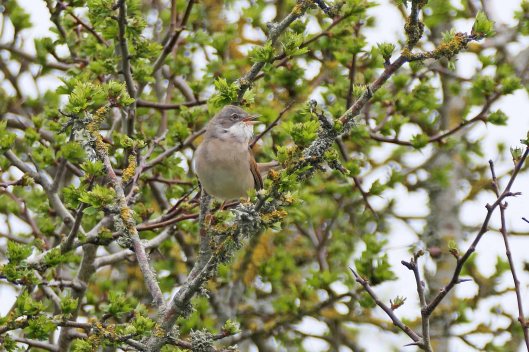
I love this time of year, when our migrating birds wing their way back to our shores for the breeding season. The latest migrant to arrive locally has been the Whitethroat (Common whitethroat, if you prefer) (Sylvia communis). I heard my first four days ago, on the 18th. It showed briefly, on a tree branch, but fairly quickly ducked back down into the scrub below. Then, yesterday, I heard three Whitethroats during my five-mile walk – they will continue to arrive for a few weeks yet, some passing through to other areas, some remaining to breed locally. The handsome little chap in my photo seemed to have found his happy place, a large area of impenetrable (to humans) trees and scrub. He was singing and songflighting, both claiming this location for himself and announcing his presence and many impressive qualities to any passing females. If I’d been a female Whitethroat, I’d certainly have been interested.
230422 whitethroat

Springtails and rust

Tags

, , , , , , ,

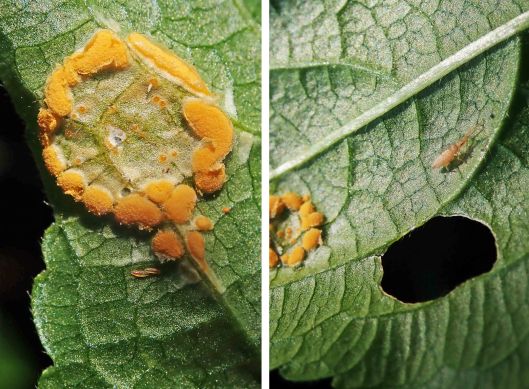
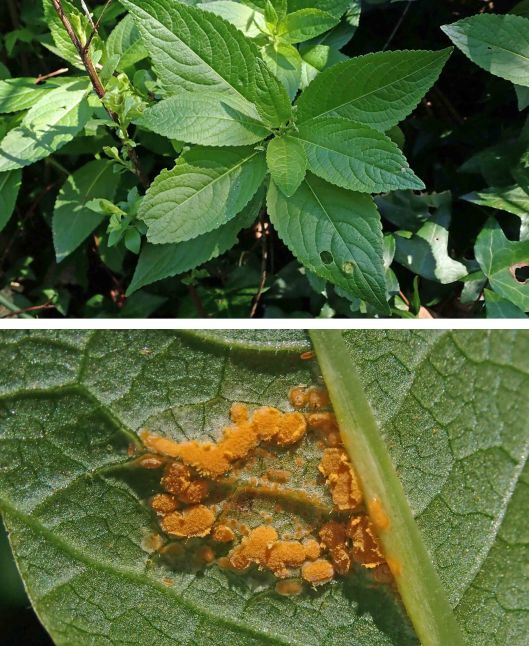
We’ve seen springtails and slime  a couple of times previously on this blog; now here’s the next instalment in the springtails series: springtails and rust fungi. I spotted this rust, Melampsora populnea, on Dog’s mercury (Merculiaris perennis) during yesterday’s walk. From the top of the leaf, all you see is a small area of puckering and some pale spots (near the hole on the leaf in the lower part of the first photograph below). But, on the underside of the leaf, it’s a different story, with the orange blobs typical of a rust fungus.

230421 dogs mercury and rust

At the time, I didn’t notice the tiny creatures munching on the fungus, neither the minuscule orange ones nor the relatively large pale orange ones. I presume the smaller ones are the offspring of the larger, which are definitely springtails, though I don’t know which species of Collembola these are, and my photos aren’t precise enough to identify them more precisely.

230421 rust and springtails

Two Jays

Tags

, , ,

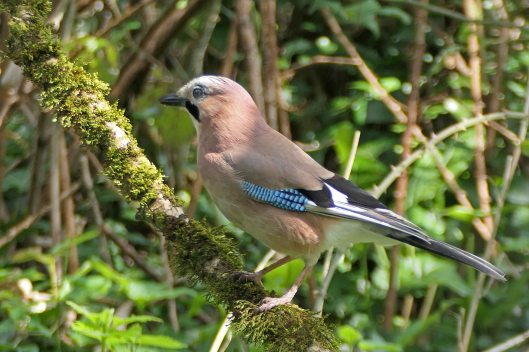
I was just leaving the local country park yesterday when these two Jays flew across my path and in to the trees and scrub behind the boundary fence.

Surprisingly, they weren’t bothered about my presence, continuing to flit about the branches and ferret about in the undergrowth. As they had a somewhat frantic air about them, I suspect they were searching for titbits to feed young ones nearby.

The final countdown

Tags

, , , ,

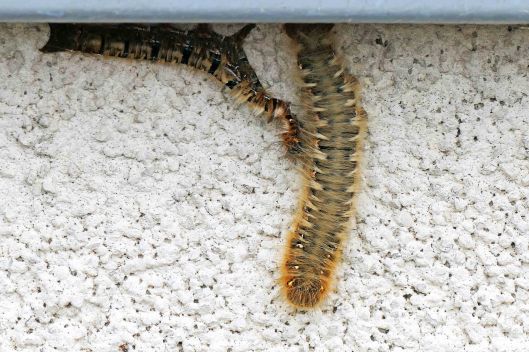
Though I was actually searching for migrating birds, the most exciting thing I found during last Sunday’s six-mile walk was this caterpillar that had just shed its skin. This is the larva of an Oak eggar moth (Lasiocampa quercus), now in the final instar of a one-year life cycle (some Oak eggar larvae have two-year life cycles) and due to pupate in June.

230419 oak eggar

Arctic tern

Tags

, , , , , ,

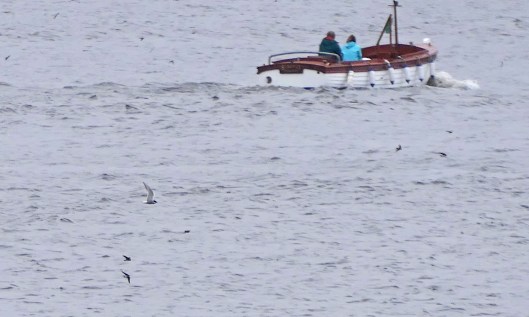
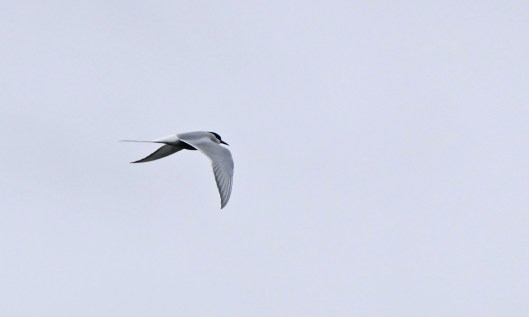
Terns of any description rarely visit Cardiff Bay but, if they’re ever going to, now, on Spring passage, is the time of year for it to happen … and it did, for two days at the end of last week. (Terns do sometimes pop in on Autumn passage as well, depending on the weather.) The Bay has some very keen and knowledgeable resident birders so when one of those, Gareth, put out the word that he’d seen a tern in the Bay, thought it was an Arctic tern but didn’t have his ‘scope with him, other locals quickly headed down with their equipment to check it out. Arctic tern it was! (Common and Arctic terns can be tricky to tell apart, and the term ‘commic’, a combination of their names, is used by birders when uncertain.)

230417 arctic tern (1)

Unfortunately, I couldn’t get there that afternoon so imagine my delight when word came through from Gareth again the next day that the tern was still showing. Though rain threatened and did, in fact, interrupt play a couple of times, I managed to find the tern. Sadly, it wasn’t giving the close views it had the day before and was mostly a small dot on the other side of the water until, when it decided to fly onwards, it flew almost directly over my head. A head-terning moment!

230417 arctic tern (2)

The Boraginaceae

Tags

, , , , , , , ,

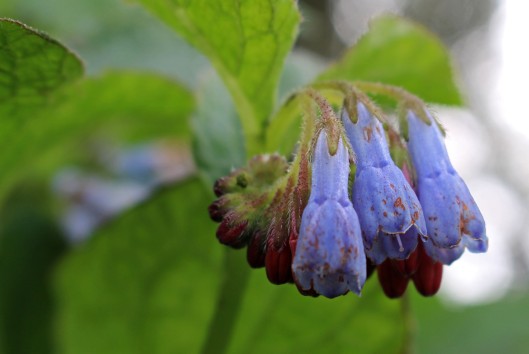
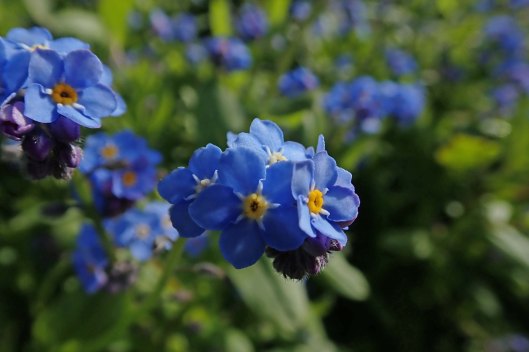
Finding flowering specimens of the Borage family was the target of this week’s Wildflower Hour. This family, the Boraginaceae, includes the various Forget-me-nots (Myosotis species), the Comfries (Symphytum species), Lungwort (Pulmonaria officinalis), Viper’s-bugloss (Echium vulgare), the Gromwells (Lithospermum species), Green alkanet (Pentaglottis sempervirens), Borage (Borago officinalis), of course, and a few other species as well. Unfortunately, our wet Spring, the recent cold spell and storm mean many of these wildflower species are not yet flowering locally but I have managed to find three species.

Comfrey : I’m not sure which of the Symphytum species this is. It’s growing on the edge of a carpark so is probably a wind-blown garden escape or was perhaps seeded via a bird dropping.

Lungwort : Sadly, this isn’t a common plant locally – I only know of two locations where it grows. I wish there was more as the bees love it.

Forget-me-not : Did you know that the yellow ring at the centre of the Forget-me-not flower fades from egg-yolk yellow to white after pollination, which indicates to insects that there’s no more nectar and they should try another flower?

A bathing bumble

Tags

, , , ,

Though it’s often difficult to tell Buff-tailed from White-tailed, I think this is a queen White-tailed bumblebee. I caught her giving herself a good clean, and found her motions both fascinating and relaxing. In this short video, I slowed her movements down to half the actual speed the better to see more clearly what she was doing. What a beautiful creature she is!

Orange mosscap

Tags

, ,

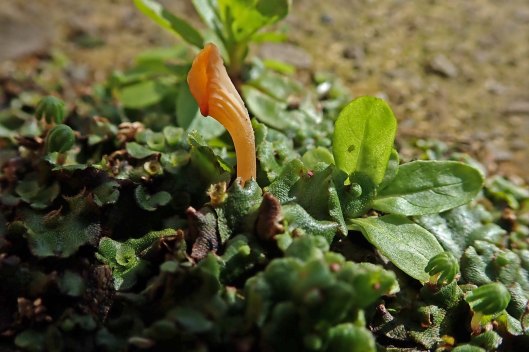
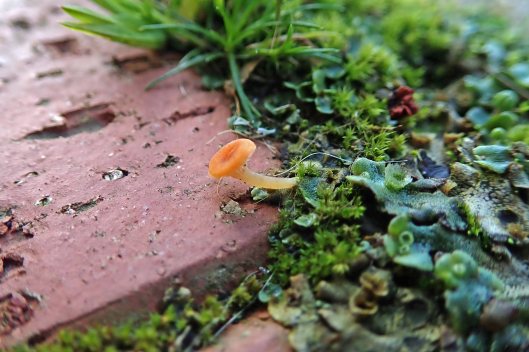
When I first spotted this little orange tube poking out of the liverwort, mosses and a smattering of other tiny plants growing at the edge of a brick footpath, I wasn’t sure what it would develop into.

230414 orange mosscap (1)

Two days later all became clear. The tube had developed in to a lovely little fungus, an Orange mosscap (Rickenella fibula), and once I’d spotted that one, I found two more growing nearby. A delightful and unexpected surprise!

230414 orange mosscap (2)

The first of the whites

Tags

, , , , ,

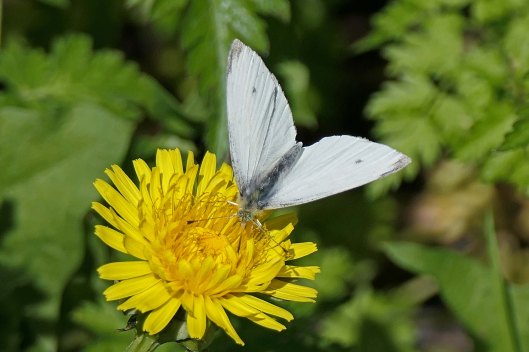
I think I was probably a little later to the Small white party than most locals this year, possibly because they have gardens and/or allotments, which the Small white butterfly (Pieris rapae) very much enjoys (though, I hasten to add that the Small white is not as destructive as many gardeners might think and it is actually the Large white, which lays its eggs in batches rather than singly, whose larvae can quickly strip those precious cabbage leaves to their veins).

230413 small white (1)

This particular Small white, one of my first three seen on 7 April, has the typical markings of a female hatching from her over-wintering pupa in the springtime, with very pale grey markings on her wing tips and a small pale grey dot on her upper wings. The butterflies that hatch in the summer will have much darker, almost black markings. These differences are known as seasonal dimorphism.

230413 small white (2)