Like a torpedo

Tags

, , , ,

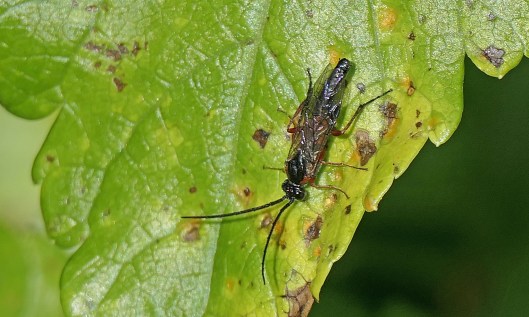
Meet Nematus lucidus, a sawfly that can be recognised both by the reddish-brown markings on its mostly black body and the torpedo shape of its abdomen.

230412 Nematus lucidus (1)

Nematus lucidus can be seen around Blackthorn and Hawthorn, as those are the plants its larvae feed on, and the adults can be seen any time from April to June. It’s thought to be common though there aren’t a lot of records in the national databases, probably because it’s under-recorded.

230412 Nematus lucidus (2)

Tipula vernalis

Tags

, , ,

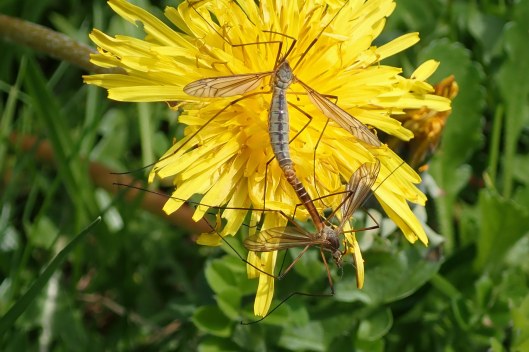
I hadn’t really wondered why these insects are called craneflies but have just been reading that the name comes from their resemblance to a crane – the long-legged bird, not the machine. These particular craneflies, the male above, the female dangling below, are Tipula vernalis, not a species I’d seen before, but my springtime habit of keeping a keen out for insects on Dandelions paid off. Spring is when this cranefly species first appears (hence the vernalis epithet, from the Latin vernus meaning ‘of the spring’), and it continues to float about its woodland and damp grassland home for several months, till June.

230410 Tipula vernalis

Rue-leaved saxifrage

Tags

, ,

Another week, another new plant – I’m on a roll!

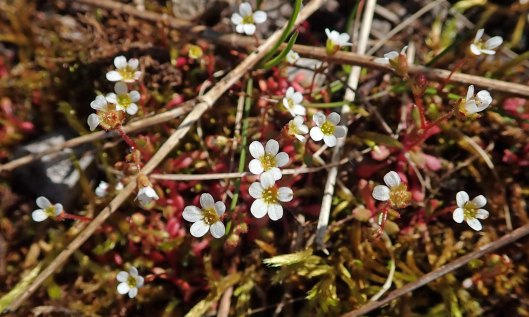
230409 rue-leaved saxifrage (1)

This hairy little annual, with the sweet white flowers, is Rue-leaved saxifrage (Saxifraga tridactylites). Its three-lobed leaves (hence the tridactyl in its name) are quite distinctive and are often tinged with red, as are the plant’s stems.

230409 rue-leaved saxifrage (2)

In Flora Britannica, Richard Mabey writes that this saxifrage is widespread but declining, though the book is now 25 years old so I’m not sure if that is still the case. Certainly, it’s not a plant I’ve come across before in my meanderings and these few were growing on the much-overgrown route of a former railway line so could originally have been carried this way by a train.

230409 rue-leaved saxifrage (3)

Good Friday Grass

Tags

, , , , ,

I wasn’t aware of the alternate common names for Field wood-rush (Luzula campestris) until I saw someone tweet about it earlier this week, saying it was flowering a little early this year.

230407 field wood-rush (1)

Turns out, this little grass, found wherever short grass grows – so in fields and downs, even in the lawn around your house, usually comes in to flower around Easter so has earned the name Good Friday grass.

230407 field wood-rush (2)

Flora Britannica also lists the vernacular name Sweep’s brooms, which apparently comes from its ‘dark, brush-like flowers’. Whatever you want to call it, it’s a pretty little thing.

230407 field wood-rush (3)

The weather effect

Tags

, , ,

The weather effect? By 1 April last year, I’d clocked 63 butterflies of 7 species. This year I’d only recorded 13 butterflies of 4 species. As well as our very wet and cool spring, it seems that last year’s hot dry summer is also having a prolonged effect on butterfly numbers. Butterfly Conservation has warned that

Drought impacts the offspring of the butterflies that are flying during the hot dry weather by causing the plants that caterpillars rely on for food to wither and die. Without sufficient food, many caterpillars will fail to survive, leading to lower numbers of butterflies in the next generation. For some of the UK species that have more than one generation in a year, the resulting major decline in numbers has already been seen. However, for others, the next generation isn’t on the wing until this summer, meaning there could be noticeably fewer butterflies around in 2023.

230406 speckled wood (1)

Imagine my delight then, when I finally spotted not one but my first two Speckled woods of 2023, a week later than last year. Let’s hope this year’s weather is a little more kind to our insect neighbours, though climate change is already affecting and will continue to affect them.


230406 speckled wood (2)

Dark-edged bee-flies

Tags

, , , , ,

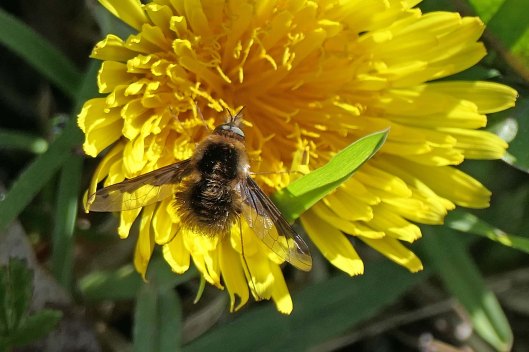
Apparently, today is #NationalDandelionDay. Dandelions are brilliant for so many reasons (I’ve blogged about their value to insects previously – see Delicious Dandelions, April 2022) but what better reason than the food they provide to all the gorgeous little bee-flies that are currently emerging all over the country.

230405 bee-fly male

These are Dark-edged bee-flies (Bombylius major), the only bee-fly species we have locally though there are other species in Britain. The top bundle of fluff is a male and the bottom is a female. The way to tell the sexes apart is to look at their eyes – if there’s a gap between the eyes, it’s a female. The males usually emerge first, with the females following a week to ten days later.

230405 bee-fly female

Spiralling ever upwards

Tags

, , ,

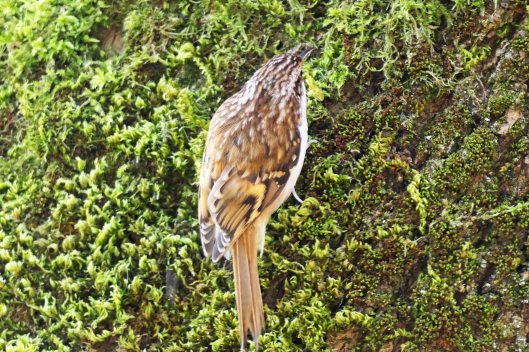
Was there ever a more aptly named bird? The Treecreeper does exactly what its name implies: it uses its long claws to creep expertly up trees, poking and probing into every nook and cranny in its constant search for niblits. If its name could be improved, ever so slightly, it would be with the addition of the word spiral, thus Spiralling treecreeper, as anyone would agree who has ever tried to watch or photograph one of these busy birds and been led a merry dance round and round a tree in an attempt to follow the bird.

230404 treecreeper

Snoozing Brimstone

Tags

, , ,

I’d seen ten Brimstones this year before I spotted this one today – nine of those zoomed past so rapidly I only managed blurry photos; one was still but very distant. So, I was delighted when I noticed this beauty snoozing under a bramble leaf. This may well have been where it had roosted during the night and it was waiting for the sunshine to warm it up before flying off.

230403 brimstone (1)