Hawfinches

Tags

, , , , ,

I’ve been holding off sharing any photos of these magnificent birds, hoping I would see them again and get closer views but I fear that’s not to be as sightings, for all the local birders who’ve spent many an hour standing and staring at likely trees, have been very random. These are Hawfinches (Coccothraustes coccothraustes), Britain’s largest finches. As they are a rare, red-listed species, we have been very fortunate indeed over the last several years to have a few birds visiting Cosmeston Lakes Country Park during the winter months. I had my first sighting this year, of a single bird, on 6 January, and then these three popped up in front of me on 30 January. Fingers crossed I will see them again before they head off to breed.

230211 hawfinch

Galls: Taxomyia taxi

Tags

, , , , , , ,

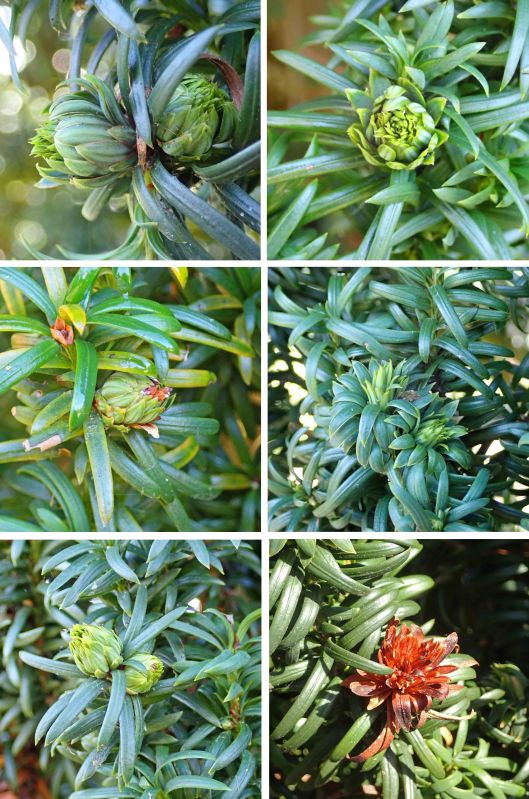
My Field Studies Council Guide to plant galls in Britain explains that the gall midge Taxomyia taxi actually causes two types of gall on Yew trees. The least common, which looks just like a swollen bud, completes its life cycle in one year – I’ve yet to find any of these. But I was very pleased earlier this week to locate several examples of the artichoke gall, in which the same midge completes a two-year life cycle. Eggs are laid in May/June, the larvae crawl in to a leaf bud and stay there, barely growing, until the following summer. At that point, they grow rapidly, over-winter again as larvae, before pupating and hatching the following May. I couldn’t find any explanation for the different life cycles.

230209 taxomyia taxi

Not wanting to kill the creatures inside, I haven’t opened up any of the galls I’ve found but, if you’re curious, as I was, about what’s inside the artichoke, the Plant Parasites of Europe website has some excellent images of the larva, the pupa and the adult fly.

Peter the Redshank

Tags

, , , , , ,

I try not to anthropomorphise wild creatures but this handsome Redshank is one exception, and that is mostly because by naming him Peter, I can more easily remember that he was ringed at Peterstone, just along the coast from Cardiff. I hadn’t seen Peter since last January and was a bit concerned that something had happened to him, so I was relieved and delighted when another local birder spotted him on 30 January, and extremely happy when I finally saw him on 2 February.

230207 peter the redshank

Fly larva: Phaonia species

Tags

, , , ,

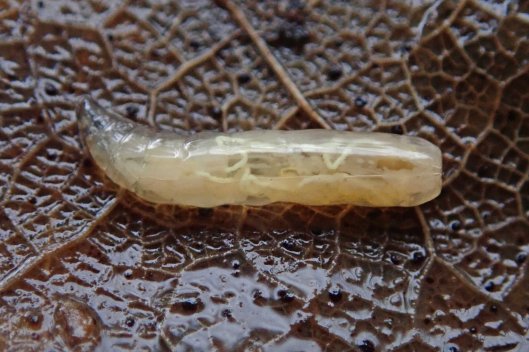
Another day, another fly larva from my riffling through the leaf litter.

230206 phaonia larva (1)

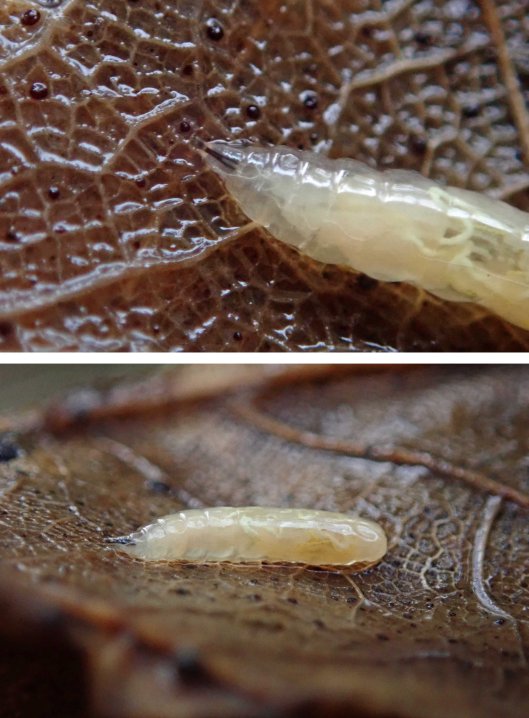
This was last Friday’s find, once again discovered amongst soggy Sycamore leaves. My go-to guy on Twitter tells me this is one of the Phaonia species of flies, and he wrote that this larva is ‘a ferocious predator that can be found throughout the winter in leaf litter. Goes after anything that it can pierce with its mouthparts.’ Beware ferocious fly larvae!

230206 phaonia larva (2)

Spring messenger

Tags

, , , ,

According to Flora Britannica, Spring messenger is a now defunct local name for Lesser celandine, and how wonderfully appropriate that name is. I’ve been watching several areas of Lesser celandine plants, wondering which would put forth the first flower but, in fact, this particular bloom was a complete surprise. I had to cross a narrow country road so a truck could complete its turn in to a tight driveway entrance and, as I was crossing, I spotted this tiny drop of sunshine beaming out from under a bush. Spring magic!

230205 lesser celandine

A Raven family

Tags

, , , , , , ,

Ravens are amongst the earliest of breeders in the bird world but, even knowing that fact, I was very surprised to see such a well-grown youngster with its parents at a local beach on Thursday. I struggled to find breeding information other than on Wikipedia, which gives figures of 18 to 21 days for incubation and 35 to 42 days for fledging. Counting back, that would mean this pair were egg-laying at the beginning of December, which I would not have believed if I hadn’t seen this family with my own eyes.

230204 raven family

First hoverfly

Tags

, , ,

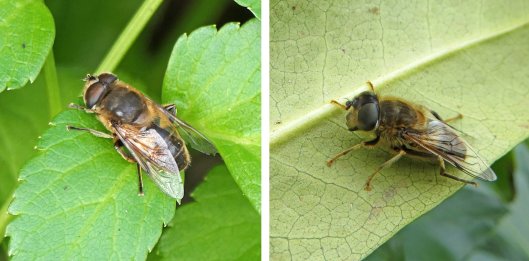
During Monday’s walk along the local section of the Wales Coastal Path, I spotted my first hoverfly of the year, and immediately got the identification wrong. It seems that every winter I forget the basics for these creatures and have to refresh my memory over and over again (old age, or hoverfly blindness?).

230203 eristalis tenax (1)

In my defence, these are two very similar species but it took a friendly follower on Twitter to remind me that, for the hoverfly I found, the ‘feet are darker than E.[Eristalis] pertinax and it has a bendy rear tibia and hairy bands on its eyes so this is Eristalis tenax‘. (The ‘foot’ is the final segment of the leg.) To remind me, and help you, I’ve included comparison photos below – Eristalis tenax, he of the darker front feet, is on the left, and Eristalis pertinax, with the pale feet, is on the right.

230203 eristalis tenax and pertinax (2)

Woodlouse: Porcellio spinicornis

Tags

, , , , ,

I’ve been leaf diving again, just ten minutes spent picking up and thoroughly examining soggy Sycamore leaves during one of my local walks.

230202 Porcellio spinicornis

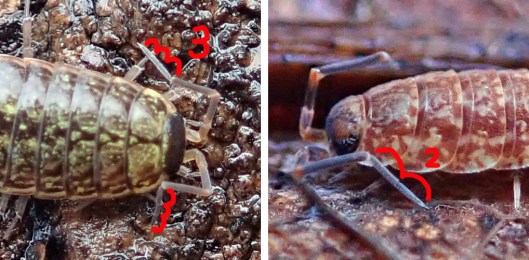
So well camouflaged was it that I almost missed this little mini-beastie, which I initially thought was a Common striped woodlouse (Philoscia muscorum) but, on closer inspection of its antennae, I now think must be Porcellio spinicornis. According to the Naturespot website, the distinguishing characteristic is the number of flagellal segments at the tip of the antennae: Porcellio spinicornis has two, while Philoscia muscorum has three. If I’d known this at the time, I would’ve taken better close-ups but I’ve tried to illustrate the differences below.

230202 woodlouse antennae