The voice of wildness

Tags

, , , ,

‘The shape and voice of wildness’ – that is one of David Gray’s many evocative descriptions of the Curlew in his piece for the BTO’s publication Into the Red. ‘Mottled mud spirit’, ‘dressed understatedly in streaked browns and greys’ are two more but, as you would expect from a well-known singer-songwriter, Gray’s most basic response is to this mystical bird’s voice: ‘To hear a Curlew’s song as it carries across the land, is to hear, quite literally, a place being sung into being’. I sincerely hope you and your children and grandchildren get to experience that singing.

230221 curlew

Galls: Phytoptus avellanae

Tags

, , , , , , , ,

These are my latest gall finds, caused by the mite species Phytoptus avellanae, shown here on Hazel (Corylus avellana) though they can also affect the buds of Filbert (Corylus maxima). The feeding of the mites on the plant cells within the buds causes those buds to swell and multiply. You can see a comparison in my photo below, the mite-infected gall bud on the left, the normal bud on the right.

230220 gall Phytoptus avellanae (1)

The mites that cause these galls are tiny, so rarely seen, but the Dutch Bladmineerders website has some excellent photos showing them in minute detail. As with so many galls, they are thought to be widespread in Britain but are not well recorded. So, if you’re out and about enjoying a spring walk and spot some Hazel, do please cast an eye over the buds, and record any galls you see. Citizen scientists really do make a difference to our knowledge of the natural world around us.

230220 gall Phytoptus avellanae (2)

Springtail and slime

Tags

, , , , , , , ,

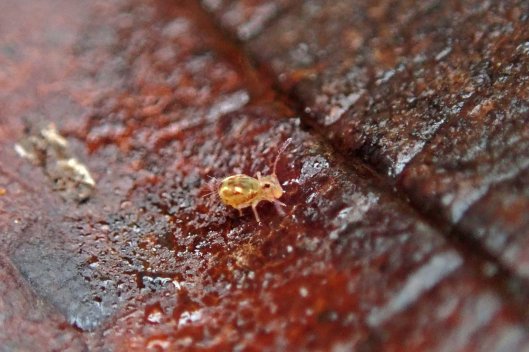
My most recent leaf-diving session in my favourite slimy Sycamore leaf spot turned up these two tiny treasures. This first is a miniscule springtail with a very hairy bottom which I think is Dicyrtomina ornata. There is another very similar springtail, Dicyrtomina saundersi, but that has distinct orange patches on its antennae and I’m not seeing that in my photos of this little critter.

230217 springtail

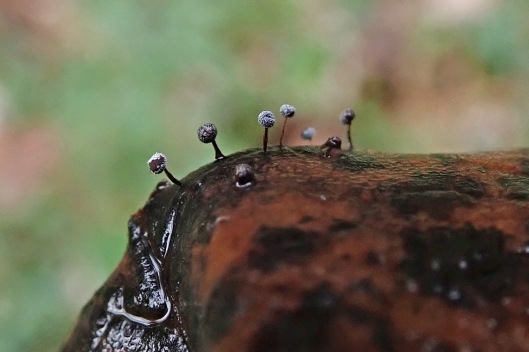
The second treasure was a lovely bit of slime, which may or may not be Metatrichia floriformis. Slime moulds can be tricky to identify accurately and I’m well out of practice.

230217 slime

Holly speckle

Tags

, , , ,

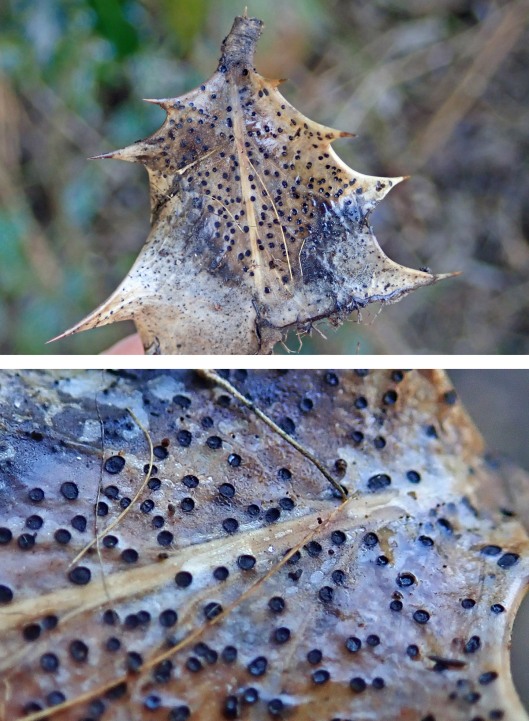
Have you ever noticed what look like little black spots on the brown fallen leaves of Holly? This is the perfectly named fungus Holly speckle (Trochila ilicina) and those spots, or speckles, are, in fact, the fungal fruiting bodies. When they first develop, they are a dark olive green but, after their lids open and the spores within are released, the speckles come to resemble tiny black craters. If you want to know more, a blog on the Woodlands.co.uk website has a very detailed description of these intriguing fungi, as well as an explanation of how their fruiting mechanism functions.

230215 holly speckle

A baker’s dozen

Tags

, , , , ,

I was walking along Sully beach over last Friday’s high tide when a walker and her wide-roaming dog put up this little flock of waders. In panic, they flew together along the beach, wheeled out over the waves and around, heading back to their original location.

230214 ringed plover (1)

Luckily for me, once they considered the woman – or, more likely, the dog – was far enough away, they settled back on the rocks again. The astute amongst you may have counted the flying flock and noted that there were, in fact, more than a baker’s dozen. That was the number of Ringed plovers. They were accompanied by two Turnstones and a single Dunlin.

230214 ringed plover (2)

Leafmines: Phyllonorycter ulicicolella

Tags

, , , , ,

I have a new leafminer to share at last, the moth Phyllonorycter ulicicolella, which mines the stems and spines of Gorse plants. The British Leafminers website notes that this mine is rarely found, and I can certainly believe that. I’d had a look before at a few Gorse bushes but not found any mines, until a posting on Twitter by local Butterfly Conservation senior moth ecologist George led me to make a more serious effort. For me, finding new leafmines is often a matter of getting my eye in – once I’ve seen something, I find it much easier to find again. George directed me to a local Gorse bush where he’d recently found some mines – I didn’t actually check that bush but knew there were other bushes that had recently been flailed further along the same road, and bingo! The mine and larva pictured here came from a cut branch lying on the ground.
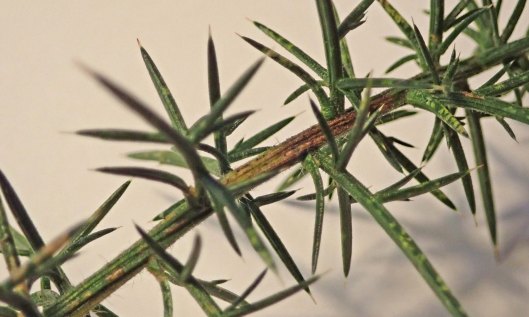
230213 phyllonorycter ulicicolella (1)

The larva is incredibly tiny – about 3mm when fully grown – so it was difficult to get clear photos. According to the UK Moths website, where you can see images of the attractive adult, this moth is ‘nationally scarce’, and can be ‘found in heathland and grassland in southern England and also northwest England’. I guess they need to update that now to include south Wales, thanks to George’s efforts in finding it locally, in various parts of Cardiff and the nearby town of Barry. I will also be continuing my search for the mines in my area.
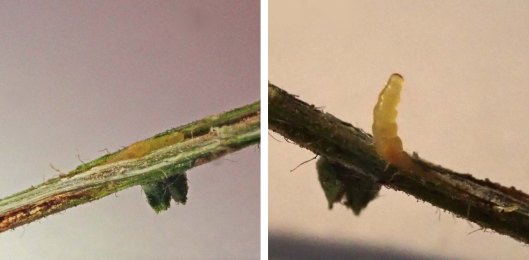

230213 phyllonorycter ulicicolella (2)