Oak: Purple hairstreak larva

Tags

, , , ,

While examining the galls on Oak leaves that I blogged about yesterday, I also made a very exciting find, my first Purple hairstreak butterfly larva. It was so well camouflaged that I’m sure I wouldn’t normally have noticed it.
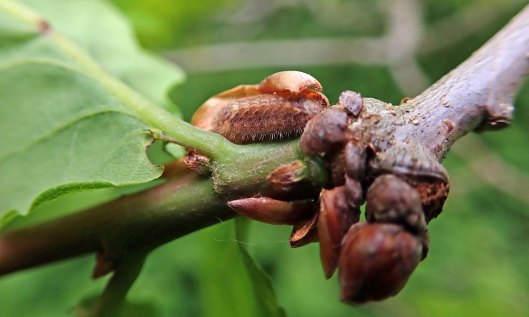
210526 purple hairstreak larva

This particular woodland contains some huge ancient Oak trees but also many younger trees planted to mark the turn of the millennium and I’ve always thought it would be good habitat for Purple hairstreak. Now that I know they’re definitely here, I’ll be looking for the stunning little butterflies when they emerge in a month or so, and also for more larvae in the meantime.
Oak: a new gall

Tags

, , , , , ,

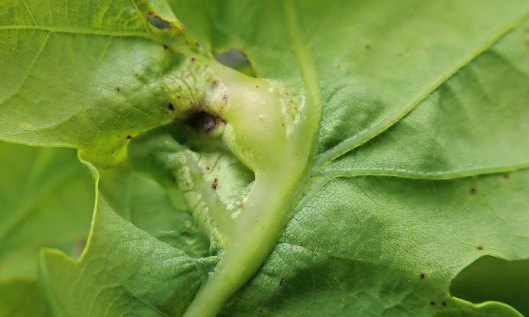
With heavy cloud and occasional rain, Sunday was not a day for finding butterflies in the woodland. So, I decided to look more closely at Oak leaves to see what I might find, and that strategy paid off in spades as the next few days’ blog posts will show. First up, I found a gall I hadn’t seen before, which turns out to be the sexual generation of the gall wasp Andricus curvator.

210525 Andricus curvator (1)

When the adult wasps emerge in the spring from the agamic (asexual) generation galls, which are formed on buds in the autumn and fall to the ground to over-winter, they lay their eggs mostly on Oak leaves but also, sometimes, on twigs or catkins, so these galls can take several forms. The ones I found (and they were numerous) were all on leaves, causing malformations and swellings, as you can see from the photos above and below.

I was tempted to split a gall open to see what was inside but it turns out I didn’t have to, as something had nibbled away at one gall, revealing a second round gall inside (see below). The larvae within this inner gall will emerge in the autumn to lay its eggs on Oak buds, and so the process will continue.

210525 Andricus curvator (4)

Butterfly courtship

Tags

, , , , ,

Some recent moments of butterfly courtship I’ve managed to catch on camera …
The dance of the Brimstones: the butter-yellow male flies in to check if the paler female is ready and willing to mate. And he’s in luck, so their (to human eyes) romantic dance begins, with the male whirling around the female, wafting his pheromones in her direction to encourage her to settle and let mating begin. This ‘dance’ can continue quite a while, as I discovered while watching this pair.

Mating was already underway when I spotted this pair of Green-veined whites. And it is not just sperm that is passing between them. The Butterfly Conservation website reports that the male also transfers ‘a so-called “nuptial gift” of nutrients that the female can assimilate and use to increase egg production. Exceptionally, male Green-veined Whites may transfer 25% of their own body mass to females during mating, though typically this is more like 15%.’

210524 green-veined whites

Sometimes males don’t know when to take ‘No’ for an answer! By pointing her abdomen in the air, this Orange-tip female is refusing to mate, presumably because she has already mated and needs to get on with the important task of egg-laying. But the male simply wasn’t getting the message and continued fluttering around the female, even landing on her outspread wings. Eventually, she flew off at speed to escape his advances.

New awakenings

Tags

, , , , , , , , , ,

Despite our un-spring-like weather, more and more wildflowers are coming in to bloom. Here are some I’ve noticed during the past fortnight’s ramblings in my local countryside: Comfrey, Field scabious, Flax, Knapweed, Oxeye daisy, Ragged robin, Red campion and Red valerian, and Yarrow. Though my video shows a decidedly blue-pink range of hues, there are other-coloured species in bloom – it’s just that I intend doing some family- or species-specific blogs so will save those photographs for now.

Dipper fledgling

Tags

, , , ,

Dippers are birds I don’t see very often. They’re primarily birds of fast-flowing rivers and, although there are two rivers, the Ely and the Taff, within walking distance of my home, where they flow in to Cardiff Bay neither river has the boulders or rocks Dippers like to use to launch themselves into the water.

210522 dipper fledgling (1)

So, it was a delight to hear a Dipper calling in the River Rhymney during Wednesday’s walk in the Welsh valleys and then, on peering down into the river, to see not only an adult bird, which flew off upstream, but also to spot and then watch this adorable fledgling, which was already practising the bobbing motion these birds are known for.

First Common blue

Tags

, , ,

This has been a strange spring, with frequent cool winds, a lack of rain that was restricting plant growth and cracking the ground, and now a couple of weeks of frequent rain that is saturating the land. This unseasonal weather has had a definite effect on wildlife, with some insects out and about early, but others emerging a week or more later than usual.

210522 common blue (2)

I would usually expect to see my first Common blue butterfly in mid May but this year’s first sighting came on Wednesday 19th and, somewhat surprisingly, it was high in the Welsh valleys, where the weather is often a few degrees cooler than my usual coastal patches. In fact, in between the sunny spells on Wednesday’s walk, I got hailed on. Go figure!

210522 common blue (1)

Crow kids

Tags

, , , , ,

These three juvenile Carrion crows were keeping incredibly quiet – in fact, two were mostly snoozing – so it was just good luck that I happened to look up into their tree and spot them.

210520 juvenile crows (1)

Their parents were in a neighbouring area of wasteland, foraging for food – a full-time job with three hungry beaks to fill. The juveniles look close to fledging so I’m picking they’ll have moved out by the time I next walk this way.

210520 juvenile crows (2)

Finally, odonata

Tags

, , , , ,

My first damselflies (still no dragonflies) of 2021 have been a long time coming but, finally, yesterday, at Cosmeston Lakes Country Park, before a thunderstorm drenched both the insects and me, I saw a small number of both Azure and Common blue damselflies in some of the more sheltered places around the fields … and it was magical!

Azure damselfly

Common blue damselfly

A treehopper

Tags

, , ,

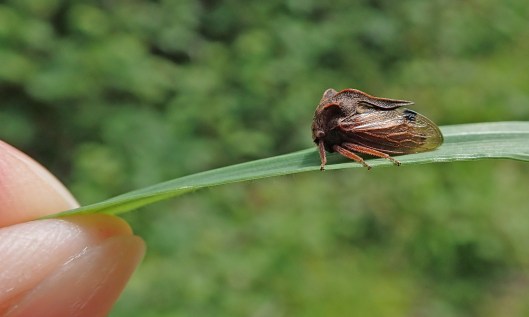
The highlight of yesterday’s walk was this little dude, a new insect for me and perhaps the coolest bug I’ve ever seen. Meet Centrotus cornutus, one of only two British species of treehopper.

210517 Centrotus cornutus (1)

As you can see from the relative size of my thumb and the fact that it’s sitting on a blade of grass, this bug is tiny, averaging just 10mm in length. The British Bugs website says they can be found ‘on a range of plants in woodland rides’ – this one was amongst scrubby vegetation under trees in a local park, and the adults can be seen between April and August.

210517 Centrotus cornutus (2)

Though I wouldn’t usually promote Wikipedia, their entry on this bug has some interesting, seemingly well-referenced information that includes the idea that ‘The bizarre horn-like extensions of the pronotum apparently help the camouflage. As a matter of fact, when this insect is at rest on a branch with the legs retracted, it looks like a part of the branch itself.’ I can imagine that camouflage works rather well.

210517 Centrotus cornutus (3)