353/366 Old Alder brackets

Tags

, , , ,

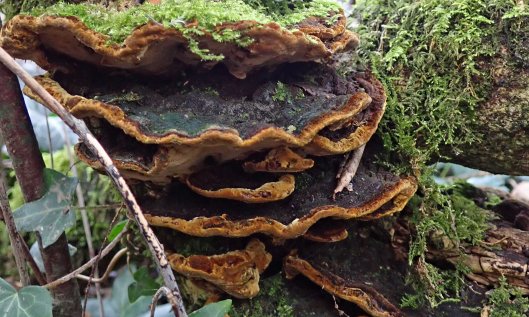
Back in December 2016, I blogged about Alder brackets (Fungi Friday: Alder bracket) and showed then the gorgeous golden globules of liquid that ooze out of them when they’re young. Today’s Alder brackets (scientific name Inonotus radiatus), found in the woodland at Cosmeston Lakes Country Park, have a longer history.

201218 alder bracket (1)

There is certainly some newer growth amongst these brackets but most have been on this Alder tree a long time, as you can tell from the luxuriant growth of moss on the top bracket of the tier.

201218 alder bracket (2)

352/366 Winter travellers

Tags

, , , , ,

When winter begins to tighten its deadly grip on the world’s northernmost latitudes, food gets scarce and many birds either flee south or face starvation.

201217 fieldfare

Fieldfares come chack-chack-chacking all the way across the North Sea from Scandinavia, some even further, from the desolate snowbound plains of Siberia.

201217 redwing

Some Redwings also fly across the North Sea, though most of those we see in Britain have come south from Iceland. Seeing and hearing these gorgeous birds is one of winter’s highlights for me.

351/366 Wild word: nidification

Tags

, , , , , ,

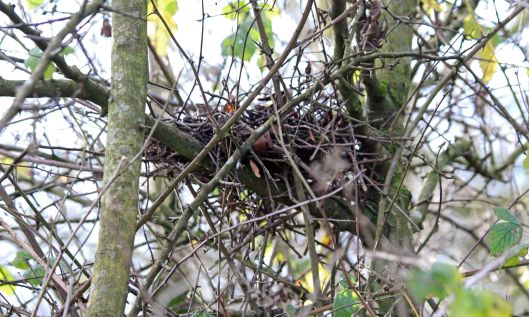
Nidification: noun; [zoology] nest-building; origin: mid 17th century from Latin nidificat– ‘made into a nest’ (from the verb nidificare, from nidus ‘nest’) + -ation (Oxford Dictionary).

201216 nidification (1)

This might not be the time of year for nest-building for most critters (though I did spot a Magpie poking a stick into what looked like a potential nest site yesterday) but it is the time of year, with the trees bare of leaves, when you can see some of our birds’ nest-building efforts from earlier this year, and previous years, if they’re birds that keep the same nest site year after year. And I only just learnt this new word this week so thought I’d pass it on.

201216 nidification (2)

350/366 S s s s … Siskin

Tags

, , , , , , ,

Siskin (Carduelis spinus) are not finches I see very often so, when I heard their high-pitched whistles at Grangemoor Park last Saturday, I immediately looked up to try to spot them.

201215 siskin (1)

And there they were, perhaps six birds, feeding on Alder cones, high above me. There were other trees in my sightline and the light was shocking so it wasn’t easy to watch or photograph them.

201215 siskin (2)

Still, I lingered on the muddy path for 20 minutes or so, enjoying their upside-down feeding techniques, listening to their noisy interaction, enjoying the fleeting glints of yellow when the sun lit their feathers. What a treat!

201215 siskin (3)

349/366 Leaf mines: Amauromyza verbasci

Tags

, , , ,

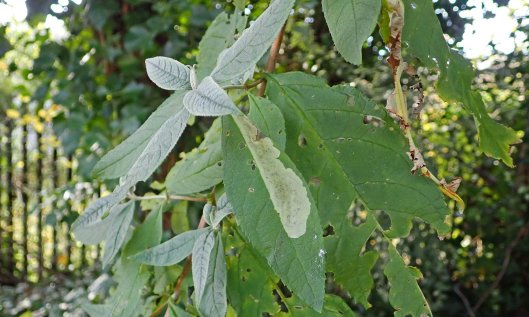
It’s #LeafmineMonday again on social media so here’s another leaf mine to look for when you’re out walking. And this is an easy plant to recognise because I’m sure everyone knows what the Butterfly bush (Buddleja davidii) looks like, right?

201214 Amauromyza verbasci (1)

These mines on Buddleja leaves, which start as a narrow corridor and quickly develop into a large blotch, are caused by the larvae of a tiny fly, Amauromyza verbasci. The fly also lays its eggs on several other plants, including Mullein and Common figwort.

201214 Amauromyza verbasci (3)

Mines can be seen from June to November, so it’s almost too late to see these now. The Buddleja plants in my area are already generating new growth but, as you can see from the photo above, the mines may still be seen on the older leaves before they drop.

201214 Amauromyza verbasci (2)

According to the UK Fly mines website, Amauromyza verbasci is widespread in Britain, though I have to say that I have only seen these mines once, despite a lot of looking at Buddleja bushes. And this sighting was a particularly lucky one for me, as this turned out to be the 1000th species (of flora and fauna) I had recorded on my local biodiversity records centre database.

348/366 Cosmeston treasure hunt

Tags

, , , ,

This was hard work! The paddocks at Cosmeston Lakes Country Park get shaved of all vegetation at least once each year, usually in autumn, and that process happened late this year, just two weeks ago. So, it took me three visits, covering almost every inch of the site, checking the field boundaries in particular, searching for any wildflowers the tractor’s blades might have missed.

I’m actually amazed I managed to find this many species still flowering: Bramble, Carline thistle, Creeping buttercup, Creeping thistle, Daisy, Herb Robert, Hogweed, Oxeye daisy, Sweet violet, Wild radish, Winter heliotrope, and Yellow-wort.

347/366 Speug

Tags

, , , , , , ,

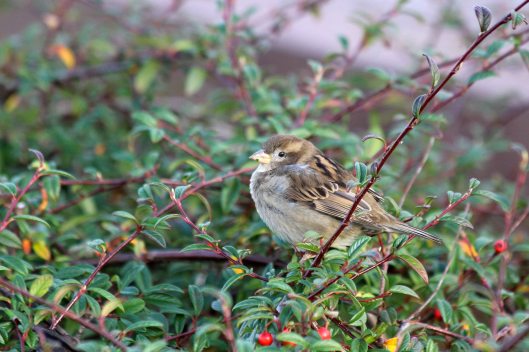
Craff, cuddy, grey spadger, roo-doo, sparr and sprug, spuggie and spurdie…. These are all regional names for the sparrow, both the House sparrow (Passer domesticus) and the Tree sparrow (Passer montanus). My ex, a Lanarkshire Scotsman, called it a speug, so that name is one I still sometimes use. And I’m sure many of you will have your own names for this little bird, one of our most common urban garden companions.

201212 house sparrow

346/366 A fungal selection

Tags

, , , , , , , , ,

Today, a selection of fungi spotted during my recent walks. Although I’ve named these fungi, my identifications are not based on microscopic examination and so cannot be positively confirmed.

The fungi are, I think, Coral spot (Nectria cinnabarina), Jelly ear (Auricularia auricula-judae), King Alfred’s cakes (Daldinia concentrica), and Velvet shank (Flammulina velutipes). And under the rotting logs in the woodland: Common grey disco (Mollisia cinerea), Lemon disco (Bisporella citrina), and Frosty bonnet (Mycena tenerrima).

345/366 Italian Alder aphid

Tags

, , ,

At first I thought this incredibly tiny creature was the early instar of a shield bug but, when I couldn’t find any pictures that resembled it on the British Bugs website, I turned to Twitter for help. Luckily, a botanist I know, Karen, had seen something similar posted recently in a Facebook group and very quickly supplied me with a name, Crypturaphis grassii, the Italian Alder aphid, so named because it’s only ever found on Italian Alder trees (Alnus cordata).
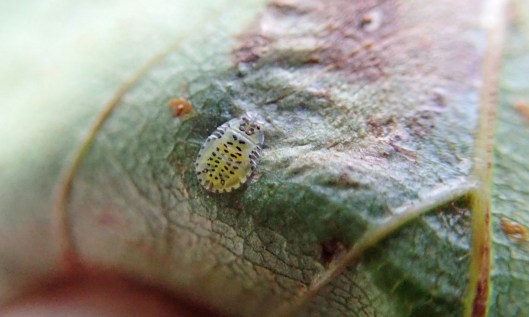
201210 Crypturaphis grassii (1)

I found online a report published in 2011, on the first records of this species in Cornwall, which provides some interesting detail about these aphids. Apparently, Crypturaphis grassii is ‘native to southern Italy and Corsica and [was] first recorded in the UK in 1998’. Intrigued, I returned to the tree I’d found my first specimen on and found many more of these creatures, with variations in colour and markings. The report explains that:

Viviparous individuals [those able to birth live young] are yellowish-green to yellowish-brown, with brown spots extending along the dorsal surface, around the edge of the abdomen and on the head. Compound eyes are reddish in colour. … Immature apterae [wingless individuals] are similar but smaller, paler and lacking in dark spots, more translucent and slightly more elongate in shape. Oviparous apterae [wingless individuals that are able to lay eggs] are similar in size and shape to viviparous apterae but are brown in colour, with transverse darker abdominal stripes, rather than spots.
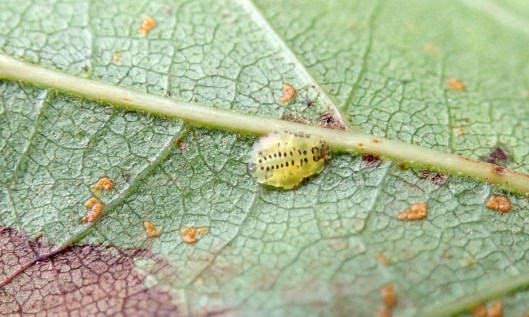
201210 Crypturaphis grassii (3)

The Italian Alder, on which the aphid feeds, was ‘commonly planted as a roadside, waterside and/or windbreak species’ during the 1980s, and, by 2011 when the report was published, the aphids had already spread widely throughout Britain, including having established colonies in the Vale of Glamorgan, which is where I found the aphids in my photographs.

201210 Crypturaphis grassii (2)

Citation: Luker, Sally. (2011). CRYPTURAPHIS GRASSII (STERNORRYNCHA: APHIDIDAE): FIRST RECORDS FOR CORNWALL. British Journal of Entomology and Natural History. 24. 205.

344/366 Not just any stick

Tags

, , ,

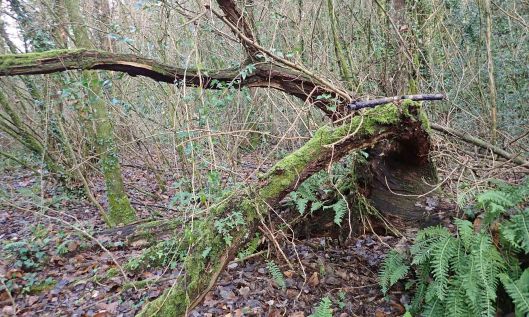
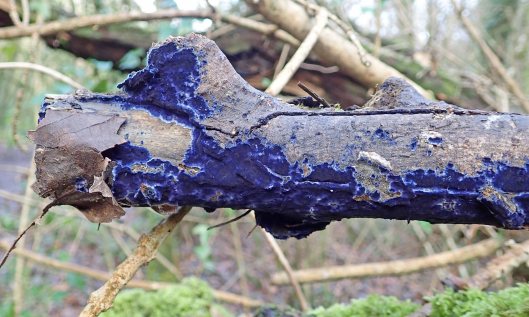
Do you see the small stick sitting on top of the big fallen branch, in the centre left of the photo? Well, that stick was the absolute highlight of my seven-and-a-half-mile walk yesterday.

201209 cobalt crust (1)

And below you can see why. This is the fungus Cobalt crust (Terana caerulea), an incredible colour to find growing on a stick in the middle of a now mostly brown woodland.

201209 cobalt crust (2)

This is the first time I’ve found Cobalt crust locally and I was/am just so excited to see it. I might just have to go back next week for another look (and, also, to get photos of the red elfcups that were just beginning to appear nearby).

201209 cobalt crust (3)