363/366 Lucky devil

Tags

, , ,

I’ve often said that the Small copper is my favourite butterfly, and that’s still true, but the butterfly in my spotlight for 2020 is the Small tortoiseshell. And the good news is that this year I’ve seen more Small tortoiseshells, both the butterflies and their larvae, than in previous years. I hope that means they’re enjoying some good luck, and their numbers are bouncing back everywhere, not just in my locality. I’ve blogged about these beautiful butterflies a few times now: the most recent post was The devil’s butterfly?, in April 2020.

201228 small tortoiseshell

362/366 New leaf flitter

Tags

, , , ,

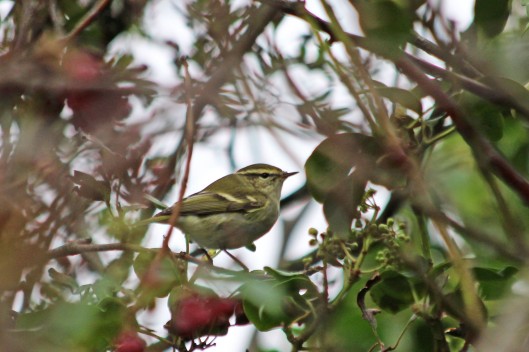
For several reasons (Covid restrictions, environmental concerns around travelling simply to see new birds, a desire for quality not quantity), I decided early in the year to restrict my birding to my local patch. That’s meant my list of the bird species I’ve seen this year only totals 118, not the 200 I’ve previously aimed for, but I’ve enjoyed spending more time observing the birds I have seen, getting to know their preferred places, behaviour, feeding patterns, etc. And I have seen one new bird this year, a stunning Yellow-browed warbler that appeared along the local coastal path back in October.

201227 yellow-browed warbler

361/366 Fave flower

Tags

, , , ,

For the next few days, in the countdown to year end, I’m going to go through some of my 2020 highlights: special wildlife moments, favourite finds, best photos.

It’s difficult to choose a favourite wildflower – there are so many crackers! – but a group I confess I’m quite partial to are the thistles: Creeping and Spear are very common hereabouts, Dwarf and Carline can be found at local country parks and reserves, and this year I identified my first Musk thistles (Carduus nutans). The photo below shows one such in bud; the open flowers in all their glory can be seen in my blog Musk thistle, July 2020.

201226 musk thistle

358/366 Complete tripe

Tags

, , ,

Though I always try to vary the routes I walk, I was reminded of how important this is on Monday’s local meander. I usually walk back from our local beach through one of the parks but this day decided to stomp up the hill via the road instead. It was a good choice, as I found lots of lovely Tripe fungi (Auricularia mesenterica) on a large stump beside the road. And the stump held the complete life cycle of the Tripe, from the small rubbery looking buttons to the bracket-like structures they later merge into.
357/366 Grainy wagtails

Tags

, , , , ,

These are very grainy photos as the weather was atrocious and I didn’t have my good camera, had only popped out briefly from home between showers to get milk and a few groceries from the corner shop, but I was so delighted to spot this family of three Grey wagtails foraging in the lane behind my house that I just had to share. It seems the usual Pied wagtails are being challenged for the urban pickings this winter!

201221 grey wagtail (3)

356/366 Leaf mines: Euleia heraclei

Tags

, , , , , , , ,

Finally, a leaf mine where I’ve actually seen the adult – in this case, a fly rather than a moth – and not the specific adult that laid the eggs that hatched into the larvae that made these particular leaf mines, but rather adult flies seen on other occasions. And very pretty little flies they are too!

201221 Euleia heraclei (1)

These are Euleia heraclei, also known as Celery flies or Celery leaf flies because one of the plants their larvae feed on is Celery. Other plants include Parsley, Hogweed, Angelica, Lovage, Wild parsnip and, the plant I found these leaf mines on, Alexanders (Smyrnium olusatrum). In the photos below, the fly on the left is the male, the one on the right the female.

According to the Nature Spot website, the adult flies are usually seen between April and November, and the British Leafminers website says that the larval mines can be seen throughout summer and into early autumn, though one of my photos below was taken as recently as 27 November and the larva is clearly visible so perhaps they have a longer season when the weather conditions are mild.

355/366 Spring … oh, wait

Tags

, , , ,

So, no, it’s not spring. It’s only really the beginning of winter and, yet, in three different locations this week I’ve found Lesser celandine (Ficaria verna) in flower. I think these glistening wildflowers do bloom quite early in the new year – they’re just even earlier than usual.

201220 lesser celandine (1)201220 lesser celandine (2)201220 lesser celandine (3)

354/366 Goosander courtship

Tags

, , , , ,

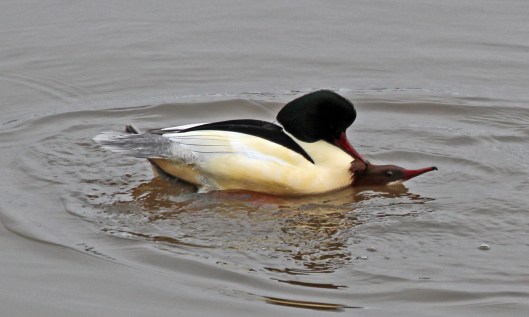
This gorgeous redheaded female Goosander is cruising along the River Ely, diving, fishing, minding her own business, when …

201219 goosander courtship (1)

… this dude literally drops out of the sky right by her, and indicates, by the way he points his beak skywards, that he’s in the mood for a little hanky panky, but …

201219 goosander courtship (2)

… when it comes to it, he feigns aloofness. The female adopts a submissive posture, and she chases him and chases him and chases him and chases him until …

201219 goosander courtship (3)201219 goosander courtship (4)

… finally, he gets the idea, and the action begins (the look on her face!) …

201219 goosander courtship (5)

… and then, after dismounting, he doesn’t want to let go. (And now I know why she has that hair-do!)

201219 goosander courtship (6)