My week in wildflowers

Tags

, , , , , , , , , , , ,

Though the weather has been pretty miserable most of this week, I have been seeing more and more wildflowers when I’m out on my wanders.
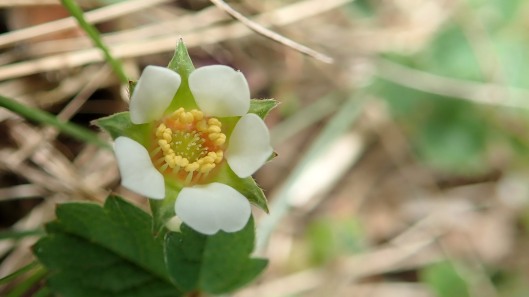
Barren strawberry

There will be no big fat juicy red berries from this little strawberry as this is a Barren strawberry (Potentilla sterilis) (it has fruit but they don’t become ‘fleshy and red’). I can tell which species it is from the top of the leaf that’s showing – the ‘terminal tooth’ is shorter than those on either side of it.

Bluebell

Last Sunday I saw my first Bluebells (Hyacinthoides sp.) of the year, almost certainly Spanish or hybrids rather than native Bluebells, but still beautiful to my eye.

Common stork's-bill

I think this is Common stork’s-bill (Erodium cicutarium), a nice surprise growing amongst the grass at Cardiff Bay Wetland Reserve.
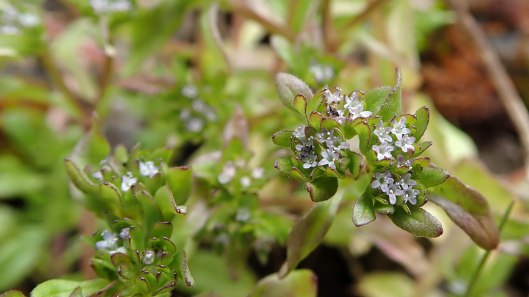
Cornsalad

Cornsalad is such a dainty little plant, with very delicate, pale blue flowers. I almost missed these growing by the path at Grangemoor Park and have since seen them in a couple of places. This is probably Common cornsalad (Valerianella locusta), but the only way to be sure it’s not one of the other four varieties is to check the fruit, which won’t be possible till later in the season.
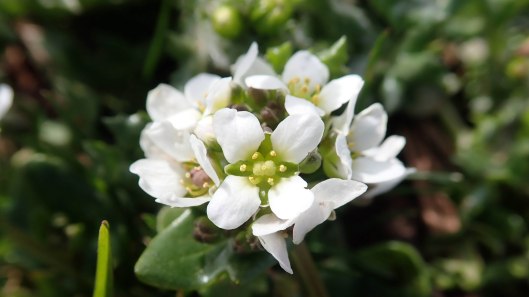
Danish scurvygrass

This is Danish scurvygrass (Cochlearia danica), originally a seaside plant that has now become widespread by following the road-salting trucks along the roads of Britain.

Gorse

Gorse (Ulex sp.) never seems to stop flowering, though the truth is that there are two Gorse species and, when one stops flowering, the other takes over.

Grape hyacinth

These Grape hyacinth (Muscari sp.) have become naturalised in my local cemetery, probably spreading from one or two deliberate grave-top plantings, or from nearby home gardens. I love their blue.

Petty spurge

Petty spurge (Euphorbia peplus) is a very common little wildflower that’s often overlooked.

Common ragwort

Spotting this flowering Ragwort by the roadside near Cardiff Bay was a bright surprise. It’s probably Common ragwort (Senecio jacobaea).

Red dead-nettle

Red dead-nettle (Lamium purpureum). I’m a big fan of all the dead-nettles – the ‘dead’ in their name refers to the fact that they aren’t covered in stinging hairs!

Three-cornered leek

Allium triquetrum, the Three-cornered leek, is a pretty, if somewhat smelly flower but considered an alien invasive plant species here in Britain.

I’m following a tree: March 2018

Tags

, , , , , ,

I think, like much of Britain’s flora and fauna (and its human population), my tree is suffering from the late arrival of warmer spring weather as not much has changed with it during March: the leaf buds haven’t developed much further, no leaves have burst open, and it’s still looking very skeletal. Warmer temperatures are forecast for next week so, fingers crossed, that gives everything a kick-start.

In the meantime, I thought I would give you a little taste of the delights to come later in the year. While I don’t have any photos of my tree in summer green, I do have a photo, taken in October 2015, of this incredible Acer pictum (Acer mono) resplendent in its glorious autumn finery. Something to look forward to, for sure!

180412 Acer pictum in autumn

Wild words: nuptial plumage

Tags

, , , , , , , ,

Nuptial plumage, also known as breeding plumage and alternate plumage, is the plumage assumed by adult birds prior to their annual breeding season. This plumage is generally more colourful than the bird’s usual plumage, presumably in order to attract the opposite sex. Birds achieve this change by moulting their feathers, before breeding into their nuptial ‘glad-rags’, and then afterwards, returning to their usual ‘day wear’.

180411a Turnstone in January

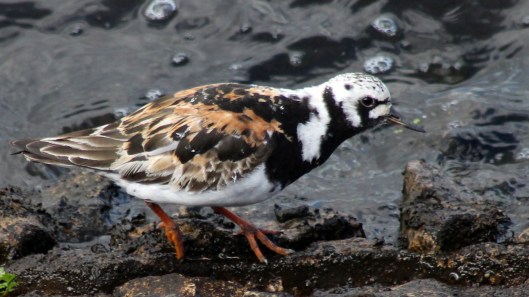
My photos show the change happening in the Turnstones I see so often in my local patch. The first photo (above), taken in January, shows the bird’s winter plumage. The following two photos, taken in March and April, show the moult in progress, and the final photo, taken in August, is after breeding has finished, when the bird is moulting from its nuptial plumage back to its winter, non-breeding plumage. To see these birds in their full nuptial plumage, I would have to head to their breeding grounds in Canada or Greenland, a tempting proposition but not affordable at this time!

180411b Turnstone in March180411c Turnstone in April180411d Turnstone in August

Cherry plum or Blackthorn?

Tags

, , , , , , ,

OLYMPUS DIGITAL CAMERA

Being a relative newbie to Britain, I’m still very much a learner when it comes to identifying plants (and everything else, to be honest), so I was pleased recently to learn how to tell Cherry plum blossom from Blackthorn.

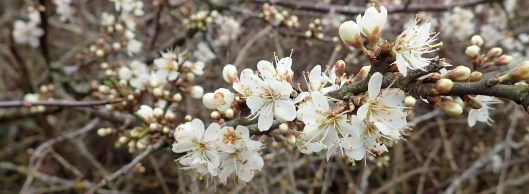
It’s partly in the timing – Cherry plum (Prunus cerasifera) usually flowers first, apparently – and also in the growth pattern, but a sure-fire way to tell whether the gorgeous blossom you’re puzzling over is this or Blackthorn (Prunus spinosa), which flowers soon afterwards, is to look at the back of the flower.

In the Blackthorn the sepals (those leaf-like bits that originally enclose the flower but split apart when the flower opens) lay flat along the backs of the flower petals, or between them when fully open (photos above), whereas in the Cherry plum, the sepals are folded back (photos below).

Nests

Tags

, , , , , , , , , ,

Just like their makers, nests come in all shapes and sizes, and they’re made of all sorts of materials: twigs and branches, feathers, moss, paper and plastic, mud. They can be seen high in trees and on buildings, hidden secretively away in hedges and behind reeds, or plonked in a hole in a concrete platoon, as I saw some Coots do recently in Cardiff. Some are messy and loosely constructed, others are cosy and snug, still others are miniature works of art.

180409 buzzard

This is prime bird-nesting season so it’s quite likely you’ll see nests when you’re out walking. Please stay well away and do not disturb parents, eggs or babies. In Britain (and I’m sure in most countries) it is, in fact, an offence under The Wildlife and Countryside Act 1981 to ‘intentionally take, damage, destroy the nest of any wild bird while it is in use or being built’ and to ‘intentionally take or destroy  the egg of any wild bird’. (You can read more details here.) And, rest assured, my photos were all taken with a long lens, well away from the birds, so as not to disturb them.

This week in insects

Tags

, , , , , , ,

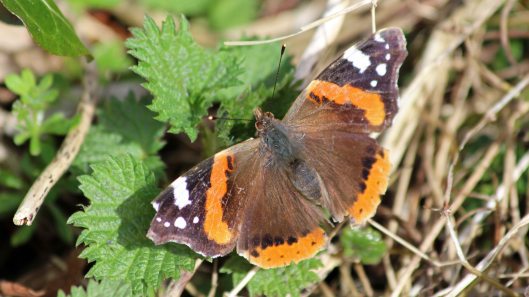
I mentioned yesterday that I saw my first butterflies of 2018 this week. The first was a Peacock but my camera was in my backpack and, by the time I extracted it, the butterfly had flown off. I was still cursing that fact when another butterfly appeared, this lovely Red admiral (Vanessa atalanta). Snap!

180408 Red admiral

On Wednesday’s walk, as well as the bee-flies I blogged about yesterday, I also saw several varieties of bee. I’m hopeless at identifying bees – I will focus on them one year to try to improve my skills, but that won’t be this year. Luckily, there’s a good Facebook group where the folks are very helpful, and they’ve IDed these as Yellow-legged mining bees (Andrena flavipes). They’re spring-flying solitary bees that make individual nests but often in large groups (the experts call them aggregations). This lot, of perhaps 20, were digging in to a sandy bank by the seaside. (Here’s a link to more information from BWARS.)

180408 Yellow-legged mining bee (1)

This next little critter was tiny, as you can see by comparison with my hand behind (and I have small hands). Once again, I needed help on the ID but the folks from my local Butterfly Conservation Facebook group are experts. This is a caterpillar of the Magpie moth (Abraxas grossulariata), a stunning-looking moth that I have not yet seen. Its caterpillar is quite lovely too, don’t you think?

OLYMPUS DIGITAL CAMERA

Though only 3 to 5mm long, these little Red Velvet Mites are hard to miss, simply because of their unusual colour. This is one of the Trombidiidae family but I don’t know which one. It’s really an arachnid (note the eight legs) rather than an insect but I’m including it here anyway. It’s carnivorous but no need to worry – it only eats creatures smaller than itself!

And, finally, a bee that I haven’t tried to put a name to – I just liked it for the way it’s positively luxuriating in the pollen of this Lesser celandine flower.

OLYMPUS DIGITAL CAMERA

Signs of spring: Bee-flies

Tags

, , ,

Last Wednesday was a ‘B’ day – not ‘B’ as in ‘B-rated’ or in any way inferior – in fact, in that sense, it was an A+ day. I named it a ‘B’ day because I saw my first Butterflies of 2018, my first Blackcap, and my first Bee-flies – and not just one Bee-fly, but a total of seven!

180407 bee-flies (7)

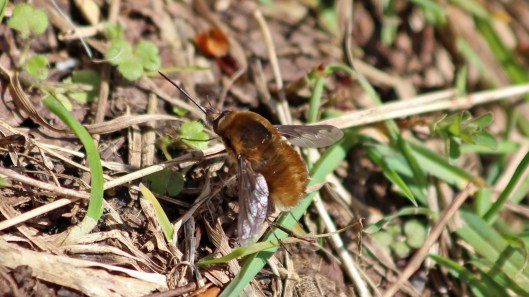
The Bee-fly (officially Bombylius major) is a strange-looking mini-beastie, a weird and wonderful combination, all the cuteness of a furry teddy-bear but with the sinister look of a sword fish. Never fear, it is entirely harmless to humans, though it does lay its eggs in the nests of bees and wasps, where the bee-fly larvae feast on the bee and wasp larvae. Its sword-shaped proboscis is no stinging machine – it’s used exclusively for drinking nectar from flowers. These are springtime mini-beasties, out now in sunny spots in your garden or local hedgerow.

Variable and promiscuous

Tags

, , , , , ,

OLYMPUS DIGITAL CAMERA

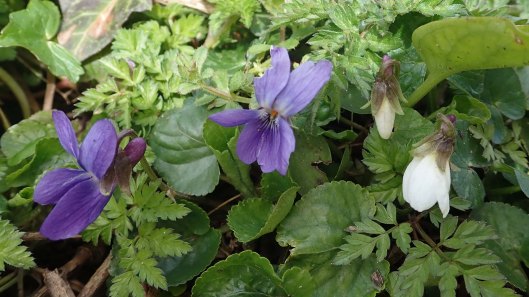
In Flora Botannica Richard Mabey’s opening statement on the violet family reads: ‘The violets are a variable and promiscuous family, apt to throw up all kinds of sports and hybrids.’ This once meant that botanists split the family into as many as 40 different species, depending on their colour variations. Fortunately, common sense and modern scientific analysis has now prevailed and that number has been almost halved. Still, violets are not always easy to identify.

Although the violets in my photos are both purple and white, they are, I believe, all Sweet violets (Viola odorata), as they all had the distinctive scent of this variety – Common dog violets (Viola riviniana) are so called because they do not smell. In olden times, Sweet violets were one of the herbs that were strewn on floors to improve the smell of your home, and they have also been used by herbalists to treat insomnia, depression and headache. All that, and pretty too!

180406 sweet violets (7)

Bundles of fluff

Tags

, , , , , , , ,

180405 Greylag goslings (1)

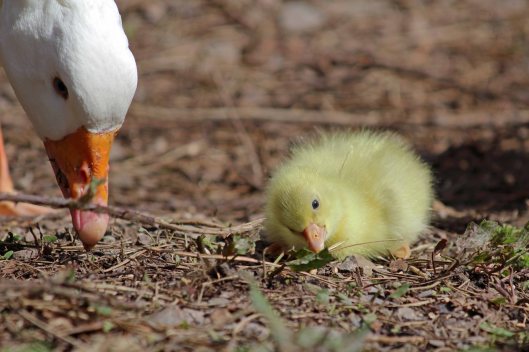
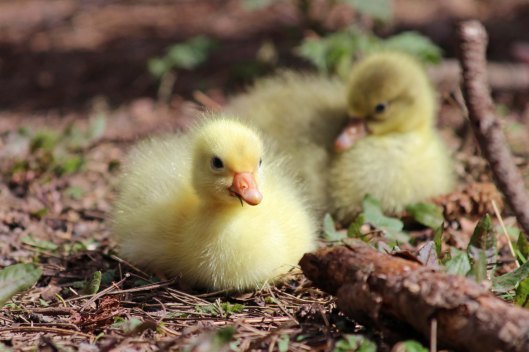
As this year’s lingering wintery weather has delayed the true advent of spring by about three weeks, I certainly wasn’t expecting to see these four gorgeous Greylag goslings when I went for a wander around Roath Park Lake on Tuesday. But, as Greylag eggs take about 28 days to incubate, Mrs Goose may well have started laying just prior to the ‘Beast from the East’ storm on 1 March. Full praise to her for persevering through two heavy dumpings of snow, freezing temperatures, and some very heavy deluges of rain as well!

180405 Greylag goslings (2)180405 Greylag goslings (5)180405 Greylag goslings (3)180405 Greylag goslings (4)180405 Greylag goslings (7)180405 Greylag goslings (6)180405 Greylag goslings (8)

Wild words: strobilus

Tags

, , , , , , ,

Strobilus: noun; a botanical term, which came originally from the Greek strephein meaning ‘to twist’, and which is used to describe the cone of a pine, fir or other conifer; and also ‘a structure resembling the cone of a conifer, such as the flower of the hop’ (Oxford Dictionary).

180404 strobilus

I have the lovely Helen of Plantlife Cymru to thank for this word because, when I originally posted this photo on Twitter, she responded by saying that ‘the strobilus is ascending’. My photo shows the newly emerged stalks of Equisetum (possibly Field horsetail, Equisteum arvense), which is a dinosaur of the plant world, a plant that reproduces using spores rather than seeds. The spores are produced in the strobili, the cone-like structures you can see on the tips of the stems.