February at Cosmeston

Tags

, , , , , , , , , , , , , , ,

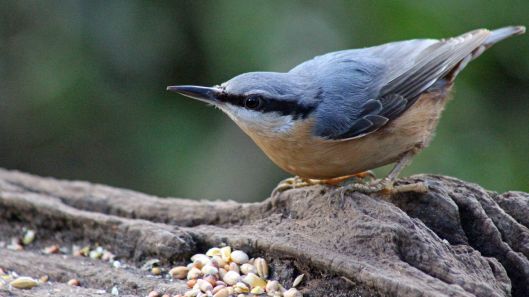
180304 180202 (1) nuthatch

2 February A stride was required so I passed through Cosmeston as part of a longer walk. I did, as always, keep an eye out for unusual birds, though the only bird that fitted that category was a Buzzard in a tree by the dipping pond, exactly where a friend had reported it the previous day.

180304 180202 (2) buzzard

I scattered some seed around for my small and hungry feathered friends, and I did linger a while by the lake to take some photos of gulls. (I’m attempting to learn to recognise gulls of different ages but I’ll post separately about that when I’ve got more photos and information.)
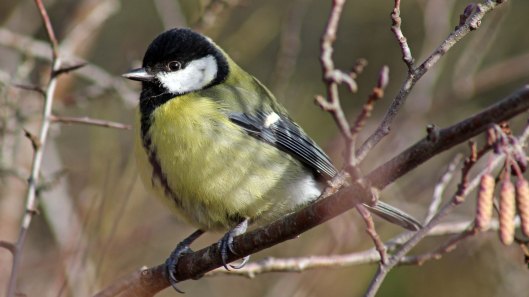
180304 180202 (3) great tit

4 February There are various routes I can take when I walk to Cosmeston; on this day I approached from the north, which produced a couple of Bullfinches near Old Cogan Farm and, further down Mile Road, a couple of Redwing feasting on ivy berries.

To escape the Sunday crowds, I headed off piste and almost immediately spotted a Green woodpecker and, seeing it fly to the ground, started stalking it. It flew off but then a mixed flock of tits and finches flew in, amongst which, to my very great delight, were 3 Lesser redpolls, a bird I’ve only seen once before and which is not often seen in these parts. They were feeding in an alder tree, moving often, doing acrobatics while suspended from cones, flitting from branch to branch, all of which made them difficult to photograph. But what a delightful 30 minutes I spent watching their antics.

9 February I was hoping to spot the Redpolls again today but lucked out, though I did spot a flock of perhaps 8 Redwings in the trees nearby. A handsome male Reed bunting was enjoying the seed a kind passerby had left on a fence post by the west lake, and it wasn’t just me who was finding the winds strong and gusty – this Tufted duck was having a bad hair day.
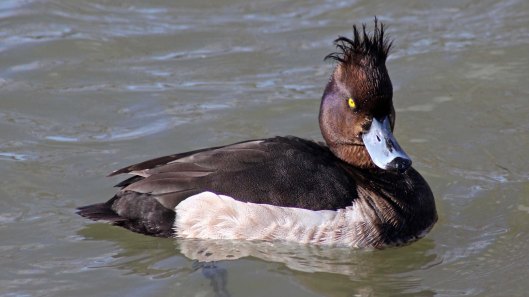
180304 180209 tufted duck

21 February This was school half-term holiday week in Wales, not a particularly pleasant time to visit a country park to enjoy the delights of nature as the parks are usually full of screaming children and frazzled parents at such times. I managed to avoid most of that by taking the paths less travelled but still found much of the wildlife was being scared away by the noise.

Still, I thought I’d make a list of what I did see: Great tit, Blackbird, Dunnock, Robin, Magpie, Goldfinch, Redwing, Carrion crow, Jay, Wren, Blue tit, Buzzard, Jackdaw, Long-tailed tit, Woodpigeon, Mistle thrush, Chaffinch, House sparrow, Starling, Green woodpecker, Reed bunting, Nuthatch, Coal tit, Coot, Cormorant, Mute swan, Black-headed gull, Lesser black-backed gull, Herring gull, Mallard, Tufted duck, Great crested grebe, Canada goose, Greylag goose and Pochard – not a bad list, with 35 bird species, and just one mammal, the ubiquitous Grey squirrel.

180304 180228 treecreeper

28 February South Wales was feeling the brunt of the ‘Beast from the East’, a freezing weather bomb from Siberia, when I paid my last February visit to Cosmeston so it was a short visit, partly for the exercise and I also bought a couple of bags of seed from the Rangers’ Office to feed the birds. You know they’re finding foraging tough when you see a Treecreeper come to the bird feeder – most unusual! And it was also unusual to have the sparse remnants of the previous day’s snow on the ground, so I had to get a few photos of birds (Chaffinch and Mallard) in snow as well. Let’s hope spring (re)appears soon.

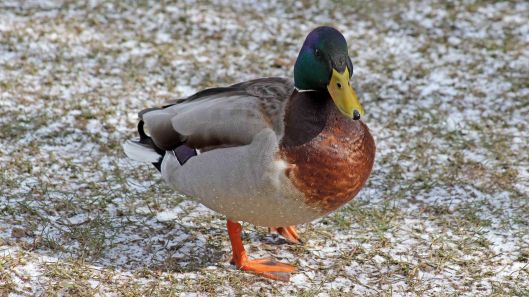
180304 180228 chaffinch180304 180228 mallard

February on the Ely embankment

Tags

, , , , , , , ,

My first February wander alongside the River Ely was in the late afternoon of Saturday the 3rd. It was quiet – were the birds all watching Wales thump Scotland in the 6 Nations rugby, I asked myself? A faint peep alerted me to a Rock pipit tootling along the embankment path towards me. It had been minding its own business, looking for a lunchtime snack, when it suddenly realised there was a stonking great human standing on the path in front of it … at which point it flew off to the relative safety of the water’s edge.

180303 180203 rock pipit (1)180303 180203 rock pipit (2)180303 180203 rock pipit (3)

Shortly afterwards, I could see a roundish form that might’ve been a rock but was, in fact, a Turnstone, the only one seen that day. And, as well as those two birds, one Pied wagtail and two Grey wagtails were in residence. One of the Greys had an interesting plumage aberration, as you can see below.

I was away for a week mid February so my next visit to the embankment was on Tuesday 20 February. A strong cold wind was blowing small waves on to the stony shore and, initially, there were no birds to be seen. But, about half way along the embankment path, I spotted a huddle of seven Turnstones, looking sleepy, enjoying a little bit of warmth from a shaft of sunlight that had reached their roosting spot from between the nearby houses. And, a minute or two later, I noticed one further Turnstone who was already meandering along, turning stones as it searched for breakfast bugs. Two Grey wagtails, hardy creatures, were also dotting about.

180303 180220 turnstones

The twenty-seventh of February was a bitterly cold day, as Britain was in the grip of a severe blast of polar weather, blown across Europe from Siberia, and even Cardiff had a few snow showers that day (quite unusual in recent years). Hopefully, the birds had found somewhere more sheltered than the embankment, as the stiff easterly was so cold that icicles were forming on branches that littered the shoreline and there was a slab of ice at least a foot wide coating the rocks along the water’s edge.

180303 180227 (3) turnstone180303 180227 (2) coot

In spite of those bitter conditions, I spied one Grey wagtail, one Turnstone, a pair of Coots, and a solitary Redshank. It made me feel cold just looking at that lovely bird standing in the icy water!

180303 180227 (1) redshank

Birding at Dryslwyn, Cilsan Bridge and Tregaron Bog

Tags

, , , , , , , , , , ,

Up at 6, collected at 7 and off we headed, west along the M4 for a 9 o’clock meet up with our other Glamorgan Bird Club buddies at the foot of Dryslwyn Castle in mid Wales. This was unexplored territory for me and the scenery of the Tywi (or Towy) Valley was simply stunning, with castles and monuments seemingly on every hill top and the beautiful River Tywi meandering through the valley below them. It was clear but cold, with a bitter wind, and heavy frost and thick ice still blanketing those spots the sun could not reach. Later, we moved on to Tregaron Bog, also known as Cors Caron National Nature Reserve, a fabulous area of marsh and wetland. And what a superb day’s birding we had!

180302 Tywi Valley (1)

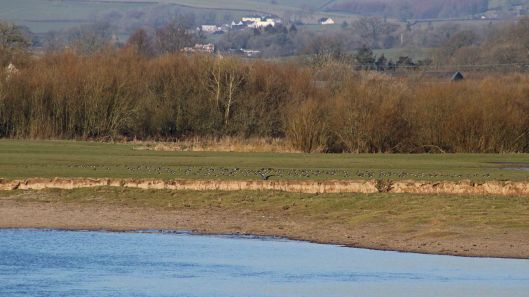
A large flock of Lapwing on the fields next to the River Tywi, and a Grey heron flying in.

180302 Tywi Valley (2)

Ducks, geese and Little grebes in the river.

180302 Tywi Valley (3)

A Red kite looks for lunch from its perch on this big old dead tree.

180302 Tywi Valley (4)

Looking towards Dinefwr Castle, with two swans flying off (possibly Mute but we also saw Whooper).

180302 Tywi Valley (5)

A thrush checks through a mole hill for potential food.

180302 Tregaron Bog (1)

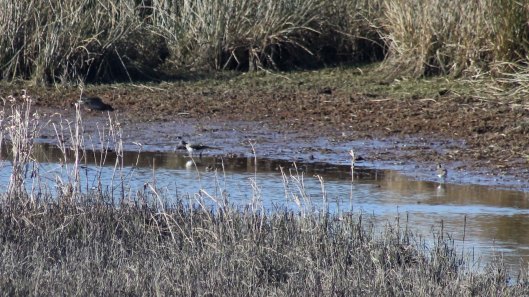
Too distant for clear shots, two Green sandpipers (and a Teal), from one of the hides at Tregaron Bog.

180302 Tregaron Bog (2)

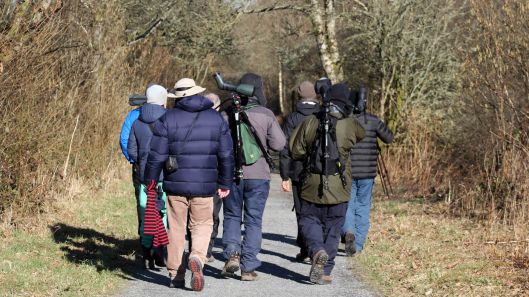
Intrepid birders, well rugged up against the chill.

180302 Tregaron Bog (3)

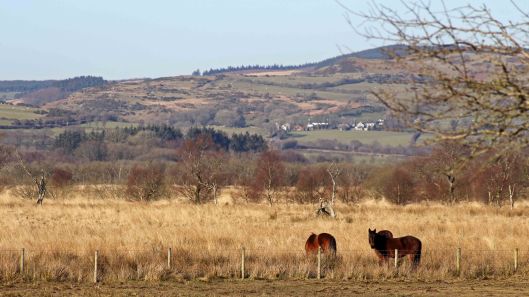
Beautiful countryside around Tregaron Bog, where grazing ponies help to manage the wetland environment.

180302 Tregaron Bog (4)

A Red kite; one of several seen this day and spectacular birds to watch.

My species list for the day was: Mute Swan, Whooper Swan, Pink-footed Goose, Greylag Goose, Canada Goose, Wigeon, Teal, Mallard, Goosander, Little Grebe, Grey Heron, Great White Egret, Little Egret, Cormorant, Red Kite, Hen Harrier, Buzzard, Lapwing, Snipe, Curlew, Green Sandpiper, Black-headed Gull, Herring Gull, Lesser Black-backed Gull, Woodpigeon, Great Spotted Woodpecker, Magpie, Jackdaw, Carrion Crow, Raven, Blue Tit, Great Tit, Coal Tit, Wren, Treecreeper, Starling, Blackbird, Fieldfare, Song Thrush, Redwing, Mistle Thrush, Robin, Stonechat, Dunnock, House Sparrow, Tree Sparrow, Pied Wagtail, Chaffinch, Goldfinch and Bullfinch. A further 7 species were seen by other members of our group but not by me: Peregrine, Common Gull, Rook, Long-tailed Tit, Goldcrest, Nuthatch, and Greenfinch.

Wild words: icicle

Tags

, , , , , ,

Icicle: noun; a hanging, tapering piece of ice formed by the freezing of dripping water (Oxford Dictionary). The word comes from the Old English word gicel, which morphed into ikyl or ikel, and later ickle, a word which is still used in parts of Yorkshire.

180228 icicle (1)

My photos were taken on the Ely embankment in Cardiff Bay yesterday, as Britain shivers its way through a blast of chilly Siberian air. The combination of freezing temperatures and the constant lapping of the water on to the branches that litter the shoreline resulted in some beautiful icicles.

180228 icicle (2)

Rye birds

Tags

, , , , , , , , ,

My original title for this blog was ‘A mad Kiwi and an Englishwoman go birding in a howling gale’. I decided that was a trifle long but it was certainly an accurate reflection of our day at Rye Harbour Nature Reserve. Nevertheless, we persevered, though we did put off walking the beach-top path – I think we would’ve been blown all the way back to Rye township if we’d tried that.

180227 Rye Harbour birds (4)

As you might expect, the birds were mostly hunkered down, sheltering where possible behind clumps of grass or huddled alongside sandy banks. Still, with brief stops here and there to scan the shingle and reeds with constantly watering eyes through fogging-up binoculars and short pops into hides (as much to warm up as to look out), we managed to clock up a total of 35 species. They were: Kestrel, House sparrow, Herring gull, Lesser black-backed gull, Black-headed gull, Mallard, Shelduck …

180227 Rye Harbour birds (3)

Shoveler (above, seen through a netting fence), Brent goose …

180227 Rye Harbour birds (5)

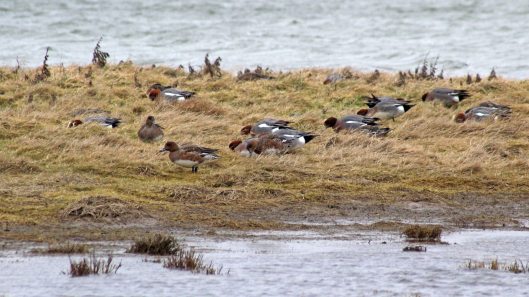
Wigeon (those handsome birds above), Oystercatcher, Carrion crow, Tufted duck …

180227 Rye Harbour birds (1)

Redshank (always a favourite of mine), Coot …

180227 Rye Harbour birds (6)

Cormorant (already beginning to nest in trees near Castle Water) …

180227 Rye Harbour birds (2)

Great black-backed gull and Lapwing (both above), Little grebe, Mute swan, Teal, Little egret, Goldfinch, Woodpigeon, Blackbird, Green woodpecker, Great tit, Coal tit, Magpie, Mistle thrush, Pied wagtail, Greylag goose, Egyptian goose, Pheasant, and Starling.

The 18-buzzard bus

Tags

, , , , ,

What do you do to help pass the time on a long bus journey? Read, sleep, listen to music, do crosswords or puzzles? I had taken along my knitting for the three-and-a-half-hour bus ride from Cardiff to London, but I didn’t knit a single stitch.

I spent the 15 minutes waiting for the bus watching the earth of a molehill moving as the little mole tidied up its tunnel (and, of course, I was hoping it might poke its head out, but no such luck). And, once we were underway, we hadn’t cleared Cardiff’s suburbs before I spotted my first buzzard hovering over a park so, after that, I decided to abandon my knitting and keep my eyes on the countryside that was whizzing past outside the window.

180226 buzzards (5)

And what did I see? My list reads as follows: Lesser black-backed gulls, Herring gulls and Black-headed gulls, Carrion crows, Robins, Jackdaws, Pied wagtails, Feral and Woodpigeons, Magpies, Starlings, Mallards and Mute swans, Mistle thrushes and Blackbirds, a Rookery, lots of rabbits and Pheasants, and two small groups of deer, plus, of course, the 18 Buzzards alluded to in the title of this blog. I was very impressed to see so many of them.

The beastie from the east

Tags

, , ,

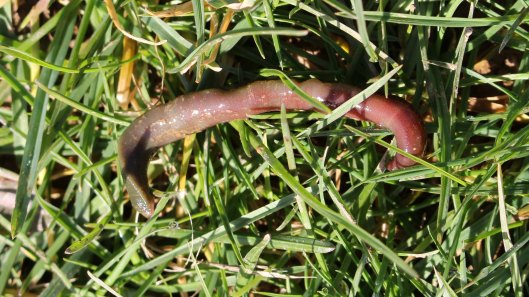
If you’re British, you’ll realise I’ve borrowed the name of this post from the nickname for the extremely cold weather blast that’s about to hit Britain but my ‘beastie from the east’ is something rather different. To be honest, I don’t actually know what it is. I spotted it on 16 February, in a puddle on a muddy walking track leading to Bodium Castle, while on holiday in East Sussex.

182025 leech (1)

It looked like an unusual earthworm but, when I picked it up, I realised it wasn’t a worm, and my friend Jill suggested it might be a leech. When we got home and checked the internet, I initially thought it might be a Horse leech (Haemopis sanguisuga) but, as I’ve never seen one – nor, indeed, any leech, I couldn’t be sure.

So, I posted some photos on Twitter. One person thought Horse leech might be right but another suggested it might be a different leech, Trocheta subviridis, though to confirm that would require a close look at its pores and, of course, I didn’t bring it home with me. So, my ‘beastie from the east’ remains a bit of an intriguing mystery.