A gathering of grebes

Tags

, , , , ,

Six is the highest number of Little grebes (Tachybaptus ruficollis) I’ve ever seen in one group – these were on Roath Park Lake a couple of days ago – but the really tricky thing was to get them all above water and in shot at the same time!

180125 Little grebes (1)

One, two, plus two with their heads below water … and two circles of bubbles.

180125 Little grebes (2)

One up, three on their way under … and two nowhere to be seen.

180125 Little grebes (3)

Nope!

180125 Little grebes (4)

Almost!

180125 Little grebes (5)

YES! Success at last.

Wild words: chlorophilia

Tags

, , ,

Chlorophilia: from the Greek khlōros, meaning green, and philia, meaning loving; thus, loving all things green and growing.
Now, that sounds straightforward enough and many of us would willingly admit to having chlorophilia but a word of caution. I’ve just been reading on the Wiki Knowledge Dump blog (the place where rejected Wikipedia articles often get resurrected) that the word (which does not appear in standard dictionaries) was ‘invented’ in 2004 to describe a physical or sexual attraction to plants. Tree-huggers, take note!

180124 chlorophilia

Heads up for Big Garden Birdwatch

Tags

, , , , ,

I don’t have a garden but that doesn’t mean I can’t take part in this weekend’s RSPB Big Garden Birdwatch ’cause you can also do your count in your local park.

All it takes is an hour of your time on either the 27th, 28th or 29th of January, a pen and paper so you can make a note of the birds you see, and maybe a cup of tea and a couple of biscuits to keep you going.

The specific list of birds to be counted is Blackbird, Blue tit, Chaffinch, Coal tit, Collared dove, Dunnock, Goldfinch, Great tit, House sparrow, Greenfinch, Long-tailed tit, Magpie, Robin, Starling and Woodpigeon. Of course, the RSPB is also interested in any other birds you see in your garden (not flying overhead), and any other creatures that have visited your garden in the past year – a mole or a hedgehog or maybe a fox?

Here’s the link so all you Brits out there can check the details and get involved.


A halcyon day

Tags

, , , , , , , , , ,

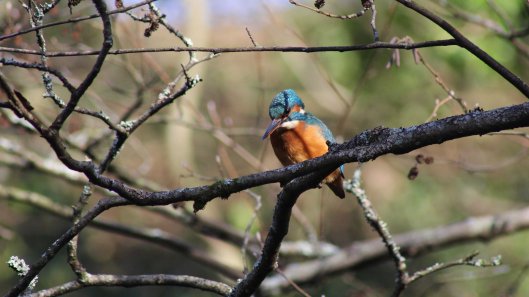
Did you know that the word halcyon is Greek for kingfisher?
180122 Kingfisher (1)

It comes from an ancient myth about Alcyone and her husband Ceyx who angered the gods by calling each other Zeus and Hera. The real Zeus and Hera were livid and punished the couple by killing Ceyx, using a thunderbolt to sink Ceyx’s ship.

180122 Kingfisher (2)

Overcome with grief at the news, Alcyone jumped into the sea and also drowned. Impressed by Alcyone’s love and compassion, Zeus and Hera transformed the couple into vibrant blue birds, the kingfishers that delight all who are privileged to see them.

180122 Kingfisher (3)

But life was not all plain sailing for the newly transformed kingfishers as Zeus declared that Alcyone could only lay her eggs in winter, at a place close to the shore where Ceyx’s body had washed up. This caused Alcyone further grief because the winter storms kept washing her eggs away.

180122 Kingfisher (4)

Eventually, Zeus relented and decreed that there would always be a period of fourteen days in the middle of winter when the seas would be calm enough for Alcyone to lay and brood her eggs.

180122 Kingfisher (5)

This period of calm came to be known as the period of halcyon days. And, though the wind was strong, gusty and icy cold for my walk along the Glamorgan Canal at Forest Farm Nature Reserve on Friday, yet it was a day of seeing beautiful kingfishers so I feel I can still call it a halcyon day!

Signs of spring: snowdrops

Tags

, , ,

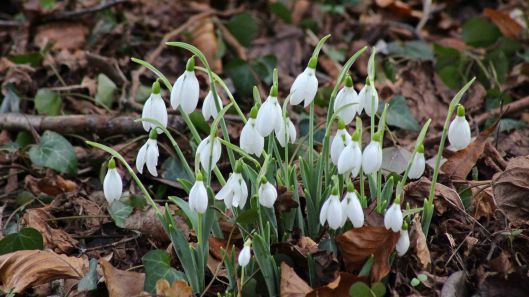
During my walk in Bute Park a few days ago, I saw my first signs of spring. And, though I love winter – as I love each of the seasons for the differences they offer – still, it is always heart-warming, when the days are short and cold and often grey, to see small signs, like these snowdrops, of the earth’s re-awakening.

180121 snowdrops

Twitching a Firecrest

Tags

, , , , ,

I don’t consider myself a twitcher – by which I mean one of those obsessives who cares only about adding ticks to lists and accumulating huge numbers of bird sightings and will travel long distances at word of a sighting to get them – but I have set myself a personal challenge of seeing 200 species of birds in Britain in 2018 if at all possible. So, when a relatively scarce bird happens to be seen in a Cardiff park, and that park is a favourite place of mine for a walk, then, of course, I’m going to go for a look.

The bird is a Firecrest (Regulus ignicapillus), cousin to the Goldcrest I blogged about a couple of days ago, only ever so slightly bigger and an equally elusive little bush flitter that is currently enjoying the bushes alongside the River Taff in Bute Park. It was first sighted by a local birder, further up the Taff, on 4 January, and I did go looking then. I couldn’t find in that day – but I did enjoy a delightful walk along the riverside trail.

180120 Firecrest (5)

Then, on 11 January, the bird – presumably the same one, as they are not very common hereabouts – was spotted further down the river, almost in the heart of Cardiff, by a local RSPB staffer out for a lunchtime run. On Thursday I went for a look and was really lucky to meet two other birders who already had the bird in their sights (when I passed by again later, on my way to the train after a long walk in the park, the bird had temporarily disappeared so I was really glad I’d seen it earlier). Typically, this little Firecrest wasn’t still for an instant and the bushes it favoured meant the light was not great for photographs but it was a real treat to see and to watch its insect-catching antics.

Spurge laurel

Tags

, , , , ,

Spurge laurel is such an uninspiring name for this lovely British native, which I was surprised and delighted to find in full flower when I was walking the south Wales coastal path at Lavernock last weekend.

180119 Spurge laurel (2)

Any gardener will recognise this plant as a member of the Daphne family – its scientific name is Daphne laureola – and, not only does it flower from the middle of winter through spring and into early summer, it also has a delicious honey smell. It’s evergreen and prefers to have its roots in rich, shaded soil, growing best on the edge of woodlands on chalk or limestone.

I must add one note of caution, though: everything about this plant is poisonous to humans, from the sap (which can cause a nasty skin rash) to the black berries that appear in late summer. Luckily, the berry toxins do not appear to affect birds, and there are reports of robins and greenfinches enjoying an autumn feast.

Britain’s smallest bird

Tags

, , , ,

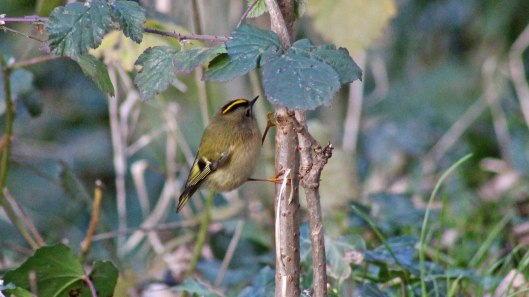
Weighing in at just 6 grams and measuring a miniscule 9cm from top of head to tip of tail, the Goldcrest (Regulus regulus) holds the title of Britain’s smallest bird. And it’s a cutie!
180118 goldcrest (1)

Though its overall plumage is a somewhat dull green, its distinguishing feature is the Mohawk-style stripe on the top of its head – it’s a vibrant yellow that’s easy to spot, and the stripe has an orange centre in male birds.

180118 goldcrest (3)

Goldcrests are most often found in coniferous woodland but they can also be found in urban settings. The birds in my photos were at Cosmeston Lakes Country Park (which is not primarily coniferous), along part of the south Wales coastal path (where there were no conifers to be seen) and in Cardiff’s Cathays Cemetery (where the wee bird was doing a grand job of cleaning up the old gravestones).

180118 goldcrest (2)

Goldcrests are completely insectivorous so are not able to feed from garden bird feeders, putting them at risk in very cold winters when there are no insects to be found. Fortunately, though, their numbers are stable, and their delightful antics can be enjoyed throughout Britain.

Wild words: brake

Tags

, , , ,

Brake is a word with several meanings. Aside from those to do with stopping, there are also these to do with the enviorment:
From the Oxford Dictionary: a botanical term for a thicket; from the old English bracu; first recorded in the plural in fearnbraca, meaning ‘thickets of fern’; related to the Middle Low German brake, which means ‘branch’ or ‘stump’.
The Merriam-Webster has a slightly different interpretation: a geographical term meaning rough or marshy land overgrown usually with one kind of plant, as in cedar brakes or coastal brakes.
The Collins Dictionary agrees with the Oxford: an area of dense undergrowth, shrubs, brushwood, etc., a thicket.

180117 brake

The word is often seen in English place names as, for example, in Boughton Brake (a forest in Nottinghamshire), Huxham Brake (a coniferous woodland in Devon), Stratfield Brake (a broadleaf woodland near Oxford, owned by the Woodland Trust), and Combe Brake (another Woodland Trust woodland, this one in Exmoor National Park).

Leaf mine in Hart’s tongue

Tags

, , , , ,

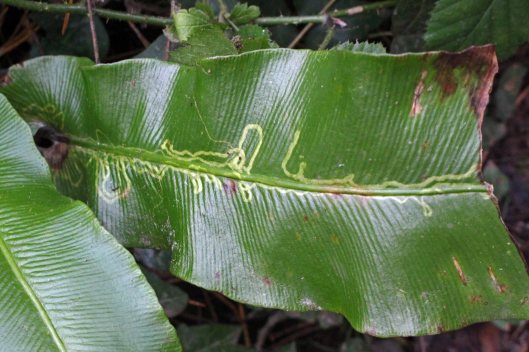
After my recent introductory post on leafminers, I thought I’d get the ball rolling with an example of a leaf mine I have actually been able to identify, as, fortunately for me, it is the only creature that creates a linear mine on the leaves of Hart’s tongue fern (Asplenium scolopendrium). The mines in my photographs were created by the larvae of a tiny fly, Chromatomyia scolopendri.

180116 Chromatomyia scolopendri (1)

As you can see, the larvae tends to mine along the midrib of the leaf but occasionally veers out towards the exterior before doubling back again. The mine is narrow and can be up to 10cms long, though I didn’t actually measure these ones. The larvae can be active any time from early spring through to autumn and they usually pupate in these mines.

180116 Chromatomyia scolopendri (2)

I found the mines on Christmas Eve, when I was on holiday in Somerset – they were at Ham Hill Country Park, near Yeovil. I’m not sure how common the little Chromatomyia scolopendri fly is, as there are 72 records showing in the Welsh Aderyn biodiversity database but only 38 records for the whole of Britain in the NBN Atlas (so where are all the Welsh records?). It’s also likely that leaf mines are under-recorded so the species may well be more common than these records suggest. Now that I know what to look for, I’ll be keeping an eye out for this one on my walks around south Wales.