Yellow-legged gull

Tags

, , , , , ,

Back in November, I thought I’d found my first Yellow-legged gull (Larus michahellis) – and it still might have been – though I’m really not convinced about it. But, this gull, the one pictured here, is absolutely, one-hundred-percent definitely a Yellow-legged gull … even though its legs are not yellow. Have I not written previously that gulls are tricksy?!

180115 Yellow-legged Gull 2w (1)

As you might guess from looking at it, this is not an adult gull. I’m reliably informed, by the expert birding friend who identified it for me, that this gull is in its second winter. My bird guide book tells me these gulls take four years to reach adult plumage so it’s half way there. Its age is the reason its legs are not yet yellow.

One of the main keys to its identification is the colour of the feathers on its back: Yellow-legged gulls are about mid way between the light grey of Herring gulls and the darker grey of Lesser black-backeds. The two photos above show my Yellow-legged gull, on the left, and, on the right, a Herring gull of the same age. I can see the difference in the feather colour and, to my eye, the shape of the head and bill look slightly different but I’m not sure I’d be confident of IDing one of these gulls without expert help.

180115 Yellow-legged gull 2w (5)

Winter walk around Cardiff Bay

Tags

, , , ,

I haven’t tried using one of these Google maps for a blog post before – not sure I will again as they’re quite labour intensive (and this one is very simple!), but it’s good to try something different. If you’ve not seen one of these maps before, you can click on the little bird markers to see a photo and some text about the bird I spotted there, and the red line shows, very approximately, my walking route.

Leafmines 101

Tags

, , , , , ,

Leafmines and their miners are a subject I started to look at last summer but I quickly discovered that, in order to identify the miner, you had to know the plant they were mining, so I needed to improve my botanical knowledge before I could go much further. That effort has begun, and is ongoing, so I will start to look again at the miners in the coming months.

Firstly though, in case you don’t know, leafmines are made by the larvae of various insects. The mines are their homes and their larders – as well as providing them with some degree of protection from predators, the larvae eat the tissue of the leaves they live within, thus creating their mines. The larvae can be the immature stages of various species of flies, sawflies or moths, and, apparently, some beetles also mine leaves.

If you look at a mine, you will often see a tiny hole at one end, which means the creature that made it has left the premises, to pupate or to being life as an adult. Sometimes, you can still see the larva within, and you can often also see the pooh (known as frass) it has left behind as it eats and tunnels.

The shapes of the mines can vary considerably, from long meandering or straight lines to roundish blotches, and these shapes, plus the placement of the mine within the leaf (some occupy just the upper or lower surface, some go right through) and the identity of the plant, are the main ways to determine which creature has made the mine.

**p.s. Since posting this, I’ve been told what I thought was a leaf mine on ivy (the photo on the right in the middle) is actually caused by a fungus, possibly Phoma hedericola, the most common leaf spot of ivy. I can see these leafmines are going to be even more tricky than I anticipated!

Winter heliotrope

Tags

, , , , ,

Officially, Winter heliotrope (Petasites fragrans) is a non-native invasive; unofficially, I think it’s got a rather lovely flower, which is particularly nice to see in the dead of winter, and its vanilla smell is divine.

180112 winter heliotrope (4)

According to Mabey’s Flora Britannica, it was brought to Britain as a garden plant in 1806, and the GB non-native species secretariat website states that it was first recorded in 1835 – presumably they mean the first record of it straying outside the bounds of the gardens where it had been planted. Though native to the Mediterranean and North Africa, it’s made itself at home in Britain, where it favours roadside verges, woodland margins and rough grassland. It seems very adaptable: in my local area, it favours sloping banks, a sunny slope in Dingle Park and a very wet and shady, steeply sloping streamside in Alexandra Park.

It can be difficult to get rid of because it grows very readily from the smallest discarded stem, sending its ‘roots’ (actually underground stems called rhizomes) spreading horizontally in all directions. Sneaky!

180112 winter heliotrope (5)

Bark

Tags

, , , , , , , ,

The skin of a tree is an amazing thing but, rather than launch in to a scientific description of its various layers, I thought I’d share just a few examples of its incredible capabilities.

The bark of the Birch tree (Betula sp.) contains good quantities of volatile oils, making it both waterproof and highly resistant to decay – the wood inside rots before the bark does.

The cracks and crevices in the bark of many tree species are great hidey holes for a wide range of small insects that make their homes there.

A good number of insects means a plentiful supply of food for birds like the Treecreeper whose beak can easily probe those hidey holes.

The high levels of toxic tannins in the bark of the Sessile oak (Quercus petraea) help protect it from insects.

The bark of the Scots pine (Pinus sylvestris) is thick enough to protect it from the fires that would occasionally sweep through its forests in prehistoric times.

Bark is also home to huge numbers of different lichen and moss species, many of which have adapted to life on the barks of specific trees.

Some animals eat bark – voles, deer and beavers, for example, and squirrels will strip the fibrous bark of certain trees to make their dreys warm and cosy.

The bark of some trees is fibrous enough to make rope and weave baskets.

Little Jenny Wren

Tags

, , , , , , ,

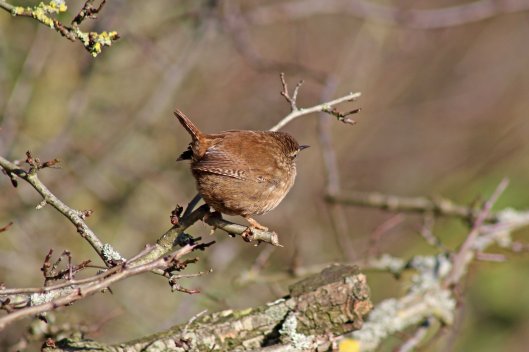
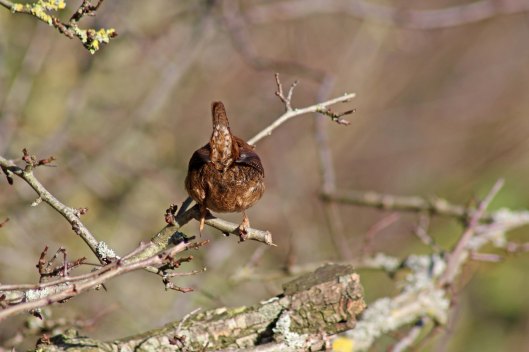
It’s not easy to get a clear crisp photograph of Little Jenny Wren as Wrens flit so quickly through the undergrowth. But, yesterday, at Cosmeston, I got lucky, as this charming little creature popped out on to a branch right in front of me and I managed to fire off several quick shots before it disappeared again. I think, in fact, that the fifth photo below is probably my best Wren shot ever!

180108 (1)180108 (2)180108 (3)180108 (4)180108 (5)180108 (6)

Encyrtidae, a parasitic wasp

Tags

, , , , ,

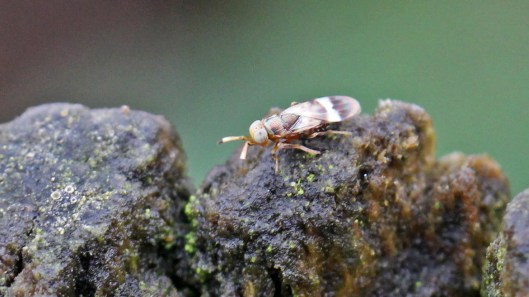
Just when I was thinking the wee flying critters had probably all disappeared for winter, up pops this little chap, tootling around on the top of an old fence post that I was checking out for lichen. I’m reliably informed, by experts on a couple of specialist pages on Facebook, that this is a member of the Encyrtidae, one of a large family of over 3700 different parasitic wasps (and that’s just the ones that have so far been identified – there are probably many many more).

180107 Encyrtidae parasitic wasp (1)

Information on the Natural History Museum website states that ‘About half of the species of Encyrtidae are associated with scale-insects … generally as endoparasitoids of immatures or less commonly adults’, which means the wasp’s larvae live inside and eat the larvae, and occasionally the adults, of scale-insects – not a particularly nice way to survive, I have to say. Some of these wasps are also parasitic on the larvae of moths and butterflies – also not nice. Still, the wasp itself is a pretty little thing, and some Encyrtidae species have been used as biological control agents to control insect pests, so the news isn’t all bad.

180107 Encyrtidae parasitic wasp (2)

Fossils from the Jurassic Coast

Tags

, , , , , , ,

Yesterday a living fossil fungus, today fossicking for fossils on Dorset’s Jurassic Coast – I’m on a roll with the old stuff!

180106 Charmouth fossils (1)

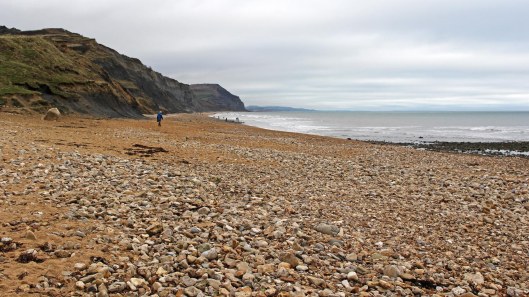
Part of one of my Christmas break days was spent at Charmouth, on England’s south coast, where my friend Sarah and I enjoyed a wonderful long beach walk, much of the time with our eyes down, searching the rocks and pebbles for fossils. Though you’re not allowed to chip away at the cliff face – and you’d be foolish to try, as it can be rather unstable and is subject to frequent mud slips, you are allowed to take fossils from the beach itself.

Sarah spotted one enormous fossil in a big boulder, but that was rather too big to pop in my pocket and bring home.

And, though it took a while to get my eye in, I did eventually find two small pieces of pyrite ammonite and another small rod-shaped rock, which looked very like the belemnite fossils being sold in the local shop. Result!